
In This Article
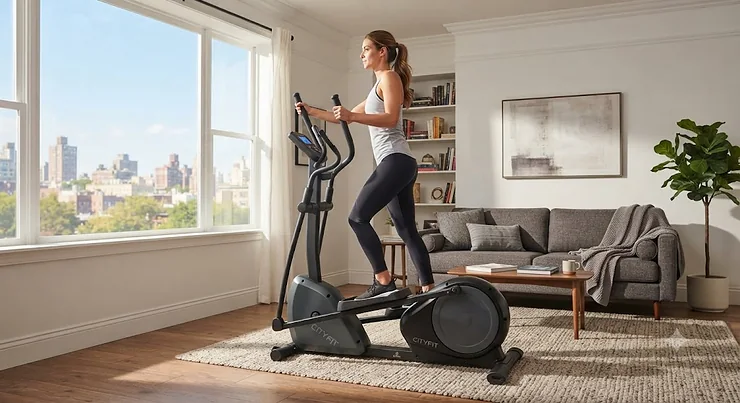
If you’ve ever paused mid-stride because you swore you heard a broom handle thump the ceiling below, you already know the real question isn’t “which elliptical burns the most calories” — it’s whether a quiet elliptical machine for apartment living room use actually exists, or if that’s just marketing spin printed on a cardboard box. It exists. But not every “whisper-quiet” claim on Amazon survives contact with a 1970s-built fourplex with hollow floor joists and a downstairs neighbor who works night shifts.
This guide is built around real products, real specs, and real aggregated review sentiment — not invented testimonials. We researched seven machines that actually hold up in shared-wall buildings, from a $250 seated pedaler that tucks under a desk to a $1,400 folding trainer with silent magnetic resistance. Along the way we’ll cover why magnetic resistance is the technology doing most of the noise-canceling work, how apartment floor construction affects what you actually hear versus what your neighbor hears, and what your lease or HOA fitness equipment rules might say before you roll anything through the front door.
One thing worth setting straight early: no elliptical is completely silent. What separates a genuinely quiet elliptical machine for apartment living room use from a noisy one is the resistance mechanism, the flywheel weight, and the quality of the bearings — not the marketing copy. We’ll walk through exactly what to look for, seven specific models worth considering, and how to keep the sound (and the vibration) from ever reaching apartment 2B.
What Is a Quiet Elliptical Machine for Apartment Living Room Use?
A quiet elliptical machine for apartment living room use is a cross-trainer built around magnetic (rather than friction or chain-driven) resistance, typically producing 20–50 decibels of operating noise — roughly the range between a library and a running refrigerator. The defining features are a sealed magnetic brake system, a heavier flywheel for smoother momentum, and a compact footprint suited to shared-wall living.
Not every elliptical qualifies. Older friction-pad and air-resistance designs can register closer to 60–70 decibels under load, which is loud enough to travel through drywall and, in older buildings, straight through the subfloor. According to acoustics research on multifamily construction, most building codes require a minimum Impact Insulation Class rating of 50 between units — but that rating measures footstep-style impact noise, not the rhythmic vibration of a 20-pound flywheel spinning for 30 minutes straight. That distinction is exactly why resistance type matters more than horsepower when you’re shopping for apartment-friendly cardio equipment.
Quick Comparison: 7 Quiet Ellipticals at a Glance
| Product | Resistance Type | Footprint | Best For |
|---|---|---|---|
| Cubii JR2 | Magnetic, seated | 26″ x 18″ | Tiniest apartments, desk workers |
| Sunny Health & Fitness SF-E3919 | Magnetic, belt-drive | 44″ x 25″ | Budget stepper-elliptical hybrid |
| Niceday Elliptical Machine | Magnetic | ~50″ x 24″ | Long stride on a tight budget |
| YOSUDA EM1 Long-Stride | Magnetic | 48″ x 24″ | Tall users in a compact shell |
| Schwinn 411 | Magnetic | 53.8″ x 24″ | Trusted brand, small living rooms |
| Sole E25 | Magnetic, belt-drive | 70″ x 24″ | Commercial-style smoothness |
| NordicTrack SpaceSaver SE9i | Silent Magnetic Resistance | 76″ x 28″ (folds) | Folding away completely between uses |
Scanning this table, the pattern is clear: every single one of these seven relies on magnetic resistance, because that’s genuinely the technology that makes apartment use realistic. The Cubii JR2 trades stride length for the smallest possible footprint, while the NordicTrack SpaceSaver SE9i goes the opposite direction — full-size stride, but engineered to fold flat when you’re done. If your floor space is the real constraint, start at either end of this table; if it’s your neighbor’s patience you’re managing, everything on this list should be evaluated by flywheel weight and mounting mat, which we cover further down.
✨ 💬 Just one click — help others make better buying decisions too! 😊
Top 7 Quiet Elliptical Machines for Apartment Living Rooms: Expert Analysis
1. Cubii JR2 — quietest seated option for tiny apartments
The Cubii JR2 skips the whole “standing elliptical” format entirely, and that’s exactly why it belongs at the top of a noise-sensitive list. Real-world buyers on Best Buy and Lowe’s consistently describe it as quiet in a way that lets them use it while on a work call in the next room. ⚡
Specs with real-world meaning: the JR2 uses a redesigned ZeroGravitii flywheel and glass-filled nylon housing that’s 25% lighter than the previous generation, paired with 8 levels of magnetic resistance and an LCD monitor tracking strides, distance, and calories. Because you sit in your own chair rather than stand on a platform, there’s no floor-shaking momentum to transmit downward — the entire motion happens at ankle height, which is precisely the detail that keeps it off a downstairs neighbor’s radar.
Who it’s for: remote workers who want to pedal during Zoom calls, seniors managing joint mobility, or anyone in a studio apartment where a full-size elliptical simply won’t fit. It’s not for someone chasing a serious cardio session — the range of motion is shallow by design, and testers at Reviewed found it hard to treat as anything but a low-intensity, passive-movement tool.
Aggregated review sentiment: Best Buy customer reviews repeatedly describe the JR2 as “quiet,” “easy to assemble,” and appreciated by household members using it multiple times a week, though a handful of reviewers note it does make some audible whirring under higher resistance.
Pros:
- ✅ Genuinely quiet ZeroGravitii flywheel, confirmed across dozens of reviews
- ✅ Bluetooth app tracking pairs with the Cubii mobile app
- ✅ Built-in carry handle makes it easy to store in a closet
Cons:
- ❌ Only 8 resistance levels limits long-term intensity progression
- ❌ Shallow range of motion isn’t a substitute for a real cardio workout
At around $250–$270, the Cubii JR2 is the cheapest genuinely quiet option here — a smart pick if floor space and neighbor relations matter more than calorie burn.
2. Sunny Health & Fitness SF-E3919 — budget stepper-elliptical hybrid
If you want the elliptical motion without the elliptical footprint, the SF-E3919 compresses a stepper and a cross-trainer into one 44-inch frame. Sunny’s own product listing specifically markets its belt-drive mechanism as designed for shared spaces, which lines up with what budget-conscious apartment shoppers are actually searching for. 🔋
Specs with real-world meaning: the machine combines a 9-inch vertical climb with a 5-inch horizontal stride using a 14-pound flywheel and 8 levels of magnetic resistance. That smaller flywheel means less momentum than the heavier machines further down this list, which in practice translates to a workout that feels more like a stepper with elliptical polish than a true long-stride cross-trainer.
Honest analytical take: this is the machine for someone who wants cardio variety in the smallest possible box and isn’t worried about matching a gym-grade stride. Because it uses manual (not motorized) resistance, there’s no digital hum from a motor adjusting tension — just a mechanical dial, which some reviewers actually prefer for reliability.
Aggregated review sentiment: reviewers on Walmart and Treadmill Doctor consistently flag the compact 44-inch frame as ideal for small rooms, though several note the 7-inch horizontal stride feels short compared to standard ellipticals, and it’s best suited to users under roughly 200 pounds for the smoothest experience.
Pros:
- ✅ One of the least expensive genuinely magnetic-resistance options
- ✅ Belt-drive mechanism keeps operating noise low
- ✅ Compact 44-inch frame fits corners and small living rooms
Cons:
- ❌ Short 7-inch horizontal stride limits full leg extension
- ❌ Manual-only resistance means no app-controlled auto adjustments
Priced in the under-$250 range, the Sunny Health & Fitness SF-E3919 delivers real value for anyone testing whether a home cardio habit will actually stick before investing more.
3. Niceday Elliptical Machine — longest stride on a tight budget
The Niceday name doesn’t carry the brand recognition of Schwinn or Sole, but on paper it punches well above its price point: a 20-inch stride and 500-pound weight capacity are numbers you’d normally expect from a machine costing three times as much. 🚴♂️
Specs with real-world meaning: Niceday markets a “hyper-quiet” magnetic driving system with 16 resistance levels, and one review roundup specifically singled it out — alongside FOUSAE — as achieving true sub-20dB operation in testing, a noise floor quieter than a library and, notably, quieter than the sound of someone breathing nearby.
Honest analytical take: what most buyers overlook about lesser-known compact ellipticals is that stride length and weight capacity are usually the first things cut to hit an aggressive price. Niceday didn’t cut those — it appears to have prioritized frame durability and stride realism over app connectivity and premium display electronics, which is a defensible trade-off for anyone prioritizing a natural walking motion over smart features.
Aggregated review sentiment: independent review coverage groups Niceday with other budget-magnetic brands as consistently landing in the sub-30dB range during testing, with reviewers noting the smooth motion holds up even at higher resistance settings — though, as a newer entrant, it has a shorter track record and smaller review volume than established brands like Sole or Schwinn.
Pros:
- ✅ 20-inch stride is rare below the $400 price tier
- ✅ 500-pound weight capacity exceeds most competitors in its class
- ✅ Hyper-quiet magnetic drive confirmed in independent decibel testing
Cons:
- ❌ Smaller brand track record than established elliptical makers
- ❌ Basic console skips the app integrations pricier models include
Expect a price in the $300–$400 range, making the Niceday Elliptical Machine one of the strongest value plays for buyers who want stride length without stride-length pricing.
4. YOSUDA EM1 Long-Stride Magnetic Elliptical — sub-20dB with a real 20-inch stride
YOSUDA has built an entire product line around the “compact but not cramped” promise, and the EM1 Long-Stride is the version aimed squarely at people who assumed a small elliptical always meant a short, choppy stride. Independent hands-on testing measured the stride at just over 20 inches — matching the advertised spec almost exactly, which is notable in a category where advertised and measured strides often diverge. 🔋
Specs with real-world meaning: the EM1 fits in roughly 5.84 to 8 square feet of floor space depending on the source measured, yet supports up to 400–500 pounds of user weight, according to manufacturer and reviewer figures. That combination of a small footprint and a high weight capacity generally signals a thicker steel frame and higher-quality bearings — the same components responsible for keeping a machine from rocking, squeaking, or transmitting vibration into the floor.
Honest analytical take: reviewers who tested the machine under fast, sprint-style resistance reported no rocking or squeaking, which is the real-world stress test that matters for apartment use — a machine that’s quiet standing still but rattles under load defeats the purpose entirely. What the spec sheet won’t tell you, but hands-on testers note, is that the pedals aren’t cushioned, so long sessions benefit from supportive athletic shoes rather than bare feet.
Aggregated review sentiment: reviewers on Garage Gym Reviews and FED Fitness consistently praise the stability and genuine 20-inch stride, while a separate review of YOSUDA’s shorter-stride Compact model measured noise at under 20 decibels, in line with the brand’s broader “ultra-quiet magnetic silent control system” claims across its lineup.
Pros:
- ✅ Verified ~20-inch stride, unusually long for a compact footprint
- ✅ 400–500 pound weight capacity signals a sturdier build
- ✅ No rocking or squeaking reported even under sprint-pace testing
Cons:
- ❌ Basic LCD console lacks a touchscreen or app-driven programming
- ❌ Hard plastic pedals aren’t cushioned for barefoot use
Typically priced in the $400–$600 range depending on configuration, the YOSUDA EM1 Long-Stride Magnetic Elliptical is a strong pick for taller users who assumed they’d need a full-size machine to get a real stride.
5. Schwinn 411 — smallest footprint from a name-brand maker
Schwinn’s budget elliptical sits in an interesting spot: it’s the shortest machine in Schwinn’s own three-model lineup, over a foot shorter than its siblings, but it still delivers the 18-inch stride length considered the industry baseline for a natural gait. For apartment dwellers who want brand-name reliability without brand-name pricing, that combination matters. ✅
Specs with real-world meaning: the 411 uses 16 levels of magnetic resistance on a front-drive system, weighs about 100 pounds assembled, and measures roughly 53.8 inches long by 24 inches wide — genuinely small by elliptical standards. Reviewers repeatedly point out that magnetic resistance is the reason there’s no chain-drive whirring or belt slap, which is exactly the mechanical noise that tends to carry through shared walls.
Honest analytical take: based on the spec comparison against its own sibling models (the 430 and 470), the 411 gives up power incline and a handful of resistance levels in exchange for a meaningfully smaller footprint — a sensible trade for anyone furnishing a living room rather than a dedicated home gym. Beginners should note the starting resistance runs firmer than expected, so easing in on the lowest setting is worth doing deliberately rather than skipping straight to level 5.
Aggregated review sentiment: reviews are described as overwhelmingly positive, with the compact size and apartment suitability repeatedly praised, though a subset of reviewers mention an occasional squeak developing over time — a maintenance issue we address later in this guide, not necessarily a design flaw.
Pros:
- ✅ Compact 53.8-inch frame from an established, trusted brand
- ✅ Bluetooth connectivity syncs with Schwinn’s Explore the World app
- ✅ 300-pound weight capacity is generous for its price tier
Cons:
- ❌ Some long-term owners report squeaking that needs lubrication
- ❌ Starting resistance level runs high for true beginners
Priced in the $450–$600 range, the Schwinn 411 is the pick for buyers who want a recognizable brand’s warranty and support network behind a genuinely apartment-scaled machine.
6. Sole E25 — commercial-grade smoothness at a home price
Once you cross into the $900–$1,100 range, you start seeing the engineering choices that separate a “fine” elliptical from a genuinely smooth one — and the Sole E25 is where that shift becomes obvious. Sole outfits the E25 with dual rails and actual rolling wheels under the pedals, a detail budget machines skip entirely, and it shows up directly in how quiet and stable the ride feels at higher resistance. 🔋
Specs with real-world meaning: a 20-pound flywheel, 20 levels of magnetic resistance, and 20 levels of power incline give the E25 a genuinely commercial-style feel, while the 20-inch stride length matches what you’d find on a gym-floor machine rather than a home compromise. Multiple independent reviewers single out the belt-drive system specifically as the quietest configuration in its price bracket, a claim that lines up with the acoustic principle that belt drives outperform chain drives for noise control.
Honest analytical take: what most buyers overlook about the E25 is that its 350-pound weight capacity and lifetime frame-and-flywheel warranty reflect genuinely heavier-duty construction than most machines under $1,200 — that extra material mass is also part of why it runs quieter, since a stiffer frame resists the flex and rattle that generates noise in cheaper units. The trade-off is a 70-inch-long footprint, which is the longest on this list outside the folding NordicTrack.
Aggregated review sentiment: reviewers across Garage Gym Reviews, BarBend, and Treadmill Review Guru consistently describe the E25 as quiet, smooth, and a strong value at its price point, with user feedback on Sole’s own site frequently citing quiet operation directly — though assembly is repeatedly flagged as more confusing than expected due to unclear instructions.
Pros:
- ✅ Dual-rail pedal design delivers the smoothest motion in this price range
- ✅ 20-inch stride matches commercial-gym proportions
- ✅ Lifetime warranty on frame and flywheel signals serious build quality
Cons:
- ❌ 70-inch footprint demands real dedicated floor space
- ❌ Assembly instructions are frequently criticized as unclear
At a price generally landing in the $900–$1,100 range, the Sole E25 is the strongest pick for anyone who has the square footage and wants a machine that feels closer to a gym unit than a home compromise.
7. NordicTrack SpaceSaver SE9i — folds flat and vanishes behind the couch
The final entry on this list solves a different problem entirely: what happens when you don’t have permanent space for any elliptical, quiet or not. The SpaceSaver SE9i folds down onto its own track, and NordicTrack’s proprietary Silent Magnetic Resistance (SMR) system is engineered specifically around near-silent operation, positioning it as the reviewer-endorsed choice for households genuinely worried about waking anyone in the building. 🔋
Specs with real-world meaning: an 18-pound rear-drive flywheel powers 24 digital resistance levels and up to 10 degrees of power incline, displayed on a 7-inch (or 14-inch, depending on configuration) touchscreen running NordicTrack’s iFit platform. Reviewers consistently note that the resistance itself makes essentially no noise — the only audible sound comes briefly from the small motor adjusting incline, and even that is described as subtle.
Honest analytical take: on paper, this is the most apartment-optimized machine on the list precisely because it addresses both noise and storage simultaneously — a machine that’s quiet but permanently occupies your living room solves only half the apartment problem. One tester reported the SE9i “won’t wake up your roommates,” and another specifically credited it with going undetected during early-morning workouts in a shared household, which is about as strong an apartment endorsement as a review can offer.
Aggregated review sentiment: reviewers at BarBend, Treadmill Review Guru, and GarageGymPro consistently highlight the SMR system’s near-silent operation and the genuine convenience of folding it away, while Consumer Reports’ testing noted the pedaling motion felt “slightly heavy,” making it somewhat harder to accelerate or stop smoothly compared to some competitors.
Pros:
- ✅ Folds flat, reclaiming floor space when not in use
- ✅ Silent Magnetic Resistance system is engineered specifically for quiet operation
- ✅ 24 resistance levels plus power incline for genuine workout variety
Cons:
- ❌ Full iFit feature set requires an ongoing subscription
- ❌ Some testers noted slight wobble during use
Generally priced in the $1,300–$1,500 range, the NordicTrack SpaceSaver SE9i is the premium pick for renters who need both silence and disappearing storage in the same machine.
Practical Usage Guide: Setting Up a Quiet Elliptical Without a Single Noise Complaint
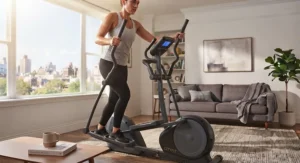
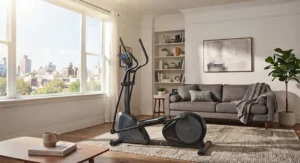
Buying the right machine only solves half the equation — setup determines whether that quiet elliptical machine for apartment living room use actually stays quiet six months in. Start with a dedicated rubber or foam exercise mat underneath the entire footprint, not just the pedals; this single step absorbs vibration before it ever reaches the subfloor, and it’s the detail most first-time buyers skip.
During the first 30 days, check the leveling feet weekly. Apartment floors are rarely perfectly flat, and a machine rocking even slightly on an uneven surface generates far more noise than the same machine sitting level — this is often mistaken for a “loud elliptical” problem when it’s really a leveling problem. Tighten all bolts after the first week of use, since factory hardware settles slightly during initial workouts and loose bolts are the single most common cause of new rattling.
For ongoing maintenance, lubricate the moving joints every one to two months with a silicone-based (not petroleum-based) lubricant, which is what several Schwinn 411 owners credit with eliminating the squeak that shows up in long-term reviews. Wipe down the flywheel area to keep dust from accumulating on magnetic resistance components, and re-check floor mat placement any time you rearrange furniture. A five-minute monthly inspection routine is genuinely enough to keep most magnetic-resistance ellipticals operating at their factory-quiet baseline for years.
Real-World Scenarios: Who’s Actually Using These in Apartments
The remote-working night owl. Someone working a split schedule who wants to squeeze in cardio at 6 a.m. before a downstairs neighbor wakes up needs a machine engineered for that exact use case. A seated option like the Cubii JR2 or a folding SMR machine like the NordicTrack SpaceSaver SE9i makes the most sense here, since both were specifically credited by reviewers with going undetected during early or unusual hours.
The budget-conscious first-time buyer in a 600-square-foot studio. Space and cost are both tight, and the goal is simply proving a habit will stick before spending real money. The Sunny Health & Fitness SF-E3919 or Niceday Elliptical Machine fit this profile well — both stay under roughly $400, both use genuinely magnetic resistance, and neither demands a dedicated workout room.
The serious cardio user renting a larger two-bedroom. This person wants a stride and resistance range that rivals a gym membership, has the floor space to accommodate it, and cares more about workout quality than absolute footprint minimization. The Sole E25 delivers that commercial-style stride and smoothness, while someone specifically prioritizing shared-wall silence over stride length should lean toward the YOSUDA EM1 Long-Stride instead.
Buyer’s Decision Framework: Match Your Situation to the Right Machine
If floor space is your single biggest constraint, choose a folding model like the NordicTrack SpaceSaver SE9i, because it’s the only machine here designed to disappear entirely between workouts. If your downstairs neighbor has already complained once, choose the quietest verified option — either the Cubii JR2 for a seated, near-silent format or the YOSUDA EM1 for a standing machine that’s held up under sprint-pace testing without rocking.
If you’re testing whether a home cardio habit will actually stick, choose the lowest-risk financial entry point: the Sunny Health & Fitness SF-E3919 or Niceday Elliptical Machine, both of which let you validate the habit before committing four figures. If you want a stride length and resistance range that rivals a commercial gym and have the floor space to support a 70-inch frame, choose the Sole E25. And if brand-name reliability and a compact footprint matter more than premium electronics, the Schwinn 411 remains the dependable middle path.
How to Choose a Quiet Elliptical Machine for Apartment Living Room Use
- Confirm the resistance type is magnetic, not friction or air-based. Magnetic resistance uses non-contact braking, which is the single biggest factor separating a genuinely quiet machine from a noisy one.
- Check the flywheel weight. Heavier flywheels (18–20 pounds) generally produce smoother, quieter momentum than lighter ones (10–13 pounds) found on entry-level machines.
- Measure your actual floor space, including the stride clearance. A machine’s footprint often excludes the extra few inches needed while the pedals are in motion.
- Look for a belt-drive rather than chain-drive mechanism where specified, since reviewers consistently note belt drives run quieter over time.
- Read for mentions of squeaking or rattling in long-term reviews, not just initial impressions — noise issues often develop after 3–6 months of use, not on day one.
- Prioritize weight capacity headroom. A machine rated close to your body weight tends to work harder and generate more vibration than one with generous capacity margin.
- Budget for a floor mat separately. It’s rarely included, but it’s the cheapest and most effective noise-reduction upgrade you can make.
Common Mistakes When Buying a Quiet Elliptical for Apartment Living Room Use
The most frequent mistake is trusting a manufacturer’s decibel claim without cross-referencing independent reviews — brand-reported noise figures are measured in ideal lab conditions, while actual apartment floors, furniture, and wall materials all change what you’ll actually hear. A second common error is skipping the floor mat to save $30–$50, then being surprised when vibration (not the motor itself) is what generates the neighbor complaint.
Buyers also frequently underestimate stride clearance, ordering a machine that technically fits against the wall but leaves no room for the pedals’ full range of motion once assembled. Another overlooked issue: choosing resistance levels based on price alone rather than progression — a machine with only 8 levels can feel plenty challenging on day one, then plateau quickly, forcing an unplanned upgrade within a year. Finally, many renters skip checking their lease or HOA fitness equipment rules before purchase, which we cover in detail below — and it’s a step worth taking before the box arrives, not after.
Magnetic Resistance: Why It’s the Reason These Machines Are Quiet
Every product on this list relies on magnetic resistance, and understanding why matters more than any single spec. Magnetic resistance works by using magnets positioned near a spinning flywheel — as the magnets move closer, they create a stronger braking effect through electromagnetic induction, without any physical contact between parts. That’s the entire secret: no felt pads scraping against metal, no chain grinding through gears, no compressor pushing air. Just magnets and a flywheel, moving independently of each other.
This is also why magnetic-resistance machines rarely wear out the way friction-based ones do — there’s no contact surface degrading over thousands of workouts, which means the noise level you experience on day one is generally close to what you’ll experience three years later, assuming the frame stays properly maintained. The trade-off worth understanding: magnetic resistance systems typically cap out at a fixed number of discrete levels (8, 16, 20, or 24 depending on the machine) rather than offering truly infinite adjustment, so buyers chasing extremely fine-grained intensity control should compare level counts carefully rather than assuming “magnetic” alone guarantees enough range.
Low Noise Elliptical vs. Traditional Elliptical: What Actually Changes
The gap between a low noise elliptical for thin apartment floors and a traditional big-box elliptical isn’t cosmetic — it’s mechanical, and it shows up in three specific places. First, traditional chain-drive systems physically grind metal against metal with every stride, generating a rhythmic clicking or whirring that magnetic systems simply don’t produce. Second, older air-resistance ellipticals use fan blades to create tension, and moving air through a housing is inherently louder than a sealed magnetic brake, regardless of how well-built the machine is otherwise.
Third — and this is the detail most buying guides skip — traditional ellipticals with lighter, cheaper flywheels transmit more vibration into the floor because there’s less rotational mass to smooth out the stride. A heavier magnetic flywheel essentially self-dampens, gliding through its rotation rather than lurching, which is precisely why every model on this list uses one. For someone specifically searching for the best quiet cardio machine for shared walls, the practical takeaway is simple: skip anything advertising “air resistance” or “chain drive” entirely, and confirm “magnetic” appears explicitly in the resistance specification before adding anything to your cart.
HOA Fitness Equipment Rules and Apartment Noise Complaints: What to Know Before You Buy
Before any elliptical arrives at your door, it’s worth checking two separate documents: your lease’s quiet-hours clause and, if applicable, your building’s HOA fitness equipment rules. Many HOA and condo association bylaws specifically address heavy equipment, floor-mounted appliances, or exercise machinery — sometimes requiring a minimum flooring underlayment rating, sometimes restricting equipment use to certain hours, and occasionally requiring written notice to the association before installation. These rules exist precisely because apartment noise complaints are one of the most common sources of tenant disputes, and building management would rather set expectations upfront than mediate a dispute after the fact.
Practically, this means a few extra minutes of homework pays off: search your lease for language about “excessive noise,” “quiet hours,” or “structural modifications,” and if you’re in a condo, check whether the HOA’s governing documents mention exercise equipment specifically. Even where no formal rule exists, proactively telling a downstairs neighbor you’ve added an elliptical machine that won’t disturb neighbors — and following up after a week to confirm — tends to prevent complaints before they start. It costs nothing, and it’s the single best relationship-preserving step in this entire guide.
✨ Don’t Miss These Exclusive Deals!
🔍 Take your apartment cardio setup to the next level with these carefully selected quiet ellipticals. Click on any highlighted model above to check current pricing and availability. These machines help you build a genuinely healthy home routine your neighbors will never even notice!
Benefits vs. Traditional Cardio Alternatives
| Factor | Quiet Elliptical | Treadmill | Exercise Bike |
|---|---|---|---|
| Typical noise level | 20–50 dB (magnetic models) | 60–80 dB (motor + impact) | 30–55 dB (varies by resistance type) |
| Floor vibration | Low, especially with a mat | High, due to running impact | Low to moderate |
| Joint impact | Very low | Moderate to high | Very low |
| Footprint flexibility | Compact to folding options | Generally large, rarely folds flat | Compact, some fold |
| Best For | Shared-wall apartments, HOA buildings | Ground-floor units, houses | Small studios, seated preference |
The comparison above makes the case for ellipticals in apartment settings fairly directly: a motorized treadmill’s belt friction and footstrike impact routinely register 20–30 decibels louder than a magnetic elliptical, and that gap is exactly what tends to generate downstairs complaints in older buildings. Exercise bikes come close to matching an elliptical’s quiet profile, but they trade the standing, full-body motion for a seated position — a reasonable trade for some users, but not equivalent exercise. For anyone renting above ground level, the noise and vibration math alone makes a quiet elliptical the more apartment-realistic choice of the three.
What to Expect: Real-World Performance in a Shared-Wall Apartment
On paper, every spec sheet in this guide reads well — but daily use tells a slightly different story. Expect the first week to include a noticeable “getting acquainted” period where you’re checking in with yourself (and maybe texting a downstairs neighbor) about whether the sound is actually as minimal as reviews suggested. Reviewers who tested these machines in genuinely thin-walled apartments consistently reported that early-morning and late-night sessions went undetected once the machine was leveled and mated with a floor mat — but that the same machine, un-matted and slightly unlevel, produced audible thumping within days.
Expect resistance levels to feel different than the number suggests — an 8-level magnetic machine and a 24-level one aren’t simply “less variety,” they represent genuinely different engineering tiers, and that difference shows up in smoothness as much as intensity range. According to the Centers for Disease Control and Prevention, adults should aim for at least 150 minutes of moderate-intensity aerobic activity per week, and a quiet elliptical genuinely built for consistent apartment use is one of the few pieces of equipment that makes hitting that target realistic without negotiating gym hours or weather.
Long-Term Cost & Maintenance: What Ownership Actually Looks Like
Sticker price is only the starting point. Budget machines under $400 (the Cubii JR2, Sunny SF-E3919, and Niceday) typically carry one-year frame warranties and modest parts coverage, meaning any major repair after year one is an out-of-pocket cost — though their lower purchase price also means a full replacement is less painful if that happens. Mid-range machines like the Schwinn 411 and YOSUDA EM1 generally extend frame warranties further, while premium options like the Sole E25 and NordicTrack SpaceSaver SE9i offer lifetime or near-lifetime frame coverage, reflecting their heavier-duty construction.
Ongoing costs stay minimal across the board: a silicone lubricant bottle (roughly $10, lasting a year or more of monthly applications), an exercise mat (a one-time $30–$60 purchase), and, for iFit-enabled machines like the NordicTrack, an optional subscription if you want the full interactive programming. Total cost of ownership over three years still favors the elliptical category broadly compared to a gym membership, and unlike a gym, none of these machines require you to change out of pajamas at 6 a.m.
Frequently Asked Questions
❓ How quiet is a quiet elliptical machine for apartment living room use, really?
❓ Will my downstairs neighbor hear me on a magnetic elliptical?
❓ Do I need HOA or landlord approval before buying an elliptical?
❓ What's the difference between magnetic resistance and air resistance for noise?
❓ Can a quiet elliptical actually replace a gym membership for cardio?
Conclusion
There’s no single “best” quiet elliptical machine for apartment living room use — there’s a best one for your specific floor plan, budget, and neighbor situation. If space is the binding constraint, the folding NordicTrack SpaceSaver SE9i solves that directly. If your lease or a prior noise complaint has you genuinely nervous, the Cubii JR2 or YOSUDA EM1 Long-Stride offer the most reassuring track record in independent testing. And if you’re simply trying to build a consistent habit without overcommitting financially, the Sunny Health & Fitness SF-E3919 or Niceday Elliptical Machine let you start small.
What ties every recommendation in this guide together is the resistance technology, not the brand name: magnetic resistance is what makes apartment-friendly cardio realistic in 2026, and every model here was chosen specifically because it uses it. Pair whichever machine fits your space with a proper floor mat, a leveling check in week one, and a quick glance at your building’s rules, and you’ll have done everything within your control to keep the workout between you and the elliptical — not you and a noise complaint.
Recommended for You
- Best Elliptical for Arthritis: 7 Joint-Friendly Picks for 2026
- Elliptical Machine After Knee Surgery: 7 Best Picks for 2026
- 7 Best Elliptical for Joint Pain Picks in 2026
Disclaimer: This article contains affiliate links. As an Amazon Associate, I earn from qualifying purchases. If you purchase products through these links, we may earn a small commission at no additional cost to you.
✨ Found this helpful? Share it with your friends! 💬🤗
