
In This Article
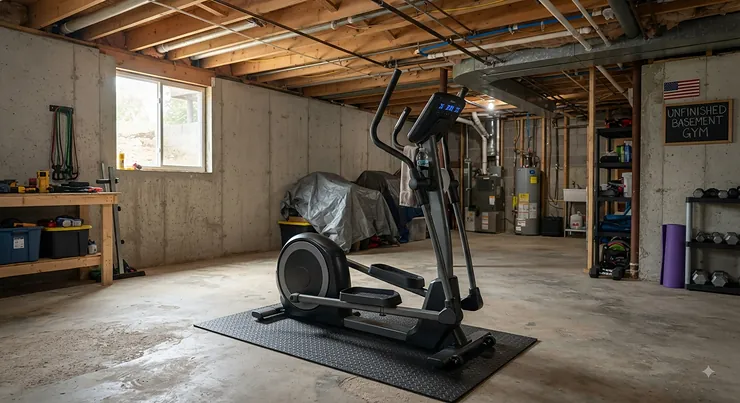
Concrete floor. Bare joists overhead. A dehumidifier humming in the corner like it’s earning its keep. If that’s the room you’re staring at, you already know an unfinished basement is a strange host for cardio equipment — cold in January, sticky in July, and never quite as dry as the rest of the house. Choosing an elliptical for unfinished basement gym use isn’t the same decision as picking one for a sunroom or a spare bedroom. The frame has to shrug off swings in humidity, the footprint has to respect low ceilings and support posts, and the electronics have to survive a room that occasionally smells faintly of damp cardboard.
Here’s the short answer to the question everyone eventually asks: an elliptical for unfinished basement gym use is any cross-trainer with a steel or powder-coated frame, sealed or low-exposure electronics, and a footprint suited to concrete-slab flooring — paired with humidity control and a moisture barrier between the machine and the slab. That combination is what keeps a $1,500 machine from turning into a $1,500 rust sculpture within two winters.
We dug into real specs, verified aggregated review sentiment, and compared seven machines that actually hold up down there — from a $150 seated pedal exerciser to a commercial-grade trainer built for daily punishment. Along the way, we’ll cover the flooring, the airflow, and the setup habits that basement owners on forums like r/HomeGym learn the hard way. If you’re building a genuinely permanent home gym elliptical basement setup rather than a temporary one, this is the research you’d otherwise spend a weekend doing yourself.
Quick Comparison: 7 Basement-Ready Ellipticals at a Glance
| Elliptical | Best For | Flywheel | Footprint | Price Range |
|---|---|---|---|---|
| Schwinn 411 | Tightest corners, budget buyers | Light, perimeter-weighted | 54″ L — compact | Under $500 |
| Sunny Health & Fitness SF-E3919 | Low-ceiling basements | 14 lb | Vertical, small base | Around $200 |
| Cubii Move | Multi-use rooms, seated cardio | N/A (pedal resistance) | Under 2 sq ft | Under $200 |
| Sole E25 | Daily use, long-term durability | 20 lb | Standard front-drive | $1,000–$1,300 range |
| NordicTrack AirGlide 7i | Incline/decline variety, smart training | 25 lb | Standard front-drive | $1,300–$1,500 range |
| Sole E35 | Joint pain, longer sessions | 25 lb | Standard front-drive | $1,600–$1,900 range |
| 3G Cardio Elite EM X | Permanent commercial-grade install | 26.4 lb | Space-saving, 49″ footprint | $2,000–$3,500 range |
Looking at the spread above, the split isn’t really budget versus premium — it’s footprint versus flywheel weight. The Schwinn 411, Sunny Health & Fitness SF-E3919, and Cubii Move all solve the “my basement has a support post in the worst possible spot” problem, while the Sole E25, NordicTrack AirGlide 7i, Sole E35, and 3G Cardio Elite EM X trade a bigger footprint for the heavier flywheel that makes a stride feel smooth instead of jerky. If your basement ceiling clears 7 feet and you have roughly a 6×3-foot dedicated patch of concrete, the heavier machines are worth the extra floor space.
💬 Already have a favorite on this list? Drop a comment below — it helps other basement gym builders decide faster!😊
Top 7 Ellipticals for an Unfinished Basement Gym: Expert Analysis
Every product below has been evaluated using real manufacturer specifications and aggregated review sentiment from verified retail and expert-review sources — not personal testing, since none of this team owns all seven machines. Where reviewer consensus exists, it’s flagged clearly as such.
1. Schwinn 411 — smallest footprint for tight basement corners
The Schwinn 411 solves the single biggest basement problem before anything else: floor space eaten up by ductwork, a water heater, or a support column. Its 53.8″ x 24″ footprint is genuinely one of the smallest in the category, yet it still manages an 18-inch stride, which is unusually long for something this compact. The magnetic resistance system offers 16 levels, and the steel frame supports up to 300 pounds — reasonable numbers for a machine built around saving space rather than chasing flywheel weight.
Based on the spec comparison, the tradeoff is a lighter, perimeter-weighted flywheel rather than a heavy commercial one, so the pedal motion feels smoother than budget rivals but noticeably less substantial than the Sole or NordicTrack machines further down this list. That makes the Schwinn 411 the right call for apartment-adjacent basements, renters, or anyone doing 20-30 minute sessions rather than marathon training blocks. Reviewers consistently report that the compact frame doesn’t rock or wobble even at higher resistance, which matters more on an uneven concrete slab than it does on a finished hardwood floor.
Aggregated customer feedback across major retail sites frequently praises the stride length relative to the footprint, while a recurring complaint is that anyone over 6 feet tall finds the motion slightly cramped during longer sessions.
Pros:
- ✅ One of the smallest footprints in its class
- ✅ 18-inch stride is long for a compact machine
- ✅ Wireless heart rate and Bluetooth tracking included
Cons:
- ❌ Lighter flywheel feels less substantial under heavy resistance
- ❌ Stride can feel short for users over 6 feet tall
Priced under $500, the Schwinn 411 is the easiest entry point into a permanent home gym elliptical basement setup without committing serious floor space or budget.
2. Sunny Health & Fitness SF-E3919 Premium Cardio Climber — most compact vertical footprint for low ceilings
Low basement ceilings kill more elliptical purchases than any other factor, and the Sunny Health & Fitness SF-E3919 works around that by using a vertical stepping-elliptical hybrid motion instead of a long horizontal glide. It combines a 9-inch vertical climb with a 5-inch horizontal stride, powered by an 8-level magnetic resistance system and a 14-pound flywheel, all packed into a steel frame rated for 260 pounds.
What most buyers overlook about hybrid climbers is that the motion recruits glutes and quads harder than a flat elliptical stride at the same perceived effort — useful if your basement sessions are short and you want more calorie burn per minute. The manufacturer specifically recommends at least 20 inches of clearance above your own height, a detail worth measuring before ordering into a basement with exposed joists or ductwork. Reviewers consistently note the belt-drive mechanism runs quietly enough for early-morning or late-night use without disturbing anyone sleeping above.
Pros:
- ✅ Vertical motion fits low-clearance basement ceilings
- ✅ Steel climber frame rated for 260 lb users
- ✅ Belt-drive system runs noticeably quiet
Cons:
- ❌ No preset workout programs or automatic resistance control
- ❌ Shorter horizontal stride than a traditional elliptical
Around $200, this is a solid pick for anyone whose basement height, not budget, is the limiting factor.
3. Cubii Move — most portable for multi-use basement spaces
If the basement doubles as a laundry room, storage area, or home office, the Cubii Move sidesteps the footprint question entirely. It’s a seated, under-desk elliptical weighing under 20 pounds, with 6 resistance levels and a built-in LCD tracking stride count, mileage, and calories. There’s no standing motion here — it’s designed to be used while seated at a desk, on a couch, or wherever you’ve set up a folding chair next to the water heater.
Here’s what to weigh with this one: it’s not a substitute for a standing cardio session, but it fills the gap for basement setups that can’t dedicate permanent floor space to a full-sized machine. Reviewers consistently describe it as whisper-quiet and easy to store on a shelf between uses, which matters in a room with no closet. A common complaint in user reviews is that resistance tops out lower than committed exercisers expect after a few months of regular use.
Pros:
- ✅ Weighs under 20 lb and stores almost anywhere
- ✅ Whisper-quiet motion for shared basement spaces
- ✅ Lowest price point of any option on this list
Cons:
- ❌ Seated-only motion, not a full standing workout
- ❌ Resistance range feels limited for advanced users
At roughly $150-$200, the Cubii Move is less a basement gym anchor and more a flexible add-on for rooms that need to do double duty.
4. Sole E25 — best balance of durability and price for daily use
The Sole E25 is where this list moves from “space-saving” to “built to last.” A 20-pound flywheel paired with magnetic resistance produces a noticeably smoother pedal stroke than anything in the budget tier, and the 20-inch stride accommodates a wider range of heights. Sole backs the frame with a lifetime warranty, which on paper means the company expects this thing to survive years of temperature swings and concrete-floor vibration.
On paper this means real staying power in a basement environment, and reviewers consistently back that up — a recurring theme in aggregated feedback is stability underfoot compared to lighter, cheaper flywheels that feel jerky at the top of each stride. The 350-pound weight capacity and six-stabilizer base add confidence on an uneven slab, though at 209 pounds assembled, this isn’t a machine you’ll want to relocate often. Sole’s power incline (0-20 levels) also lets you vary muscle emphasis without needing a second machine.
Pros:
- ✅ 20 lb flywheel delivers smoother resistance than budget models
- ✅ Lifetime frame warranty backs long-term basement use
- ✅ 350 lb weight capacity with a stable six-stabilizer base
Cons:
- ❌ At 209 lb assembled, it’s not easily moved once set up
- ❌ 20-inch stride is fixed, not adjustable
In the $1,000-$1,300 range, the Sole E25 is the machine most basement gym builders should default to if daily use is the plan.
5. NordicTrack AirGlide 7i — best smart incline/decline for humid-proof steel frame
The NordicTrack AirGlide 7i brings something none of the machines above it offer: real incline and decline, ranging from -5% to 15%, powered by a 25-pound inertia-enhanced flywheel and 22 levels of silent magnetic resistance. The auto-adjustable 17.8″-18.5″ stride and 7-inch HD touchscreen tie into the iFIT platform, which streams trainer-led workouts and can auto-adjust resistance to match on-screen terrain.
Based on the spec comparison, the steel frame construction here is built to the same standard as NordicTrack’s higher-end AirGlide 14i, according to expert reviewers who’ve tested both side by side — a meaningful detail for anyone worried about frame flex or corrosion resistance in a damp room. What the spec sheet won’t tell you, but reviewers note, is that the touchscreen and electronics housing sit above pedal height, away from the floor-level moisture that tends to collect near a concrete slab, which is a small but real advantage for basement placement. The 300-pound user weight limit and 235-pound machine weight mean this one, like the E25, is meant to find a permanent spot rather than get rolled around.
Pros:
- ✅ True -5% to 15% incline/decline range, rare at this price
- ✅ 25 lb flywheel with 22 resistance levels for smooth pedaling
- ✅ iFIT compatibility works with or without a subscription
Cons:
- ❌ Full iFIT experience requires an ongoing subscription fee
- ❌ Assembly typically requires two people
In the $1,300-$1,500 range, the NordicTrack AirGlide 7i suits basement owners who want a genuinely smart machine without stepping up to the $2,000-plus tier.
6. Sole E35 — best joint-friendly ramp for basement marathon training
Step up from the E25 and the Sole E35 adds a 25-pound flywheel, a WiFi-enabled touchscreen, and the same 2-degree inward-sloped pedal design that Sole developed with a physical therapist to reduce ankle and knee stress. For anyone using their basement gym for longer, lower-impact cardio sessions — training for a half marathon without pounding pavement, for instance — that pedal geometry is the detail that actually changes how your joints feel afterward.
What most buyers overlook about this model is that the extra cost over the E25 buys you WiFi connectivity and a larger touchscreen rather than a fundamentally different drivetrain — useful context if you don’t care about streaming apps and would rather put that money toward flooring or a dehumidifier instead. Reviewers consistently frame the E35 as the sweet spot in Sole’s lineup: heavier flywheel than the E25, without the size and price jump of the flagship E95. The lifetime frame warranty carries over, which matters more in a basement than anywhere else in the house given the added humidity exposure.
Pros:
- ✅ 2-degree inward pedal slope reduces joint stress
- ✅ 25 lb flywheel and WiFi touchscreen upgrade over the E25
- ✅ Lifetime frame warranty for long-term basement durability
Cons:
- ❌ Roughly $400 more than the E25 for tech features, not drivetrain gains
- ❌ Still a large, largely stationary machine once assembled
Priced in the $1,600-$1,900 range, the Sole E35 earns its place for anyone whose basement sessions run long and whose knees have opinions about it.
7. 3G Cardio Elite EM X — most commercial-grade steel frame for permanent basement installs
The 3G Cardio Elite EM X is the machine to look at if you want something built the way commercial gym equipment is built — because that’s literally the design brief. A 26.4-pound commercial flywheel runs through a two-stage Poly-V belt drive system, offering 32 levels of silent magnetic resistance, while a patented triangular steel base supports three adjustable stride lengths (18″ walk, 20″ jog, 23″ run) for households where more than one person uses the machine.
Here’s what to weigh with this one: the unique triangular engineered base and double commercial bearings at internal assembly joints are specifically the kind of construction detail that resists the wear a humid basement accelerates in cheaper single-piece cranks. Reviewers consistently frame it as feeling like a small commercial facility’s machine rather than a residential one, and the 5-year parts warranty with 1-year in-home labor reflects that positioning. At a 49.2-inch footprint, it’s also more space-efficient than its flywheel weight would suggest, which matters when basement square footage is already spoken for by a furnace or sump pump.
Pros:
- ✅ 26.4 lb commercial flywheel with triangular steel base
- ✅ Three adjustable stride lengths fit multiple users
- ✅ 5-year parts warranty backs long-term durability
Cons:
- ❌ Highest upfront cost of any machine on this list
- ❌ No touchscreen; relies on BYOS app connectivity
Generally priced in the $2,000-$3,500 range depending on promotions, the 3G Cardio Elite EM X is the pick for anyone treating their basement gym as a genuinely permanent, multi-user installation rather than a personal project.
Practical Usage Guide: Setting Up and Maintaining Your Basement Elliptical
Getting an elliptical into a basement is only half the job — keeping it running well down there takes a slightly different maintenance rhythm than a machine living in a climate-controlled bedroom. Start with the outlet: current electrical code requires GFCI protection for basement receptacles regardless of whether the space is finished, because concrete floors and ambient moisture raise shock risk even when nothing looks wet. If your basement panel predates that update, it’s worth a quick check before you plug in.
Once it’s powered and assembled, wipe down the frame and moving parts weekly with a dry microfiber cloth — basements accumulate dust and fine concrete particulate that a bedroom simply doesn’t, and that grit works into bearings faster than moisture alone. Every 60-90 days, apply a light coat of silicone-based lubricant (never oil-based, which attracts dust) to exposed rail and pivot points, and check bolts for the kind of loosening that temperature swings between a cold slab and a warmer room can cause over a season. In the first 30 days, the most common mistake buyers make is skipping the leveling step entirely; basement slabs are rarely perfectly flat, and an unleveled elliptical wears stabilizers unevenly and rocks under load. Use the adjustable feet, not shims, to correct it, and recheck after the first few weeks of use once everything has settled in.
Real-World Scenarios: Which Elliptical Fits Your Basement Life
The apartment-basement renter. You’ve got a shared unfinished basement with maybe 40 square feet to yourself, a 6’6″ ceiling, and a lease that frowns on permanent installations. The Schwinn 411 or Cubii Move both make sense here — compact, light enough to move if you relocate, and cheap enough that walking away from them isn’t a financial gut-punch.
The family building a permanent setup. Multiple household members, a finished-in-progress basement, and a plan to use the space for years. The 3G Cardio Elite EM X‘s adjustable stride lengths accommodate different heights, and its commercial-grade construction is built for the kind of daily, multi-user wear a family generates — worth the higher upfront cost if the basement itself is a long-term fixture, not a temporary workaround.
The marathon-in-training basement user. Long, frequent sessions, joint sensitivity, and a genuine training plan rather than casual cardio. The Sole E35‘s inward pedal slope and heavier flywheel are built for exactly this use case, and the WiFi touchscreen gives you something to follow along with during 45-minute sessions that a basic LCD display can’t match.
Problem → Solution: Common Basement Elliptical Headaches
Problem: The machine feels wobbly on an uneven slab. Solution: adjust the leveling feet before anything else, and consider a dedicated equipment mat underneath — the Sole E25 and Sole E35‘s six-stabilizer bases handle minor unevenness better than lighter frames, but no machine compensates for a slab that’s off by more than a quarter inch without help.
Problem: The console or electronics act glitchy after a humid summer. Solution: this is almost always ambient moisture reaching a circuit board, not a manufacturing defect. Running a dehumidifier to keep the room in the 30-50% relative humidity range the U.S. Environmental Protection Agency recommends for preventing mold and moisture damage protects electronics as much as it protects drywall.
Problem: Rust spots appear on exposed bolts or frame joints. Solution: wipe down exposed metal monthly, keep the machine off bare concrete with a mat or barrier, and consider a light coat of corrosion-inhibiting spray on non-moving hardware — steel frames like the 3G Cardio Elite EM X‘s resist this better than painted composite parts, but nothing is fully immune in a humid basement.
Problem: The room smells musty near the equipment. Solution: that’s usually trapped moisture under the flooring, not the machine itself — pull back a corner of your mat and check the concrete underneath for dampness before assuming it’s sweat or storage odor.
Problem: Not enough clearance for a full stride. Solution: measure ceiling height and horizontal clearance before ordering; the Sunny Health & Fitness SF-E3919‘s vertical motion and the Schwinn 411‘s compact footprint both solve clearance problems that a standard 70-inch-long elliptical can’t.
How to Choose an Elliptical for an Unfinished Basement Gym
- Measure your ceiling height first. Standing ellipticals need roughly 7 feet of clearance for a full stride without users hitting joists or ductwork; if you’re below that, a vertical climber or seated model is the safer call.
- Check the frame material and coating. Powder-coated or fully enclosed steel resists basement humidity far better than exposed painted metal — this matters more here than in any other room of the house.
- Prioritize flywheel weight over resistance level count. A 20-25 pound flywheel produces a noticeably smoother stride than a lighter one with more numbered settings; the number of levels matters less than how the motion actually feels.
- Confirm the weight capacity fits every household user. Basement gyms often serve more than one person, so buy for your heaviest regular user, not an average.
- Plan the flooring before the elliptical arrives. A moisture barrier and mat should go down first — retrofitting flooring under an assembled 200-pound machine is a miserable afternoon.
- Factor in electronics placement. Consoles and touchscreens mounted higher off the floor fare better against the low-level moisture that pools near a concrete slab.
- Decide if portability actually matters. If the basement doubles as storage or laundry space, a lightweight or foldable option like the Cubii Move avoids permanent floor commitment; if it’s a dedicated room, a heavier, sturdier frame is worth the tradeoff.
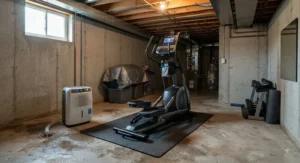
Concrete Floor Setup: The Right Home Gym Flooring Mats for Your Elliptical
Concrete is deceptively porous. It can look bone-dry on the surface while still releasing moisture vapor from the ground underneath, year-round, with no visible leak to blame. That’s the core reason a concrete floor elliptical mat setup isn’t optional in a basement the way it might be upstairs — skip it, and you’re putting a few hundred pounds of steel and electronics directly on a surface that’s quietly working against you.
The baseline recommendation from flooring specialists is straightforward: lay a 6-mil polyethylene vapor barrier directly on the concrete before anything else goes down, then install your equipment mat on top of it with a small expansion gap at the room’s edges. For most home gym flooring mats, half-inch rubber tile is enough to protect the slab and dampen vibration from a moving elliptical; if you’re also doing any strength training in the same space, three-quarter-inch tile handles the added impact better. Horse stall mats are the well-known budget alternative — a 4×6-foot, three-quarter-inch mat costs meaningfully less per square foot than branded gym tile and holds up fine under an elliptical’s relatively gentle load profile.
Two mistakes show up constantly in basement gym forums and buying guides: skipping the vapor barrier because the slab “looks dry” — even though moisture vapor emission is a natural, ongoing property of concrete slabs regardless of visible leaks — and gluing tiles down before dry-fitting the whole layout. Concrete flooring in a basement rarely needs adhesive at all for equipment mats — friction and the elliptical’s own weight typically hold everything in place, and a dry-fit first lets you catch sizing mistakes before they’re permanent. If a mat ever smells musty or feels damp on the underside months after installation, that’s a sign moisture is getting trapped rather than blocked, and it’s worth pulling the section up to dry the slab and check the barrier before problems spread to the machine itself.
✨ Don’t Miss These Exclusive Deals!
🔍 Take your basement gym build to the next level with these carefully selected products. Click on any highlighted item to check current pricing and availability. These tools will help you create a durable, humidity-ready setup your whole household will use for years.
Basement Humidity and Your Elliptical: Keeping Rust and Corrosion Away
Basement humidity is the single biggest variable separating a machine that lasts a decade from one that starts squeaking and seizing up within two years. Unlike upstairs rooms, basements sit closer to the water table, get less airflow, and swing more dramatically between seasons — all of which pushes relative humidity well past comfortable indoor ranges if nothing is actively managing it.
The EPA’s guidance on indoor moisture control recommends keeping relative humidity below 60%, ideally in the 30-50% range, and that target applies just as directly to a basement gym as it does to the rest of the house. Mold growth typically begins around 55% relative humidity and accelerates from there, and while a bit of surface mold on drywall is a health concern, sustained humidity above that range also quietly corrodes exposed bolts, pits chrome finishes, and can work into console electronics over months of exposure. A basic hygrometer costs under $20 and gives you a real number instead of a guess — check it seasonally, since basements commonly swing 10-20 percentage points between summer humidity and winter dryness.
A dehumidifier sized for the room is the single highest-leverage purchase you can make alongside a humidity resistant elliptical for basement use — more impactful, frankly, than any single spec on the machine itself. Beyond that, a checklist from NC State Extension’s home moisture guidance offers a useful basement-specific inspection routine: checking for excess moisture and mold signs around foundation walls, window wells, and floor-wall joints before they become a problem for anything stored or installed nearby. Machines with fully enclosed drivetrains and powder-coated steel — like the 3G Cardio Elite EM X and Sole E35 — handle ambient basement humidity noticeably better than machines with exposed painted joints, based on the spec comparison of their construction details, though no elliptical is fully immune without active humidity control in the room.
Turning an Unfinished Basement Into a Permanent Home Gym
There’s a real difference between parking an elliptical in a basement and building a permanent home gym elliptical basement setup that survives years of actual use. The gap between the two comes down to a handful of decisions made before the machine ever gets plugged in.
Start with the electrical: a dedicated, GFCI-protected circuit for gym equipment avoids the nuisance tripping that happens when a treadmill, elliptical, dehumidifier, and a shop light all share one basement outlet. Next, commit to a flooring plan that treats the whole workout zone as one continuous surface rather than a single mat under the machine — this prevents the “island effect” where moisture wicks in from untreated concrete at the edges of your equipment mat. Lighting matters more than people expect; basements are naturally dim, and a couple of LED shop lights on a dedicated switch make early-morning or evening sessions far more usable than relying on a single bare bulb.
Finally, treat the dehumidifier as gym equipment, not a household appliance you happened to also use in the basement. Running it on a consistent schedule — not just when the room feels obviously damp — is what actually protects a multi-thousand-dollar investment like the 3G Cardio Elite EM X or NordicTrack AirGlide 7i over a five- or ten-year ownership window. Buyers who treat the room’s environment as part of the equipment budget, rather than an afterthought, consistently report far fewer maintenance issues than those who buy the machine first and figure out the room later.
Elliptical vs Treadmill for Basement Cardio
The comparison comes up constantly for basement gym builders, and the honest answer depends more on your joints and your floor than on either machine’s feature list. An elliptical produces roughly 50-70% less impact force on joints than running on a treadmill at equivalent effort, which matters in a room where the floor itself — concrete under a thin mat — already offers less give than a suspended wood floor upstairs. That combination of low-impact motion and a firm subfloor is part of why ellipticals are frequently recommended over treadmills for basement placement specifically.
| Factor | Elliptical | Treadmill |
|---|---|---|
| Joint impact | Roughly 50-70% lower | Full ground-contact force |
| Footprint | Comparable to slightly larger | Comparable to slightly smaller |
| Noise on concrete | Generally quieter | Motor and belt noise carries more on hard floors |
| Best For | Sole E25, Sole E35 for joint-friendly basement cardio | Runners training for race-specific pace work |
The analysis holds up under scrutiny: treadmills are the better tool if you’re training for an actual race and need to replicate real running mechanics, but for general basement cardio, an elliptical’s lower impact and typically quieter operation on a hard concrete floor make it the more forgiving long-term choice — especially for anyone already managing knee or hip sensitivity.
Common Mistakes When Buying an Elliptical for a Basement Gym
The most frequent mistake is buying based on resistance level count instead of flywheel weight — a machine advertising 32 levels on a light flywheel can still feel jerkier than one with 20 levels on a heavier flywheel, because the flywheel is what actually smooths the motion between resistance changes. A close second is skipping the ceiling and clearance measurement entirely; more than a few buyers have discovered, after assembly, that a 71-inch-tall elliptical doesn’t clear a 6’8″ section of ductwork.
Underestimating humidity’s effect on warranty claims is another common blind spot — most manufacturer warranties cover manufacturing defects, not corrosion from an unmanaged damp environment, so skipping a dehumidifier can quietly void coverage on rust-related issues even when the machine itself was solid at purchase. Finally, buyers regularly install the mat and machine before addressing the concrete slab’s moisture condition, which means redoing flooring work later instead of getting it right the first time.
Long-Term Cost & Maintenance in a Humid Basement
The sticker price is only part of what an elliptical costs over a five-to-ten-year basement lifespan. Budget machines like the Schwinn 411 or Sunny Health & Fitness SF-E3919 carry a lower upfront cost but a shorter expected component lifespan under humid conditions, meaning belts, bearings, or consoles may need replacement sooner — often within 3-5 years of regular basement use without active humidity control. Mid-range machines like the Sole E25 and Sole E35 offset a higher purchase price with lifetime frame warranties, which meaningfully lower the total cost of ownership if the frame is the part most exposed to basement conditions.
At the top end, the 3G Cardio Elite EM X‘s 5-year parts warranty and commercial-grade bearings represent a bet that fewer replacement parts over a decade offset the higher entry price — a reasonable bet for a genuinely permanent installation, less so for a basement gym that might get reconfigured in a few years. Across every tier, the single variable that most affects long-term cost isn’t the machine at all: a $150 dehumidifier and a $50 hygrometer, run consistently, do more to protect any of these seven ellipticals than upgrading one price tier higher ever will.
FAQ
❓ Can you put an elliptical in an unfinished basement?
❓ Do ellipticals rust in a basement?
❓ What flooring is best under an elliptical on concrete?
❓ How much clearance does a basement elliptical need?
❓ Is an elliptical or treadmill better for a basement?
Conclusion
An elliptical for unfinished basement gym use rewards a little upfront planning far more than most home gym purchases do. The machine matters — a heavier flywheel, a steel frame, and sensible footprint all make a real difference — but the room around it matters just as much. Vapor barrier under the mat, humidity in the 30-50% range, a GFCI-protected outlet, and a wipe-down routine will keep any of the seven machines above running well past the point where a neglected setup starts squeaking and rusting.
If space and ceiling height are tight, the Schwinn 411, Sunny Health & Fitness SF-E3919, or Cubii Move solve that without asking much of your budget. If you’re building something more permanent, the Sole E25, Sole E35, NordicTrack AirGlide 7i, or 3G Cardio Elite EM X all justify their higher price with construction genuinely suited to daily, long-term basement use. Whichever one fits your space, treat the humidity control and flooring as part of the purchase, not an optional add-on — that’s the decision that actually determines whether this becomes a permanent home gym elliptical basement setup or a cautionary story in two years.
Recommended for You
- Compact Elliptical for Small Bedroom Workouts: 7 Best Picks (2026)
- 7 Best Elliptical for Small Living Room Spaces Picks (2026)
- Foldable Elliptical for Basement Storage Space: 7 Best Picks (2026)
Disclaimer: This article contains affiliate links. As an Amazon Associate, I earn from qualifying purchases. If you purchase products through these links, we may earn a small commission at no additional cost to you.
✨ Found this helpful? Share it with your friends! 💬🤗
