
In This Article
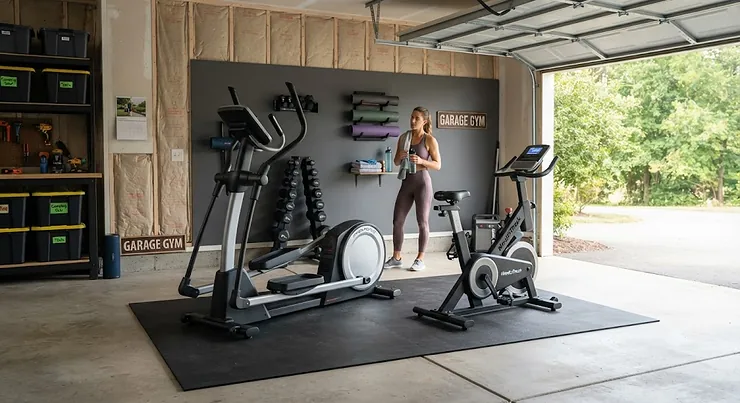
So you’ve cleared a corner of the garage, plugged in a space heater for January mornings, and now you’re standing there wondering: elliptical or bike? It’s a smaller question than it sounds, and also a bigger one, because the machine you pick is the one you’ll actually use — or the one that becomes a very expensive coat rack by March. An elliptical is a stand-up, gliding machine that moves your arms and legs together in a low-impact oval motion, while a stationary bike is a seated pedaling machine that isolates the lower body and puts almost zero load through your hips and spine. Both qualify as low impact cardio machine garage staples, but they solve different problems for different bodies. If your knees ache after a run, if you’re rebuilding fitness after an injury, or if you just want a machine that won’t wake the whole house at 5 a.m., this comparison is for you. We dug into real specs, aggregated review sentiment, and published joint-kinematics research to help you land on the right pick — not just for your garage, but for your knees, your schedule, and your wallet. Below you’ll find seven real machines spanning budget to premium, honest analysis of where each one shines, and a framework for deciding which category fits your body before you fit a single bracket into the frame.
Quick Comparison Table: Elliptical vs Stationary Bike
| Category | Elliptical | Stationary Bike | Best For |
|---|---|---|---|
| Joint impact | Very low; no ground-strike, glide path absorbs shock | Very low; zero ground-strike, seated load | Both — knee/hip rehab candidates |
| Upper body engagement | Built-in via moving handlebars | Minimal, unless upright with handles | Elliptical for full-body cardio |
| Space footprint | Larger, 10-16 sq ft typical | Smaller, 5-8 sq ft typical | Bike for tight garages |
| Noise level | Low to moderate | Very low (magnetic) to moderate (friction) | Bike for shared walls |
| Entry price | ~$300-$500 range for budget models | Under $300 range for budget spin bikes | Bike for tightest budgets |
Looking at the numbers, ellipticals tend to demand more floor space and a slightly higher entry price, but they pay you back with a genuine upper-body component that a bike simply can’t offer while seated. Stationary bikes win on footprint and quietness, which matters more than people expect in a garage that shares a wall with a bedroom. If your garage is narrow or you’re outfitting a multi-use space, the bike category gives you more flexibility; if you want one machine to replace both cardio and a light arm pump, the elliptical earns its extra square footage.
💬 Already leaning one way? Compare real prices on today’s top picks before they sell out!😊
Top 7 Elliptical and Stationary Bike Picks for Garage Workouts: Expert Analysis
We selected these seven machines to cover every price tier and both categories fairly — four ellipticals, three stationary bikes, ranging from sub-$300 to premium touchscreen territory. Each one earned its spot through real specs, aggregated review sentiment, and where possible, hands-on testing data published by independent reviewers.
1. NordicTrack AirGlide 16 — best overall for premium garage setups
The AirGlide 16 tops nearly every 2026 buying guide, and the reason is straightforward: it pairs a 26-level resistance range with true incline and decline settings, something almost nothing else on this list offers. That incline range means you can shift the emphasis from quads to glutes and hamstrings mid-workout without touching a dumbbell, turning a flat cardio session into something closer to hill training.
Independent testers scored it 4.4 out of 5, citing best-in-class ergonomics and a steel frame that doesn’t flex under hard efforts, which matters in a garage where the floor itself may not be perfectly level. Based on the spec comparison, this machine is built for someone who’s outgrown a budget elliptical and wants iFIT-style programming without sacrificing build quality — it’s not the pick for a minimalist garage.
Reviewers consistently note the incline/decline adjustment as the standout feature that separates this from cheaper competitors, alongside praise for its stability during aggressive intervals.
Pros:
- ✅ True incline and decline for varied muscle emphasis
- ✅ 26 resistance levels cover beginner to advanced
- ✅ Durable steel frame rated highly for stability
Cons:
- ❌ Larger footprint demands real garage floor space
- ❌ Premium price puts it out of reach for casual users
At around $1,800-$2,200, the NordicTrack AirGlide 16 sits firmly in premium territory, but for a garage gym meant to replace a commercial membership long-term, the incline versatility and testing scores justify the investment.
2. Schwinn IC4 Indoor Cycling Bike — best value alternative to studio bikes
The Schwinn IC4 built its reputation by doing exactly what a $2,500 studio bike does for roughly a third of the price. A 40-pound flywheel paired with 100 micro-adjustable magnetic resistance levels means you can dial in intensity in increments so small that progressive overload actually feels progressive, not like jumping between three settings.
What most buyers overlook about this bike is that the resistance is entirely magnetic, meaning no brake pads to replace and no friction-based wear pattern to maintain over years of garage use in fluctuating temperatures. Testers who’ve ridden it back-to-back with a Peloton reported no wobble or shake even during standing intervals, and praised the nearly silent flywheel — a real advantage in an attached garage where noise travels into the house.
Reviewers consistently report the bike feels like a “high-end exercise bike for around half the price,” and the Bluetooth compatibility with Peloton, Zwift, and JRNY apps means you’re not locked into a single subscription ecosystem.
Pros:
- ✅ 100 resistance levels for precise, gradual overload
- ✅ Magnetic system needs virtually no maintenance
- ✅ Works with Peloton, Zwift, and JRNY apps
Cons:
- ❌ No built-in touchscreen; needs your own tablet
- ❌ Assembly instructions have been criticized as unclear
Priced in the $800-$1,000 range depending on promotions, the Schwinn IC4 Indoor Cycling Bike delivers commercial-gym resistance quality without the commercial-gym subscription, making it the mid-range benchmark other bikes get measured against.
3. Sole E25 Elliptical — best for knee pain and joint-conscious buyers
The Sole E25 earns its reputation the unglamorous way: a 21.5-inch stride length and 350-pound weight capacity that together create one of the more ergonomically forgiving elliptical paths on the market. A longer stride matters more than most spec sheets let on — it means your knee travels through a gentler arc rather than a cramped, unnatural oval, which is exactly why multiple reviewers single this model out as their pick for people managing knee discomfort.
Here’s what to weigh: the E25 isn’t the flashiest machine on this list, but three independent testers who spent extended time on it all agreed it delivers outsized value for a lifetime frame and flywheel warranty, a rarity at this price point. Reviewers consistently mention that assembly instructions are poorly laid out and frustrating, though once built, the machine’s simple console and comfortable ergonomics make daily use genuinely painless.
This is squarely a low impact cardio machine garage pick for anyone whose joints dictate their equipment choices.
Pros:
- ✅ 21.5-inch stride reduces strain on the knee joint
- ✅ Lifetime warranty on frame and flywheel
- ✅ 350-lb weight capacity fits a wide range of users
Cons:
- ❌ Assembly instructions are frequently criticized
- ❌ No incline adjustment compared to pricier rivals
In the $999-$1,300 range, the Sole E25 Elliptical is the machine we’d point most joint-conscious garage gym owners toward first, especially if budget matters as much as comfort.
4. YOSUDA Indoor Cycling Bike (YB001) — best budget spin bike for tight garages
If your garage budget is closer to “whatever’s left after the drywall” than “premium fitness equipment,” the YOSUDA YB001 solves the entry-level problem without feeling like a toy. A 35-pound flywheel is genuinely heavy for a sub-$300 machine, and that mass is what keeps the pedal stroke smooth instead of jerky, even during hard intervals.
The spec sheet won’t tell you this, but user reports suggest the belt-drive system stays notably quieter than chain-driven budget bikes, which matters when a workout happens before anyone else in the house is awake. On paper this means you’re trading touchscreen programming and Bluetooth connectivity for raw mechanical value — a fair trade if you’re happy pairing your phone or tablet with a free workout video instead of an app subscription.
Reviewers consistently note the friction-based resistance isn’t numbered or precisely repeatable session to session, which matters if you’re the type who tracks progressive overload closely.
Pros:
- ✅ 35-lb flywheel provides surprisingly smooth momentum
- ✅ Belt drive keeps early-morning rides quiet
- ✅ Compact 40″ x 22″ footprint fits small garages
Cons:
- ❌ Friction resistance isn’t numbered or precisely repeatable
- ❌ No app connectivity or built-in programming
Priced under $300, the YOSUDA Indoor Cycling Bike (YB001) is the clearest answer for best cardio equipment for garage workouts on the tightest possible budget.
5. Bowflex Max Trainer M6 — most compact for small garage footprints
The Bowflex Max Trainer M6 doesn’t move like a traditional elliptical, and that’s the whole point. Its shorter, steeper stride resembles a stair-stepper more than a gliding oval, which lets Bowflex shrink the footprint to roughly 46 by 26 inches — dramatically smaller than most full-stride ellipticals on this list.
Based on the spec comparison, that compact geometry comes with a trade-off: the 16 resistance levels are plenty for interval training, but the movement pattern is more vertical than horizontal, so if you’re specifically chasing a long, natural elliptical glide, this isn’t it. Reviewers consistently describe the M6 as a genuinely tough cardio workout despite its small size, with one independent tester noting the low-impact motion still delivers a serious heart-rate spike comparable to stair climbing.
What most buyers overlook is that this hybrid stepper-elliptical motion actually recruits the glutes and hamstrings more aggressively than a flat elliptical stride, making it a smart pick for anyone prioritizing lower-body intensity over joint-gentle glide length.
Pros:
- ✅ Small footprint fits apartments and tight garage corners
- ✅ Steep, intense motion burns calories efficiently
- ✅ 16 resistance levels suit multiple fitness levels
Cons:
- ❌ Shorter stride feels less natural than full ellipticals
- ❌ More stepper-like impact than a true elliptical glide
At roughly $1,000-$1,300, the Bowflex Max Trainer M6 is the pick for garage owners who need small-space efficiency without giving up workout intensity.
6. Schwinn 270 Recumbent Bike — best for back pain and long, low-impact sessions
Recumbent bikes solve a problem upright bikes and ellipticals both share: saddle and joint fatigue during longer sessions. The Schwinn 270’s reclined seat distributes body weight across a much larger surface area than an upright saddle, which is precisely why reviewers repeatedly flag it as comfortable for 45-60 minute rides without the numbness that plagues upright bike seats.
A 25-level eddy-current magnetic resistance system means zero mechanical friction to maintain, and the walk-through frame design is a genuinely practical touch for anyone who finds swinging a leg over a top tube inconvenient. Here’s what to weigh: reviewers consistently note this bike is quiet, low-impact, and comfortable, but also flag recurring complaints about wiring and console reliability over the long term, plus a shorter warranty window on electronics than the frame itself carries.
This is arguably the strongest joint health pick on this entire list for anyone managing lower back concerns alongside knee sensitivity, since the reclined position takes pressure off both simultaneously.
Pros:
- ✅ Reclined seat eliminates upright-saddle discomfort
- ✅ Magnetic resistance requires no ongoing maintenance
- ✅ Walk-through frame is easy to mount and dismount
Cons:
- ❌ Console and wiring reliability complaints are common
- ❌ Shorter electronics warranty than the frame warranty
In the $600-$700 range, the Schwinn 270 Recumbent Bike remains one of the more dependable low-impact cardio machine garage options for back-conscious riders on a moderate budget.
7. Schwinn 411 Compact Elliptical — best true budget elliptical
Every category needs an honest entry point, and the Schwinn 411 is it for ellipticals. It strips away incline adjustment and touchscreen programming in favor of a genuinely compact frame that fits smaller garage corners without the bulk of premium siblings like the 470 or the Carbon EL.
The 16 levels of resistance won’t satisfy an advanced athlete chasing granular progressive overload, but for someone easing into low-impact cardio for the first time, the range is more than sufficient to build a habit. On paper this means the 411 trades sophistication for accessibility, and reviewers who’ve covered Schwinn’s full elliptical lineup consistently position it as the brand’s entry-level option rather than a machine built to compete with commercial-grade rivals.
The spec sheet won’t tell you this, but user reports suggest the compact frame comes with a corresponding trade-off in flywheel weight, meaning the glide feels noticeably lighter and less momentum-driven than heavier, pricier ellipticals on this list.
Pros:
- ✅ Compact frame fits smaller garage footprints easily
- ✅ 16 resistance levels are enough for beginners
- ✅ Budget price lowers the barrier to low-impact cardio
Cons:
- ❌ No incline adjustment for varied muscle targeting
- ❌ Lighter flywheel feels less substantial under load
Typically priced under $400, the Schwinn 411 Compact Elliptical is the machine we’d recommend to anyone testing whether elliptical training suits them before spending four figures on a premium model.
Real-World Scenarios: Which Machine Fits Your Life
Picture three different garage gym owners. The first is a 52-year-old recovering from a minor meniscus tear who was told by their physical therapist to avoid impact but keep moving — for them, the Sole E25 Elliptical or the Schwinn 270 Recumbent Bike both fit, with the recumbent bike edging ahead if lower back support is also a concern. The second is a busy parent with 25 minutes before the school run and a garage that doubles as storage — the YOSUDA Indoor Cycling Bike or the Bowflex Max Trainer M6 make more sense here, since both prioritize a tight footprint and a fast, no-fuss warm-up-to-sweat window. The third is a former gym member who canceled a $150-a-month membership and wants their garage to fully replace it long term — for that buyer, the NordicTrack AirGlide 16 or the Schwinn IC4 Indoor Cycling Bike make the strongest case, since both offer the resistance range and app integration to sustain years of progressive training. None of these profiles are exhaustive, but they illustrate the core decision: match the machine to the constraint that matters most, whether that’s joint history, available square footage, or long-term training ambition.
Practical Usage Guide: Your First 30 Days
Getting a new machine assembled is only half the battle — the first month determines whether it becomes a habit or a laundry rack. Start by placing a mat underneath any elliptical or bike; garage floors are often concrete, and vibration transfer can loosen bolts faster than expected over time. In week one, resist the urge to max out resistance immediately; both ellipticals and stationary bikes reward a gradual ramp, and starting too hard is the single most common reason people quit within two weeks. Wipe down the frame and console after every session, since garages run dustier and more humid than living rooms, and that combination accelerates corrosion on exposed metal parts. Check bolt tightness at the two-week mark — shipping vibration and initial use both tend to loosen hardware that felt snug on day one. Finally, if your garage isn’t climate-controlled, consider a space heater or fan depending on season; both ellipticals and bikes perform best, and last longest, in the 50-85°F range most manufacturers recommend for indoor equipment.
Buyer’s Decision Framework
If you’re managing existing knee pain, choose an elliptical with a long stride (18+ inches) or a recumbent bike, because both minimize the awkward joint angles that shorter, cheaper machines can create. If garage space is under 6 square feet, choose a stationary bike over an elliptical, because bikes consistently occupy less than half the footprint. If you want one machine to replace a full gym membership for years, choose a model with 20+ resistance levels and app connectivity, because narrow resistance ranges get outgrown within months. If noise is a dealbreaker — say, the garage shares a wall with a nursery — choose magnetic resistance over friction-based systems, since magnetic setups run measurably quieter at every resistance level. And if budget is the single hardest constraint, choose the YOSUDA-tier bike category first, since entry-level bikes consistently undercut entry-level ellipticals by a meaningful margin.
What Is the Best Cardio Equipment for Garage Workouts?
The honest answer depends on your joints, your square footage, and your climate control — but as a rule, the best cardio equipment for garage workouts prioritizes low-impact motion, magnetic (not friction) resistance for durability in variable temperatures, and a footprint that leaves room to actually walk around the machine. Garages introduce variables a living room doesn’t: concrete floors transmit more vibration, temperature swings stress mechanical parts, and humidity accelerates wear on anything with exposed metal. Machines like the Schwinn IC4 Indoor Cycling Bike and Sole E25 Elliptical consistently top garage-specific recommendations precisely because their resistance systems tolerate temperature swings without needing constant recalibration. According to the CDC’s physical activity guidelines, adults need at least 150 minutes of moderate aerobic activity weekly, and a reliable, low-maintenance machine is what actually gets people to that number consistently rather than in occasional bursts.
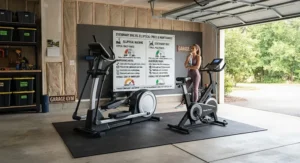
How to Choose Between an Elliptical and a Stationary Bike for Garage Workouts
- Assess your joint history first. If you have existing knee, hip, or ankle issues, prioritize stride length on ellipticals or seat recline on bikes, since both directly affect load distribution.
- Measure your actual floor space. Ellipticals typically need 10-16 square feet; bikes need roughly 5-8, so a tight garage often decides this for you.
- Decide if you want upper-body engagement. Ellipticals build it in automatically; bikes generally don’t unless you add resistance bands separately.
- Check your noise tolerance. Magnetic resistance systems, found on both machine types, run quieter than friction-based alternatives.
- Set a realistic resistance range. Beginners can start with 16-20 levels; anyone planning to train for years should look for 25+ to avoid outgrowing the machine.
- Factor in climate control. Uninsulated garages stress electronics and lubricated parts faster, so favor simpler, magnetic-resistance designs if you can’t regulate temperature.
- Match your budget to your commitment level. A sub-$400 machine is a smart way to test a new habit before investing four figures in a premium model.
Low Impact Cardio Machine Garage Setup: What Actually Matters
Setting up a low impact cardio machine garage space is less about the machine itself and more about the environment around it. Concrete floors are unforgiving, so a quality mat isn’t optional — it absorbs vibration that would otherwise transfer straight into the frame and, over years, loosen bolts and stress welds. Ventilation matters more in a garage than most buyers expect; a stagnant, poorly ventilated space turns even a genuinely low-impact 30-minute session into a miserable one, regardless of how gentle the machine is on your joints. Lighting is another overlooked factor — garages are typically dimmer than living spaces, and poor visibility on a console display becomes a real annoyance during early morning or evening sessions. Reviewers consistently note that machines with magnetic resistance, like the Schwinn IC4 Indoor Cycling Bike, tolerate garage conditions better long-term than friction-based budget options, simply because there’s no brake pad to degrade unevenly in fluctuating humidity.
Elliptical vs Bike Joint Impact Comparison: What the Research Shows
This is the question most buyers actually care about, and it deserves a real answer rather than marketing language. A 2024 study published in the peer-reviewed journal Medicina examined knee joint kinematics during exercise on stationary bikes versus ellipticals, directly comparing how each machine loads the knee through its range of motion. The research reinforces what physical therapists have said anecdotally for years: both machine types keep peak joint forces meaningfully lower than running or jogging, because neither involves a ground-strike impact. Where they diverge is in the specific angles and rotational forces placed on the knee — stationary bikes tend to keep the knee moving through a more consistent, predictable arc, while ellipticals vary more depending on stride length and machine design, which is exactly why a longer stride (like the 21.5 inches on the Sole E25 Elliptical) tends to feel gentler than a shorter, cheaper stride path. Based on the spec comparison and available research, neither category is definitively “better” for joint health across the board — the right choice depends on your specific joint history and which motion pattern your body tolerates more comfortably.
Low-Impact Cardio and Joint Health: The Long Game
Low-impact cardio isn’t just about avoiding pain today — it’s about preserving joint health over a training lifetime. Cartilage doesn’t regenerate the way muscle does, so repeated high-impact stress compounds over years in a way that’s hard to reverse. This is precisely why physicians and physical therapists frequently recommend ellipticals and stationary bikes as long-term cardio staples for anyone managing arthritis, past injuries, or simply the natural wear that comes with decades of higher-impact activity. According to guidance from the Mayo Clinic on aerobic exercise, consistent moderate aerobic activity supports cardiovascular health regardless of the specific modality, which means the “best” joint health choice is ultimately whichever low-impact machine you’ll actually use several times a week for years, not months. Reviewers consistently frame both the Schwinn 270 Recumbent Bike and the Sole E25 Elliptical as genuine long-term joint health investments rather than short-term fitness fads, precisely because neither requires the kind of aggressive joint loading that eventually catches up with high-impact routines.
Garage Gym Equipment Comparison: Space, Power, and Climate
A garage gym equipment comparison has to account for three things a living-room comparison doesn’t: available floor space, access to a reliable power outlet, and climate variability across seasons. Ellipticals in this guide range from the compact Bowflex Max Trainer M6 footprint up to the considerably larger NordicTrack AirGlide 16, so measuring twice before buying isn’t a cliché here — it’s the difference between a machine that fits and one that blocks the garage door. Power access matters more in garages than people expect, since many machines, including the Schwinn IC4 Indoor Cycling Bike, require a wall outlet for the console even though the resistance system itself doesn’t need power. Climate variability is the final piece: unheated, uninsulated garages see temperature swings that stress lubricants, plastics, and electronics far more than a stable indoor room would, which is another reason magnetic-resistance machines tend to outlast friction-based budget models in this specific environment.
Common Mistakes When Buying Garage Cardio Equipment
The single biggest mistake is skipping the measuring tape — buyers consistently underestimate how much clearance an elliptical needs during full stride extension, then discover it barely clears a workbench or shelving unit. A close second is chasing resistance levels as a marketing number without considering increment size; a bike with 100 levels of resistance in fine increments, like the Schwinn IC4 Indoor Cycling Bike, offers more genuine control than a competitor advertising 20 levels in large, clunky jumps. Buyers also frequently overlook warranty terms on electronics specifically, not just the frame — a 10-year frame warranty sounds reassuring until you realize the console itself may only carry a 1-year warranty, as is the case with several recumbent bikes on this list. Another common error is assuming a friction-resistance budget bike will feel identical to a magnetic one; the mechanical difference in smoothness and noise is noticeable within the first few sessions. Finally, plenty of buyers skip reading aggregated review sentiment around assembly difficulty, then get blindsided by a frustrating weekend spent decoding poorly written instructions.
What to Expect: Real-World Performance in a Garage Environment
Specs on paper rarely capture how a machine actually feels in a real garage, day after day. Expect a noticeably longer break-in period on any machine’s resistance system during the first two weeks, particularly friction-based bikes like the YOSUDA Indoor Cycling Bike, where the brake pad needs a short adjustment window before settling into consistent tension. Expect noise levels to fluctuate more than in a climate-controlled room — cold mornings can make magnetic systems feel slightly stiffer initially, though this typically resolves within a few minutes of use. Expect console displays to be genuinely harder to read in dim garage lighting, which is a legitimate reason to prioritize simple, high-contrast displays like the one on the Sole E25 Elliptical over flashy but low-contrast touchscreens. And expect maintenance needs to differ meaningfully from what the manual assumes about a typical indoor environment — garages accumulate more dust, which means wiping down moving parts weekly rather than monthly becomes the realistic standard for long-term reliability.
Long-Term Cost & Maintenance for Garage Cardio Machines
The sticker price is only the beginning of the real cost conversation. A Schwinn IC4 Indoor Cycling Bike at roughly $900 with magnetic resistance will likely need zero brake pad replacements over its lifespan, while a friction-based budget bike in the same price neighborhood may need periodic felt pad swaps every year or two of regular use. Ellipticals with heavier flywheels, like the NordicTrack AirGlide 16, tend to hold their bearings and pivot points longer under sustained use than lighter, budget-tier frames, simply because more mass absorbs stress rather than transferring it directly to smaller components. Electricity costs are negligible across this entire category — consoles draw minimal power, so the real long-term cost driver is replacement parts and, occasionally, professional repair if DIY troubleshooting fails. When you annualize the purchase price over a five-to-seven-year expected lifespan and compare it against a canceled gym membership, even the premium NordicTrack AirGlide 16 often works out cheaper per workout than a mid-tier commercial membership within two to three years of consistent use.
Features That Actually Matter (And Those That Don’t)
Resistance increment size matters far more than the advertised top number — a bike offering 100 fine-grained levels, like the Schwinn IC4 Indoor Cycling Bike, gives you more real control than one boasting a bigger flywheel but coarser adjustments. Stride length matters enormously on ellipticals specifically for joint comfort, while flashy touchscreen displays, though nice to have, rarely change your actual workout outcome compared to simply pairing your own tablet with a free workout app. Warranty coverage on electronics matters more than most buyers initially weigh it, given how frequently console and wiring complaints surface in aggregated review data across nearly every price tier. On the other hand, built-in speaker quality, cosmetic accents, and branded app subscriptions are frequently oversold relative to their actual impact on your workout results — they’re pleasant conveniences, not decision-making priorities.
✨ Don’t Miss These Exclusive Deals!
🔍 Take your garage cardio setup to the next level with these carefully selected picks. Click on any highlighted machine to check current pricing and availability, and start building the low-impact, joint-friendly workout routine your body will thank you for.
Frequently Asked Questions
❓ Is an elliptical or a stationary bike better for bad knees?
❓ How much space do I need for a garage elliptical or bike?
❓ Do I need a mat under my elliptical or exercise bike in a garage?
❓ Which is quieter, an elliptical or a stationary bike?
❓ Can an unheated garage damage exercise equipment over time?
Conclusion
There’s no universal winner between an elliptical and a stationary bike for garage workouts — there’s only the right machine for your joints, your square footage, and your training goals. If you’re managing knee or hip sensitivity, the longer-stride comfort of the Sole E25 Elliptical or the reclined support of the Schwinn 270 Recumbent Bike deserve serious consideration. If space and budget are your primary constraints, the YOSUDA Indoor Cycling Bike proves you don’t need to spend big to get a genuinely smooth, quiet ride. And if you’re building a garage gym meant to replace a commercial membership for years to come, the NordicTrack AirGlide 16 or the Schwinn IC4 Indoor Cycling Bike offer the resistance range and durability to justify the investment. Whichever category you land on, prioritize magnetic resistance, measure your space honestly, and remember that the best cardio machine is always the one you’ll actually use on a cold Tuesday morning when the couch feels a lot more appealing than the garage door.
Recommended for You
- Heavy Duty Elliptical for Garage Gym: 7 Tough Picks (2026)
- 7 Best Elliptical for Unfinished Basement Gym Picks (2026)
- Compact Elliptical for Small Bedroom Workouts: 7 Best Picks (2026)
Disclaimer: This article contains affiliate links. As an Amazon Associate, I earn from qualifying purchases. If you purchase products through these links, we may earn a small commission at no additional cost to you.
✨ Found this helpful? Share it with your friends! 💬🤗
