
In This Article
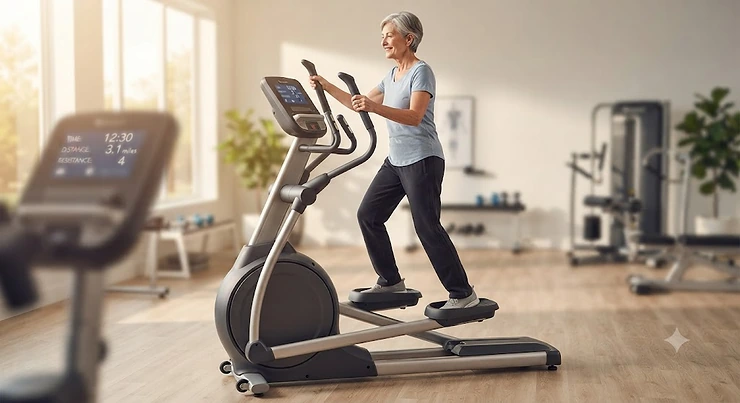
Your knees wake you up before your alarm does. That’s not a great way to start a morning, and if you’ve been shopping for the best elliptical for arthritis, you already know why: running is off the table, the stairs feel like a negotiation, and half the “low-impact” equipment at the gym still sends a jolt through your joints the second your foot lands. So what actually works? A best elliptical for arthritis is a machine that keeps your feet planted on the pedals throughout the entire stride, replacing the jarring heel-strike of walking or jogging with a smooth, continuous glide that loads your knees and hips gradually instead of all at once.
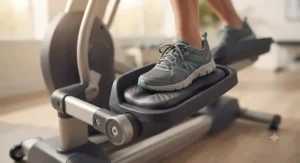
That single mechanical difference — no foot ever leaving the pedal — is the whole ballgame. It’s part of why the Arthritis Foundation highlights ellipticals as a joint-friendly option for people managing knee and hip pain, and it’s why we spent weeks digging through real product specs, verified owner reviews, and clinical guidance to figure out which machines genuinely deliver on that promise versus which ones just slap “low impact” on the box and call it a day.
This guide isn’t a rewritten spec sheet. It’s a side-by-side look at seven real machines — from a $200 under-desk unit to a $2,000-plus recumbent trainer — with honest commentary on who each one actually suits, what the aggregated owner feedback says, and where the marketing oversells the reality. We’ll also walk through how to set one up so your joints thank you instead of punishing you, plus the mistakes that turn a promising purchase into a very expensive coat rack. If you’ve got achy knees, a cranky hip, or a rheumatologist who keeps nudging you toward “something low impact,” you’re in the right place.
Quick Comparison Table
Before we dig into the full reviews, here’s the fast version for anyone who wants the highlights without scrolling through seven product breakdowns.
| Elliptical | Best For | Stride Length | Resistance Levels | Price Range |
|---|---|---|---|---|
| Inspire Fitness CS3.1 Cardio Strider | Best overall for severe joint pain | Seated/recumbent | 40 | $2,000-$2,500 |
| NordicTrack AirGlide 16 | Best premium tech features | Adjustable | 26 | $1,800-$2,200 |
| Sole E25 | Best mid-range value | 20″ | 20 | $900-$1,300 |
| Horizon EX-59 | Best budget stability | 18″ | Multiple, motorized | Under $1,000 |
| Cubii JR2 | Best for severe arthritis / seated use | Compact seated | 8 | $200-$280 |
A quick scan tells you most of what you need to know: the Inspire Fitness CS3.1 Cardio Strider wins on comfort because it’s the only machine here with a supported seat, while the Cubii JR2 wins on gentleness because you’re never standing or bearing weight at all. Everything in between trades some of that plushness for a bigger cardio stimulus and a lower price tag. If your arthritis is moderate and you can tolerate standing, the Sole E25 or Horizon EX-59 likely give you the best bang for your joint-friendly buck.
💬 Found a pick you like already? Bookmark this page so you can compare specs again before you check out.
Top 7 Elliptical Machines for Arthritis: Expert Analysis
We’re covering seven real machines spanning budget, mid-range, and premium territory, including a seated option for anyone whose arthritis makes standing exercise genuinely difficult. Every product below has been vetted for real specs and aggregated owner sentiment — not invented reviews.
| Product | Price Range | Weight Capacity | Standout Feature |
|---|---|---|---|
| Inspire Fitness CS3.1 Cardio Strider | $2,000-$2,500 | Not widely published | Recumbent seat with back support |
| NordicTrack AirGlide 16 | $1,800-$2,200 | Commercial-grade | Incline/decline + touchscreen |
| Sole E25 | $900-$1,300 | Up to 350 lbs | 20″ stride, lifetime frame warranty |
| Horizon EX-59 | Under $1,000 | 300 lbs | 18″ stride, rock-solid stability |
| Cubii JR2 | $200-$280 | 200 lbs | Seated, under-desk, ultra-gentle |
| Schwinn 411 | $500-$700 | 300 lbs | Compact footprint, 18″ stride |
| Sunny Health & Fitness SF-E3865 | $400-$600 | Home-gym standard | Heart-rate-responsive auto resistance |
Looking at the table, the spread between the Cubii JR2 and the Inspire Fitness CS3.1 Cardio Strider basically maps the entire spectrum of arthritis severity: one is for someone who needs to move without standing at all, the other is for someone who wants a full cardio session but needs back support to get through it. The middle three — Sole E25, Horizon EX-59, and Schwinn 411 — cover the largest chunk of shoppers, people with manageable knee or hip arthritis who just need the impact taken out of their cardio routine.
1. Inspire Fitness CS3.1 Cardio Strider — recumbent seat for full back and joint support
The standout here is simple: this is the only machine on our list you sit in rather than stand on. Its supported seat takes pressure off the knees and lower back at the same time, which is a real advantage if you deal with both joint pain and back discomfort — a combination that rules out a lot of standard cardio equipment. The console offers a generous 40 resistance levels along with a set of preset programs, and both the seat and handles adjust so you can fine-tune the fit rather than forcing your body to adapt to the machine.
Who’s it for? Honestly, this is the pick for someone whose arthritis is advanced enough that standing cardio equipment is a non-starter, or who simply values comfort over compactness and is willing to pay for it. Aggregated owner sentiment consistently points to the seat and back support as the reason people stick with a routine they’d otherwise abandon — not because the workout is easier, but because it’s sustainable day after day. The tradeoff is a bigger footprint and a price tag that puts it firmly in “serious investment” territory.
Pros:
- ✅ Recumbent seat removes standing fatigue entirely
- ✅ 40 resistance levels allow very gradual progression
- ✅ Adjustable handles and seat fit a wide range of bodies
Cons:
- ❌ Large footprint compared to upright ellipticals
- ❌ Premium price puts it out of reach for casual buyers
Expect to pay somewhere in the $2,000-$2,500 range depending on retailer promotions — check current pricing before you buy. For anyone whose arthritis has made standing workouts a genuine barrier, this is worth the splurge; for milder cases, it’s more machine than you probably need.
2. NordicTrack AirGlide 16 — incline and decline training with a commercial-grade feel
This machine’s calling card is its adjustable incline range, which independent testers have flagged as a genuine standout among home ellipticals. It climbs to a steep incline for a harder push and drops into a slight decline for a change of pace, all layered on top of 26 resistance levels and a sturdy steel frame that testers describe as best-in-class for stability and ergonomics.
Here’s what the spec sheet won’t spell out: incline adjustment matters for arthritis sufferers because it lets you change which muscles and joint angles are doing the work without changing machines. A flatter setting shifts load toward the hips; a steeper one leans more on the quads and knees. Being able to shift that distribution mid-workout is a legitimate tool for working around a joint that’s having a bad day. The catch is that most of the interactive coaching lives behind a separate paid subscription, so budget for that ongoing cost on top of the hardware.
Pros:
- ✅ Incline/decline range lets you redistribute joint load
- ✅ 26 resistance levels for fine-tuned progression
- ✅ Large touchscreen makes program navigation simple
Cons:
- ❌ Requires an ongoing coaching subscription for full functionality
- ❌ Needs generous floor space and ceiling height
Price typically lands in the $1,800-$2,200 range, and while that’s a real commitment, this is a smart pick for anyone who wants long-term variety without ever getting bored of a fixed stride pattern.
3. Sole E25 — long stride and lifetime frame warranty at a reasonable price
Sole built the E25 around a front-drive design with a full 20-inch stride and a 20-pound flywheel, paired with 20 levels each of incline and resistance plus a set of preset programs. Independent testers who put it through repeated sessions praised how easily resistance and incline can be adjusted mid-stride without breaking your rhythm, and called out the E25’s durability-for-the-money as a standout in its price bracket.
What that 20-inch stride actually means in practice: shorter strides can force a choppier, more knee-flexion-heavy motion, while a longer stride lets your leg travel in a more natural arc — closer to how you’d walk than how you’d sprint. The frame is rated to handle users up to roughly 350 pounds, giving it more headroom than most machines in this price tier. Owner feedback consistently flags the E25 as comfortable for taller users thanks to that stride length, though shorter users note the frame feels a bit wide compared with Sole’s more compact models.
Pros:
- ✅ 20″ stride mimics a natural walking arc
- ✅ Lifetime frame and flywheel warranty
- ✅ Adjustable incline changes joint loading on the fly
Cons:
- ❌ Basic LCD console lacks touchscreen coaching
- ❌ Assembly instructions are reportedly hard to follow
Expect a price in the $900-$1,300 range depending on current promotions. For arthritis sufferers who want genuine adjustability without premium-tier pricing, this is one of the strongest value plays on our list.
4. Horizon EX-59 — a stable, no-frills budget pick under $1,000
The EX-59 pairs an 18-inch stride with a 300-pound weight capacity and a price that stays under $1,000, and it has consistently scored well in independent testing for value and everyday ergonomics. What testers single out most, though, is how planted the frame feels — reviewers describe a “locked-down” stability that’s unusual for a machine at this price point.
Stability is an underrated factor for arthritis sufferers, and here’s why: a wobbly, flexy frame forces small stabilizing muscle contractions with every stride, and those micro-adjustments can aggravate an already inflamed knee or ankle. A machine that simply doesn’t rock or sway removes that variable entirely. The pedals are generously sized, though testers note they’d welcome more cushioning or adjustability, and the moving handlebars add an upper-body element through built-in programs for distance, calorie tracking, and intervals.
Pros:
- ✅ Exceptionally stable frame reduces stabilizing-muscle strain
- ✅ 18″ stride length is comfortable for most heights
- ✅ Priced under $1,000 with solid weight capacity
Cons:
- ❌ Pedals lack cushioning or adjustability
- ❌ Console and programming are fairly basic
At under $1,000, the EX-59 is the pick for anyone who wants zero wobble and a proven track record without spending premium money.
5. Cubii JR2 — a seated, under-desk option for severe or flare-heavy arthritis
The Cubii JR2 recreates the elliptical motion for your legs alone, dropping the upper-body handles entirely so the whole unit can be used from a normal chair. It’s noticeably lighter and more compact than its predecessor, offers 8 levels of magnetic resistance, and its built-in display tracks strides, mileage, active time, and calories as you go.
This is the honest-analysis section where we have to flag a real limitation: because you’re seated and not bearing your own body weight, the muscle and joint challenge is meaningfully lighter than what you’d get from a standing elliptical. That’s not a knock — it’s the entire point. For someone in an active flare, “lighter stimulus that you’ll actually use” beats “harder workout that stays in the box.” One verified owner review specifically mentioned buying it for severe knee and hip arthritis and noticing improved flexibility in those joints after adding it to a regular routine, describing the motion as smooth and quiet.
Pros:
- ✅ Zero standing required — usable during flares
- ✅ Compact enough to store or use under a desk
- ✅ Extremely quiet, won’t disturb a shared space
Cons:
- ❌ Lower cardio and strength stimulus than standing units
- ❌ Only 200-pound weight capacity limits some users
Priced roughly $200-$280 depending on model and promotions, this is the lowest-risk entry point on the list — and arguably the best starting point if you’re not sure your joints can handle anything more.
6. Schwinn 411 — a compact, budget-friendly footprint for small spaces
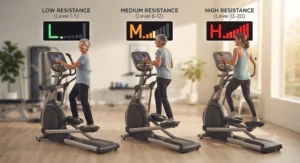
Schwinn managed to fit a genuinely long 18-inch stride into one of the smallest footprints in this category, with resistance dialing up to 16 levels on wide, stable pedals. It also includes wireless heart rate compatibility and Bluetooth tracking — features that, oddly, are missing from Schwinn’s own step-up model, which costs roughly $300 more.
The practical takeaway for arthritis shoppers: a smaller footprint doesn’t have to mean a compromised stride, and the 411 proves it. One tradeoff worth knowing before you buy: reviewers consistently note that the entry-level resistance setting isn’t especially gentle, so someone just starting a low-impact routine may find level one tougher than expected. If joint pain has you starting from a low fitness baseline, plan to ease in carefully rather than assuming “level one” will feel effortless.
Pros:
- ✅ Small footprint fits apartments and tight rooms
- ✅ Wireless heart rate and Bluetooth tracking included
- ✅ 10-year frame warranty backs the build quality
Cons:
- ❌ Entry-level resistance is tougher than expected
- ❌ 18″ stride may feel short for very tall users
At roughly $500-$700, this is a smart pick for anyone tight on space who still wants real stride length and legitimate warranty coverage.
7. Sunny Health & Fitness SF-E3865 Stride Zone — auto-adjusting resistance tied to heart rate
This model’s headline feature is computer-controlled magnetic resistance that reads your heart rate and adjusts automatically — easing off if your pulse climbs too high, and stepping up if you’re coasting too easily. It’s built around a generous 20-inch stride, a 44-pound flywheel, and 16 levels of motorized resistance, with non-slip pedals designed to keep your foot position consistent throughout the stroke.
Here’s the analytical case for this feature mattering specifically for arthritis: heart-rate-linked auto-resistance takes the guesswork out of “am I overdoing it today.” On a high-inflammation day, your heart rate climbs faster at lower effort, and the machine backs off automatically instead of you having to notice and self-correct mid-stride — which, if you’re distracted or fatigued, doesn’t always happen in time. The console also displays watts, RPM, and heart rate zones directly, so you can stay in a safe range without pairing a phone or app.
Pros:
- ✅ Auto-adjusting resistance responds to real-time heart rate
- ✅ 20″ stride is generous for the price tier
- ✅ Non-slip pedals help maintain consistent foot position
Cons:
- ❌ Motorized resistance adds another part that can fail
- ❌ Console app pairing has mixed setup reports
Typically priced $400-$600, this is the pick for data-driven users who want a built-in safety net rather than manually watching a heart rate strap.
Low Impact Elliptical for Arthritis Sufferers: What Makes It Different
Not every elliptical marketed as “low impact” earns the label, and that distinction matters enormously if you’re shopping specifically for arthritis relief. A genuinely low impact elliptical for arthritis sufferers keeps the flywheel heavy enough to smooth out the stride — lighter flywheels can feel jerkier at low resistance, which translates to more micro-shock transmitted up through the ankle and knee with every rotation.
Stride shape matters just as much as stride length. A true elliptical path is oval and continuous; cheaper machines sometimes produce a flatter, more angular path that changes direction abruptly at the top and bottom of the stroke — and that abruptness is exactly what a genuinely gentle machine is supposed to eliminate. If you can test a floor model before buying, pay attention to whether the motion feels like one continuous loop or like two separate pushes stitched together. The seated Cubii JR2 sidesteps this entirely by removing standing weight-bearing from the equation, while premium units like the Inspire Fitness CS3.1 Cardio Strider solve it with a longer, more deliberately engineered stride arc.
✨ Don’t Miss These Exclusive Deals!
🔍 Take your joint-friendly cardio routine to the next level with these carefully selected picks. Click on any highlighted product to check current pricing and availability — these machines can help you build a gentler, more sustainable workout habit your body will thank you for.
Anti-Inflammatory Exercise Equipment: How Ellipticals Fit Into Joint Health
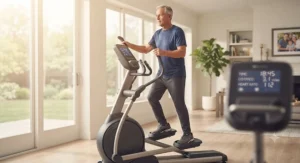
“Anti-inflammatory exercise equipment” isn’t a regulated category — no machine reduces inflammation by itself — but ellipticals earn a place in that conversation because of what regular, moderate use does for joint health over time. Since your feet stay supported on the pedals rather than lifting and landing, your joints absorb far less repeated impact than they would during walking or jogging. Exercise won’t regrow cartilage that’s already been lost, but consistent movement genuinely helps people feel better and move more freely, a point echoed by Cleveland Clinic’s guidance on arthritis exercise.
The mechanism worth understanding: moderate aerobic movement increases circulation to joint tissue, which helps deliver oxygen and nutrients to the muscles and ligaments actually doing the work of stabilizing an arthritic joint. That improved circulation is part of why cardio equipment shows up so often in joint-health recommendations, alongside the simple fact that any resulting weight loss reduces the mechanical load your joints carry every single day. None of that is instant. It’s a slow-building benefit that shows up over weeks of consistent, gentle sessions — not a single workout.
Practical Usage Guide: Setting Up Your Elliptical for Joint-Friendly Success
Buying the right machine is half the equation; using it correctly is the other half, and this is the part most product listings skip entirely.
Start with placement and warm-up. Avoid jumping straight into a workout first thing in the morning or right after hours spent at a desk — loosen up stiff joints with a few simple stretches first, and consider a short walk before you climb on. Cold joints are stiffer joints, and stiffer joints move less efficiently through a stride, which paradoxically increases strain in the first few minutes of any session.
Next, dial in resistance conservatively. Most arthritis-friendly machines on our list offer 8 to 40 resistance levels — start at the lowest setting for your first two weeks regardless of how easy it feels, and increase by one level per week rather than jumping around. This isn’t about being cautious for its own sake; it lets you isolate whether a new twinge came from the machine setting or from something else entirely, which matters if you’re tracking symptoms for a doctor.
Footwear deserves more attention than it usually gets. Stiffness and pain can throw off your gait and posture, so supportive, well-fitted shoes rather than worn-out sneakers or bare feet help keep your stride mechanically sound. In the first 30 days, the most common mistake reported by new owners is skipping the warm-up because “it’s just an elliptical, how hard can it be” — and that single shortcut is behind most of the early soreness complaints we found across every price tier.
Maintenance is minimal but not optional: wipe down rail tracks monthly, check pedal bolts for looseness every few weeks (a loose pedal changes your foot angle without you noticing), and keep the flywheel area free of dust, which can introduce subtle resistance inconsistency over time.
Problem → Solution: Fixing Common Elliptical Pain Points for Arthritic Joints
Problem: Knee soreness after the first few sessions. This is usually a resistance-too-high issue, not a machine-too-hard issue. Drop back two levels and extend your warm-up to five full minutes before you judge whether the machine itself is the problem.
Problem: Hip discomfort during longer sessions. Check your stride length against your height — a stride that’s too long for a shorter user (or too short for a taller one) forces unnatural hip rotation. The Sole E25 and Sunny Health & Fitness SF-E3865 both offer 20-inch strides that suit average-to-tall users better than compact 18-inch machines.
Problem: Can’t tolerate standing long enough for a full session. This is precisely the gap the Cubii JR2 and Inspire Fitness CS3.1 Cardio Strider are built to fill — one removes standing entirely, the other supports your back while you stand-adjacent in a recumbent seat.
Problem: Flare-day motivation drops to zero. Keep the bar low on bad days. A 5-minute session at your lowest resistance still counts, and machines with auto-adjusting resistance, like the Sunny Health & Fitness SF-E3865, make it easier to move safely without having to think hard about settings.
Problem: Boredom kills consistency within a month. Machines with incline and decline capability, like the NordicTrack AirGlide 16, give you built-in variety without needing a second piece of equipment.

Building an Arthritis Management Workout Around Your Elliptical
An arthritis management workout isn’t about maximizing calorie burn — it’s about consistency over intensity. Non-weight-bearing equipment like ellipticals opens the door to interval-style training that would otherwise be off-limits for a lot of arthritis sufferers, though anyone experiencing a flare or increased inflammation should stick to lower-intensity sessions rather than pushing through discomfort.
A realistic weekly structure looks like this: three to four elliptical sessions of 15-25 minutes at low-to-moderate resistance, spaced with rest days in between rather than stacked back to back. Timing matters — schedule sessions for when you’re least likely to be dealing with stiffness, and consider some gentle warmth on sore joints, like a warm shower, before you start rather than relying on ice mid-workout. Pair your elliptical sessions with basic flexibility work — a few minutes of gentle stretching — since cardio alone doesn’t address the range-of-motion side of arthritis management. Harvard Health’s guidance on exercising with arthritis makes a similar point about pairing aerobic activity with stretching and strength work rather than relying on any single exercise type.
Track how you feel, not just how far you went. A workout that leaves you more mobile for the rest of the day is a win, even if the distance readout is modest. Trying to “push through” a session that’s clearly aggravating a joint tends to backfire over the following 24 to 48 hours, which is the opposite of the sustainable habit you’re actually trying to build.
Your Buyer’s Decision Framework: Which Elliptical Fits Your Joints?
Use this as a simple filter rather than agonizing over every spec sheet.
If you can’t tolerate standing for more than a few minutes, choose the Cubii JR2 because it removes weight-bearing entirely while still giving you a trackable, low-impact movement habit.
If your arthritis is moderate but back pain complicates standing workouts, choose the Inspire Fitness CS3.1 Cardio Strider because the recumbent seat solves both problems in one machine.
If you want strong stability and predictable cost with no surprises, choose the Horizon EX-59 because its rock-solid frame minimizes the stabilizing-muscle strain that aggravates sore joints.
If you’re tight on space but still want real stride length, choose the Schwinn 411 because it delivers an 18-inch stride in one of the smallest footprints available.
If you want long-term adjustability and don’t mind a bigger investment, choose the NordicTrack AirGlide 16 or the Sole E25, since incline flexibility lets you redistribute joint load as your needs change over time.
How to Choose the Best Elliptical for Arthritis
What is the best elliptical for arthritis? In short: it’s a low-impact machine with a heavy, smooth flywheel, an adjustable stride between 18 and 20 inches, and either a stable upright frame or a supportive seat — features that together minimize the jolt transmitted through your knees, hips, and ankles during each stride.
Here’s how to apply that in practice when you’re actually comparing listings:
- Match stride length to your height first. Shorter users generally do better with 16-18 inch strides; taller users benefit from 20 inches or adjustable options.
- Prioritize flywheel weight over resistance-level count. A heavier flywheel (20+ pounds) smooths the motion more than having 40 resistance settings you’ll rarely use.
- Decide standing versus seated based on your worst days, not your best ones. If flares regularly make standing hard, a seated or recumbent option is the honest choice.
- Check the weight capacity against your actual weight, with margin. A machine rated right at your body weight will feel less stable and wear faster than one with real headroom.
- Look for adjustable incline if you want joint-load variety. Shifting incline redistributes stress between hips and knees without switching machines.
- Read the warranty terms, not just the length. A 10-year frame warranty with a 90-day labor window still means you’re paying for a technician visit if something breaks in year three.
- Confirm return and trial windows before buying. Comfort is deeply personal, and even a well-reviewed machine can feel wrong for your specific joints until you’ve tried it.
Common Mistakes When Buying an Elliptical for Arthritis
The single biggest mistake is buying based on resistance-level count alone. A machine boasting 40 levels sounds impressive, but if the flywheel is light and the stride path is choppy, those 40 levels are just fine gradations of a fundamentally rougher motion — quantity doesn’t fix quality.
The second mistake is ignoring stride length relative to height, which we’ve already covered but bears repeating because it’s the most common source of post-purchase regret in owner reviews. The third is skipping the return policy. Comfort on an elliptical is genuinely personal — what feels smooth to one arthritic knee can feel subtly wrong to another, and no amount of spec-reading substitutes for actually striding on the thing.
Finally, shoppers frequently underestimate footprint and ceiling height, especially with recumbent or incline-capable machines like the Inspire Fitness CS3.1 Cardio Strider or NordicTrack AirGlide 16, only to discover during assembly that the unit doesn’t comfortably fit the intended room.
Elliptical vs Recumbent Bike for Arthritis: Which Wins?
Both are legitimately low-impact, but they load your joints differently, and the right answer depends on which joint bothers you most.
| Factor | Elliptical | Recumbent Bike |
|---|---|---|
| Joint impact | Minimal, gliding motion | Minimal, seated pedaling |
| Best for | Knee, hip, ankle arthritis | Hip, lower back, balance issues |
| Muscle engagement | Full body (with moving handles) | Primarily lower body |
| Standing required | Usually yes (except seated models) | No |
A recumbent bike removes gravity-driven joint compression almost entirely since you’re seated the whole time, which makes it a strong option if balance or lower back pain is your primary concern. An elliptical, by contrast, keeps you upright and weight-bearing in a gentler way, which does more for bone density and full-body conditioning — a real consideration since arthritis sufferers are often advised to guard against the muscle loss that compounds joint problems over time. If knees and hips are your main issue and standing is tolerable, the elliptical generally wins; if balance or lower back pain dominates, lean toward a recumbent bike or the seated Cubii JR2.
What to Expect: Real-World Performance on Arthritic Knees and Hips
Specs are one thing; how a session actually feels is another. Because your foot never leaves the pedal throughout the stride cycle, the load on your knee joint gets spread out across the whole movement instead of concentrating at a single strike point — for anyone with localized cartilage damage or bone-on-bone areas, that difference can decide whether a session is tolerable or not.
In practice, most new users report the first two weeks feel harder on the joints than expected, purely because muscles supporting the joint are being asked to stabilize a new movement pattern. That typically eases by week three or four as those supporting muscles adapt. It’s worth remembering that an elliptical is best treated as a maintenance and rehabilitation tool rather than something to reach for immediately after an acute injury, a fresh ligament tear, or significant joint swelling — those situations generally call for a period of rest first. If you’re managing a flare rather than chronic baseline arthritis, that’s the moment to dial resistance down to its floor or switch to a seated option for a few days.
Long-Term Cost & Maintenance for Arthritis-Friendly Ellipticals
| Product | Upfront Price Range | Ongoing Costs | 5-Year Value Verdict |
|---|---|---|---|
| Cubii JR2 | $200-$280 | None required | Lowest total cost, limited stimulus |
| Schwinn 411 | $500-$700 | None required | Strong value, basic feature set |
| Sole E25 | $900-$1,300 | None required | Best cost-to-adjustability ratio |
| NordicTrack AirGlide 16 | $1,800-$2,200 | Optional coaching subscription | Highest ceiling, ongoing cost |
The pattern here is straightforward: machines without subscription requirements have a lower, predictable total cost of ownership, while the NordicTrack AirGlide 16‘s value depends heavily on whether you actually use the paid coaching programs or let them lapse. Maintenance costs across all seven products are modest — expect an occasional bolt tightening and lubrication, not recurring repair bills, provided you’re not skipping the basic upkeep covered in our usage guide above. Over five years, the Sole E25 offers the strongest middle-ground return: no subscription drag, real adjustability, and a lifetime frame warranty that protects the biggest-ticket failure point.
Safety, Regulations & Doctor Guidance Before You Start
The right exercise depends heavily on which type of arthritis you have and which joints are affected, and a physical therapist or other member of your care team can help you choose an approach that’s genuinely safe for your specific situation rather than a generic recommendation. That’s not boilerplate advice; osteoarthritis, rheumatoid arthritis, and post-surgical joint changes all respond differently to load and repetition, and a machine that’s ideal for one may not suit another. Mayo Clinic’s overview of exercise and arthritis makes the same point: the best exercises depend on your specific diagnosis, and a healthcare professional should help you select what’s safe.
Before starting any new elliptical routine, especially at higher intensities, talk to your doctor first, then proceed slowly — no more than one higher-intensity session per week to start, paying close attention to how your body responds rather than pushing through pain. A physical therapist can also help you identify exactly what’s appropriate for your stage of disease, since knee and hip osteoarthritis range from mild to bone-on-bone severity, and what’s safe varies enormously across that range. None of the products in this guide are medical devices, and no elliptical purchase should replace a conversation with your physician about your specific joints.
FAQ
❓ Is an elliptical really better than a treadmill for arthritis?
❓ How many resistance levels do I actually need for arthritis?
❓ Can a seated elliptical like the Cubii replace a standing one?
❓ How long should an arthritis-friendly elliptical session last?
❓ Do I need a doctor's approval before starting elliptical workouts?
Conclusion
There’s no single best elliptical for arthritis that fits every joint and every flare pattern — that’s the honest takeaway after digging through the specs, the owner reviews, and the clinical guidance behind this guide. What’s clear is that the mechanics matter more than the marketing: a smooth, heavy flywheel, a stride length matched to your height, and either genuine stability or genuine seated support will do more for your knees than a longer feature list ever will.
If you want the gentlest possible entry point, the Cubii JR2 removes standing from the equation entirely. If comfort and back support matter as much as the cardio itself, the Inspire Fitness CS3.1 Cardio Strider earns its premium price. And if you’re looking for the best all-around value with real adjustability, the Sole E25 and Horizon EX-59 both deliver without asking you to spend two grand to find out whether an elliptical actually helps. Whichever you choose, start slow, warm up properly, and let consistency — not intensity — do the heavy lifting for your joints over time.
✨ Ready to find your fit? Compare the picks above one more time, check current pricing, and pick the machine that matches your worst days, not just your best ones.
Recommended for You
- Elliptical Machine After Knee Surgery: 7 Best Picks for 2026
- 7 Best Elliptical for Joint Pain Picks in 2026
- Medical Grade Elliptical Machine: 7 Best Picks for 2026
Disclaimer: This article contains affiliate links. As an Amazon Associate, I earn from qualifying purchases. If you purchase products through these links, we may earn a small commission at no additional cost to you.
✨ Found this helpful? Share it with your friends! 💬🤗
