
In This Article
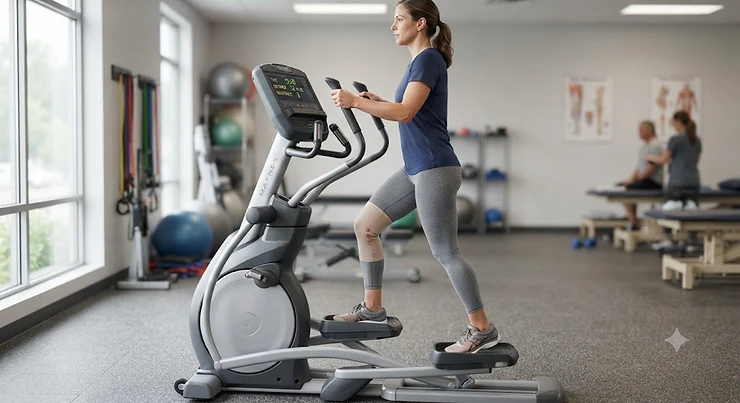
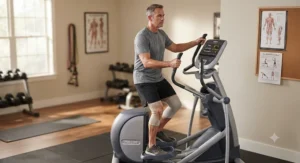
Six weeks after surgery, most people aren’t thinking about “getting back in shape.” They’re thinking about getting up off the couch without wincing. That’s the strange, in-between phase where an elliptical machine after knee surgery starts to look less like fitness equipment and more like a rehab tool with wheels.
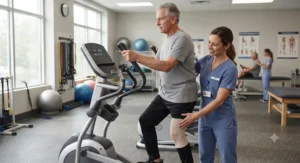
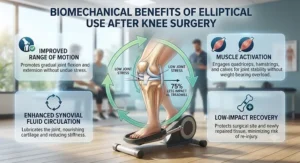
Here’s the short answer: an elliptical machine after knee surgery is a piece of low-impact cardio equipment that lets your surgically repaired joint move through a smooth, closed-chain motion — no ground impact, no sudden stops — so you can rebuild cardiovascular fitness and leg strength without risking the implant or incision. It’s not a replacement for physical therapy. It’s the thing you do between PT sessions, on the days your therapist isn’t watching.
According to OrthoInfo, the patient education arm of the American Academy of Orthopaedic Surgeons, low-impact activities like walking, swimming, and elliptical training are specifically named as appropriate long-term exercise after a knee replacement — while running, jumping, and other high-impact sports are generally discouraged for the life of the implant. That single fact is why this category of machine has quietly become one of the most searched pieces of home fitness equipment among post-op patients over 50.
This guide covers seven real machines — from $150 under-desk pedalers to $4,000 clinical-grade recumbent trainers — and breaks down exactly which one fits your stage of recovery, your budget, and your surgeon’s restrictions. We’ll also get into elliptical after hip replacement considerations, since a surprising number of readers land here after a different joint entirely, and the buying logic overlaps more than you’d expect.
Quick Comparison Table: Elliptical Machines for Surgery Recovery
Before we go deep on all seven, here’s the 30-second version.
| Product | Type | Best For | Price Range |
|---|---|---|---|
| Sunny Health & Fitness SF-E3872 | Under-desk pedaler | Bed/chair-bound early recovery | Around $150-$200 |
| Cubii JR2 | Seated under-desk elliptical | Desk workers easing back in | $200-$280 range |
| Teeter FreeStep LT1 | Recumbent cross trainer | Zero-impact full-body cardio | $700-$900 range |
| HCI PhysioStep LXT | Clinical recumbent linear trainer | Surgeon-grade rehab at home | $3,400-$4,300 range |
| Schwinn 411 | Compact standing elliptical | Small spaces, later-stage recovery | Around $500 |
| Sole E25 | Standard standing elliptical | Low step-up, returning to fitness | $900-$1,100 range |
| NordicTrack AirGlide 7i | Standing elliptical w/ incline | Advanced recovery, long-term use | $1,300-$2,200 range |
Looking at the table, the split isn’t really budget versus premium — it’s mobility stage. The Sunny Health & Fitness SF-E3872 and Cubii JR2 exist for the weeks when standing up for ten minutes is still a project. The Teeter FreeStep LT1 and HCI PhysioStep LXT bridge you into standing tolerance without ever leaving a seat. The Schwinn 411, Sole E25, and NordicTrack AirGlide 7i are for once your surgeon has cleared full weight-bearing standing exercise, whether that’s week six or month six.
💬 Found the stage that matches yours? Scroll down for the full breakdown — or jump straight to the comparison table below.
Top 7 Elliptical Machines for Knee Surgery Recovery: Expert Analysis
1. Sunny Health & Fitness SF-E3872 — most affordable option for bed-to-chair recovery
The standout here is simple: this is a pedaler you can use while lying in bed with your leg propped up, which most “ellipticals” simply can’t do. It’s a magnetic, belt-driven pedal exerciser measuring roughly 24″ x 19″ x 11″ and weighing about 24 pounds, with 8 levels of tension adjustment and a digital monitor tracking time, speed, distance, and calories.
What most buyers overlook about this category is that it isn’t trying to be a real elliptical — it’s a circulation and range-of-motion tool disguised as one, and that’s exactly its value in week one or two post-op, when OrthoInfo’s own hip and knee guides recommend frequent gentle ankle and leg movement to reduce swelling and clot risk. Reviewers consistently report that it’s whisper-quiet and easy to position under a recliner or bed frame, which matters when you can’t easily bend down to adjust equipment yourself. A few users note it can slide on hardwood floors under higher resistance, and one reviewer specifically mentioned it being a manageable option for an elderly parent recovering from surgery who wanted to keep blood moving without leaving a chair.
Pros:
- ✅ Usable from bed, recliner, or wheelchair
- ✅ Extremely lightweight and portable at ~24 lbs
- ✅ Whisper-quiet magnetic resistance
Cons:
- ❌ Can slide on smooth flooring at higher tension
- ❌ Too gentle to serve as your only long-term machine
Priced around $150-$200, the Sunny Health & Fitness SF-E3872 is the lowest-risk purchase on this list — it’s the machine you buy for the first month, not the machine you keep for the next ten years.
2. Cubii JR2 — best all-around seated elliptical for the return to your desk
The Cubii JR2‘s standout feature is that it’s the most-reviewed under-desk elliptical on the market, which means its 8 magnetic resistance levels have been stress-tested by an enormous number of post-surgery users, not just healthy people looking to fidget less at work.
Built from glass-filled nylon and about 25% lighter than the prior generation, the JR2 pairs a full elliptical foot path (rather than a simple pedal circle) with an LCD monitor tracking strides, distance, minutes active, and calories — and Sunny/Cubii’s own materials note it activates over 50% of your body’s major muscle groups while seated. What most buyers overlook is that the elliptical motion, not a circular pedal path, better mimics the gait pattern physical therapists want you retraining after knee surgery, which is why several reviewers specifically mention using it during at-home rehab. Reviewers with arthritis or joint replacements consistently report noticing more flexibility after regular use, and one Best Buy reviewer described buying it specifically for severe knee and hip arthritis and finding real improvement in joint mobility. The main complaint across reviews is weight — at roughly 19-27 pounds depending on the exact configuration, it’s portable but not featherlight, and it’s a bit heavy to lift with one hand while you’re still favoring a leg.
Pros:
- ✅ True elliptical gait path, not a circular pedal motion
- ✅ Free Cubii Studio+ app with instructor-led sessions
- ✅ Attachable chair lock keeps your seat from rolling
Cons:
- ❌ Heavier than competing under-desk pedalers
- ❌ Provides less muscle challenge than standing exercise
At $200-$280 range, the Cubii JR2 earns its reputation as the best elliptical for recovery among seated options — it’s the machine most likely to become a permanent fixture under your desk long after the surgery is behind you.
3. Teeter FreeStep LT1 — best zero-impact full-body recumbent trainer
What sets the Teeter FreeStep LT1 apart is its patented natural stride, licensed from commercial physiotherapy steppers — this isn’t a home-fitness knockoff of clinical technology, it’s a scaled-down version of the real thing.
The LT1 combines a reclining, height-adjustable seat with synchronized handles and pedals, so your arms and legs move together in a linear, gliding stepping motion rather than a jarring up-and-down. Thirteen levels of magnetic resistance (0-110 lb of tension) mean the same machine can serve you on a low-energy day two weeks post-op and still challenge you six months later. Here’s what the spec sheet won’t tell you, but the design implies: because the seat fully supports your back and hips, there’s essentially no balance requirement, which matters enormously if you’re still using a cane or worried about a fall reinjuring the joint. Teeter’s own consumer perception survey found 93% of participants reported less stress on their knees and back compared with other cardio equipment, and buyers consistently describe the assembly as manageable in about an hour with the included BILT app instructions. The most common gripe is that, being recumbent, it takes up a fairly large footprint (about 54″ x 38″) for what feels like a modest-looking machine.
Pros:
- ✅ Zero-impact recumbent seated position
- ✅ Engages arms and legs simultaneously for full-body cardio
- ✅ 13 resistance levels support early rehab through general fitness
Cons:
- ❌ Larger footprint than its compact appearance suggests
- ❌ Basic console lacks the touchscreens of premium ellipticals
In the $700-$900 range, the Teeter FreeStep LT1 is a strong gentle recovery workout machine pick for anyone who wants one piece of equipment to carry them from week three all the way through a full return to fitness.
4. HCI PhysioStep LXT — surgeon recommended exercise equipment for serious rehab
The HCI PhysioStep LXT stands out because it’s genuinely built for clinics first, homes second — it shows up in physical therapy offices and cardiac rehab centers, not just living rooms.
Its defining feature is a 2:1 contralateral linear stepping motion (your legs move in a natural walking rhythm rather than a circular ellipse) paired with an oversized 20″ seat that rotates a full 360 degrees and adjusts across a 24″ range — a detail that matters more than it sounds, because it means the seat can be positioned for easy, low-transfer entry rather than requiring you to swing a surgical leg over a fixed frame. Based on the spec comparison with home-market machines like the Teeter FreeStep, the PhysioStep line’s 9″ LCD console and support for interval, hill, and heart-rate-controlled programs reflect commercial-grade engineering rather than consumer defaults. Reviewers on rehab-focused retail sites are notably candid about why they bought it: one described using it after knee surgery specifically because it cost less than a comparable NuStep and “works really well,” while another mentioned recovering from a leg amputation and finding it more supportive than cheaper alternatives. If there’s a catch, it’s the price and footprint — this is commercial equipment, and it looks and costs like it.
Pros:
- ✅ Fully rotating, low-transfer swivel seat
- ✅ Used in real PT clinics and cardiac rehab centers
- ✅ Extensive program library including heart-rate-controlled workouts
Cons:
- ❌ Premium price compared to home-market recumbent trainers
- ❌ Larger, heavier unit requiring dedicated floor space
At $3,400-$4,300 range, the HCI PhysioStep LXT is the machine to consider if your surgeon has specifically mentioned transitioning “from physical therapy to home exercise” — it’s designed for exactly that handoff.
5. Schwinn 411 — best compact standing elliptical once you’re cleared to stand
The Schwinn 411‘s standout feature is a genuinely surprising 18-inch stride length for a machine that costs a fraction of most standing ellipticals — most competitors at this price only manage 12-14 inches.
With 16 resistance levels, both static and moving handlebars (the static set has contact heart-rate sensors), and a step-up height around 9 inches, the 411 is compact enough for an apartment but still delivers the longer, more natural stride your knee needs once you’ve moved past seated or recumbent equipment. Based on the spec comparison, that stride length is the single biggest reason physical therapists like standing ellipticals over shorter-stride budget models — a cramped stride forces more knee flexion per stroke, which is the opposite of what you want in months two through six of recovery. Reviewers consistently praise the Bluetooth heart-rate tracking and the Explore the World app pairing, and several specifically mention it as a good “starter” standing elliptical for smaller home gyms. The tradeoff for the compact frame and low price is a lighter-duty flywheel system than you’d find on machines twice its cost, and a fairly basic backlit display compared to touchscreen competitors.
Pros:
- ✅ 18-inch stride, unusually long for the price point
- ✅ Bluetooth wireless heart-rate compatible
- ✅ Compact footprint fits smaller spaces
Cons:
- ❌ Lighter flywheel than premium standing ellipticals
- ❌ Basic display lacks touchscreen or app-driven resistance
Around $500, the Schwinn 411 is the budget entry point for standing elliptical training — a reasonable “first standing machine” once your surgeon signs off on full weight-bearing cardio.
6. Sole E25 — best low step-up elliptical for returning to fitness
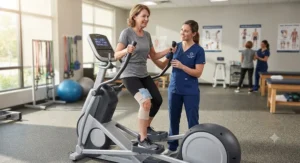
The Sole E25‘s standout advantage is its notably low 14-inch step-up height combined with a 20-inch stride — a rare combination that makes mounting and dismounting easier on a joint that’s still regaining full flexion.
Designed in collaboration with a physical therapist, the E25’s foot pedals sit at a 2-degree inward slope specifically to reduce ankle and knee stress, and its four-rail rear-wheel design minimizes the side-to-side pedal wobble that can feel unstable on cheaper units. What most buyers overlook is that the 20-level power incline isn’t just a “more burn” feature — angling the ramp changes which muscles absorb the load stride to stride, letting you (with your surgeon’s input) shift work away from a still-healing knee and toward hips and glutes on harder days. Reviewers describe it as especially comfortable for smaller or shorter users thanks to its narrower pedal stance and padded handles, and the lifetime frame and brake warranty comes up repeatedly as a reason buyers felt comfortable spending close to four figures on a “basic” elliptical. The tradeoff is size: at 70″ x 24″ x 70″, it’s a large machine that needs real floor space and roughly 8-foot ceilings for comfortable clearance.
Pros:
- ✅ Low 14-inch step-up height eases entry and exit
- ✅ Physical-therapist-informed pedal design reduces joint stress
- ✅ Lifetime warranty on frame and resistance brake
Cons:
- ❌ Large footprint requires a dedicated exercise space
- ❌ No touchscreen; console is deliberately basic
In the $900-$1,100 range, the Sole E25 is arguably the best elliptical for recovery among full-size standing machines — the low step-up height alone solves a real problem most standing ellipticals ignore.
7. NordicTrack AirGlide 7i — best premium pick for long-term recovery and beyond
The NordicTrack AirGlide 7i stands out for its -5% to 15% incline and decline range, a feature almost no other elliptical in its price class offers, paired with a 7″ HD touchscreen running iFIT’s trainer-led programming.
An auto-adjustable 17.8″ to 18.5″ stride, 22 levels of silent magnetic resistance, and a 25-pound flywheel combine to produce a notably smooth ride, while the SmartAdjust and ActivePulse features can automatically moderate incline and speed to keep your heart rate in a target zone — genuinely useful if your cardiologist or PT has given you specific heart-rate guidance during recovery. Here’s what the spec sheet won’t tell you, but the design implies: the decline setting specifically targets the hamstrings rather than the quads and glutes that incline emphasizes, giving you a way to vary which muscle groups absorb load on days your knee feels more sensitive. Reviewers and testers consistently flag the 7″ touchscreen as smaller and dimmer than they’d like compared to NordicTrack’s own 14i and 16i models, and note there’s no separate device tray if you’d rather stream your own content instead of iFIT. The iFIT subscription (billed monthly) is effectively required to unlock the automatic incline and trainer-led features, which is worth factoring into your total cost of ownership.
Pros:
- ✅ Auto-adjusting incline and decline for varied muscle loading
- ✅ ActivePulse heart-rate-zone automation
- ✅ Smooth, quiet 25-lb flywheel with auto-adjustable stride
Cons:
- ❌ Full smart features require an ongoing iFIT subscription
- ❌ Touchscreen is smaller than higher-tier NordicTrack models
At $1,300-$2,200 range depending on promotions, the NordicTrack AirGlide 7i is the machine to grow into — it’s overkill for week four post-op, but it’s the one you won’t outgrow by year two.
Top 7 Products: Full Spec Comparison
| Product | Stride/Motion | Resistance Levels | Best For | Price Range |
|---|---|---|---|---|
| Sunny Health & Fitness SF-E3872 | Circular pedal | 8 | Bed/chair-bound recovery | $150-$200 |
| Cubii JR2 | Elliptical, seated | 8 | Desk-based rehab | $200-$280 |
| Teeter FreeStep LT1 | Linear recumbent | 13 | Zero-impact full body | $700-$900 |
| HCI PhysioStep LXT | 2:1 linear recumbent | Multiple + programs | Clinical-grade rehab | $3,400-$4,300 |
| Schwinn 411 | 18″ standing stride | 16 | Compact standing entry | Around $500 |
| Sole E25 | 20″ standing stride | 20 | Low step-up standing | $900-$1,100 |
| NordicTrack AirGlide 7i | Auto stride + incline | 22 | Long-term progression | $1,300-$2,200 |
This side-by-side makes the progression obvious: resistance levels and stride length climb steadily as you move from the Sunny Health & Fitness SF-E3872 toward the NordicTrack AirGlide 7i, which roughly tracks how recovery itself unfolds. Notice that price doesn’t scale purely with “how advanced” a machine is — the HCI PhysioStep LXT costs more than the standing ellipticals not because it’s more capable in a fitness sense, but because it’s built to commercial durability standards for clinics. If you’re buying for a specific rehab timeline rather than long-term general fitness, that’s an important distinction to weigh before spending clinic-level money on a home unit.
💬 Just one click — help others make better buying decisions too!😊
Your First 30 Days: A Practical Elliptical Usage Guide After Surgery
Setup matters more than people expect. Place any seated or recumbent unit on a hard, level surface (not carpet, which lets units rock slightly) and, if you’re using an under-desk pedaler like the Cubii JR2 or Sunny Health & Fitness SF-E3872, engage the chair-anchor feature every single time — a rolling chair under load is a genuine fall risk in the first few weeks.
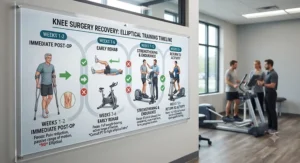
Start absurdly short. Two to five minutes, two or three times a day, is a legitimate starting dose for the first week your surgeon clears movement — this mirrors the “2 to 3 minutes, several times an hour” pacing OrthoInfo’s own knee exercise guides recommend for early ankle and leg motion. Resistance should feel almost too easy; the goal in week one isn’t burn, it’s blood flow and joint lubrication. A common first-30-days mistake is judging progress by resistance level instead of consistency — five short sessions a day beats one long session, both for swelling control and for rebuilding the habit of moving. By week three or four, most cleared patients can extend sessions to 10-15 minutes and begin nudging resistance up by one level every few days, always stopping short of sharp pain (some post-op soreness is normal; stabbing or swelling that worsens after exercise is not).
Maintenance is simple but often skipped: wipe down seats and handles after use, check under-desk units for chair-anchor wear monthly, and re-tighten any visible bolts on standing ellipticals after the first 20-30 uses, since new frames settle. Log your minutes somewhere — even a phone note — because that log is exactly what your surgeon or PT will want to see at your follow-up.
Real Recovery Scenarios: Matching the Machine to the Patient
Consider three realistic profiles. First, a 62-year-old retiree three weeks post total knee replacement, living alone, cleared only for seated movement: the Sunny Health & Fitness SF-E3872 or Cubii JR2 fits, since both can be used from a chair with minimal setup and no standing balance requirement — exactly the low-risk profile a solo recovery calls for.
Second, a 45-year-old remote worker eight weeks post-op, cleared for light standing activity but still favoring the leg on stairs: the Teeter FreeStep LT1 bridges the gap nicely, letting them build standing tolerance in a supported seated position before committing to a fully standing elliptical, especially useful given a full workday of sitting followed by an evening session. Third, a 38-year-old former recreational runner five months post-op, cleared for unrestricted low-impact cardio and eager to rebuild real cardiovascular capacity: the Sole E25 or NordicTrack AirGlide 7i makes more sense here, since the longer stride and incline range give room to actually train, not just rehab, and match someone whose environment (dedicated home gym space, budget for a bigger machine) supports it.
The pattern across all three: budget and timeline aside, the deciding factor is almost always current standing tolerance and fall risk, not overall fitness ambition.
Solving the Most Common Post-Surgery Elliptical Problems
Problem: Pain during use, not just soreness after. Stop immediately and reduce resistance to the lowest level or switch to a seated option like the Cubii JR2 for a few days before retrying; sharp in-motion pain is a signal to dial back, not push through.
Problem: Difficulty balancing on a standing elliptical early in recovery. This usually means you’ve moved to standing equipment too soon — a recumbent option such as the Teeter FreeStep LT1 removes the balance requirement entirely while still building the same muscles.
Problem: Swelling that increases after sessions. Shorten sessions rather than skipping them; OrthoInfo and general post-op guidance both point toward frequent short movement plus leg elevation and icing afterward, rather than eliminating activity.
Problem: Boredom killing consistency. Machines with app integration, like the Cubii JR2‘s Studio+ program library or the NordicTrack AirGlide 7i‘s iFIT workouts, meaningfully help adherence in the slow middle months of recovery when progress feels invisible.
Problem: A machine that felt fine at 6 weeks now feels too easy at 6 months. This is a good problem — it usually means it’s time to graduate from a seated or recumbent unit toward a standing elliptical with a longer stride, assuming your surgeon agrees.
How to Choose the Best Elliptical for Recovery
Picking the best elliptical for recovery comes down to matching the machine to where you actually are, not where you hope to be in a month. Here’s the process, step by step:
- Confirm your surgeon’s current activity clearance first. Nothing on this list should be used before you have explicit clearance for the type of motion involved — seated, standing, or weight-bearing.
- Assess your current standing tolerance honestly. If standing more than a couple of minutes is uncomfortable, a seated or recumbent machine is the right starting category, full stop.
- Check the step-up height on any standing model. Lower step-up heights, like the 14 inches on the Sole E25, reduce the single hardest motion — the initial mount — for a still-recovering knee.
- Prioritize stride length appropriate to your height, not the longest available. A stride too long for your leg length forces overextension; check manufacturer height charts before buying.
- Weigh resistance range against where you’ll be in six months, not just today. A machine with only a handful of resistance levels can feel limiting once you’re stronger.
- Factor in footprint and floor surface. Recumbent trainers and full-size ellipticals need real space and a hard, level floor; apartment dwellers should measure first.
- Decide whether app-driven programming actually matters to you. It genuinely helps some people stay consistent and is irrelevant to others — don’t pay for iFIT or Bluetooth features you won’t use.
Elliptical After Hip Replacement: What’s Different From Knee Recovery
A meaningful share of readers researching an elliptical machine after knee surgery are actually recovering from hip surgery, and the buying logic shifts in a few specific ways. OrthoInfo’s guide to activities after hip replacement lists specific hip precautions in early recovery — commonly avoiding crossing the legs at the knees and not raising the knee above hip height — that directly affect which machines are appropriate.
This matters for seat height and pedal path. A recumbent machine like the Teeter FreeStep LT1 or HCI PhysioStep LXT, both with adjustable, often reclining seats, generally lets you keep hip flexion within a safer range than a standard seated pedaler with a fixed, lower seat position. On a standing elliptical, the concern flips: hip precautions make the initial mounting motion (swinging a leg over a center bar) more relevant than knee flexion is, which is exactly why the low step-up height on machines like the Sole E25 matters just as much for hip patients as knee patients — arguably more, since a wide stepping-over motion can violate common hip precautions. Reviewers on rehab-focused sites specifically mention using recumbent steppers after a broken hip or hip surgery for this exact reason, describing the seated, low-transfer entry as easier to manage than a fixed-frame standing machine.
The honest takeaway: for elliptical after hip replacement specifically, ask your surgeon about your individual hip precautions before choosing between seated and standing categories, since the “right” answer depends more on your specific precautions than on general fitness level.
Post-Op Cardio Equipment vs. Traditional Rehab Alternatives
Elliptical machines aren’t the only post-op cardio equipment option, and it’s worth knowing how they stack up against the alternatives your PT might also suggest.
| Equipment Type | Joint Impact | Balance Demand | Typical Setting |
|---|---|---|---|
| Elliptical (seated/recumbent) | Very low | Minimal | Home, clinic |
| Elliptical (standing) | Low | Moderate | Home, gym |
| Recumbent bike | Very low | Minimal | Home, clinic |
| CPM (continuous passive motion) machine | None (passive) | None | Home, early post-op |
| Treadmill (cushioned deck) | Moderate | High | Home, gym |
The analysis here matters more than the table alone: a CPM machine moves your joint for you in the first days after surgery and isn’t a cardio tool at all, while a recumbent bike shares the low-impact, low-balance profile of a recumbent elliptical like the Teeter FreeStep LT1 but skips the upper-body engagement an elliptical provides. Cushioned treadmills remain the highest-impact, highest-balance-demand option on this list, which is exactly why most surgeons push patients toward elliptical or recumbent bike training well before treadmill walking becomes a fitness focus rather than a mobility one. A peer-reviewed study in PMC on active ankle movement after orthopedic surgery found measurably better venous outflow and blood rheology in patients who performed regular active leg movement compared with those who didn’t — a reminder that the cardio-equipment category you choose matters less than simply choosing one and using it consistently.
Common Mistakes When Buying Recovery Cardio Equipment
The single most common mistake is buying based on where you’ll be in six months rather than where you are now — a NordicTrack AirGlide 7i sitting unused in week two post-op because standing that long isn’t realistic yet is a wasted investment, at least temporarily.
A close second is skipping the step-up height and stride-length specs entirely in favor of brand recognition; a well-known name doesn’t guarantee the geometry fits a still-limited range of motion. Buyers also frequently underestimate footprint, ordering a full-size standing elliptical like the Sole E25 into a room that can’t actually accommodate its 70-inch length plus safe clearance. On the flip side, some buyers overspend on clinical-grade equipment like the HCI PhysioStep LXT when a home-market recumbent trainer would have served the same recovery window at a quarter of the cost — that machine earns its price for genuine long-term or multi-user clinical use, not necessarily for one person’s single recovery. Finally, don’t ignore return policies: post-op needs change fast, and a machine that’s right in week two may need to be exchanged for something more capable by week ten.
Surgeon Recommended Exercise Equipment: What Orthopedic Guidelines Actually Say
It’s worth being precise about what “surgeon recommended exercise equipment” actually means, because marketing language often overstates it. No individual elliptical model carries a blanket endorsement from AAOS or any orthopedic body — what OrthoInfo and similar clinical resources actually endorse is the category: low-impact, closed-chain cardio activities including elliptical training, cycling, and swimming, as opposed to high-impact sports.
That distinction matters because it means the real “recommendation” you’re looking for isn’t a brand name, it’s a set of characteristics: no ground-impact stride, adjustable and controllable resistance, and a stride or motion path that doesn’t force excessive or sudden joint flexion. Every machine on this list qualifies on those terms, which is exactly why they were selected — the differences between them are about recovery stage, comfort, and budget, not about which one has surgeon approval and which doesn’t. If a specific product listing claims individual surgeon endorsement, that’s a marketing claim worth verifying rather than taking at face value; your own surgeon’s direct guidance for your specific procedure and precautions should always override general product marketing.
Long-Term Cost & Maintenance
Sticker price is only part of the real cost picture. The Cubii JR2 and Sunny Health & Fitness SF-E3872 carry the lowest upfront cost and essentially no ongoing expense — no subscription, minimal moving parts, and replacement chair anchors or pedal straps if needed are inexpensive.
Standing ellipticals like the Schwinn 411 and Sole E25 have a higher upfront cost but similarly low ongoing expense, since both rely on magnetic resistance (no belts to replace as frequently as older friction-based systems) and their multi-year or lifetime frame warranties reduce the odds of a costly repair down the line. The NordicTrack AirGlide 7i shifts the cost structure meaningfully: its most useful smart features are gated behind a monthly iFIT subscription, so the real three-year cost of ownership includes that recurring fee on top of the purchase price — worth calculating before you buy if the auto-incline and trainer-led programming are a major draw. The HCI PhysioStep LXT, meanwhile, is built to commercial durability standards, which generally means a longer service life and better parts availability than consumer-grade competitors, partially offsetting its high purchase price if you expect to use it for a decade or share it among family members recovering from different procedures over time.
Safety, Precautions & When to Stop
Every machine on this list assumes you have explicit clearance from your surgeon or physical therapist for the type of motion involved — this article is not a substitute for that guidance. OrthoInfo’s total knee replacement exercise guide is a useful reference for understanding the general progression your care team may follow, but your specific precautions, weight-bearing status, and timeline should always come from your own medical team.
Stop and contact your surgeon if you notice increasing swelling that doesn’t respond to rest and elevation, sharp or stabbing pain during motion (as opposed to general post-exercise soreness), redness or warmth around the incision, or any signs consistent with a blood clot such as calf pain, swelling, or tenderness. Never use a standing elliptical if you’re still relying on a walker or cane for balance indoors, and never increase resistance or session length faster than your care team has approved, even if a machine “feels easy.”
Frequently Asked Questions
❓ Is an elliptical machine safe right after knee surgery?
❓ How long after knee replacement can I use a standing elliptical?
❓ Is a recumbent elliptical better than a seated pedaler for recovery?
❓ Can an elliptical replace physical therapy after surgery?
❓ What resistance level should I start on after surgery?
Conclusion
The right elliptical machine after knee surgery isn’t the most expensive one, or even the most advanced one — it’s the one that matches your current standing tolerance, your surgeon’s clearance, and the actual space you have to put it. For very early recovery, the Sunny Health & Fitness SF-E3872 and Cubii JR2 remove balance risk almost entirely. For the bridge period, the Teeter FreeStep LT1 and HCI PhysioStep LXT offer full-body cardio without ever leaving a seat. And once you’re cleared to stand and move, the Schwinn 411, Sole E25, and NordicTrack AirGlide 7i give you real room to rebuild fitness, not just tolerate exercise.
Whichever stage you’re in, the evidence is consistent: gentle, frequent, low-impact movement — not intensity — is what orthopedic guidance actually points toward in the months after surgery. Pick the machine that fits where you are today, and let your recovery timeline tell you when it’s time to upgrade.
✨ Ready to Take the Next Step in Your Recovery?
🔍 Browse today’s availability on any of these seven picks and check current pricing before you buy. The right low-impact machine can make the difference between a recovery that stalls and one that steadily builds toward your old, active self again!
Recommended for You
- 7 Best Elliptical for Joint Pain Picks in 2026
- Medical Grade Elliptical Machine: 7 Best Picks for 2026
- Low Impact Elliptical Machine: 7 Best Picks for Joints in 2026
Disclaimer: This article contains affiliate links. As an Amazon Associate, I earn from qualifying purchases. If you purchase products through these links, we may earn a small commission at no additional cost to you.
✨ Found this helpful? Share it with your friends! 💬🤗
