
In This Article
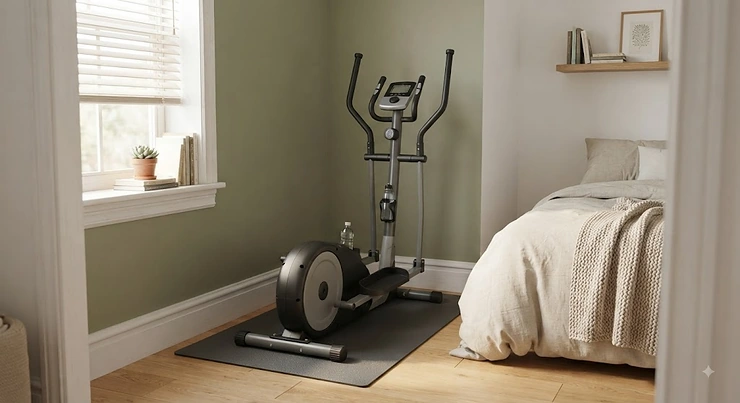
A budget elliptical for bedroom use has to clear a bar that gym equipment never faces: it has to disappear. It can’t hog the space where your bed, your dresser, and your laundry basket are already fighting for square footage, and it definitely can’t sound like a dying lawnmower at 6 a.m. while your roommate is asleep on the other side of a thin wall. That’s the actual brief, and most “top 10” lists skip right past it in favor of machines built for a converted garage. Below, you’ll find seven real, currently available machines picked specifically for tight bedrooms, thin floors, and thinner budgets — plus the comparison data, the honest trade-offs, and the setup tricks nobody puts in the product description.
What is a budget elliptical for bedroom use? It’s a compact, low-cost elliptical trainer — typically under 10 square feet of floor space, often foldable — engineered to deliver low-impact cardio in a small room without disturbing neighbors or dominating your living space. Most fall between roughly $70 and $450, though sturdier commercial-adjacent models run higher.
Ellipticals earn their reputation here because the motion keeps both feet planted for a full-body workout with minimal strain on your joints. That matters more in a bedroom setup than a gym one — you’re far more likely to stick with a routine that doesn’t hurt the next morning. And consistency, not intensity, is what actually counts: the CDC’s current physical activity guidelines frame the real target as about 150 minutes of moderate-intensity activity a week, which a 20-minute bedroom session five times a week covers without much drama.
Quick Comparison: Budget Elliptical for Bedroom at a Glance
| Product | Footprint | Price Range | Best For |
|---|---|---|---|
| Sunny Health & Fitness SF-E902 Air Walk Trainer | Folds flat, ~14 sq ft open | Under $100 | Absolute lowest entry cost |
| Sunny Health & Fitness SF-E905 | 28″L x 17″W, compact | $150–$200 range | Tightest permanent corner |
| Cubii Move | Under-desk, sits on floor | $150–$200 range | Watching TV or working while moving |
| YOSUDA Foldable Elliptical Machine | ~2–4 sq ft folded | $250–$350 range | Quietest folding option |
| ANCHEER Elliptical | Compact standing frame | $180–$280 range | First-time buyer on a strict budget |
| Niceday Elliptical Machine | Compact standing frame | $300–$450 range | Longer stride without going premium |
| SOLE E25 | ~25–30 sq ft in use | $1,000+ range | Buyers who want gym-grade durability |
Notice the spread: this isn’t seven versions of the same machine. You’ve got an air walker, a seated under-desk option, two folding standing ellipticals, and a genuinely commercial-grade unit at the top. Sunny Health & Fitness SF-E902 Air Walk Trainer wins on raw price, but YOSUDA Foldable Elliptical Machine and Niceday Elliptical Machine trade a little cash for meaningfully better stride mechanics — worth it if you’re over 5’8″ and tired of feeling cramped. The SOLE E25 sits apart entirely; it’s not really “budget,” but it anchors the comparison so you can see exactly what extra money buys.
💬 Already narrowing it down? Jump to the pick that fits your room size and skip straight to setup below.
Top 7 Budget Ellipticals for Bedroom: Expert Analysis
1. Sunny Health & Fitness SF-E902 Air Walk Trainer — cheapest way to start moving today
The Sunny Health & Fitness SF-E902 Air Walk Trainer strips the elliptical down to its essentials, and that’s precisely the point. It uses a gliding, arm-and-leg air-walker motion rather than a resistance flywheel, with a genuinely generous 30-inch stride that most sub-$200 machines can’t touch. That long stride matters practically: it’s one of the least expensive offerings from the brand, priced at just under $100, yet it folds down for storage and includes a digital monitor tracking time, count, and calories. Based on the spec comparison with pricier standing ellipticals, this is the machine for someone who has never done a structured cardio session and wants zero financial risk while finding out if the habit sticks. Reviewers consistently note the motion is gentle enough for early mornings and note some soreness in the glutes after the first few sessions — a normal beginner response, not a red flag. Where it falls short is resistance depth; there’s little to push against once your fitness improves, so treat it as a stepping stone rather than a long-term investment. That’s genuinely fine for a first machine — you can always trade up once you know cardio is a habit you’ll keep.
Pros:
- ✅ Lowest price point of any real elliptical in this list
- ✅ 30-inch stride feels natural even for taller users
- ✅ Folds flat for closet or under-bed storage
Cons:
- ❌ Minimal resistance progression for advancing fitness
- ❌ Not built for high-intensity interval sessions
Priced under $100, this is less an investment and more a low-risk trial — solid value if you just need proof a bedroom cardio habit will actually stick.
2. Sunny Health & Fitness SF-E905 — smallest permanent footprint in this lineup
The Sunny Health & Fitness SF-E905 is built for exactly the scenario this article addresses: a corner too small for a full elliptical, still big enough for a compact one. It measures 28 inches long by 17 inches wide by 57 inches tall, with an 11-inch stride, and offers 8 levels of adjustable magnetic resistance along with padded handlebars for upper-body engagement. What most buyers overlook about this model is that the short 11-inch stride is a deliberate trade for footprint — it’s specifically designed compact, showing fitness stats and resistance adjustment for an affordable price, but that stride length works best for users under roughly 5’10”; taller frames may feel cramped mid-stride. Aggregated review sentiment on this model is largely positive for the price point, with a strong star rating and a very large review count on major retail sites, though a recurring theme among critical reviews flags the stride as confining for bigger users and the standard warranty as modest. If you’re under six feet tall and need a machine that vanishes into an actual bedroom corner rather than a converted spare room, this earns its spot.
Pros:
- ✅ Genuinely tiny footprint for a standing elliptical
- ✅ 8 resistance levels for real progression over time
- ✅ Built-in pulse sensors on the handlebars
Cons:
- ❌ Short 11-inch stride cramps taller users
- ❌ Basic frame warranty compared to pricier models
At roughly $150–$200, it delivers real resistance progression in a footprint few competitors can match — the value case is strongest if you’re on the shorter side.
3. Cubii Move — the one you can use while actually doing something else
The Cubii Move isn’t a standing elliptical at all — it’s a seated, under-desk elliptical that turns a chair, a couch, or the edge of a bed into your workout station, which solves the bedroom-space problem differently than anything else on this list. It weighs less than 20 pounds, making it easy to move around the house, and includes a display monitor tracking strides, calories, distance, and active time in real time. Here’s what the spec sheet won’t tell you, but the format implies: because it’s seated and low-resistance by design, this is a low-intensity companion tool, not a substitute for a real cardio session — think “extra movement while you scroll your phone” rather than “sweat-through-your-shirt workout.” It offers six adjustable resistance levels, enough to add real effort if you commit to it deliberately rather than passively. Reviewers on major retailers commonly praise the portability and quiet operation, while a recurring critical theme is that the resistance ceiling feels low for anyone already moderately fit. For someone whose “bedroom workout” reality is 20 minutes of pedaling while catching up on a show, this is the most realistic fit on the list.
Pros:
- ✅ Under 20 lbs — easiest machine here to relocate
- ✅ Works from a chair, couch edge, or bed frame
- ✅ Six resistance levels for gradual progression
Cons:
- ❌ Seated motion burns fewer calories than standing ellipticals
- ❌ Resistance ceiling is low for advanced fitness levels
In the $150–$200 range, this isn’t trying to replace a full workout — it’s trying to add movement to time you’d spend sitting anyway, and on that narrow goal it delivers.
4. YOSUDA Foldable Elliptical Machine — quietest folding option for thin apartment walls
The YOSUDA Foldable Elliptical Machine targets the exact anxiety most bedroom elliptical shoppers have: will this wake up my neighbors or my partner? It runs on a silent magnetic drive rated below 25 decibels, quiet enough that a 5 a.m. session or an 11 p.m. wind-down blends into the background without disturbing family or neighbors. The stride measures 15 inches, comfortably accommodating users up to about 5’9″, and the machine arrives roughly 95% pre-assembled, with most people finishing setup in about 15 minutes. Based on the spec comparison with the SF-E905, the added 4 inches of stride length is a meaningful upgrade in comfort, and the folding mechanism — reducing footprint to roughly 3.66 square feet when collapsed — means it can lean against a wall or slide under a bed frame between sessions. What most buyers overlook is that “16 resistance levels” sounds dramatic but the top few levels on budget magnetic drives tend to feel similar in practice; treat the number as a marketing ceiling, not sixteen distinct workout intensities. Reviewers consistently highlight the near-silent operation and easy setup as the standout features, with occasional notes about the plastic pedal feel at higher resistance.
Pros:
- ✅ Sub-25dB operation, genuinely apartment-safe
- ✅ Folds to a fraction of its working footprint
- ✅ Fast, mostly pre-assembled setup
Cons:
- ❌ 15-inch stride still limits taller users
- ❌ Upper resistance levels feel compressed together
In the $250–$350 range, the noise performance alone justifies the step up from the cheapest options if you share walls with anyone.
5. ANCHEER Elliptical — best entry-level fitness equipment for a first real machine
The ANCHEER Elliptical sits right in the sweet spot between the ultra-budget air walkers and the pricier folding units, and it’s built specifically for first-time buyers who want a proper standing elliptical without the premium price tag. It offers a 15-inch stride, 14 resistance levels, and a 400-pound weight capacity, which on paper punches meaningfully above machines at a similar price point. What most buyers overlook about entry-level fitness equipment in this category is that weight capacity and stride length matter more day-to-day than resistance-level count — a 400 lb capacity means the frame won’t feel wobbly underfoot, which is the single biggest complaint about cheaper compact ellipticals. Based on the spec comparison, the 14 resistance levels give genuine room to grow from a casual walking pace up to a legitimately sweaty interval session, unlike the SF-E902’s minimal resistance ceiling. Aggregated review sentiment frames it as reliable for daily use with a stable ride, while a recurring complaint centers on the LCD display feeling basic compared to app-connected competitors. This is the machine to buy if you want to commit to daily cardio without committing to a four-figure price tag.
Pros:
- ✅ 400 lb weight capacity for a genuinely stable ride
- ✅ 14 resistance levels for real long-term progression
- ✅ Strong value relative to comparable standing ellipticals
Cons:
- ❌ Basic LCD display with no app connectivity
- ❌ Assembly reportedly takes longer than folding competitors
At roughly $180–$280, it’s the strongest all-around case for someone who wants their first “real” elliptical rather than a starter toy.
6. Niceday Elliptical Machine — longest stride before you hit premium pricing
The Niceday Elliptical Machine is the compromise pick for anyone who read the SF-E905 and ANCHEER sections and thought, “still too short.” It’s available with 15.5-, 18-, or 19-inch stride variants, 16 resistance levels, and a 400-pound loading capacity, with a higher-capacity version offering a longer 20-inch stride and 500-pound rating. Independent testing describes its hyper-quiet operation, under 40 decibels, alongside commercial-grade construction that outlasts cheaper models by years. Based on the spec comparison, this is the first machine on the list that genuinely narrows the gap toward gym-quality stride mechanics while staying well under four figures. It also supports Bluetooth connectivity through the Kinomap app, letting you follow guided rides rather than staring at a blank wall — a small feature that matters a lot for keeping a bedroom routine interesting after week three. Reviewers consistently praise the sturdier feel underfoot compared to sub-$250 competitors, with occasional notes that assembly requires two people due to the frame weight. If your bedroom has the extra 2–3 square feet to spare, this is the smartest step-up purchase in the lineup.
Pros:
- ✅ Longer stride options fit taller users comfortably
- ✅ Commercial-grade build feel for the price tier
- ✅ App connectivity keeps workouts from feeling repetitive
Cons:
- ❌ Larger footprint than the folding budget options
- ❌ Heavier frame makes assembly a two-person job
In the $300–$450 range, this is where “budget” and “durable” genuinely overlap rather than trading off against each other.
7. SOLE E25 — the premium benchmark worth knowing about
The SOLE E25 doesn’t belong in most “cheap compact elliptical for small bedrooms” searches on price alone, but it earns its place here as the honest ceiling — the machine that shows you exactly what more money buys, so the budget picks above don’t feel like guesses. Its complete operational space requirement runs approximately 25 to 30 square feet, which stays manageable even in a studio apartment, and it includes transport wheels so a single person can reposition it when the room needs to double as guest space. SOLE backs its ellipticals with a lifetime frame warranty, a tier of durability confidence none of the sub-$450 machines on this list can match. On paper, this means the flywheel, bearings, and drive mechanism are engineered to handle years of daily use without the wobble or belt noise that creeps into budget magnetic-resistance machines after a year or two. What most buyers overlook is that the price premium isn’t really about resistance levels or stride length — budget machines have both — it’s about long-term mechanical tolerance and warranty backing. This is the pick for someone who has already tested the cardio habit on a cheaper machine and is ready to invest in a piece of equipment meant to last a decade, not a New Year’s resolution.
Pros:
- ✅ Lifetime frame warranty, unmatched in this lineup
- ✅ Commercial-quality drive mechanism and stability
- ✅ Transport wheels for easy single-person repositioning
Cons:
- ❌ Price puts it well outside a strict “budget” category
- ❌ Footprint too large for the tightest bedroom corners
At $1,000 and up, this isn’t a starter purchase — it’s the reward for confirming the habit sticks and wanting equipment that will still be smooth in year five.
Setting Up a Bedroom Workout Corner That Works
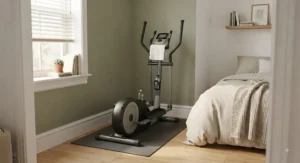
A bedroom workout corner succeeds or fails on planning, not motivation. Start with a hard measurement: clear at least 6–12 inches of space around every side of the machine so mounting and dismounting doesn’t mean clipping your dresser. Ceiling height matters more than people expect — add your own height plus about 6 inches of clearance for the natural bob of an elliptical stride, especially with taller models like the Niceday Elliptical Machine. Place a thin rubber mat under any standing machine; it does double duty, absorbing vibration for downstairs neighbors and protecting carpet or hardwood from repetitive wear marks. If storage is tight, prioritize machines that fold flat or roll on built-in wheels, like the YOSUDA Foldable Elliptical Machine or SOLE E25 — both convert from workout station back to bedroom floor in under a minute. Finally, angle the machine so you’re facing a window, mirror, or TV rather than a blank wall; boredom, not fatigue, is what actually kills a home cardio habit in month two.
Real-World Scenarios: Who Should Buy Which Machine
If you’re a college student in a 200-square-foot dorm room testing whether cardio is even for you, the Sunny Health & Fitness SF-E902 Air Walk Trainer removes the financial excuse entirely — under $100 and foldable under a bed. If you’re a remote worker who wants low-key movement during video calls without leaving your desk chair, the Cubii Move solves a completely different problem: it’s not about a dedicated session, it’s about breaking up eight sedentary hours. If you’re renting a small apartment with shared walls and genuinely cannot risk noise complaints, the YOSUDA Foldable Elliptical Machine‘s sub-25dB rating is the deciding factor over almost any spec on this list. And if you’ve already built a consistent three-month habit on a cheaper machine and you’re ready to stop replacing wobbly frames every winter, the SOLE E25 is the logical next purchase — not because your old machine failed, but because your habit outgrew it.
Your Buyer’s Decision Framework
If your top priority is price above everything else, choose the Sunny Health & Fitness SF-E902 Air Walk Trainer because it removes financial risk while you test the habit. If your top priority is silence for thin apartment walls, choose the YOSUDA Foldable Elliptical Machine because its sub-25dB rating is the lowest verified noise level in this comparison. If your top priority is stride comfort for a taller frame, choose the Niceday Elliptical Machine because its 18–20 inch stride variants outclass every other option under $500. If your top priority is passive movement alongside other activities, choose the Cubii Move because it’s designed to be used seated, not as a dedicated session. And if your top priority is long-term durability over a strict budget ceiling, choose the SOLE E25 because its lifetime frame warranty reflects genuinely different internal engineering, not just a bigger price tag.
How to Choose a Budget Elliptical for Bedroom
- Measure your actual clear floor space first. Add 6–12 inches of buffer on every side before comparing footprints — manufacturer dimensions rarely include stride clearance.
- Match stride length to your height, not the marketing copy. Users under 5’8″ generally do fine with an 11–15 inch stride; taller users should look toward 18–20 inches.
- Prioritize decibel ratings if you share walls. A sub-40dB rating, like the Niceday Elliptical Machine, protects both roommates and downstairs neighbors.
- Check weight capacity against your own weight with margin. A 400-pound rating on the ANCHEER Elliptical means the frame stays stable well below its ceiling, reducing wobble at any weight.
- Decide whether folding or fixed suits your room. A folding machine like the YOSUDA Foldable Elliptical Machine trades a little frame rigidity for daily storage flexibility.
- Treat resistance-level counts skeptically. Sixteen levels on a budget magnetic drive often compress into five or six meaningfully different intensities in practice.
- Confirm the warranty before the price. A frame that fails in year two erases any savings from a lower sticker price.
Common Mistakes When Buying Entry-Level Fitness Equipment
The single most common mistake is buying on footprint alone and ignoring stride length, which leaves taller users cramped within the first week — a frustration that’s largely responsible for compact ellipticals ending up as expensive coat racks. A close second is skipping the noise rating entirely; a machine that’s whisper-quiet on a showroom floor can sound completely different on a wood-frame apartment floor, which is why sub-40dB specs matter more than most buyers realize going in. Buyers also tend to over-index on resistance-level counts as a marketing number rather than checking real user feedback on whether the top levels actually feel distinct. Another frequent misstep: assuming any elliptical “counts” as entry-level fitness equipment regardless of assembly complexity — some folding models genuinely take an hour or more solo, which discourages first-time buyers before the first workout even happens. Finally, plenty of shoppers assume the cheapest option is automatically the smartest starting point; sometimes it is, but a machine like the ANCHEER Elliptical at a slightly higher price point can prevent the frustration-driven return that a flimsier unit invites.
Budget Elliptical vs Full-Size Gym Elliptical
The core trade-off between a compact bedroom machine and a full-size gym elliptical comes down to stride mechanics versus footprint. Gym-grade ellipticals typically offer 20+ inch adjustable strides and rear-drive flywheels that feel exceptionally smooth at high speed, but they demand 15+ square feet of dedicated floor space that most bedrooms simply don’t have. Compact models compress that stride to 11–20 inches and rely on front-drive or air-walker mechanics, sacrificing some smoothness for a footprint that fits an actual bedroom corner.
| Factor | Compact Bedroom Elliptical | Full-Size Gym Elliptical |
|---|---|---|
| Typical stride | 11–20 inches | 20+ inches, often adjustable |
| Footprint | 2–10 sq ft | 15–25+ sq ft |
| Noise level | Often under 40dB (magnetic) | Varies, gyms mask ambient noise |
| Price range | $70–$450 | $600–$2,500+ |
| Best For | Renters, small rooms, beginners | Dedicated home gyms, tall users |
Looking at the table, the gap isn’t really about workout quality — it’s about who has the space to justify it. A gym elliptical’s longer stride and heavier flywheel genuinely feel smoother at speed, but for someone doing 20–30 minutes of steady-state cardio in a bedroom, a compact machine like the Niceday Elliptical Machine delivers the same cardiovascular benefit without asking you to sacrifice half the room. The gap only really matters if you’re training for something specific — marathon cross-training, for instance — where stride biomechanics start to matter more than convenience.
What to Expect: Cardio for Beginners
Cardio for beginners on an elliptical rarely feels dramatic in week one, and that’s actually the point — low-impact machines are designed to build a sustainable habit rather than deliver an immediate, exhausting shock to the system. Because your feet stay planted on the pedals rather than leaving the ground, the joint stress is meaningfully lower than running, which means most beginners can complete a full 20-minute session on day one without the next-day soreness that scares people away from other cardio equipment — a benefit Cleveland Clinic highlights as one of the elliptical’s core advantages. What most first-timers don’t expect is how much upper-body engagement matters — using the moving handlebars, when your machine has them, roughly doubles the muscle groups involved compared to pedaling with your hands resting on a stationary rail. That impact reduction is structural, not just a marketing claim: both feet stay in contact with the surface throughout the motion, unlike walking, jogging, or running, which is also why the Arthritis Foundation recommends ellipticals specifically for people managing joint sensitivity. Expect the first two weeks to feel like calibration: finding a comfortable resistance level, a stride rhythm, and a time of day that actually sticks. The physical results — steadier resting heart rate, easier stair climbing — typically show up around week four to six of consistent use, not week one.
Entry Level Elliptical for Beginners at Home
An entry level elliptical for beginners at home should optimize for three things above everything else: low intimidation factor, forgiving resistance range, and a stride length that doesn’t feel awkward on day one. Machines like the Sunny Health & Fitness SF-E902 Air Walk Trainer and ANCHEER Elliptical both fit this brief precisely because they don’t overwhelm a new user with dozens of programs or a steep resistance curve — the goal in month one is consistency, not intensity. Beginners specifically benefit from a shorter learning curve on assembly and setup too; a machine that takes two hours to build before your first workout is a genuine habit-killer, which is why pre-assembled or simple-frame options tend to see better long-term usage rates than complex, feature-heavy machines. It’s also worth starting at a lower resistance level than feels challenging — beginners consistently overestimate their starting intensity, leading to early burnout or soreness that derails the habit before it forms. Give yourself permission to spend the first two weeks at the lowest one or two resistance settings; progression matters far more than a strong first session.
Long-Term Cost & Maintenance of an Affordable Elliptical Machine
An affordable elliptical machine for daily cardio isn’t just its sticker price — total cost of ownership includes the mat, occasional bolt tightening, and eventually replacement bearings or belts on budget magnetic-drive units. Most compact ellipticals in the $150–$350 range need a quarterly maintenance check: tightening the pedal arm bolts, wiping down the resistance mechanism, and confirming the frame hasn’t developed any wobble on hard flooring. Higher-end machines like the SOLE E25 justify part of their price premium through reduced maintenance frequency — a lifetime frame warranty reflects genuine confidence that the core mechanism won’t need attention for years, not just marketing language.
| Price Tier | Typical Lifespan | Maintenance Frequency | Cost-Per-Use (est., 3x/week) |
|---|---|---|---|
| Under $150 (e.g. SF-E902) | 1–2 years typical use | Minimal moving parts to maintain | Very low, but shortest lifespan |
| $150–$350 (e.g. YOSUDA, ANCHEER) | 2–4 years typical use | Quarterly bolt/frame checks | Low, best overall balance |
| $1,000+ (e.g. SOLE E25) | 8–10+ years typical use | Annual checks, lifetime frame warranty | Lowest over a decade of use |
The analysis here favors patience over impulse: a $200 machine used three times a week for two years works out to roughly 78 cents per workout, which is already cheaper than most gym memberships — but a $1,200 machine used consistently for eight years drops that cost-per-use even lower while adding meaningfully better stride mechanics. For an independent look at how testers actually evaluate elliptical durability and ergonomics over time, Consumer Reports’ elliptical testing program is a useful reference point before committing to any tier. The smartest long-term move for most bedroom shoppers is starting in the $150–$350 tier, confirming the habit holds for six months, and only then deciding whether a premium upgrade like the SOLE E25 is worth the jump.
Features That Actually Matter (And Those That Don’t)
Stride length, weight capacity, and decibel rating actually matter — they directly determine whether the machine fits your body, your floor, and your walls without compromise. A stable, wobble-free frame matters more than almost any digital feature, because a machine that shakes underfoot gets abandoned regardless of how many workout programs it advertises. What matters far less than marketing suggests: a high resistance-level count on a budget magnetic drive, since the top few levels frequently feel nearly identical in practice, and elaborate app ecosystems that require a subscription to unlock their most useful features. Bluetooth connectivity is a nice-to-have, not a deciding factor — it’s genuinely useful for keeping workouts interesting, as the Niceday Elliptical Machine‘s Kinomap support demonstrates, but it shouldn’t outrank a shorter stride or a wobbly frame in your decision-making. The honest filter: if a feature affects whether you’ll actually use the machine three months from now, it matters; if it only affects the spec sheet, it probably doesn’t.
Frequently Asked Questions
❓ How much floor space does a budget elliptical for bedroom actually need?
❓ Are cheap compact ellipticals for small bedrooms actually good for weight loss?
❓ Will an elliptical wake up my downstairs neighbors?
❓ What's a realistic budget for an entry-level elliptical for beginners at home?
❓ How long until I see results from cardio for beginners on an elliptical?
Conclusion
A budget elliptical for bedroom use isn’t about finding the cheapest possible machine — it’s about matching stride length, noise level, and footprint to the actual room you have and the actual body using it. The Sunny Health & Fitness SF-E902 Air Walk Trainer removes financial risk for first-timers, the YOSUDA Foldable Elliptical Machine solves the noise anxiety that stops so many apartment dwellers from starting, and the SOLE E25 shows what a serious long-term investment looks like once the habit is proven. Somewhere in between, the ANCHEER Elliptical, Niceday Elliptical Machine, Sunny Health & Fitness SF-E905, and Cubii Move each solve a slightly different version of the same problem: getting real cardio into a room that was never designed for it. Measure your space, be honest about your height and noise constraints, and pick the machine that fits the life you’re actually living — not the one with the flashiest spec sheet.
✨ Ready to Claim Your Bedroom Workout Corner?
🔍 Take your home cardio routine to the next level with the picks above. Click on any highlighted product to check current pricing and availability before making your move. The right machine turns a spare corner into a habit you’ll actually keep.
Recommended for You
- Quiet Elliptical Machine for Apartment Living Room – 7 Top Picks (2026)
- Best Elliptical for Arthritis: 7 Joint-Friendly Picks for 2026
- Elliptical Machine After Knee Surgery: 7 Best Picks for 2026
Disclaimer: This article contains affiliate links. As an Amazon Associate, I earn from qualifying purchases. If you purchase products through these links, we may earn a small commission at no additional cost to you.
✨ Found this helpful? Share it with your friends! 💬🤗
