
In This Article
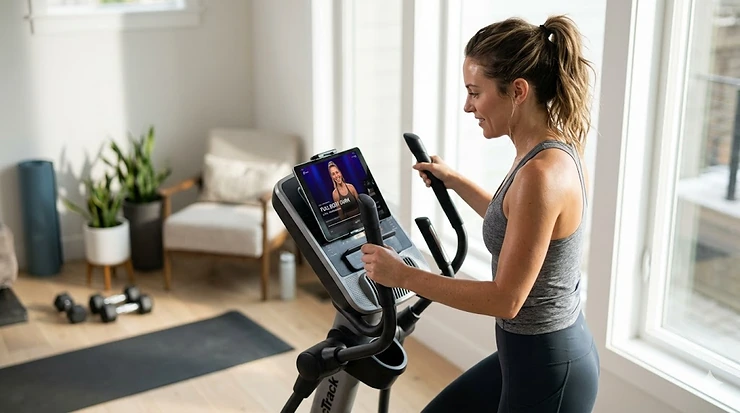
So you want the energy of a Peloton class — the thumping playlist, the coach yelling encouragement at exactly the wrong moment, the leaderboard dopamine hit — but on an elliptical. Smart move. Low-impact cardio, full-body burn, zero knee trauma. The problem? There is no Peloton elliptical machine. There never has been. Peloton’s hardware lineup sticks to bikes, treadmills, and a rower. But here’s the secret that thousands of Peloton Digital subscribers already know: you don’t need Peloton hardware to use the Peloton app.
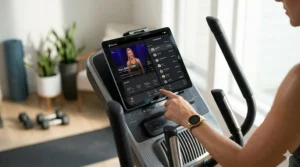
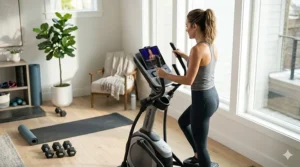
The Peloton app elliptical machine concept is elegantly simple. You subscribe to Peloton App+ (around $24/month), prop your phone or tablet in your elliptical’s device holder, and stream any class you want — cycling rides work beautifully, as do HIIT cardio, walking, and bootcamp classes. Instructors cue effort levels and resistance shifts; you match those to your elliptical’s resistance settings. It’s not a perfect one-to-one mapping, but the motivational magic is absolutely intact.
What this means in practice is that your elliptical becomes the hardware, and the Peloton app becomes the brain. The right machine makes all the difference. A wobbling, noisy, $199 bargain-bin elliptical with a tiny device shelf is going to make following Peloton classes miserable. A well-built machine with a proper device holder, smooth resistance changes, and a quiet drive system? That’s where the experience clicks.
According to the American College of Sports Medicine, elliptical training provides equivalent cardiovascular benefits to running while reducing impact forces on joints by up to 75% — making it one of the most recommended cardio modalities for long-term consistency.
In this guide, I’ve researched and selected 7 real, currently available elliptical machines on Amazon that pair seamlessly with streaming class elliptical experiences through the Peloton Digital app — across every budget from entry-level to premium.
Quick Comparison: Best Peloton App Elliptical Machines in 2026
| Machine | Flywheel | Resistance Levels | Stride Length | Price Range | Best For |
|---|---|---|---|---|---|
| Schwinn 430 | 20 lbs | 20 | 20″ | $499–$649 | Budget beginners |
| Horizon EX-59 | 14.3 lbs | 10 | 20″ | $699–$899 | Minimalist users |
| Schwinn 470 | 20 lbs | 26 | 20″ | $799–$999 | App-connected mid-range |
| Sole E35 | 25 lbs | 20 | 20″ | $1,499–$1,699 | Best all-rounder |
| Sole E55 | 20 lbs | 20 | 22″ | $1,699–$1,999 | Serious daily trainers |
| NordicTrack AirGlide 14i | 18 lbs | 26 | 14–20″ | $1,499–$1,799 | Heavy users & tall riders |
| Bowflex Max Trainer M9 | N/A | 20 | N/A | $1,799–$1,999 | HIIT & calorie torchers |
The table above tells a clear story: Schwinn dominates the sub-$1,000 bracket with solid Bluetooth connectivity and Peloton Digital compatibility, while Sole earns its premium price tag through elite build quality and a near-silent drive system. The Bowflex Max Trainer M9 plays an entirely different game — it’s a hybrid stair-climber/elliptical designed for maximum calorie burn in minimum time, which pairs exceptionally well with Peloton’s HIIT and bootcamp-style classes.
💬 Just one click — help others make better buying decisions too! 😊
Top 7 Peloton App Elliptical Machines: Expert Analysis
1. Schwinn 430 Elliptical — Best Budget Pick for Peloton Digital Streaming
The Schwinn 430 is the machine that makes the Peloton app elliptical machine experience accessible without a second mortgage. Don’t let the price fool you — this is a legitimately capable elliptical trainer from a brand with decades of fitness equipment credibility.
Key specs in plain English: 20 resistance levels sounds like a lot, and it is — you can match Peloton instructor cues from “easy recovery” to “all-out sprint” across 20 distinct settings without running out of range. The 20-inch stride length accommodates users up to about 6’0″ without the choppy, unnatural stride that plagues cheaper compact ellipticals. The manually adjustable incline (up to 9 degrees) adds training variety that most budget machines skip entirely.
What most buyers overlook about the 430 is its dual-track LCD display, which lets you monitor two data screens simultaneously — heart rate and cadence on one, distance and calories on the other. When following a live workout elliptical trainer class through Peloton, keeping tabs on multiple metrics at once matters. The integrated device shelf holds your phone securely, and 22 preset programs give you something to do on days when you’re not in the mood to open the app.
Customer feedback consistently praises the 430’s stability and quiet operation — two things that matter a lot when you’re trying to hear instructor cues through your phone’s speaker. The frame warranty runs 10 years, which is unusually solid at this price.
My honest take: If this is your first elliptical and your primary goal is to follow instructor led elliptical machine classes through Peloton Digital, the 430 is the smartest entry point. It won’t wow you with tech, but it won’t fail you either.
✅ 20 resistance levels match Peloton cue ranges well
✅ Quiet drive system — you’ll actually hear your instructor
✅ 10-year frame warranty at this price is exceptional
❌ No Bluetooth connectivity — you’re relying entirely on your device
❌ Manual incline only; no motorized adjustments mid-class
Price range: Around $499–$649 | A genuinely impressive value for the fundamentals.
2. Horizon Fitness EX-59 Elliptical — Best for Minimalists Who Just Want to Move
The Horizon EX-59 does something the fitness equipment industry has largely forgotten how to do: it keeps it simple and does it well. No giant touchscreen. No proprietary app ecosystem trying to lock you in. Just a beautifully engineered elliptical that connects to your device via Bluetooth and gets out of the way.
What the specs actually mean: The 14.3-pound flywheel is lighter than the Schwinn 430, but Horizon’s “Advanced Pulley System” compensates by delivering a remarkably smooth, consistent pedal motion — users frequently describe it as feeling heavier than the number suggests. The tighter Q-factor (the horizontal distance between pedals) is something most competitors bury in the footnotes; on the EX-59, it’s a headline feature, because a narrower stance genuinely reduces hip and back stress during long live class elliptical sessions.
The EX-59 connects via Bluetooth to your phone, streams audio through its integrated speakers, and charges your device via a rapid USB port. So when you’re 40 minutes into a Peloton cycling class and your phone battery is dropping, this machine has your back.
The lifetime frame warranty at this price range is extraordinary. Horizon quietly builds some of the most durable home gym equipment available, and the EX-59 reflects that engineering-first philosophy. Reviewers who bought this machine as a replacement for older, noisier machines are consistently the most satisfied.
My honest take: Perfect for the person who wants a clean, reliable on-demand workout elliptical trainer experience without the complexity. You bring the Peloton app; this machine handles everything else.
✅ Bluetooth speakers + rapid USB charging — your phone stays alive
✅ Narrow Q-factor reduces hip and back strain on long sessions
✅ Lifetime frame warranty is genuinely rare at this price
❌ Lighter flywheel means slightly less resistance range for advanced athletes
❌ Fewer resistance levels than competitors in this tier
Price range: Around $699–$899 | Worth every dollar for the build quality alone.
3. Schwinn 470 Elliptical — Best Mid-Range Pick for Peloton Digital Compatibility
The Schwinn 470 is the machine I’d recommend to someone who asked me, “What’s the best bang-for-the-dollar Peloton Digital compatible elliptical?” It’s Bluetooth-connected, app-friendly, and packed with enough features to keep an intermediate user engaged for years.
The upgrade that actually matters: Compared to the 430, the 470’s 26 resistance levels (vs. 20) might sound like a marginal improvement — but in practice, those extra 6 notches of adjustment give you significantly finer control at the upper end of the resistance range. Peloton instructors in HIIT classes are notorious for quick resistance bumps; the 470’s motorized incline system (up to 10 degrees) adjusts on the fly without you having to break stride.
Bluetooth connectivity is where this machine truly earns its keep as a Peloton app elliptical machine. You can sync it with Peloton Digital, Explore the World, and other third-party apps simultaneously. The built-in media shelf is one of the better-designed ones I’ve seen under $1,000 — it holds tablets securely without slipping during high-intensity intervals.
The 20-pound flywheel delivers a rear-drive motion that biomechanics researchers at Harvard Health Publishing have noted produces a more natural, walking-like stride pattern compared to front-drive designs. Users up to 6’2″ report comfortable stride length.
✅ Bluetooth connects directly to Peloton Digital without adapters
✅ Motorized incline adjusts mid-workout — no hands required
✅ 26 resistance levels give fine-grained HIIT control
❌ Dual LCD display feels dated compared to touchscreen competitors
❌ Frame warranty drops to 10 years vs. Sole’s lifetime coverage
Price range: Around $799–$999 | The sweet spot between price and Peloton-app capability.
4. Sole E35 Elliptical — Best All-Around Peloton App Compatible Machine
The Sole E35 is the machine that silences the “you get what you pay for” argument. It’s built like a commercial gym unit, whisper-quiet, and now features a 10.1-inch HD touchscreen with screen mirroring — which means you can literally cast your Peloton app directly to the E35’s display. No squinting at a phone mounted six feet away.
The spec sheet doesn’t tell you this: The E35’s 25-pound flywheel is actually heavier than the more expensive Sole E55 (which uses a 20-pound unit). That extra flywheel mass creates a more stable, consistent pedal motion under load — you feel it particularly at higher resistance levels where lighter flywheels tend to “lurch.” For streaming live workout elliptical trainer sessions where resistance changes come fast, that smoothness is not a luxury; it’s the whole experience.
The PT-designed pedals with a 2-degree inward slope are a detail that Peloton class veterans will appreciate immediately. After 45 minutes of following a high-cadence cycling class on an elliptical, that slight inward angle means the difference between feeling refreshed and feeling like your ankles staged a protest.
Sole’s screen mirroring capability deserves its own paragraph. Open Peloton app on your iOS device, mirror it to the E35’s 10.1-inch display, and suddenly you have a proper instructor-led elliptical machine experience — the instructor fills the screen, your metrics are in view, and the whole setup looks intentional rather than cobbled-together.
✅ Screen mirroring turns your Peloton app into a full-screen experience
✅ 25-lb flywheel — heavier and smoother than pricier competitors
✅ PT-designed pedals with 2° inward slope protect joints over long sessions
❌ Premium price means a bigger upfront commitment
❌ Not sold on Amazon — direct from Sole’s website (check Amazon for availability)
Price range: Around $1,499–$1,699 | Outstanding long-term value when you factor in the lifetime frame warranty.
5. Sole E55 Elliptical — Best for Serious Daily Trainers
If the E35 is the reliable all-rounder, the E55 is its longer-striding sibling built for users who’ve graduated beyond occasional workouts and into genuine daily training. The headline upgrade is the 22-inch stride length — a detail that sounds technical but translates immediately to a more natural, powerful extension that taller users and stronger athletes feel from the very first session.
Why the longer stride matters for Peloton classes: Peloton cycling instructors frequently call for power pushes — sustained, forceful pedal strokes at moderate resistance. On an 18-inch or 20-inch stride elliptical, that cue results in a slightly cramped, choppy motion. On the E55’s 22-inch path, you can actually reach into the stride the way the instructor intends, recruiting more glute and hamstring activation in the process.
The E55 also ships with a chest-strap heart rate monitor — not the grip-sensor variety that requires you to hold on, but a wireless strap that broadcasts your data continuously. When a Peloton instructor calls out target heart rate zones, you can track compliance in real time without interrupting your stride.
Customers who upgraded from lesser machines frequently describe the E55 using one word: substantial. The machine doesn’t shift, wobble, or creak. At 241 pounds, it feels like it’s bolted to the floor.
✅ 22″ stride — the longest in its class, ideal for taller users
✅ Wireless chest-strap HRM included — real-time heart rate during Peloton classes
✅ Commercial-grade construction built for daily use
❌ Heavier and larger — needs a dedicated, permanent space
❌ Costs more than the E35 despite a lighter flywheel
Price range: Around $1,699–$1,999 | Justified for daily users who train with purpose.
6. NordicTrack AirGlide 14i Elliptical — Best for Heavy Users and Tall Riders
The NordicTrack AirGlide 14i has one specification that immediately sets it apart from everything else on this list: a 400-pound weight capacity. Every other machine here tops out at 300–375 pounds. For larger-framed individuals who want to use a Peloton app elliptical machine without worrying about weight limits, the AirGlide 14i is simply the answer.
The incline story: The 14i features both incline and decline capability — you can tilt the elliptical path forward or backward, simulating downhill terrain that recruits different muscle groups entirely. Most ellipticals only go uphill. The ability to decline actually provides a genuine training advantage for athletes preparing for race events or simply wanting to engage anterior leg muscles in ways that flat-plane elliptical motion never reaches.
The 14-inch HD touchscreen is compatible with iFIT, but here’s the practical detail for Peloton users: the large tablet shelf accommodates full-size tablets and phones with room to spare, and the frame’s media architecture was clearly designed with third-party app streaming in mind. Prop your device, connect to Peloton Digital via the app on your phone, and you have a fully functional streaming class elliptical setup.
With 26 resistance levels and a variable-stride design (the stride length auto-adjusts from 14 to 20 inches), the AirGlide adapts to users of different heights without manual adjustment — a genuinely useful feature for households with multiple users following Peloton app classes.
✅ 400-lb weight capacity — the highest on this list
✅ Incline AND decline capability expands muscle targeting
✅ Variable 14-20″ stride adapts automatically to user height
❌ iFIT-centric design means Peloton integration is via phone/tablet only
❌ Higher price point than most mid-range options
Price range: Around $1,499–$1,799 | A premium investment for users who’ve been let down by underpowered machines before.
7. Bowflex Max Trainer M9 — Best for HIIT Cardio & Maximum Calorie Burn
The Bowflex Max Trainer M9 is not a traditional elliptical. Let’s be precise: it’s a hybrid machine that blends elliptical motion with stair-climber mechanics, producing a movement pattern that engages the glutes, core, and upper body simultaneously at intensities that standard ellipticals simply can’t replicate. If your Peloton class of choice is HIIT cardio, bootcamp, or anything with the words “push it” in the description, this machine was designed with you in mind.
Why the HIIT math works differently here: The hybrid stair/elliptical motion places your body in a more upright position than traditional ellipticals, which forces greater core activation and — according to Bowflex’s internal research — produces up to 2.5x the calorie burn compared to standard elliptical motion in the same time window. The 14-minute HIIT protocol that the M9 was engineered around pairs exceptionally well with Peloton’s shorter, high-intensity on-demand classes.
The built-in 10-inch HD touchscreen streams Netflix and Prime Video natively, but the real value for Peloton Digital subscribers is the integrated device shelf that allows phone or tablet mounting at eye level. All 20 resistance levels are accessible through the moving handlebars without removing your hands — critical when a Peloton instructor calls a quick resistance change mid-sprint.
Bowflex’s JRNY app comes free for one year, but if you’re committed to Peloton, you can safely ignore it. The machine delivers its core HIIT experience without any app dependency.
✅ Hybrid stair/elliptical motion maximizes calorie burn for HIIT classes
✅ Resistance controls on moving handlebars — no hand removal during sprints
✅ Most compact footprint of any machine in the premium tier
❌ Shorter stride than traditional ellipticals — tall users above 6’2″ may feel cramped
❌ 3-year frame warranty significantly shorter than Sole or Horizon’s lifetime coverage
Price range: Around $1,799–$1,999 | Best ROI if you’re serious about HIIT and short on floor space.
How to Use the Peloton App on Your Elliptical: A Practical Setup Guide
Here’s what no product listing tells you: setting up a proper Peloton app elliptical machine experience takes about 10 minutes and a few smart decisions upfront.
Step 1: Subscribe to the right Peloton tier. Peloton App+ ($24/month) is what you want. It includes full access to live and on-demand classes across cycling, running, walking, HIIT cardio, and bootcamp — all of which adapt well to elliptical use.
Step 2: Choose your class type strategically. Cycling classes are the most popular among elliptical users because the resistance and cadence structure translates almost perfectly. When your Peloton instructor says “add three points of resistance,” you add three clicks on your elliptical. Simple. Walking and cardio classes work equally well. What doesn’t work are Tread-specific interval runs where incline changes are automated — save those for treadmill days.
Step 3: Mount your device properly. This is genuinely underrated. A phone perched on a tiny ledge at the wrong angle means you’re craning your neck for an hour and wondering why your form fell apart. Most ellipticals on this list have proper media shelves; if yours doesn’t, a clip-on bike phone mount (widely available on Amazon) solves the problem for under $15.
Step 4: Calibrate your resistance mapping. On your first session, spend 5 minutes matching Peloton’s 0-100 output scale to your elliptical’s resistance levels. At “resistance 30” on Peloton, what number on your machine feels equivalent? Write it down. After a week, this becomes intuitive.
Step 5: Use Bluetooth headphones. Non-negotiable. Your elliptical’s mechanical noise plus instructor audio through a phone speaker is a recipe for constantly pausing the class to turn up the volume. A decent pair of wireless earbuds transforms the experience from functional to genuinely immersive.
Common mistake to avoid in the first 30 days: Don’t chase the leaderboard on an elliptical. Peloton’s live class leaderboard is calibrated for Peloton Bike output data. Your elliptical is generating different metrics. Train to the instructor’s effort cues, not to the numbers — and you’ll get far better results.
Who Should Buy Which Peloton App Elliptical Machine: Real-World Scenarios
Choosing an elliptical isn’t about finding the best machine in the abstract. It’s about finding the best machine for you, in your specific situation.
The apartment dweller who wants daily cardio without rattling the downstairs neighbor: The Horizon EX-59 is your answer. It’s the quietest machine in this lineup, its narrow footprint fits in tight spaces, and the lifetime frame warranty means you won’t be replacing it when you eventually move somewhere bigger.
The rehabbing runner coming off a knee injury who wants to maintain fitness through Peloton live classes: Go straight to the Sole E35. The PT-designed inward-angled pedals were literally designed for people whose joints are talking back to them. The smooth 25-pound flywheel eliminates the jarring motion that aggravates post-injury sensitivity. Physical therapists recommend Sole’s pedal geometry specifically for this population.
The person who’s been a Peloton Bike rider for two years and wants to cross-train on an elliptical without giving up their class experience: The Sole E35 with screen mirroring is the closest thing to a “real” Peloton experience on an elliptical. Same screen size, same instructor visibility, same class structure — just a different movement pattern.
The busy professional who can only carve out 20 minutes a day and needs those 20 minutes to count: The Bowflex Max Trainer M9, paired with Peloton’s shorter HIIT and bootcamp classes, turns a 20-minute session into something metabolically comparable to 45 minutes on a standard elliptical. The hybrid motion burns more, in less time.
The family with two adults of different heights sharing one machine: The NordicTrack AirGlide 14i’s variable auto-stride (14-20 inches, adjusting to your natural gait) means one person at 5’4″ and another at 6’1″ can both use the same machine at full effectiveness — no manual adjustment, no compromise.
Peloton App Elliptical Machine vs. Buying a Peloton Bike: The Honest Comparison
| Factor | Peloton App + Elliptical | Peloton Bike+ |
|---|---|---|
| Hardware cost | $499–$1,999 | ~$2,495–$2,995 |
| Monthly app cost | ~$24/month (App+) | ~$44/month (All-Access) |
| Joint impact | Very low | Low |
| Muscle engagement | Full body (arms + legs) | Lower body focused |
| Class variety | Any class with effort adaptation | Cycling-optimized classes |
| Home footprint | Medium to large | Medium |
The math here is unambiguous for a large segment of buyers. A Schwinn 470 paired with Peloton App+ costs around $800–$900 upfront and $24/month. A Peloton Bike+ costs $2,495+ upfront and $44/month. Over two years, that’s a difference of roughly $1,900–$2,100 in favor of the elliptical setup — and you’re getting a full-body workout rather than a lower-body-dominant one.
The honest counterargument: Peloton’s hardware integrates seamlessly with its platform. Metrics auto-populate. The leaderboard is calibrated to your actual output. If that data integration is valuable to you, the Bike+ justifies its premium. But if you want the coaching experience, the music, and the community — and you’re willing to do a small mental translation of effort cues — the Peloton Digital compatible elliptical path delivers 90% of the experience at a fraction of the cost.
✨ Don’t Miss These Exclusive Deals!
🔍 Take your Peloton app elliptical machine setup to the next level with these carefully selected machines. Click on any highlighted product to check current pricing and availability. These picks will help you get studio-quality workouts from the comfort of your home!
What to Expect: Real-World Peloton Class Performance on an Elliptical
Let me set honest expectations, because the fitness internet is full of overselling.
What works brilliantly: Any class where the instructor uses relative effort language — “push to a 7 out of 10,” “find a resistance where conversation is difficult,” “match this tempo.” This language translates perfectly to any elliptical. Peloton’s cycling instructors — particularly instructors known for effort-based coaching like Alex Toussaint and Kendall Toole — give cues that require zero translation. You feel them immediately.
What requires mental translation: Output-based cues (“hit 120 watts,” “power to 250”) are calibrated for the Peloton Bike’s power measurement system. Your elliptical doesn’t measure watts the same way. Treat these as directional cues, not precise targets. “High output” means push harder on your elliptical; “steady state” means maintain your current pace.
What genuinely doesn’t work: Automated resistance changes. On a Peloton Bike, certain classes automatically adjust the bike’s resistance through Bluetooth. Your elliptical doesn’t have that integration. You’ll make all resistance changes manually — which, after a week, becomes second nature.
The bottom line: according to research published by the National Institutes of Health, instructor-led group exercise — even when delivered digitally — increases exercise adherence by up to 30% compared to self-directed workouts. The reason to use Peloton on an elliptical isn’t just about optimization. It’s about showing up consistently, session after session, because a human being on a screen is holding you accountable.
How to Choose the Right Peloton App Elliptical Machine: 6 Expert Criteria
Buying an elliptical to pair with Peloton Digital isn’t the same as buying a standalone machine. You have specific needs that standard buying guides overlook.
- Device holder quality and position. This is the #1 overlooked spec. A flimsy phone shelf that vibrates your screen into blur during a fast-paced class is a deal-breaker. Look for rubberized grips, secure depth (not just a thin ledge), and positioning at or near eye level. The Schwinn 470 and Sole E35 both excel here.
- Resistance range and step granularity. Peloton instructors call out resistance changes frequently — sometimes in single increments, sometimes in large jumps. You need enough levels (at least 20) with small enough increments to mimic the range. Anything below 16 levels will leave you making compromises.
- Drive system noise. You need to hear your instructor. A noisy chain-drive or poorly maintained belt will force you to crank up your phone’s volume until the whole neighborhood knows you’re doing a cycling class at 6am. Magnetic resistance systems — used by every machine on this list — are dramatically quieter than friction-based alternatives.
- Stride length for your height. The rule of thumb: 18 inches for users under 5’7″, 20 inches for 5’7″–6’0″, 22+ inches for 6’0″ and above. Following a Peloton class on a stride that’s too short produces a choppy, uncomfortable motion that breaks your rhythm during high-cadence segments.
- Flywheel weight. Heavier flywheels (20+ pounds) produce smoother momentum — important when a Peloton instructor calls quick resistance changes during intervals. Light flywheels “hiccup” slightly with sudden resistance shifts. The Sole E35’s 25-pound flywheel is the benchmark in this regard.
- Bluetooth connectivity. Even if you’re streaming Peloton from your phone via the screen, Bluetooth connectivity to fitness apps means your elliptical’s metric data (cadence, heart rate via sensors) feeds into Apple Health or Google Fit, building a complete picture of your training load over time. The Schwinn 470 handles this particularly well.
Common Mistakes When Buying a Peloton App Elliptical Machine
Even well-intentioned buyers get this wrong. Here are the pitfalls I see repeatedly.
Mistake 1: Prioritizing screen size over device holder quality. A 7-inch built-in display that can’t mirror your Peloton app is less useful than a solid device holder that secures your 6.1-inch phone screen. Unless the machine supports screen mirroring (like the Sole E35), the built-in display is largely irrelevant for Peloton streaming — it’s your phone or tablet doing the work.
Mistake 2: Underestimating the importance of flywheel weight. The fitness industry has done a poor job of explaining this. A heavy flywheel isn’t about “more resistance” — it’s about the quality of motion. A 25-pound flywheel at resistance level 5 feels more controlled and smooth than a 14-pound flywheel at the same level. During instructor-led elliptical machine classes where you’re maintaining consistent cadence for 5-minute blocks, that smoothness compounds into significantly better form.
Mistake 3: Buying based on app features they’ll never use. The NordicTrack SE7i is a good machine, but if you’re committed to Peloton Digital, you have zero use for iFIT’s proprietary Google Maps workouts. Don’t pay for platform features you’ll be bypassing. Focus on hardware quality.
Mistake 4: Ignoring assembly requirements. Most ellipticals in this category require 1-3 hours of assembly from one to two people. If you order a 250-pound box and have nobody to help, you have a problem. Factor in professional assembly options (usually $80-$150) when comparing real costs.
Long-Term Cost & Maintenance: The Real Numbers for Peloton App Elliptical Setups
The purchase price is just the beginning of the conversation.
Year 1 total cost of ownership (using the Schwinn 470 as example):
- Machine: ~$899
- Peloton App+ subscription: $24 × 12 = $288
- Assembly (optional): ~$100
- Year 1 total: ~$1,287
Compare that to a Peloton Bike+:
- Machine: ~$2,495
- All-Access Membership: $44 × 12 = $528
- Year 1 total: ~$3,023
The elliptical setup saves approximately $1,736 in year one. By year three, that gap widens to nearly $4,000 when you factor in the higher monthly Peloton membership cost.
Maintenance reality check for ellipticals: Unlike treadmills, which require belt lubrication every 6 months and motor servicing every few years, magnetic resistance ellipticals are impressively low-maintenance. The main tasks are occasional pedal-arm bolt tightening (a 10-minute job with a wrench), keeping the drive cover dust-free, and inspecting the foot pedal straps annually. According to data from the Physical Activity Council, home cardio equipment with proper minimal maintenance averages 8-12 years of reliable use — meaning your $900 elliptical amortizes to less than $100 per year in hardware cost.
The machines with lifetime frame warranties (Sole, Horizon) provide additional peace of mind that protects against the most expensive single failure mode. Sole’s warranty, in particular, covers the frame and flywheel for life — the two components that actually wear out on a heavily used machine.
Frequently Asked Questions
❓ Can I use the Peloton app on any elliptical machine?
❓ Which Peloton classes work best with an elliptical machine?
❓ Do I need Peloton App+ or the All-Access Membership for elliptical use?
❓ What stride length should I look for in a Peloton Digital compatible elliptical?
❓ Can I see the Peloton leaderboard when using an elliptical instead of a Peloton Bike?
Conclusion
The Peloton app elliptical machine experience is one of the genuinely clever fitness hacks of the modern era — you get world-class coaching, curated playlists, and the psychological pull of a live class community, all mounted on a piece of equipment that’s kinder to your joints than almost anything else in the cardio universe.
For most people, the Schwinn 470 hits the sweet spot: real Bluetooth connectivity, proper Peloton Digital compatibility, and enough resistance granularity to follow HIIT and cycling classes effectively, all for under $1,000. Step up to the Sole E35 if you want a more premium feel, screen mirroring for a true large-display experience, and the kind of whisper-quiet drive system that makes streaming live workout elliptical trainer sessions feel genuinely professional.
Budget-conscious beginners should start with the Schwinn 430 — it earns more than its price suggests. And if your fitness goal is maximum calorie burn in minimum time, the Bowflex Max Trainer M9 paired with Peloton HIIT classes is a combination that genuinely delivers.
The machines exist. The app exists. The only missing ingredient is you, clipping in your earbuds and pressing play.
✨ Ready to upgrade your home cardio setup?
🔍 Check the latest pricing and availability on any of the featured ellipticals above by clicking the highlighted product names. These are some of the best machines available for streaming Peloton classes — your joints will thank you.
Recommended for You
- 7 Best NordicTrack iFit Elliptical Machines for 2026
- 7 Best High Definition Screen Elliptical Machines of 2026
- 7 Best Large Display Elliptical Machines for Enhanced Workouts 2026
Disclaimer: This article contains affiliate links. As an Amazon Associate, I earn from qualifying purchases. If you purchase products through these links, we may earn a small commission at no additional cost to you.
✨ Found this helpful? Share it with your friends! 💬🤗
