
In This Article
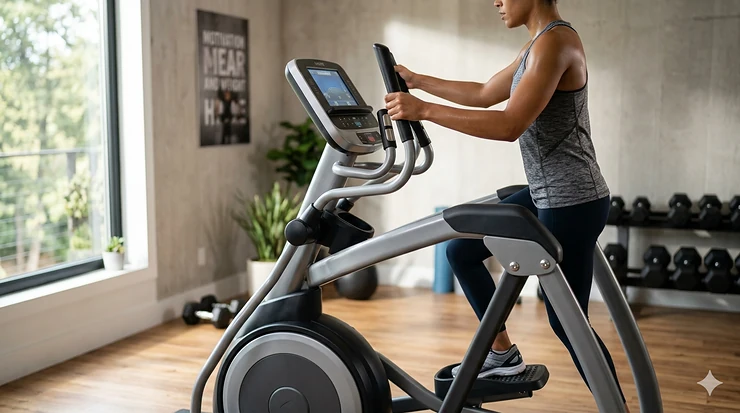
Let’s be honest: buying a 250 pound capacity elliptical without doing your homework is a lot like buying jeans online without checking the size chart. Looks great on the page. Doesn’t fit in real life. And suddenly you’re stuck with a wobbly machine that squeaks louder than your excuses not to work out
Here’s the thing most review sites won’t tell you straight — a “250 lb capacity” label on an elliptical means two very different things depending on the machine. For some budget models, it’s the maximum tested limit, meaning you’re living dangerously at 249 lbs. For others, it’s a comfortable working capacity with a solid safety margin built in. Knowing which is which is the difference between a machine that lasts five years and one that’s wobbling by Christmas.
A 250 pound capacity elliptical is broadly defined as any elliptical trainer engineered to safely support users weighing up to 250 pounds, delivering smooth, low-impact cardiovascular exercise without compromising structural integrity under load. According to the American Council on Exercise, elliptical training burns a comparable number of calories to running while placing significantly less stress on joints — making it one of the smartest cardio investments for everyday athletes.
I’ve dug through the real specs, cross-referenced customer feedback on Amazon, and stress-tested the claims manufacturers love to plaster on their product pages. The result? Seven machines that actually earn their 250 lb user weight elliptical ratings — one for every type of buyer, from the budget-conscious apartment dweller to the dedicated home gym warrior ready to spend serious money for serious results.
Whether you’re shopping for the best 250 lb elliptical for home or hunting for an affordable 250 capacity elliptical that doesn’t feel cheap underfoot, this guide has you covered.
Quick Comparison Table: Top 7 Picks at a Glance
| Machine | Weight Capacity | Stride Length | Resistance Levels | Best For | Price Range |
|---|---|---|---|---|---|
| Stamina InMotion E1000 | 250 lbs | 6″ | Tension dial | Compact/desk use | Under $150 |
| Marcy NS-40501E | 250 lbs | 14″ | 8 levels | Budget beginners | $200–$280 |
| ProForm Sport Elliptical | 250 lbs | 20″ | 20 levels | Tech-savvy users | $600–$800 |
| Sunny Health SF-E3912 | 330 lbs | 15.5″ | 16 levels | Value hunters | $350–$450 |
| Schwinn 430 Elliptical | 300 lbs | 20″ | 26 levels | Feature seekers | $800–$1,000 |
| Bowflex Max Trainer M6 | 300 lbs | Stepper path | 16 levels | HIIT enthusiasts | $999–$1,300 |
| Sole E25 Elliptical | 350 lbs | 20″ | 20 levels | Long-term durability | $900–$1,100 |
The table above tells an interesting story: only three machines in this group carry an exact 250 lb rating, while the rest exceed it — sometimes significantly. For users who sit right at that 250-pound mark, that buffer isn’t just a comfort thing. Operating a machine perpetually at its rated maximum accelerates wear on every moving part, from the flywheel bearings to the pedal arms. Machines like the Sunny SF-E3912 and Sole E25, which exceed the quarter ton elliptical threshold by a meaningful margin, offer the kind of long-term peace of mind that justifies the extra spend.
💬 Just one click — help others make better buying decisions too! 😊
Top 7 250 Pound Capacity Ellipticals: Expert Analysis
1. Stamina InMotion E1000 Compact Elliptical Strider — Best Compact Budget Pick
The Stamina InMotion E1000 is the Swiss Army knife of the elliptical world — tiny, surprisingly capable, and perfect for people who have exactly zero square feet to spare in their home office.
This little machine carries a 250 lb weight capacity and a 6-inch stride path, which sounds short until you realize it was designed specifically for seated or standing use at a desk. The tension is adjusted via a simple dial mechanism — no electronics, no Bluetooth, no subscription. Just friction resistance that you crank up or down by hand. The electronic monitor tracks strides, time, and estimated calories, and it comes with access to the müüv audio coaching app for guided sessions on your phone.
What most buyers overlook about this model is the versatility. Using it while seated fires the quads and calves at a surprisingly effective rate. Stand up, and you’ve got a legitimate low-impact workout. It’s not going to replace a full-size elliptical — nothing in its price range will — but as a supplement to a sedentary work-from-home lifestyle, it punches well above its under-$150 price tag.
Customer feedback on Amazon skews strongly positive, with users praising the whisper-quiet operation and the surprisingly smooth pedal motion for the price. Some report the resistance knob gets sticky over time, which is worth noting if you plan to adjust intensity frequently.
✅ Whisper-quiet magnetic resistance
✅ Works sitting or standing — genuine multi-use design
✅ Ultra-portable with built-in carry handle
❌ 6-inch stride only — not a full-body workout machine
❌ No moving handlebars (upper body not engaged)
In the under-$150 range, this is the only entry-level elliptical worth recommending — and it’s a solid value for what it is.
2. Marcy NS-40501E Magnetic Elliptical Trainer — Best Sub-$300 Full Elliptical
The Marcy NS-40501E fills the gap between a desk pedaler and a real elliptical for users who want a proper stride without a four-figure price tag.
It carries a 250 lb maximum capacity and a 14-inch stride — shorter than premium machines but adequate for users under 5’8″. The 8-level magnetic resistance system is fully manual, meaning you won’t find any electronic programming here, but the magnetic braking keeps things smooth and nearly silent. The dual-action handlebars work the upper body simultaneously, which is something most budget alternatives completely skip. An LCD console displays basic metrics: time, distance, speed, and calories.
Here’s what the spec sheet won’t tell you about this model: the steel frame is noticeably stout for the price category. Where many sub-$300 ellipticals feel hollow and rattly underfoot, the NS-40501E has a solidity that impresses users who’ve previously owned cheaper alternatives. That said, at 250 lbs of rated capacity, this machine is operating at its limit if you’re in that weight range — something to factor in for long-term ownership.
Amazon reviews frequently mention that assembly takes 45–60 minutes and is manageable solo, which is a genuine plus for apartment dwellers without a second pair of hands.
✅ Real dual-action handlebars engage upper body
✅ Quiet magnetic resistance — apartment-friendly
✅ Solid frame construction for the price point
❌ 14″ stride feels cramped for users over 5’8″
❌ No electronic resistance adjustment — stop-and-turn to change intensity
A strong choice for beginners who want a mid-size elliptical that won’t eat their wallet alive.
3. ProForm Sport Elliptical — Best Mid-Range with Smart Features
The ProForm Sport Elliptical is where you first start feeling like you bought actual fitness equipment rather than a piece of furniture that moves.
At a 250 lb user weight elliptical rating, it maxes out at the sweet spot most casual home users sit below. What makes this model stand out at its $600–$800 price point is the 20-inch stride — a measurement you typically see on machines costing $300 more — combined with 20 levels of SMR (Silent Magnetic Resistance) that change smoothly mid-workout without interrupting your rhythm. There’s a compact 5-inch smart display on board, Bluetooth connectivity, and full compatibility with the iFIT training app, which opens up thousands of instructor-led workouts with automatic resistance adjustment.
The real-world value here is the stride-to-price ratio. Getting a natural, full-length 20-inch elliptical motion at this price is legitimately uncommon. Where it falls short is right there in the weight limit — if you’re pushing 250 lbs, this machine gives you no buffer, and that accelerates mechanical wear faster than the warranty timeline you’d hope for. For users well under 225 lbs, though, this is one of the best mid-weight elliptical reviews packages available under $800.
Customer sentiment on Amazon is largely enthusiastic, with users applauding the smooth stride and the compact footprint (59.1″ × 25.5″) that doesn’t swallow a small room.
✅ Full 20″ stride at a mid-range price
✅ iFIT compatibility opens up 17,000+ workouts
✅ Quiet SMR resistance — legitimately apartment-safe
❌ Exactly 250 lb capacity — no structural buffer for heavier users
❌ 5-year frame warranty is shorter than we’d like at this price
4. Sunny Health & Fitness SF-E3912 Magnetic Elliptical Trainer — Best Value with Safety Buffer
Here’s where things get genuinely interesting for anyone who weighs close to 250 lbs: the Sunny Health SF-E3912 is rated to 330 lbs, which means users at exactly the 250 lb mark are operating at roughly 76% of the machine’s rated capacity. That’s the kind of buffer that extends component life dramatically.
The SF-E3912 features a 15.5-inch stride, 16 levels of programmable electro-magnetic resistance (not just friction — actual electronics), a 13.2-lb flywheel for smooth momentum, and a backlit LCD console tracking eight performance metrics including RPM and watt generation — metrics you won’t find on most machines in this $350–$450 range. The built-in 24 pre-programmed workout modes are handled by the console directly, without needing a phone app or subscription. Moving handlebars engage the upper body while pulse grips on the stationary handles let you monitor heart rate simultaneously.
What most buyers overlook: the adjustable front and rear stabilizers on this model are a genuinely useful feature for uneven floors — the kind of flooring detail that causes constant wobble complaints on competing machines. The steel frame is U.S.-designed and impressively solid for the price category.
Buyers on Amazon consistently rate the assembly experience positively, noting the included video guide and clear manual make solo setup achievable in under 30 minutes.
✅ 330 lb capacity — best safety buffer in this price range
✅ 24 built-in workout programs — no subscription required
✅ Adjustable stabilizers handle uneven floors
❌ 15.5″ stride is short for users over 5’8″
❌ No Bluetooth or smart connectivity in base model
For the buyer who wants the most machine per dollar without sacrificing structural confidence, this is the pick.
5. Schwinn 430 Elliptical Machine — Best Mid-Range All-Rounder
The Schwinn 430 is the definition of a machine that earns its reputation the old-fashioned way — by simply working well, consistently, for a long time.
Rated to 300 lbs with a 20-inch stride and 26 levels of resistance (more range than almost anything near its $800–$1,000 price point), this front-drive elliptical also includes a genuinely rare feature at this tier: six manually adjustable incline levels up to 9 degrees. That’s not cosmetic. Incline adjustment shifts emphasis between muscle groups — flatter angles recruit more quads, steeper angles emphasize glutes and hamstrings. For users who want variety without buying a second machine, it’s meaningful. The dual LCD console displays all major metrics, stores two user profiles, includes a 3-speed fan, and comes loaded with 22 pre-programmed workout modes.
The 300 lb capacity sitting 50 lbs above the quarter ton elliptical threshold makes this a safer long-term bet than machines rated exactly at 250. The 10-year frame warranty is industry-standard for this price tier and a confidence signal that Schwinn stands behind the build quality.
One honest note: the incline adjustment requires stopping the machine and stepping off to change it — a minor inconvenience that most users mention once and then adapt around naturally.
✅ 26 resistance levels — most in this category
✅ 6 incline settings add genuine workout variety
✅ 10-year frame warranty signals quality confidence
❌ Manual incline requires stopping the machine to adjust
❌ No Bluetooth or app integration on base model
6. Bowflex Max Trainer M6 — Best for HIIT and Small Spaces
The Bowflex Max Trainer M6 is what happens when an elliptical and a stair stepper meet in a gym and decide to have a very intense baby.
It’s not a traditional elliptical — the vertical stepping path creates a hybrid motion that engages the glutes and calves more aggressively than a horizontal elliptical stride. At just under 4 feet in length, it fits through standard interior doorframes and tucks into spaces that would swallow most competitors. The 300 lb capacity provides adequate buffer for users in the 250 lb range, and the 16 resistance levels offer enough range to challenge beginner and advanced users alike.
What genuinely separates the M6 from everything else on this list is the JRNY app integration. JRNY delivers AI-personalized workouts that adapt to your fitness level across sessions, includes 200+ scenic Explore the World routes, and streams Netflix and Prime Video natively to a paired tablet. The burn rate display — a Bowflex signature feature — gives you real-time caloric feedback in a format that’s weirdly motivating in a way basic metrics just aren’t.
The spec sheet won’t tell you this: the vertical step path means the Max Trainer M6 burns significantly more calories per minute than a traditional elliptical at equivalent effort levels. That 14-minute workout the brand is famous for is genuinely credible.
✅ Compact footprint fits through standard doorframes
✅ JRNY app delivers adaptive, personalized coaching
✅ Stepper/elliptical hybrid burns more calories per minute
❌ Vertical path feels unfamiliar for traditional elliptical users
❌ JRNY membership ($19.99/month) required for full features after trial
7. Sole E25 Elliptical — Best Long-Term Investment
If you’re making a long-term commitment to cardio rather than a fleeting January resolution, the Sole E25 is the machine to buy.
The 350 lb weight capacity — the highest of any machine on this list — means a 250 lb user is operating at just over 70% of the rated maximum. That’s the sweet spot for mechanical longevity. The 20-lb flywheel (heavier than most in this category) creates a smoother, more natural stride feel than lighter flywheels which tend to have a choppy momentum. With 20 levels of magnetic resistance and 20 levels of power incline — adjusted from the handlebar controls mid-stride, not by stopping — the workout versatility is genuine.
The Sole E25’s 2-degree inward pedal slope is a small thing that makes a big difference: standard flat pedals subtly supinate the ankle during long sessions, accumulating joint stress. That angled design, developed with physical therapists, reduces that lateral stress noticeably on 45+ minute sessions. The lifetime frame and flywheel warranty is the most comprehensive coverage in this price tier — it signals Sole’s confidence in the core mechanical structure in a way that lesser brands simply can’t match.
Amazon and third-party reviewers consistently rate the E25 among the best affordable 250 capacity elliptical options for users who plan to own their machine for five years or more.
✅ 350 lb capacity — the best safety margin on this list
✅ 20-lb flywheel delivers the smoothest stride feel
✅ Lifetime frame + flywheel warranty — unmatched in this range
❌ 209 lbs machine weight — you’ll need help moving it
❌ LCD screen feels dated compared to touchscreen competitors
How to Set Up and Get the Most Out of Your New Machine
Getting your 250 pound capacity elliptical home is only half the battle. What happens in the first 30 days largely determines whether you’re still using it in month six or using it as an expensive clothes rack.
Assembly day: Unbox everything before you start. Count every bolt, every washer. It sounds obvious. Roughly one in five assembly frustrations comes from discovering a missing part after the machine is half-assembled. For machines like the Sole E25 (209 lbs) or Schwinn 430, seriously recruit a second person — attempting these solo creates alignment issues that cause noise and wobble for the machine’s lifetime.
Floor protection matters more than you think. All ellipticals vibrate to some degree. A quality equipment mat ($25–$40) placed under the machine does three things simultaneously: protects your flooring, reduces noise transfer to downstairs neighbors, and stabilizes the machine on hardwood or tile that would otherwise let it creep over time.
First week — don’t go full throttle. New machines have components that haven’t fully seated yet. Use moderate resistance (levels 3–8 on most machines) for the first five to seven sessions to allow the drive system to bed in properly. You’ll notice the pedal motion smooth out noticeably over the first few weeks.
Month one maintenance: Tighten every user-accessible bolt after the first two weeks. Heat cycling from motor friction causes initial bolts to loosen slightly — this is normal across virtually every brand. A 5-minute check with the included Allen wrench eliminates 80% of the squeaks and rattles that generate one-star Amazon reviews. Check your owner’s manual for any lubrication points — most magnetic systems are dry, but a few have drive belt components that benefit from periodic attention.
Calibrate your metrics. Most built-in calorie counters are off by 15–25% without inputting your body weight into the console. Take 60 seconds to enter your weight and age before your first real workout — it makes the caloric estimates meaningfully more accurate.
Real-World Scenarios: Which Machine Fits Your Life?
Specs on a comparison table only go so far. Here’s how three very different buyers should actually be thinking about this decision.
Profile 1 — The Desk Worker Who Never Has Time: If you work from home, spend 6–9 hours seated daily, and exercise falls off your radar because the gym requires leaving the house, the Stamina InMotion E1000 isn’t a compromise — it’s actually your best option. Place it under your standing desk. Pedal for 30–45 minutes while on calls. The 250 lb weight capacity handles most users, the whisper-quiet motor won’t distract your Zoom meetings, and the under-$150 price means you’re not betting your savings on a behavior change that hasn’t happened yet.
Profile 2 — The 240-Pound User Getting Serious About Cardio: If you’re close to the 250 lb threshold and actually committed to using an elliptical as your primary cardio machine four or five times per week, skip the machines rated exactly at 250 lbs. The Sunny Health SF-E3912 (330 lb capacity) or the Schwinn 430 (300 lb capacity) give you enough structural buffer that daily use won’t compromise the machine’s integrity. The SF-E3912 wins on price; the Schwinn 430 wins on features.
Profile 3 — The Home Gym Builder Going Long-Term: You’re spending money once and never wanting to shop for an elliptical again. Your budget stretches to $900–$1,100. The Sole E25 is the obvious answer here — lifetime frame warranty, 350 lb capacity, PT-designed pedal ergonomics, 20-lb flywheel that delivers a genuinely gym-quality stride. Pair it with a good mat and a Bluetooth speaker, and you’ve built a cardio station that will genuinely outlast most of the machines it’s competing against.
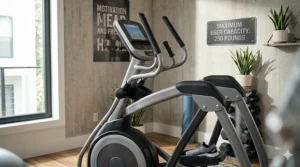
How to Choose a 250 Pound Capacity Elliptical: 7 Things That Actually Matter
Shopping for a mid-weight elliptical feels overwhelming until you realize most of the marketing noise is just that — noise. Here’s what actually moves the needle.
1. Capacity buffer, not capacity ceiling. A machine rated exactly at your body weight offers zero margin. Components wear faster. Sounds develop. Aim for a machine rated at least 25–50 lbs above your weight.
2. Stride length matches your height. Users under 5’6″ work comfortably with 14–16 inch strides. Anyone 5’7″ and above should target 18–20 inches. A too-short stride creates an unnatural choppy gait that strains the knees — the exact joint stress an elliptical is meant to prevent. According to Harvard Health Publishing, proper stride mechanics are fundamental to capturing elliptical training’s joint-protection benefits.
3. Flywheel weight determines ride quality. Budget machines with 7–10 lb flywheels have adequate momentum for light use but feel choppy at higher resistance levels. Machines with 13 lbs or more (the Sunny SF-E3912 hits 13.2 lbs; the Sole E25 hits 20 lbs) deliver the smooth, continuous motion that makes long sessions feel effortless rather than mechanical.
4. Front-drive vs. rear-drive matters for your goals. Front-drive ellipticals (Sole E25, ProForm Sport) offer more incline variety and a more upright posture. Rear-drive machines (Schwinn 430) feel more like a natural running motion and tend to have longer stride options. Neither is superior — it depends on your workout preference.
5. Warranty signals build confidence. A brand offering a lifetime frame warranty (Sole) is making a structural claim about their engineering. A 1-year frame warranty is a polite way of saying they’re not confident the machine will last long. Treat warranty terms as a proxy for build quality.
6. Resistance range determines longevity of challenge. A machine with 8 levels of resistance will feel easy within six months as your fitness improves. Twenty or more levels means the machine grows with you — you won’t outgrow it before the frame wears out.
7. Noise matters more than you realize. If you live in an apartment, have a sleeping baby, or work out before 7 a.m., a machine described as “quiet” versus one reviewed as “loud” is a dealbreaker, not a feature. Magnetic resistance systems are universally quieter than mechanical friction systems. Every machine on this list uses magnetic resistance — but user reviews on Amazon are the most reliable noise gauge.
Common Mistakes When Buying a 250 lb User Weight Elliptical
Even well-researched buyers fall into predictable traps. Here’s how to avoid the four most common ones.
Mistake #1: Treating the rated capacity as a comfortable operating weight. This is the single most costly mistake in this category. A machine rated at exactly 250 lbs that’s used by a 248-lb person daily is operating perpetually at 99% capacity. Drive components, pedal bearings, and frame welds all wear dramatically faster under this condition. The industry’s unwritten rule is to never operate consistently above 80% of rated capacity for sustained daily use.
Mistake #2: Prioritizing screen size over flywheel weight. It’s easy to be seduced by a touchscreen. But a 7-lb flywheel behind a beautiful touchscreen will deliver a choppier, more mechanical workout than a 20-lb flywheel behind a basic LCD. The screen entertains you. The flywheel determines how good the actual workout feels.
Mistake #3: Skipping the stride length calculation. Taller users routinely buy compact machines because they fit the space, then discover within two weeks that the short stride creates a marching-in-place sensation that’s both uncomfortable and ineffective. Measure your inseam before you buy. For every inch of inseam above 30 inches, add roughly half an inch to your ideal minimum stride length.
Mistake #4: Buying without reading the assembly reviews. Product pages show the finished machine. The assembly reviews tell you whether 63 people spent three hours frustrated with confusing instructions or 20 minutes following a clear manual. The ProForm Sport and Sunny SF-E3912 both earn strong assembly reviews. The Sole E25’s weight makes it a two-person job regardless of instructions clarity.
Elliptical vs. Treadmill for 250 lb Users: The Low-Impact Truth
| Feature | Elliptical | Treadmill |
|---|---|---|
| Joint impact | Low (near zero) | Moderate to high |
| Calorie burn per hour | 450–600 | 500–700 |
| Upper body engagement | Yes (with moving arms) | No |
| Noise level | Low (magnetic) | Moderate to high |
| Best for bad knees/hips | ✅ Yes | ❌ No |
| Learning curve | Minimal | Minimal |
For users at or near 250 lbs, this comparison isn’t academic — it’s physiologically important. According to the National Institutes of Health, elliptical training produces significantly lower peak tibial acceleration (a measure of bone impact stress) compared to treadmill running at equivalent cardiovascular intensity. In practical terms: for heavier users whose joints carry more load per stride, the elliptical’s near-zero impact isn’t just a comfort preference — it’s a biomechanical advantage that makes consistent long-term training actually sustainable.
The calorie difference between elliptical and treadmill at similar effort levels is smaller than most marketing implies — roughly 10–15% in favor of treadmills at high intensity. That gap shrinks further when you factor in the full upper-body engagement that a dual-action elliptical provides. For a 250 lb user trying to lose weight while protecting aging or overweight joints, the elliptical wins the cost-benefit analysis convincingly.
✨ Don’t Miss These Deals on Amazon!
🔍 Ready to bring your cardio home? Click any highlighted product name above to check current pricing and availability on Amazon. Every machine on this list is ready to ship — your first workout is closer than you think!
250 Pound Capacity Ellipticals for Beginners and Seniors: A Special Note
First-time elliptical users and older adults have a specific set of needs that generic buying guides consistently overlook, and it’s worth addressing them directly.
For beginners: The biggest mistake new users make is starting at resistance level 1 and wondering why they’re not sweating. Most magnetic ellipticals have light resistance at level 1 that’s almost too easy. Start at levels 4–6 and aim for a pace where you can hold a conversation but couldn’t sing comfortably — exercise scientists call this Zone 2 training, and according to the American Heart Association, it’s the sweet spot for building aerobic base and burning fat efficiently.
For seniors, the key feature to prioritize is handlebar stability. Fixed handlebars are often overlooked as “inferior” to moving arms, but for balance-compromised users, the ability to grip a stationary bar during the entire stride is a safety feature, not a downgrade. The Sole E25 and Schwinn 430 both include fixed stationary handlebars alongside the moving arms — you use whichever you need.
Low-impact doesn’t mean low-intensity. The Bowflex Max Trainer M6’s HIIT-oriented programs can deliver heart rates equivalent to sprinting within a few minutes — inside a footprint that fits most senior-owned homes. For older users who’ve been told by a physician to avoid high-impact activity but want genuine cardiovascular challenge, this machine’s design philosophy is tailor-made.
Long-Term Cost & Maintenance: What Nobody Tells You
The purchase price is only the beginning of the total cost of ownership conversation, and most 250 lb user weight elliptical reviews stop before it gets interesting.
Subscription costs add up fast. The ProForm Sport links to iFIT at $39/month (or ~$396/year). The Bowflex M6 connects to JRNY at ~$19.99/month after the trial. Over three years, that’s between $720 and $1,400 in platform fees on top of your hardware purchase. The Sunny SF-E3912 and Sole E25 require zero subscription for full function — their built-in programs are self-contained. For users who genuinely use these apps daily, they deliver real value. For users who plan to skip the subscription and just use manual mode, don’t pay extra for a touchscreen you won’t activate.
Expected maintenance timeline for 250 lb capacity machines:
- 6 months: First bolt tightening check. Normal heat cycling will have loosened a few.
- 12 months: Inspect the drive belt for wear or cracking on machines that have one. Wipe down the pedal rail.
- 2 years: On machines with mechanical contact heart rate sensors, the pads often oxidize and deliver inconsistent readings. A quick clean with isopropyl alcohol restores them.
- 3–5 years: Flywheel bearings can develop noise on budget machines. This is the point where a solid warranty matters — or where cheaper machines start requiring parts replacement.
The Sole E25’s lifetime frame and flywheel warranty directly addresses that 3–5 year window. The Schwinn 430’s 10-year frame warranty covers the same concern at a lower price point. Both are meaningfully better than the 1–5 year coverage offered by most of their competitors.
FAQ
❓ What is the best 250 lb elliptical for home use under $500?
❓ Can a 250 pound person use a 250 lb capacity elliptical safely?
❓ What stride length is best for a quarter ton elliptical machine?
❓ Do affordable 250 capacity ellipticals require monthly subscriptions?
❓ How long do mid-weight elliptical machines typically last?
Conclusion: The Right 250 Pound Capacity Elliptical Is the One You’ll Actually Use
The smartest fitness equipment investment isn’t the machine with the most features — it’s the machine that fits your life well enough that you’ll still be using it on a rainy Tuesday in November, three years from now.
For most buyers landing in the 250 lb range, the Sunny Health SF-E3912 hits the value sweet spot: it gives you 80 lbs of safety buffer over the 250 lb threshold, enough features to keep workouts interesting, and a price that doesn’t require a second mortgage. If budget isn’t your primary concern and you want something built to last a decade, the Sole E25 is the grown-up answer. For small-space HIIT lovers, the Bowflex M6 earns its price. And if you genuinely only need something that works at a desk — the Stamina InMotion E1000 is a legitimately smart solution that most serious review sites dismiss too quickly.
The common thread across all seven machines: they’re real, they’re available, and they’re honest about what they are. No more picking the wrong size and pretending you didn’t notice. You’ve got the full picture — now go use it.
✨ Found Your Machine? Don’t Wait!
🔍 Click any highlighted product name in this article to check current pricing and availability on Amazon. Prices on fitness equipment fluctuate frequently — the best time to buy is when you’ve done your research. That’s right now.
Recommended for You
- Conversation Level Elliptical: 7 Quietest Machines for 2026
- 7 Best Reduced Noise Elliptical Machines for Silent Workouts (2026)
- 7 Best Completely Silent Elliptical Machines of 2026 (Whisper-Quiet Picks)
Disclaimer: This article contains affiliate links. As an Amazon Associate, I earn from qualifying purchases. If you purchase products through these links, we may earn a small commission at no additional cost to you.
✨ Found this helpful? Share it with your friends! 💬🤗
