
In This Article
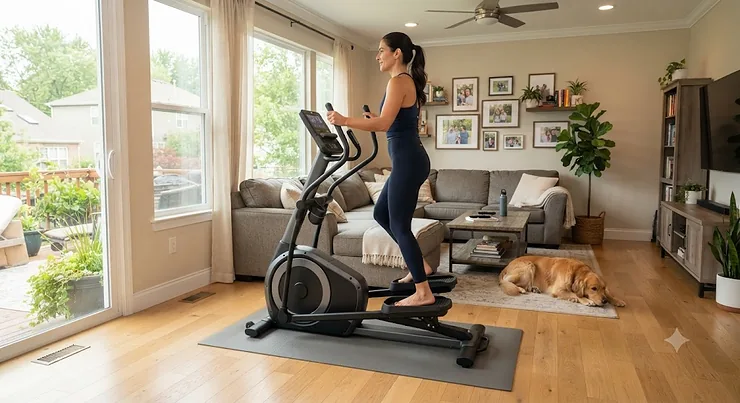
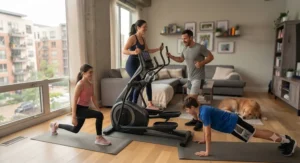
An elliptical for home family use is a low-impact cardio machine — usually front- or rear-drive, with adjustable stride and resistance — built to comfortably fit more than one body type, height, and fitness level in the same household. That’s the textbook version, anyway. The lived-in version looks more like this: your teenager wants intervals before soccer practice, your partner wants a slow incline walk while catching up on a show, and you want something your knees won’t hate you for tomorrow. One machine, three completely different jobs.
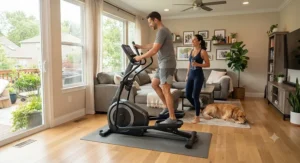
That’s a harder brief than it sounds. A lot of ellipticals are engineered for a single “average” rider — one stride length, one weight ceiling, one saved workout. Ask that same machine to flex between a 5’2″ parent and a 6’1″ teenager, and things get creaky fast, sometimes literally. So this guide isn’t a generic “best ellipticals” roundup dressed up with the word “family.” It’s specifically about which machines handle the handoff between users well, which ones quietly cap out around 220 pounds when your household needs 300+, and which “smart” features are genuinely useful versus expensive noise.
We researched seven real, currently available models spanning entry-level to premium, pulled specs straight from manufacturer data and hands-on reviewers, and layered in honest analysis about who each one actually suits. Federal exercise guidance calls for adults to log at least 150 minutes of moderate-intensity activity every week, according to the CDC’s physical activity guidelines — a target a shared home elliptical can make dramatically easier to hit, for everyone in the house, not just the one person who booked the gym membership. Let’s get into it.
Quick Comparison Table
| Product | Stride | Weight Capacity | User Profiles | Best For |
|---|---|---|---|---|
| NordicTrack AirGlide 7i | 20″ adjustable | 300 lb | Multiple (app-based) | Overall family versatility |
| NordicTrack FS14i FreeStride | 10″-20″ adjustable | 350 lb | Multiple (app-based) | Households with very different heights |
| Sole E35 | 20″ fixed | 350-375 lb | Multiple on-console | Bigger households, heavier riders |
| Schwinn 470 | 20″ fixed | 300 lb | 4 on-console | Best value multi-user pick |
| ProForm Carbon EL | 19″ adjustable | ~300 lb | Single | Budget with incline |
| Schwinn 411 | 18″ fixed | 300 lb | Single | Small spaces, single primary user |
| Sunny Health SF-E905 | Fixed, compact | 220 lb | None | Testing the waters cheaply |
Looking at the spread here, the two NordicTrack models and the Sole E35 pull ahead specifically on multi-user logistics — bigger weight ceilings and either app-based or on-console profiles that remember each person’s settings. The Schwinn 470 is the sweet spot for most families: four saved profiles at roughly half the price of the premium picks. The Schwinn 411 and Sunny Health SF-E905, meanwhile, are better thought of as single-user machines that happen to live in a shared house — fine for one dedicated user, riskier if three different body types are climbing on and off it weekly.
💬 Already narrowing it down? Jump straight to the pick that matches your household size below!😊
Top 7 Ellipticals for Home & Family Use: Expert Analysis
Here’s the full breakdown of all seven machines — real specs, honest trade-offs, and who each one is genuinely built for, not just who the marketing copy claims it’s for.
1. NordicTrack AirGlide 7i — best all-around pick for mixed-height households
The NordicTrack AirGlide 7i earns the top spot mostly because it refuses to specialize in only one type of user. Its 20-inch adjustable stride is engineered to comfortably fit riders roughly between 5’2″ and 6’4″, which in practice means your shortest and tallest household members can both use it without one of them wincing through the whole workout. Twenty-two levels of magnetic resistance give you enough range to go from a light recovery day to a leg-burning hill session, and a 25-pound flywheel keeps the motion smooth rather than jerky at low speeds — the kind of detail that matters a lot more once someone’s using it for 40 minutes instead of 10.
Based on the spec sheet, this is the machine for a household where nobody’s body type quite matches anyone else’s. It’s less obviously the right pick if you specifically want simple, no-subscription programming: the 7-inch HD touchscreen is built around iFIT-powered trainer sessions that adjust resistance and incline automatically, and getting real use out of that screen means paying for an iFIT plan on top of the machine — roughly $15 a month for one person or around $39 for a family plan. Reviewers note the console can feel underused without that add-on. Aggregated owner feedback consistently flags the stride smoothness and quiet operation as standouts, while a recurring complaint centers on the console nudging you toward the paid subscription more than some buyers expect.
Pros:
- ✅ 20-inch stride fits a wide range of family heights comfortably
- ✅ 22 resistance levels cover beginner through advanced sessions
- ✅ Heavy 25-lb flywheel keeps pedaling smooth and quiet
Cons:
- ❌ iFIT subscription needed to unlock full touchscreen value
- ❌ 300-lb weight capacity may be tight for larger households
Expect to pay in the $1,000-$1,300 range depending on current promotions — check current price before buying, since Amazon listings shift often. For a family that genuinely spans several heights and fitness levels, the NordicTrack AirGlide 7i is worth the mid-tier spend; if your household is closer in size and you don’t want a subscription nudge, keep reading.
2. NordicTrack FS14i FreeStride Trainer — most adjustable stride for very different body types
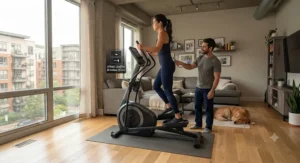
If the AirGlide 7i handles moderate height differences well, the NordicTrack FS14i FreeStride Trainer is built for the extreme version of that problem. Its headline feature is a free-stride system rather than a fixed oval path, letting the effective stride length shift across a wide range depending on how you move — meaning a much shorter user and a much taller one can each settle into a stride that actually fits their gait instead of fighting a one-size machine. What most buyers overlook about free-stride tech is that it doesn’t just change comfort — it changes injury risk, since a stride that’s too long for your legs forces awkward hip rotation over hundreds of reps a session.
The 14-inch HD touchscreen and iFIT integration mirror the AirGlide’s setup, complete with the same subscription requirement, so factor that into your total cost of ownership before comparing sticker prices. Reviewers who’ve used both the fixed-stride and free-stride NordicTrack lines tend to prefer this one specifically for households with teenagers and adults sharing the machine, since the stride adjustment takes seconds and doesn’t require tools.
Pros:
- ✅ Free-stride system adapts to very different leg lengths
- ✅ 350-lb weight capacity, highest among tested premium picks
- ✅ 14-inch touchscreen with strong iFIT workout library
Cons:
- ❌ Priciest option in this roundup by a clear margin
- ❌ iFIT subscription effectively required to justify the screen
Pricing typically lands in the $1,800-$2,100 range at the time of research, putting it well above the other six picks — a real premium, not a rounding error. This is the pick for a household where “one size fits all” has never actually worked, and you’re willing to pay for the adjustment range that solves it.
3. Sole E35 — best for bigger households and heavier riders
The Sole E35 solves a different family problem: weight capacity headroom. Depending on the exact production run, Sole rates the E35 at 350 to 375 pounds of user weight, among the highest in this lineup, and reviewers who’ve tested it specifically point out that its ability to save multiple profiles directly on the console makes it a genuinely practical option for households where more than one person wants regular use. That combination — high weight ceiling plus on-console profiles — is exactly what a multi-user home needs and what a lot of competitors quietly skip.
Here’s what the spec sheet won’t tell you outright: a 25-pound flywheel and a 20-inch stride mean the ride feels closer to commercial-gym quality than most machines under $2,000, but the trade-off is size and setup. Based on the spec comparison, this isn’t a machine you tuck into a corner and forget about — it needs a dedicated footprint, and reviewers consistently mention that assembly is a two-person job worth budgeting time (or a paid assembly fee) for. Aggregated review sentiment is strongly positive on build quality and long-term durability, backed by Sole’s lifetime frame and flywheel warranty, with the assembly process being the most repeated point of friction.
Pros:
- ✅ 375-lb weight capacity, highest tested in this roundup
- ✅ On-console multiple user profiles built in
- ✅ Lifetime frame and flywheel warranty
Cons:
- ❌ Large footprint with no folding option
- ❌ Assembly commonly described as a two-person, multi-hour job
Prices generally sit in the $1,500-$1,700 range — always check current pricing, since Sole runs frequent promotions. For a bigger family or a household where riders vary significantly in weight, the Sole E35 is one of the more honest multi-user values here.
4. Schwinn 470 — best value for multiple saved profiles
If the Sole E35 is the multi-user pick for bigger budgets, the Schwinn 470 is the multi-user pick for everyone else. Its console holds four separate saved user profiles alongside roughly two dozen preset workout programs, which in real terms means four different family members can each log in, pick up their saved resistance level, and not have to re-enter their stats every session — a small feature that removes a surprising amount of friction from actually getting on the machine regularly.
Its 20-inch stride length suits a height range of roughly 5 feet to about 6’3″, which covers most households comfortably, though it’s worth noting the frame runs slightly tighter than the Sole E35’s, and at least one testing panel found the layout cramped enough that a reviewer’s knee brushed the frame repeatedly during workouts. That’s a real trade-off for the price: you get four profiles and a proper stride length, but the frame geometry rewards average-to-tall users more than petite ones. Reviewer sentiment overall is positive on value and smoothness, with occasional durability complaints about pedal and handle hardware after a year or two of regular use.
Pros:
- ✅ Four saved user profiles at a mid-range price
- ✅ 20-inch stride and 25 resistance levels
- ✅ 10-degree motorized incline adds workout variety
Cons:
- ❌ Frame can feel tight for petite users
- ❌ Some owners report hardware wear after a year or two
Typical pricing runs around $900-$1,100 — check current price, as this model frequently sees discounts. For families of three or four who each want their own saved settings without paying premium prices, the Schwinn 470 is the most balanced pick in this whole lineup.
5. ProForm Carbon EL — best budget pick with real incline
The ProForm Carbon EL targets a specific gap: incline adjustment at a genuinely low price. A 20-degree adjustable ramp with five positions lets you shift the workout’s muscle focus without buying a pricier machine, and a roughly 19-inch power-adjustable stride gets close to the 20-inch “gold standard” stride length usually reserved for higher-tier models. Based on the spec comparison, this is unusually generous engineering for a machine that regularly sells under $800.
The catch, and it’s a meaningful one for a family machine, is weight capacity — listings and reviewers put the practical limit somewhere around 275 to 300 pounds, on the lower end for this roundup, and there’s no on-console multi-user profile system, just app pairing through iFIT, Strava, Garmin, Google Fit, or Apple Health. What most buyers overlook is that “smart-app compatible” isn’t the same thing as “built for multiple users” — it just means each person needs their own phone logged into their own app to get personalized tracking, which is a workable system but a more manual one than a saved on-console profile. Reviewer sentiment is consistently positive on value for the incline feature specifically, with the weight capacity being the most repeated caution for larger households.
Pros:
- ✅ 20-degree power incline rare at this price point
- ✅ 19-inch adjustable stride, close to premium-tier length
- ✅ Silent magnetic resistance keeps operation quiet
Cons:
- ❌ Weight capacity lower than most rivals here
- ❌ No on-console profiles, relies on app pairing instead
Expect a price in the $700-$900 range, occasionally dipping lower during sales — always confirm the current price before ordering. This is a strong pick for a lighter, incline-curious household on a tighter budget, less so if anyone in the family is near or over that weight ceiling.
6. Schwinn 411 — most compact for small apartments and single-primary-user homes
The Schwinn 411 is the space-saver of this group. At roughly 54 inches long by 24 inches wide, it fits into rooms where the other six machines simply wouldn’t, and its 18-inch stride is notably longer than most competitors in this price range, which is a genuinely impressive spec for a machine this compact and this cheap. Sixteen levels of eddy current resistance and a fixed frame keep the mechanics simple, which honestly works in its favor — fewer moving parts, fewer things to eventually break.
Here’s the honest trade-off for a family shopping specifically for multi-user use: the 411’s console is built around a single saved user profile, compared with four on the pricier Schwinn 470, so it’s genuinely designed around one primary rider rather than a rotating household. It’ll still physically hold multiple people fine — a 300-pound weight limit and a height range stretching from roughly 4’6″ to 6’2″ are generous for a budget machine — but everyone will be sharing one set of saved settings, which gets old fast in a house with different fitness levels. Aggregated reviews consistently praise the stride length for the price and the compact footprint, with the single profile and lighter overall build being the most common trade-off buyers mention.
Pros:
- ✅ Compact footprint fits small rooms and apartments
- ✅ 18-inch stride is unusually long for the price
- ✅ 300-lb capacity and generous height range for a budget unit
Cons:
- ❌ Only one saved user profile, not built for rotating users
- ❌ Lighter frame can feel less stable at high resistance
Pricing generally sits in the $400-$550 range, making it one of the most affordable full-size options here — check current price for exact figures. Think of the Schwinn 411 as the right call for a small space with one clear primary user and occasional guest use, rather than a true four-person rotation machine.
7. Sunny Health & Fitness SF-E905 — best for testing the waters before a bigger investment
The Sunny Health & Fitness SF-E905 is the entry point of this entire list, and it’s worth being upfront about what that means. It weighs roughly 60 to 70 pounds fully assembled and is rated for a maximum user weight of about 220 pounds — the lowest capacity here by a wide margin — and there’s no user-profile system at all, just an eight-level manual tension dial and a basic LCD display tracking time, speed, distance, and calories. Based on the spec comparison, this machine isn’t really competing on family versatility; it’s competing on price and footprint.
That’s not necessarily a knock. As one review guide framed it, a machine like this is a low-cost way to find out whether elliptical training will actually stick before spending real money on it, and for a household that isn’t sure it will, that’s a legitimately useful role. The trade-off is real, though: at roughly a 220-pound weight limit, several members of an average family will simply be over the recommended ceiling, and the light frame means noticeably less stability at higher resistance than the heavier machines on this list. Reviewer sentiment is mixed but generally fair for the price — people who fit comfortably within the weight limit report a workable, low-cost way to start, while heavier users and those wanting a sturdier feel steer toward the pricier picks above.
Pros:
- ✅ Very low price point for a first elliptical
- ✅ Compact and lightweight, easy to move or store
- ✅ Simple 8-level resistance dial, no learning curve
Cons:
- ❌ Only about 220-lb weight capacity, low for a shared household
- ❌ No user profiles, no incline, minimal display data
Typical pricing runs around $180-$250, making it the cheapest machine on this list by a wide margin — as always, confirm the current price at checkout. Treat the Sunny Health & Fitness SF-E905 as a genuine “try it before you commit” option, not a long-term multi-user solution.
How to Choose an Elliptical Machine for Multiple Users
Picking an elliptical machine for multiple users comes down to fewer variables than the spec sheets make it look like. Here’s the actual decision order, based on what tends to break down first in a shared household:
- Weight capacity first, always. Add roughly 50-75 pounds of headroom above your heaviest regular user — a machine rated exactly at someone’s body weight wears out faster and feels less stable.
- Stride length and adjustability second. A fixed 18-20 inch stride works fine if your household’s heights are within a few inches of each other; an adjustable or free-stride system earns its higher price if they’re not.
- User profiles third. On-console profiles (like the Sole E35 or Schwinn 470) beat app-based tracking for pure convenience, since nobody needs their phone to start a workout.
- Resistance range fourth. Look for at least 16-20 levels so a beginner and an advanced user both have real room to work within on the same machine.
- Footprint and floor space fifth. Measure the space before falling for a spec sheet — a 20-inch-stride premium machine won’t matter if it doesn’t fit the room.
- Noise level sixth, especially relevant if the machine shares a wall with a bedroom or a video call setup.
- Warranty and assembly reality seventh. Heavier, sturdier machines like the Sole E35 often need two people and an afternoon to assemble — budget the time, or the optional paid assembly fee, before delivery day.
Working through that order in sequence — rather than starting with screen size or brand name, which is where most people start — tends to surface the right machine for a shared household a lot faster.
Adjustable Settings Elliptical Family Setup Guide: First 30 Days and Ongoing Maintenance
Getting the adjustable settings on a family elliptical dialed in correctly in the first week matters more than most buyers expect — a stride or resistance level set wrong early on is exactly why some machines end up as expensive coat racks by month two.
Week one: Have every regular user complete a short setup session rather than eyeballing settings. On adjustable-stride machines like the NordicTrack AirGlide 7i or FreeStride FS14i, dial the stride to a length where the knee stays close to a natural walking angle — not overstretched, not cramped. Save that as a profile immediately if the console supports it.
Weeks two through four: This is when loose bolts and squeaky pivot points show up, especially on lighter frames like the Schwinn 411 or Sunny Health SF-E905. A five-minute monthly check — tightening visible bolts, wiping down pedal tracks, checking that leveling feet still sit flush — heads off most of the wobble complaints reviewers mention.
Common first-30-days mistakes: skipping the individual profile setup and just sharing one generic resistance level (which shortchanges whoever’s more advanced); placing the unit on carpet without a mat, which traps dust in the flywheel mechanism; and over-tightening the pedal bolts, which reviewers note is a common cause of early squeaking on budget models. A rubber-backed equipment mat under the whole footprint, wiped-down pedal tracks weekly, and a proper monthly bolt check are the three habits that separate a machine that lasts five years from one that starts creaking by month six.
Real-World Family Scenarios: Who Should Buy What
Matching a machine to a household is easier with a concrete profile in mind rather than an abstract spec comparison.
The mixed-height family of four, budget around $1,000: Two parents, a teenager, and a tween, ranging from 5’1″ to 6’2″. The Schwinn 470 fits this household well — four saved profiles cover everyone, the 20-inch stride handles most of that height range, and the price leaves room for a mat and accessories without stretching the budget.
The multigenerational household with a heavier primary user: A grandparent managing joint pain alongside two adult children, one of whom is over 250 pounds. The Sole E35‘s high weight capacity and on-console profiles make it the safer long-term investment here, even at a higher price, since undersizing weight capacity in this scenario risks both safety and machine longevity.
The small apartment with one dedicated user and occasional guests: A single professional in a one-bedroom, with a partner who uses it a few times a month. The Schwinn 411‘s compact footprint and generous stride-for-price ratio suit this household better than a bulkier premium machine that would dominate the living room.
Common Mistakes When Buying a Family Friendly Elliptical Trainer
The most expensive mistake buyers make with a family friendly elliptical trainer is optimizing for the person doing the shopping instead of the household using the machine. A parent who’s 5’9″ picks a fixed 18-inch stride that feels great to them and cramped to a 6’2″ teenager six months later.
A second common mistake is ignoring weight capacity math entirely — treating the manufacturer’s number as a hard ceiling for the single heaviest user, rather than building in headroom, which accelerates wear and voids some warranties early. A third is skipping the profile-and-tracking question until after purchase, only to discover the “smart” machine requires four separate phone apps logged in for four family members to get personalized data, which in practice means nobody bothers and everyone just uses manual mode. And a fourth, subtler mistake: buying based on flywheel weight or resistance-level count alone, without checking whether the frame width and handlebar spacing actually suit a shorter or narrower-shouldered user comfortably — two machines with identical resistance specs can feel completely different to two different bodies.
Multi-User Profile Fitness Machine vs Single-User Elliptical
The gap between a true multi-user profile fitness machine and a single-user elliptical isn’t really about the hardware — most of these machines share similar flywheels, belts, and resistance systems. It’s about what happens to the data and the settings between sessions.
On a single-profile machine like the Schwinn 411 or the profile-less Sunny Health SF-E905, every user starts from the same default resistance and has to manually re-adjust each time, and calorie or distance tracking gets muddled if two people use it back to back without resetting. On a true multi-profile machine like the Schwinn 470 or Sole E35, each person logs in, the resistance and incline recall their last session, and the tracked stats stay meaningfully personal rather than an averaged mess. The premium tier — the NordicTrack AirGlide 7i and FreeStride FS14i — pushes this further through app-based profiles tied to iFIT accounts, which adds richer tracking but also adds a subscription dependency the on-console systems don’t have.
Practically speaking, a household of two fairly similar adults may not notice much difference either way. A household spanning kids, teens, and adults at very different fitness levels will feel the difference from week one — the multi-profile systems remove the friction that otherwise makes people just skip logging in altogether.
Family Friendly Elliptical Trainer Features That Actually Matter (And Those That Don’t)
Marketing copy for a family friendly elliptical trainer tends to spotlight the same handful of features, and not all of them earn the attention.
Actually matters: weight capacity headroom, adjustable or generous fixed stride length, on-console multi-user profiles, and flywheel weight (heavier generally means smoother, quieter motion). These directly affect whether every household member can use the machine comfortably and safely, session after session.
Doesn’t matter as much as it seems: built-in speaker systems (a phone or tablet does the job fine), an enormous number of preset programs (most households settle into two or three favorites within weeks, regardless of whether the console offers 10 or 30), and touchscreen size beyond what’s needed to read your stats clearly from arm’s length. Exercise physiology research summarized by patient-advocacy groups has found that the energy your body burns running on a flat treadmill and pedaling an elliptical at a similar pace ends up fairly comparable, even though the perceived effort can feel quite different between the two — a reminder that raw calorie-burn marketing claims matter less than whether people in your specific household will actually use the machine consistently.
Elliptical for Home Family Use: What to Expect for Every Age Group
An elliptical for home family use behaves differently depending on who’s on it, and setting expectations by age group helps avoid disappointment.
Teenagers and active adults get the most out of higher resistance levels and interval programming — this is where the 20-25 resistance-level machines like the Schwinn 470 or Sole E35 earn their keep, letting a fitter user actually work hard rather than pedaling through a maxed-out setting in minutes.
Parents managing time constraints tend to value quick-start simplicity over deep programming — being able to hop on, load a saved profile, and go in under a minute matters more to this group than a library of workout videos they’ll rarely open.
Older adults or anyone managing joint concerns benefit most from the low-impact motion itself. Low-impact machines including ellipticals are a commonly recommended option for people managing arthritis pain in the hips, knees, or ankles, according to Mayo Clinic’s guidance on exercising with arthritis — though starting at a lower resistance and shorter session length is worth discussing with a healthcare provider first, particularly for anyone new to exercise or managing an existing condition.
Younger children shouldn’t be using any of these machines unsupervised at all — more on that in the safety section below.
Shared Home Gym Equipment: Long-Term Cost & Maintenance
Treating an elliptical as shared home gym equipment changes the total cost of ownership math compared to buying it for one person. More users means more cumulative hours on the belt and bearings, which shortens the runway before parts wear out — but it also means the cost per workout drops fast, since you’re spreading one purchase price across every family member’s sessions instead of one.
A rough way to think about it: a $1,000 machine used by four people three times a week works out to roughly 600-plus sessions in its first year alone, putting the cost-per-use well under $2 almost immediately — a fraction of even a basic single-person gym membership, before accounting for gas or travel time. The trade-off is maintenance frequency. Multi-user machines need bolt checks and belt inspections more often than single-user ones simply because of the added wear, and budget frames — the Schwinn 411 and Sunny Health SF-E905 among them — will show that wear sooner than the heavier-duty Sole E35 or Schwinn 470. Budgeting for an annual belt or pedal-bearing replacement, typically in the $30-$60 range for parts, keeps a heavily used family machine running well past its warranty window.
✨ Ready to stop guessing and start comparing real listings? Check current availability and pricing on the picks above! 🔋
Safety & Space: Keeping Kids Safe Around a Family Elliptical
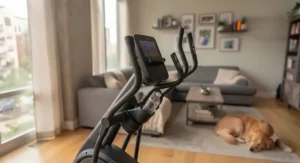
Bringing home shared exercise equipment changes the safety calculus of a room, especially with young children in the house. Moving parts, pinch points, and a machine that’s genuinely heavy enough to injure a small child if it tips are real considerations, not hypothetical ones. Tens of thousands of children are treated in U.S. emergency departments every year for injuries linked to home exercise equipment, ranging from friction burns to fingers or limbs caught in moving parts, according to HealthyChildren.org’s guidance on childproofing home exercise equipment, a resource published by the American Academy of Pediatrics.
Physicians who specialize in pediatric safety generally recommend restricting a young child’s access to the room entirely — a closed door, a gate across the doorway, or a barrier around the equipment itself — rather than relying on supervision alone while the machine is in motion. Practical steps that fit an elliptical specifically: unplug or power down the console when not in use, keep the area under the pedals clear of toys that could cause a trip, and set clear rules for older children about supervised-only use until they’re tall and coordinated enough to use the stride safely. None of the seven machines in this guide include child-lockout features, so the responsibility sits entirely with household setup and supervision — worth factoring into where in the home the machine ultimately lives.
Frequently Asked Questions
❓ How much weight capacity do I need for an elliptical for home family use?
❓ Can one elliptical really work for both short and tall family members?
❓ Do multi-user profiles actually make a difference day to day?
❓ Is a cheaper elliptical machine for multiple users worth it for a family just starting out?
❓ How often should a shared elliptical be maintained?
Conclusion
Choosing an elliptical for home family use really comes down to being honest about who’s actually going to use it and how often, rather than shopping for the single most impressive spec sheet. The NordicTrack AirGlide 7i and FreeStride FS14i solve the mixed-height, feature-rich end of the problem if the budget allows it. The Sole E35 and Schwinn 470 hit the sweet spot most multi-person households actually need — solid weight capacity, real user profiles, sane pricing. And the ProForm Carbon EL, Schwinn 411, and Sunny Health SF-E905 all serve a real purpose too, whether that’s a tighter budget, a smaller room, or simply testing whether elliptical training sticks before committing further.
None of these machines are a bad purchase in isolation — they’re just built for different households. Match the weight capacity, stride length, and profile system to your specific family, not the other way around, and whichever one you land on should earn its floor space for years, not months.
✨ Don’t Miss These Exclusive Deals!
🔍 Take your home cardio setup to the next level with one of the picks above. Click through to check current pricing and availability before deciding. A machine that fits your whole household is worth the extra five minutes of comparison shopping!
Recommended for You
- Best Elliptical for Athletes: 7 Top Picks Tested for 2026
- Elliptical for Heavy Person: 7 Best Heavy-Duty Picks (2026)
- Elliptical for Short Person: 7 Picks That Actually Fit (2026)
Disclaimer: This article contains affiliate links. As an Amazon Associate, I earn from qualifying purchases. If you purchase products through these links, we may earn a small commission at no additional cost to you.
✨ Found this helpful? Share it with your friends! 💬🤗
