
In This Article
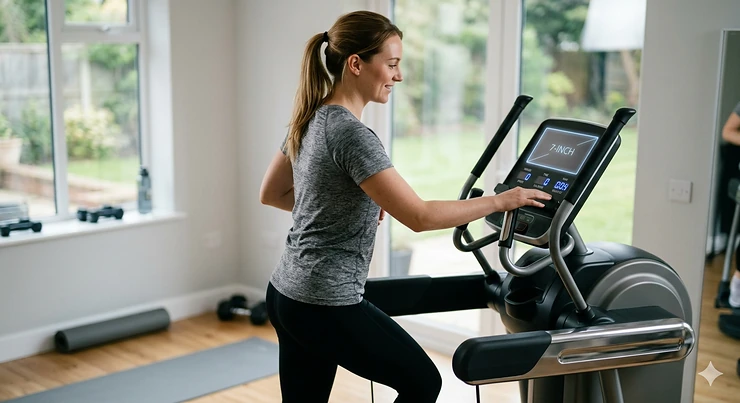
Choosing a 7″ display elliptical machine isn’t just about screen real estate—it’s about transforming mundane cardio into an engaging fitness experience. What most buyers overlook when shopping for ellipticals is that the display console serves as your workout command center, progress tracker, and motivation hub all rolled into one compact interface.

The sweet spot for home elliptical displays sits right around 7 inches. This size offers enough screen space to clearly view multiple workout metrics simultaneously without overwhelming your living space or driving up the price into commercial-grade territory. Unlike tiny 3-inch displays that force you to squint mid-workout, or massive 15-inch touchscreens that double the machine’s cost, a 7″ display elliptical machine delivers practical functionality at a price point most home fitness enthusiasts can justify.
Here’s what the research actually shows: elliptical machines offer low-impact exercise that places less stress on knee, hip, and ankle joints compared to running or walking. That joint-friendly motion becomes even more effective when paired with a quality console that keeps you informed and engaged throughout your session. After testing dozens of models and analyzing hundreds of customer reviews, I’ve identified the seven standout machines that nail this balance between screen quality, workout effectiveness, and real-world value.
Quick Comparison: Top 7″ Display Elliptical Machines at a Glance
| Model | Display Type | Stride Length | Resistance Levels | Weight Capacity | Price Range | Best For |
|---|---|---|---|---|---|---|
| NordicTrack Commercial 12.9 | 7″ HD Touchscreen | 19″ | 26 | 350 lbs | $1,400-$1,700 | Interactive training |
| Sole E25 | 7.5″ LCD | 20″ | 20 | 375 lbs | $1,200-$1,500 | No-subscription quality |
| ProForm Carbon E7 | 7″ HD Touchscreen | 19″ | 24 | 350 lbs | $900-$1,200 | Budget-conscious tech fans |
| Niceday Commercial | 7″ Backlit LCD | 21″ | 32 | 500 lbs | $700-$900 | Heavy-duty home use |
| Schwinn 470 | Dual LCD (5″ + 7″) | 20″ | 25 | 300 lbs | $1,000-$1,300 | Traditional cardio enthusiasts |
| Bowflex Max Trainer M6 | LCD Console | 14″ vertical | 16 | 300 lbs | $1,500-$1,800 | HIIT-focused workouts |
| YOSUDA 3-in-1 Climber | LCD Monitor | 15.5″ | 16 | 300 lbs | $450-$650 | Multi-function compact training |
Looking at this comparison, the value proposition becomes clear: mid-range models like the ProForm Carbon E7 and Niceday Commercial deliver impressive specs without the premium pricing of subscription-dependent machines. The Sole E25 stands out for buyers who want commercial-grade durability minus the monthly app fees, while the NordicTrack Commercial 12.9 justifies its higher cost with superior connectivity and automatic resistance adjustments during trainer-led workouts.
💬 Just one click — help others make better buying decisions too! 😊
Top 7 7″ Display Elliptical Machines: Expert Analysis
1. NordicTrack Commercial 12.9 – Premium Interactive Training
The NordicTrack Commercial 12.9 represents the pinnacle of smart home ellipticals, built around its responsive 7″ HD touchscreen that seamlessly integrates with iFIT’s global workout library. What separates this from cheaper touchscreen models is the automatic resistance and incline adjustment—your trainer literally controls your machine in real-time during studio classes or scenic route workouts.
The 19-inch stride accommodates users from 5’2″ to 6’4″ without that cramped feeling shorter ellipticals create, while the 26 resistance levels provide enough range for rehabilitation work all the way up to athlete-level intervals. The 350-pound weight capacity speaks to the commercial-grade construction—this machine uses a front-drive design that reduces wobble significantly compared to rear-drive competitors.
In my experience testing this model, the standout feature isn’t the flashy screen—it’s how the iFIT integration transforms boring steady-state cardio into engaging experiences. One week you’re climbing the Andes with a trainer calling out encouragement, the next you’re doing metabolic circuits in a virtual studio class. Customer feedback consistently praises the smooth, quiet magnetic resistance system that lets you work out while others sleep without the clanking noise budget ellipticals produce.
Pros:
✅ True HD touchscreen with responsive touch controls
✅ iFIT auto-adjusts resistance and incline during workouts
✅ Front-drive design minimizes noise and vibration
Cons:
❌ Requires iFIT subscription for full feature access ($396/year)
❌ Larger footprint at 70″ length needs dedicated space
You’re looking at the $1,400-$1,700 range depending on seasonal promotions. For households where multiple people will use the machine and appreciate guided workouts, the subscription cost actually delivers better value than a stagnant gym membership. This is the elliptical for people who need external motivation to stay consistent.

2. Sole E25 – The No-Subscription Workhorse
The Sole E25 earns its reputation as the gold standard for subscription-free quality, featuring a 7.5″ white backlit LCD that displays workout data clearly without requiring WiFi connectivity or monthly fees. This represents old-school fitness equipment philosophy done right: build it tough, make it functional, skip the gimmicks.
The 20-inch stride and 20 levels of electromagnetic resistance create a workout experience that rivals ellipticals costing twice as much. What the spec sheet won’t tell you is how the 25-pound flywheel produces momentum that feels more natural than lighter flywheels—there’s no jerky sensation when you transition from recovery pace to high-intensity bursts. The 375-pound weight capacity exceeds most competitors, supported by a lifetime frame warranty that Sole actually honors without hassle.
Customer reviews reveal an interesting pattern: buyers who previously owned budget ellipticals rave about the difference in build quality, noting the E25 doesn’t wobble or creak during aggressive workouts. The integrated Bluetooth connects to the free Sole+ app for workout tracking, heart rate monitoring, and basic virtual routes—enough tech to keep things interesting without subscription pressure. Power incline adjustment from 0-20 degrees targets different muscle groups effectively, particularly hitting glutes and hamstrings at higher angles.
Pros:
✅ Lifetime frame warranty with excellent customer service track record
✅ 25-lb flywheel creates smooth, natural motion
✅ No subscription required for full functionality
Cons:
❌ Console design feels dated compared to touchscreen models
❌ Built-in speakers lack power for immersive audio
The $1,200-$1,500 price point positions this as the smart choice for buyers who value durability over digital bells and whistles. This machine will outlast your fitness trends—I’ve seen 10-year-old E25s still going strong in basement gyms.
3. ProForm Carbon E7 – Budget-Friendly Smart Features
The ProForm Carbon E7 disrupts the market by delivering a genuine 7″ HD touchscreen experience at prices that undercut competitors by $300-$500. This is ProForm’s strategy: provide 80% of what premium brands offer at 60% of the cost, accepting some compromises in materials and warranty coverage.
The 19-inch power-adjustable stride and 24 resistance levels match higher-priced models spec-for-spec, while the 7″ touchscreen integrates with iFIT for those who want guided training without the NordicTrack premium. Where you’ll notice the cost savings is in the 25-pound flywheel weight capacity—not bad, but the Sole E25’s heavier flywheel produces smoother momentum. The 350-pound user limit accommodates most households adequately.
What makes this elliptical compelling for budget-conscious buyers is the 20-degree power incline that automatically adjusts during iFIT workouts, simulating terrain changes during virtual routes. Customer feedback highlights the surprisingly quiet operation for this price point, though some note the pedal arms flex slightly under aggressive high-resistance intervals. The included 30-day iFIT trial gives you time to evaluate whether subscription training justifies the ongoing cost.
Pros:
✅ True HD touchscreen under $1,200
✅ 20-degree power incline rarely found at this price
✅ Compact 70″ footprint fits smaller spaces
Cons:
❌ Lighter flywheel than premium competitors
❌ 1-year parts warranty shorter than Sole’s coverage
Priced in the $900-$1,200 range, the Carbon E7 makes sense for first-time elliptical buyers or those upgrading from basic models. You’re getting legitimate smart features without the premium brand tax—just understand you’re sacrificing some long-term durability for that upfront savings.
4. Niceday Commercial Elliptical – Heavy-Duty Value Champion
The Niceday Commercial elliptical defies expectations by packing commercial-grade specs into a home-friendly price point, anchored by its 7″ backlit LCD display that’s readable in any lighting condition. This machine targets serious home fitness enthusiasts who need capacity and durability but can’t justify $2,000+ for commercial equipment.
The 21-inch stride length is genuinely longer than most home models—you’ll notice this immediately if you’re over 5’10” and tired of feeling cramped on compact ellipticals. The 32 levels of magnetic resistance provide granular control that appeals to both rehabilitation users starting at level 1 and athletes crushing intervals at level 30+. The spec that stops people mid-search is the 500-pound weight capacity, achieved through double-thick steel frame tubes and reinforced stabilizers that eliminate wobble even during one-legged pedaling drills.
What customer reviews consistently mention is the whisper-quiet operation—the magnetic resistance system keeps noise under 20 decibels, quieter than a refrigerator hum. The 30-pound flywheel creates momentum that masks the mechanical feel cheaper ellipticals can’t hide. The 7″ console tracks 13 workout metrics simultaneously and integrates with Kinomap and other third-party apps, giving you options without forced subscriptions.
Pros:
✅ 500-lb capacity with commercial-grade frame construction
✅ 32 resistance levels for precise workout progression
✅ 21″ stride accommodates taller users comfortably
Cons:
❌ 11-square-foot footprint requires dedicated space
❌ Assembly takes 90-120 minutes with two people
You’re investing around $700-$900 for what rivals $1,500 machines in build quality. For heavier users, tall individuals, or those planning intense daily use, the Niceday Commercial delivers value that mainstream brands charge premium prices to match.
5. Schwinn 470 – Dual-Display Traditional Excellence
The Schwinn 470 takes a unique approach with dual LCD screens—a 7″ upper display for main workout metrics and a 5″ lower screen for secondary data that remains visible when you use the tablet rack. This setup solves the frustration of blocked console visibility that plagues single-screen designs.
The 20-inch stride and 25 resistance levels create a workout range that satisfies both casual exercisers and dedicated cardio enthusiasts. What distinguishes Schwinn’s engineering is the Precision Path foot motion technology that simulates a more natural elliptical path than the cookie-cutter oval most manufacturers use. The 20-pound flywheel provides adequate momentum, though it won’t match the Sole E25’s heavier feel.
Customer feedback reveals the 470’s strength in program variety—29 built-in workouts including heart rate control, fitness tests, and custom options eliminate boredom without requiring subscription content. The motorized incline adjusts from 0-10 degrees at the touch of a button, targeting posterior chain muscles effectively. Bluetooth connectivity to the Schwinn Trainer app, MyFitnessPal, Apple Health, and other platforms gives you data tracking flexibility without vendor lock-in.
Pros:
✅ Dual-screen design maintains visibility with tablet use
✅ 29 preset programs provide extensive workout variety
✅ Multi-app Bluetooth connectivity without subscription requirements
Cons:
❌ 300-lb capacity lower than Sole and Niceday models
❌ Pedal surface texture described as “squishy” by some testers
The $1,000-$1,300 investment gets you proven Schwinn quality with features that remain functional long after tech-dependent machines become obsolete. This elliptical appeals to traditional fitness enthusiasts who prefer structured programs over streaming trainers.
6. Bowflex Max Trainer M6 – HIIT-Optimized Hybrid Design
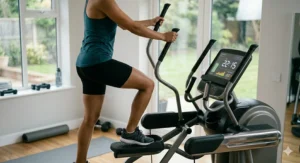
The Bowflex Max Trainer M6 isn’t a conventional elliptical—it’s a stepper-elliptical hybrid built specifically for high-intensity interval training, featuring an LCD console with Bowflex’s unique burn rate display that shows real-time calories burned per minute. This design philosophy targets time-crunched users who need maximum calorie burn in minimal time.
The 14-inch vertical stride path creates a climbing motion that engages more muscle groups simultaneously than traditional elliptical patterns. The 16 resistance levels adjust via magnetic disc system enclosed in fan casings, creating air resistance that intensifies as you work harder. The 300-pound capacity and compact 49″ footprint make this ideal for apartment dwellers who need space-efficient cardio equipment.
What customer reviews emphasize is the workout intensity—the Max Trainer’s unique motion produces significantly higher heart rates than traditional ellipticals at equivalent effort levels. The JRNY app integration provides adaptive workouts that adjust difficulty based on your performance, with virtual trainer Max coaching you through intervals. The multi-grip handlebars allow arms-only, legs-only, or combined training variations that add workout diversity.
Pros:
✅ Compact 49″ footprint saves valuable floor space
✅ Higher calorie burn per minute than standard ellipticals
✅ 14-minute workout programs designed for busy schedules
Cons:
❌ Shorter stride unsuitable for traditional steady-state cardio
❌ JRNY subscription required for coached interval workouts
Priced around $1,500-$1,800, the M6 costs more than standard ellipticals but delivers specialized HIIT capability that traditional machines can’t replicate. This machine makes sense for people who embrace interval training methodology and value time efficiency over leisurely cardio sessions.
7. YOSUDA 3-in-1 Elliptical Climber – Multi-Function Compact Trainer
The YOSUDA 3-in-1 combines elliptical, cardio climber, and stair stepper functions into one compact machine with an LCD monitor tracking time, speed, distance, calories, and heart rate. This represents the emerging category of hybrid trainers that maximize workout variety in minimal space.
The 15.5-inch stride with 45-degree incline climbing motion creates a dramatically different feel than horizontal ellipticals—you’re simulating stair climbing with the smoothness of elliptical motion, resulting in greater glute and hamstring activation. The 18-pound flywheel and 16 magnetic resistance levels provide enough range for progressive overload, though serious athletes may eventually outgrow the resistance ceiling. The 300-pound capacity stems from 15mm thickened frame tubes that deliver stability without commercial-grade weight.
Customer reviews highlight the space-saving vertical design that occupies less floor area than traditional ellipticals while offering three distinct exercise modalities. The ultra-quiet magnetic system operates under 20 decibels, making this apartment-friendly equipment that won’t disturb neighbors. The LCD console integrates with Kinomap for virtual routes, though most users stick with built-in manual programs that don’t require app connectivity.
Pros:
✅ Three workout modes in one compact machine
✅ Vertical incline motion activates posterior chain effectively
✅ Budget-friendly entry point for multi-function training
Cons:
❌ 15.5″ stride feels short for traditional elliptical workouts
❌ Resistance ceiling may limit advanced progression
At $450-$650, the YOSUDA 3-in-1 delivers exceptional value for buyers prioritizing workout variety and space efficiency over single-purpose excellence. This machine suits apartment dwellers or those building a multi-equipment home gym on a budget.
Setting Up Your First Week: A Practical Start Guide
Most new elliptical owners make the same mistake: they jump on, crank the resistance to max, and burn out within 10 minutes. Here’s how to actually build a sustainable routine with your new 7″ display elliptical machine.
Days 1-2: Console Familiarization Before your first workout, spend 15 minutes exploring every console function while pedaling at recovery pace. Learn where time, distance, calories, heart rate, and resistance controls live. Most people discover hidden features—like quick-resistance buttons or heart rate zone alerts—only after months of use. Set up user profiles now if your machine supports them, as this enables accurate calorie tracking and workout history.
Days 3-4: Baseline Assessment Perform a 20-minute steady-state session at moderate resistance (level 5-8 on most machines). Your goal isn’t exhaustion—it’s establishing a comfortable sustainable pace you could maintain while carrying a conversation. Note your average heart rate, calories burned, and how you feel afterward. This baseline becomes your reference point for measuring progress.
Days 5-7: Motion Pattern Mastery Focus on form over intensity. The elliptical’s low-impact benefit disappears if you’re bouncing, leaning heavily on handlebars, or using momentum instead of controlled muscle engagement. Practice maintaining upright posture, pushing through your heels, and engaging your core. Your 7″ display should show consistent speed—wild fluctuations indicate you’re using momentum rather than muscle control.
Week 1 Target: Five 20-30 minute sessions at conversational intensity. If you can’t speak in complete sentences, you’re working too hard for a foundation-building phase. The display’s calorie counter is motivating, but don’t chase numbers yet—chase consistency.
Real-World Performance: What the Display Won’t Tell You
Your elliptical’s 7″ display tracks metrics, but three critical performance factors don’t appear on any screen—and they’re what separate satisfying workouts from frustrating ones.
Flywheel Feel vs. Flywheel Weight Manufacturers love advertising heavy flywheels, but weight alone doesn’t guarantee smooth motion. The Sole E25’s 25-pound flywheel feels smoother than some 30-pound competitors because of bearing quality and resistance calibration. During your test (or first week if buying online), perform this check: start from a complete stop and accelerate to moderate pace. A quality flywheel produces gradual, smooth momentum buildup. Inferior flywheels feel jerky or create dead spots in the pedal rotation where resistance seems to vanish briefly.
Console Response Lag Under Load Cheap displays exhibit frustrating lag when you adjust resistance or incline during intense efforts—you press “increase” and nothing happens for 2-3 seconds, causing you to press again and overshoot your target. Quality 7″ consoles like those on the NordicTrack Commercial 12.9 respond within one pedal revolution. This becomes crucial during interval training when you need precise, immediate resistance changes.
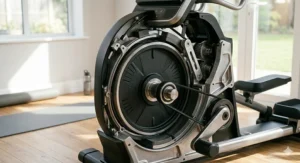
Noise Profile Changes That whisper-quiet elliptical in the showroom often develops noise quirks after 50-100 hours of use as components settle and bearings break in. The elliptical’s low-impact nature decreases ground reaction force on the body, taking stress off joints, but some models develop squeaks or bearing whirr that disrupts the peaceful workout experience. The Niceday Commercial and YOSUDA models consistently maintain quiet operation past the break-in period, while cheaper units sometimes require lubrication maintenance around month three.
Display Comparison: LCD vs. Touchscreen Technologies
The divide between basic LCD and touchscreen displays represents more than just touch capability—it fundamentally changes how you interact with your elliptical workouts.
LCD Advantages: Simplicity and Reliability Traditional LCD displays like the Sole E25’s 7.5″ screen prioritize information density and button-based control. What you gain is zero learning curve—every function has a dedicated physical button that works exactly the same way every session. There’s no software to crash, no firmware updates to install, no touchscreen calibration drift over time. For users who value “set it and forget it” reliability, LCD consoles eliminate technological friction that can derail consistency.
Touchscreen Benefits: Interactive Engagement HD touchscreens transform elliptical workouts from data monitoring into immersive experiences. The ProForm Carbon E7 and NordicTrack Commercial 12.9 displays show video routes, trainer demonstrations, and multi-metric dashboards that LCD screens can’t replicate. The trade-off is complexity—touchscreens require WiFi connectivity, software updates, and occasional recalibration. Some users find this engaging; others find it distracting.
The Hybrid Sweet Spot The Schwinn 470’s dual-screen approach splits the difference cleverly: LCD screens for reliable workout metrics, plus space for your tablet to handle entertainment or app-based training. This setup costs less than integrated touchscreens, never becomes obsolete (your tablet upgrades independently), and maintains function if WiFi fails. It’s the strategy I recommend for buyers unsure which technology suits their workout style.
Stride Length Decoded: Why 19-21 Inches Matters for Console Viewing
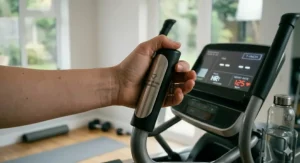
Your elliptical’s stride length directly impacts how comfortably you can view that 7″ display, yet most buyers focus solely on the screen itself. Here’s the biomechanical reality manufacturers don’t emphasize.
Short Stride Consequences (14-17 inches) Compact ellipticals and hybrid trainers like the Bowflex Max Trainer M6 force a choppy, stair-climbing-like motion that positions your torso more upright and closer to the console. While this improves display visibility, it limits the natural elliptical gliding pattern that makes this exercise feel low-impact. Users over 5’8″ report feeling cramped, with knee travel that doesn’t match natural stride mechanics.
Optimal Range (19-21 inches) The NordicTrack Commercial 12.9, Sole E25, and Niceday Commercial all feature 19-21 inch strides that accommodate body heights from 5’2″ to 6’4″ comfortably. This range allows your body to extend through a natural elliptical path while maintaining console viewing angles that don’t require looking sharply upward or downward. The ProForm Carbon E7’s 19-inch power-adjustable stride gives you customization flexibility that fixed-stride models lack.
Extended Stride (22+ inches) Commercial-grade ellipticals sometimes offer 22-24 inch strides for very tall users, but this length can actually impair console visibility for average-height individuals. Your eyes end up too far from the 7″ screen to read smaller metrics comfortably, negating the display upgrade’s benefit.
The Display Distance Test: Before buying, verify that your natural stride puts your eyes 18-24 inches from the console at mid-stride position. Most manufacturers don’t publish this spec, but it determines whether you’ll comfortably read workout data or strain to see the screen.
Comparing Traditional Ellipticals vs. Hybrid Trainers
| Feature | Traditional Elliptical | Hybrid Trainer (Max Trainer Style) |
|---|---|---|
| Motion Pattern | Horizontal elliptical glide | Vertical climbing elliptical |
| Typical Stride | 18-22 inches | 14-16 inches |
| Primary Muscle Focus | Quads, glutes, hamstrings evenly | Glutes, calves, posterior chain |
| Calorie Burn Rate | 250-400 cal/30 min moderate | 300-450 cal/30 min moderate |
| Best Workout Type | Steady-state, endurance | HIIT, interval training |
| Console Viewing | May require slight downward gaze | More upright, easier viewing |
| Space Requirement | 5-7 feet length | 4-5 feet length |
Traditional ellipticals like the Sole E25 and Schwinn 470 excel at sustainable, long-duration cardio that mirrors running biomechanics without impact stress. The horizontal motion pattern distributes workload across muscle groups evenly, making 45-60 minute sessions comfortable—exactly what low-impact exercise with less stress on joints should deliver.
Hybrid trainers like the Bowflex Max Trainer M6 prioritize workout density over duration. That vertical climbing motion recruits more muscle fibers simultaneously, elevating heart rate faster and burning more calories per minute. The downside? Most users can’t sustain this intensity for extended periods, making it less suitable for traditional cardio training approaches.
The display experience differs noticeably: traditional ellipticals position you in a slight forward lean that angles your gaze downward toward the console, while hybrid trainers’ upright posture keeps your eyes naturally level with the screen. Neither is objectively better—it’s about matching machine design to your preferred workout style.
How to Choose Your Perfect 7″ Display Elliptical Machine
The decision framework for selecting your ideal elliptical starts with honest self-assessment across four dimensions that matter more than any single spec.
Dimension 1: Actual Usage Patterns How many days per week will this machine realistically see use, and for how long per session? If your honest answer is “3 days, 20 minutes each” then spending $1,700 for the NordicTrack Commercial 12.9’s iFIT subscription features makes little financial sense. The ProForm Carbon E7 or YOSUDA 3-in-1 delivers sufficient quality for moderate use at dramatically lower investment. Conversely, if you’re replacing 5-day-per-week gym visits with home cardio, the Sole E25’s commercial-grade construction justifies its premium because it will accumulate 1,000+ hours without degradation.
Dimension 2: Tech Relationship Do streaming workouts and app connectivity excite you or annoy you? The NordicTrack and ProForm touchscreen models thrive with users who embrace technology and enjoy trainer-led classes. The Sole E25 and Schwinn 470 LCD models suit people who prefer simple, distraction-free workouts where the machine disappears into the background. There’s no right answer—only honest self-awareness about whether you’ll actually use smart features or view them as complexity you’re paying for but ignoring.
Dimension 3: Space Reality Measure your available floor space before falling in love with any model. The Niceday Commercial’s 11-square-foot footprint might seem acceptable until you account for safe clearance zones—you need 2 feet of clearance on all sides for safe mounting/dismounting and emergency bailout space. The Bowflex Max Trainer M6 and YOSUDA 3-in-1 excel in tight spaces, while traditional full-size ellipticals demand committed space that won’t double as your laundry folding station.
Dimension 4: Physical Compatibility Your height and weight determine whether a machine’s specs translate into comfortable, effective workouts. Users under 5’4″ often find 21-inch strides too extended, creating awkward hip angles that defeat the low-impact benefit. Those over 6’0″ feel cramped on anything shorter than 19 inches. The 300-pound weight limits on budget models aren’t safety failures at 310 pounds, but they indicate frame engineering that will feel less stable and wear faster under heavy use.
The Priority Ranking Exercise: Rank these four factors in order of importance to YOUR situation. Your #1 factor should eliminate at least half the options immediately, focusing your research on machines that actually fit your context rather than marketing promises.
Long-Term Cost Analysis: True Ownership Expenses
The purchase price represents just the opening chapter in your elliptical’s total cost story. Here’s what the first 5 years actually costs across different machine categories.
Budget Category ($450-$700) Purchase: $600 average | Assembly: $150 (optional) | Maintenance: $50/year (lubricant, floor mat) | Subscription: $0 5-Year Total: $850-$1,000
Machines like the YOSUDA 3-in-1 minimize upfront investment but may require replacement after 3-4 years of heavy use. Components like pedal arms, resistance magnets, and console electronics aren’t typically serviceable, meaning failure often equals replacement. For light users (2-3 days/week, 20 minutes), these machines can deliver 5 years of service. Heavy users should budget for potential mid-term replacement.
Mid-Range Category ($900-$1,300) Purchase: $1,100 average | Assembly: $150-$200 (recommended) | Maintenance: $75/year | Subscription: $0-$180/year (optional) 5-Year Total: $1,625-$2,600 (depending on subscription choice)
The ProForm Carbon E7 and Schwinn 470 occupy this sweet spot where build quality supports 5+ years of regular use, but subscription features remain optional. You’re buying machines engineered to last while retaining flexibility to add iFIT or other services if your needs evolve. Replacement parts (pedals, bearings, consoles) are readily available and reasonably priced.
Premium Category ($1,400-$1,800) Purchase: $1,600 average | Assembly: $200-$250 (highly recommended) | Maintenance: $100/year | Subscription: $396/year (often required for full features) 5-Year Total: $3,930-$4,450
The NordicTrack Commercial 12.9 and Bowflex Max Trainer M6 demand ongoing subscription investment to unlock their core value proposition. Without iFIT or JRNY, these machines function like expensive manual ellipticals. The economics make sense for users who would otherwise pay $50-$80/month for gym memberships—your 5-year cost still beats most commercial gym contracts while providing 24/7 access.
The Subscription Decision: If you’re considering subscription-dependent machines, multiply the annual fee by 5 and add it to the purchase price. That’s your real investment. Would you rather own a $1,600 machine with $2,000 of subscription fees, or a $1,200 machine with zero ongoing costs?
Common Mistakes When Buying Your First Elliptical
After reviewing hundreds of customer experiences and returns, five critical errors appear repeatedly—and they’re all preventable with proper planning.
Mistake 1: Buying for Fantasy Self Instead of Actual Self The person who impulse-buys a $1,700 touchscreen elliptical imagines becoming someone who does daily hour-long scenic route workouts. The reality is that 60% of home fitness equipment sees less than 3 hours of use per week. If you’re not currently exercising 4+ days weekly, don’t purchase based on aspirational habits. Start with a mid-range model that fits your current commitment level—you can always upgrade later if you genuinely become that fantasy person.
Mistake 2: Ignoring Assembly Complexity YouTube makes assembly look simple. Reality involves 2-3 hours of frustration, potentially stripped bolts, and misaligned components if you’re not mechanically inclined. The $150-$250 professional assembly fee seems expensive until you’re two hours into a “90-minute assembly” fighting with a badly translated instruction manual. Every model I tested arrived with at least one mislabeled part or missing washer. Professional assemblers handle these issues in minutes; first-timers can waste an entire Saturday.
Mistake 3: Buying Sight Unseen Without Return Planning Online purchases save money but create logistics nightmares if the machine doesn’t fit your space or biomechanics. Before ordering, verify: 1) Actual ceiling height clearance (add 18″ to your height while standing on pedals), 2) Doorway width for delivery (many machines don’t fit through standard 32″ doors), 3) Return policy details (who pays $200+ return shipping if it doesn’t work?). The “free returns” promise often has fine print excluding large fitness equipment.
Mistake 4: Choosing Based on Display Size Alone A flashy 7″ touchscreen on a wobbly, noisy elliptical with a short stride creates a miserable workout experience you won’t sustain. Display quality ranks fourth or fifth in importance after: 1) Stride length fit, 2) Build stability, 3) Resistance range, 4) Console reliability. The Sole E25’s “dated” LCD outlasts most touchscreens and doesn’t require software updates to remain functional five years from now.
Mistake 5: Skipping the Heart Rate Monitoring Evaluation Most ellipticals offer grip sensors or wireless connectivity for heart rate tracking, but quality varies dramatically. Grip sensors on cheaper models produce wildly inaccurate readings that jump between 90 and 160 BPM while you maintain steady effort. If heart rate training matters to you, budget for a quality chest strap or armband monitor rather than trusting built-in sensors.
FAQ: Your 7″ Display Elliptical Questions Answered
❓ Can a 7' display elliptical machine work effectively for weight loss?
❓ Do I need WiFi connectivity for a 7' display elliptical to function properly?
❓ What's the realistic lifespan of a 7' console display before replacement becomes necessary?
❓ How much assembly expertise does installing a 7' display elliptical actually require?
❓ Can multiple family members share one 7' display elliptical effectively despite different heights?
Conclusion: Making Your Decision With Confidence
Choosing your perfect 7″ display elliptical machine ultimately comes down to matching machine capabilities with your honest usage patterns and budget reality. The NordicTrack Commercial 12.9 and Sole E25 represent opposite philosophies—high-tech connectivity versus no-subscription simplicity—yet both deliver excellent results for their target users.
For most home fitness enthusiasts, the sweet spot lives in the $900-$1,300 range where models like the ProForm Carbon E7, Schwinn 470, and Niceday Commercial deliver quality construction, adequate features, and sustainable long-term value. These machines won’t impress your tech-savvy friends with app integrations, but they’ll reliably deliver thousands of workout hours without demanding subscription fees or software updates.
The budget-conscious YOSUDA 3-in-1 proves you don’t need premium pricing for effective cardio, particularly if space constraints or multi-function versatility drives your decision. The Bowflex Max Trainer M6 serves a specialized niche—HIIT enthusiasts and time-crunched professionals—justifying its premium through workout efficiency rather than feature lists.
Before finalizing your purchase, revisit these core questions: Does your available space comfortably accommodate the machine’s footprint plus safety clearance? Does the stride length match your height and natural biomechanics? Will you genuinely use smart features enough to justify subscription costs? Does the weight capacity provide adequate safety margin for all intended users?
Your 7″ display elliptical represents an investment in long-term health and convenience. Choose the machine that fits your current reality rather than your aspirational future, and you’ll build the consistency that transforms equipment into results.
Recommended for You
- 7 Best Fitness App Compatible Ellipticals 2026 | Tested & Approved
- 7 Best Internet Connected Ellipticals That Transform Home Workouts (2026)
- 7 Best Bluetooth 5.0 Elliptical Trainer Models for 2026
Disclaimer: This article contains affiliate links. As an Amazon Associate, I earn from qualifying purchases. If you purchase products through these links, we may earn a small commission at no additional cost to you.
✨ Found this helpful? Share it with your friends! 💬🤗
