
In This Article
Here’s the unglamorous truth about home gyms: the mat is the cheapest thing in the room and the easiest to get wrong. Buy too small, and your elliptical’s rear stabilizer hangs off the edge, grinding into laminate. Buy too big, and you’ve laid a rubber runway across the spare bedroom you also call an office.
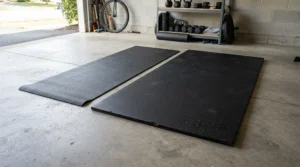
That’s what this 4×6 vs 3×6 exercise equipment mat size guide for home gym is for. On paper, the gap is tiny: a 4×6 mat covers 24 square feet and a 3×6 covers 18. In a real room, those six square feet decide whether you can step on and off the machine comfortably, whether a bench still fits beside it, and whether the door still swings.
🏋️ Picking a size isn’t about “bigger is better.” It’s about matching the mat to the machine, the floor, and the way you actually move around the equipment. Even Garage Gym Reviews’ 2026 treadmill mat roundup opens by asking whether the mat will sit under a folding treadmill, elliptical, bike, or rower. The machine comes first.
Below, you’ll find an equipment mat size comparison, seven real mats worth considering, and practical steps for measuring, placing, and maintaining them. Everything is grounded in published specs and honest analysis, not invented test stories.
What Is a 4×6 vs 3×6 Equipment Mat? The Quick Comparison
A 4×6 equipment mat measures 48 by 72 inches (24 square feet); a 3×6 measures 36 by 72 inches (18 square feet). Both protect floors, dampen vibration, and keep carpet fibers out of machinery. Your pick depends on the machine’s footprint, the room, and how much working space you want around it.
| Feature | 4×6 Mat | 3×6 Mat |
|---|---|---|
| Size | 48″ x 72″ | 36″ x 72″ |
| Coverage | 24 sq ft | 18 sq ft |
| Best For | Ellipticals with side clearance, equipment-plus-bench zones, mixed-use corners | Treadmills, narrow ellipticals, bikes in tight rooms |
| Watch Out For | Eats floor space; heavier to move | Can fall short on machines longer than 72″ |
Looking at the table, the 4×6 wins on forgiveness: the extra 12 inches of width gives you a margin for error and room to step off sideways. The 3×6 wins on footprint, but its 72-inch length is the catch. Some ellipticals list lengths of 70 inches or more, so a “true” 3×6 leaves almost no rear coverage. That’s why many 3-foot mats are sold at 6.5 or 7 feet instead.
💬 Just one click — help others make better buying decisions too!😊
Top 7 4×6 and 3×6 Gym Equipment Mats: Expert Analysis
Seven real products follow, spanning budget, mid-range, and premium, plus one modular alternative for awkward rooms. Prices are ranges only and change often, so check current price before you buy.
1. BalanceFrom 3×6.5 High Density Mat — foldable budget workhorse for treadmills
The standout is the foldable version, which divides into six 13-inch folds so the mat tucks away with the machine.
The listing specs this mat at 78 by 36 inches and 1/4 inch thick, with patterns on both sides and a two-year warranty. Those extra six inches of length over a true 3×6 matter, because they cover the rear step-on zone of a 72-inch-class treadmill. The surface is moisture resistant and wipes clean with soap and water.
Based on the spec comparison, this is the sensible default for one machine in a bedroom or basement corner. A quarter-inch of PVC is protection, not cushioning, so don’t expect it to mute a heavy treadmill’s thud the way thicker rubber might. Buyers with machines wider than about 30 inches should look at 4×6 instead.
I couldn’t verify a large pool of aggregated reviews for this exact SKU during research. It’s worth knowing that Garage Gym Reviews names a BalanceFrom high-density mat as its pick for heavy machines. Skim the newest critical reviews for odor and flatness comments before ordering.
Pros:
- ✅ Foldable version stores easily
- ✅ Extra length covers rear step-on zone
- ✅ Two-year warranty listed
Cons:
- ❌ Only 1/4 inch thick
- ❌ Too narrow for wide machines
2. BalanceFrom 4×6 High-Density Mat — the no-drama 4×6 baseline
The standout is simplicity: a big, flat PVC rectangle with an anti-slip surface, nothing more.
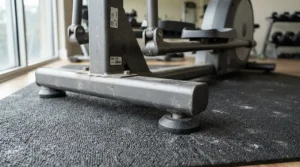
It measures 72 inches long, 48 wide, and about 0.24 inches thick. That 48-inch width turns a cramped elliptical corner into a proper zone, with room for a step-off, a set of dumbbells, or a foam roller. The anti-slip texture is designed to keep gear from creeping during hard sessions.
Here’s what most buyers overlook: width is the underrated luxury. Even a 24-inch-wide elliptical sits on this mat with 12 inches to spare per side, which makes mopping, vacuuming, and getting on and off easier. The tradeoff is length, since a 72-inch mat is still short for a machine with a 73-inch-plus operating length.
Aggregated review sentiment wasn’t verifiable in my research, so check the live listing’s critical reviews for edge curl and odor. As with any PVC mat, an out-of-box smell and a rolled-up curl are common themes to look for.
Pros:
- ✅ Generous 48-inch width
- ✅ Anti-slip surface
- ✅ Same family offers many sizes
Cons:
- ❌ 72-inch length is tight for long ellipticals
- ❌ Thin for heavy-impact machines
3. Fitvids 4×6 Equipment Mat — straightforward 48″ x 72″ with a size ladder
The standout is the range: the same 1/4-inch high-density line comes in multiple sizes, including 96 by 48 inches.
The 48 by 72 version is the 4×6 option. A size ladder helps when you’re torn between sizes, because you can pick a longer sibling if your machine outgrows 72 inches. The 1/4-inch PVC is aimed at treadmills and bikes, with floor protection as the job.
In my read of the specs, this is a “buy the size you actually measured” product. It makes sense for someone who has done the tape-measure homework and wants exact coverage without paying for a premium brand. The sister sizes also help if you add a second machine later and want matching mats.
Verified aggregated review data wasn’t available to me for this listing. Check review recency, because multi-size listings often mix feedback from different sizes.
Pros:
- ✅ Multiple sizes available
- ✅ 1/4-inch high-density PVC
- ✅ Simple, honest 4×6 spec
Cons:
- ❌ Limited thickness for heavy machines
- ❌ Reviews may mix several sizes
4. Gorilla Mats 4×6 Large Exercise Mat — shoe-friendly mat that doubles as workout space
The standout is dual use: it’s marketed for floor workouts and as a base for weights and machines.
The listing describes a 6 by 4 foot, 1/4-inch mat that’s non-slip, flat, and shoe-friendly. Because it works as a workout surface, you can stretch, do HIIT, or lift beside the machine without a second mat.
My analysis: this suits people who want one multipurpose zone. It does come with a caveat. Foam-style mats can compress or dent under concentrated point loads such as bench legs or machine feet, so check the manufacturer’s load guidance before parking something heavy on it.
I couldn’t verify a pooled review sentiment for it, so look for comments on odor and long-term flatness in recent reviews. If you only need heavy-equipment protection, a dense solid PVC mat may be the better fit.
Pros:
- ✅ Doubles as workout surface
- ✅ Shoe-friendly top
- ✅ 4×6 coverage for mixed use
Cons:
- ❌ Foam may dent under point loads
- ❌ Not purpose-built for heaviest machines
5. SuperMats GymMat 4×6 — thicker solid PVC for weight-stack machines
The standout is thickness: 3/8 inch, 50% more than the 1/4-inch mats above.
The listing describes odor-free solid PVC with a non-slip surface that cleans with a damp cloth, aimed at weight stacks and free weights. It’s meant to keep floor and carpet dust out of belts and mechanical parts too.
A thicker mat helps with vibration and dents, and solid PVC avoids the squish of foam. It’s the one I’d shortlist if the machine is heavy or the floor is expensive hardwood. The retailer page shows a one-customer comment saying the mat had good thickness, relaxed quickly, and fit its spot. That’s a single data point, not a trend.
Pros:
- ✅ 3/8-inch solid PVC
- ✅ Odor-free, non-slip surface
- ✅ Wipes clean with a damp cloth
Cons:
- ❌ Costs more than 1/4-inch mats
- ❌ Heavier to move

6. SuperMats 14GS 3×6.5 — commercially rated 3-footer
The standout is durability: it’s rated for gym and light institutional use.
The 3 by 6.5 foot mat weighs 19 pounds and is made from solid PVC, which is reassuringly hefty. It’s designed to muffle machine noise and keep dust and carpet fibers out of moving parts. SuperMats sells it for ellipticals and treadmills.
That 6.5-foot length is the real selling point for 3-foot buyers. A standard 3×6 leaves you almost no margin, while this mat adds six inches. Based on specs alone, it fits long treadmills and many ellipticals when width isn’t an issue.
I didn’t find aggregated review data for it. Because it’s sold through a commercial fitness retailer, read the care and return terms before purchasing.
Pros:
- ✅ Commercially rated solid PVC
- ✅ 6.5-foot length adds margin
- ✅ Noise- and vibration-dampening design
Cons:
- ❌ Pricier than budget 3×6 mats
- ❌ 19 pounds is heavy to reposition
7. SUPERJARE 24 Sq Ft Rubber Top Tiles — modular 4×6 you can reshape
The standout is flexibility: six interlocking tiles that total 24 square feet.
Those are 0.4-inch-thick EVA foam tiles with a rubber top. Six tiles totaling 24 square feet works out to roughly 2-foot squares. Arrange them in a 2×3 grid for a 4×6 footprint, a long runway, or an L-shape around a corner.
My analysis: modular tiles win in oddly shaped rooms and for renters who move. They lose on seams, since dust and sweat can sneak between tiles and edges can shift under rolling loads. Use a 4×6 grid under your machine so the tiles lock together properly.
I couldn’t verify aggregated review sentiment, so check recent reviews for tile separation and edge lift.
Pros:
- ✅ Reshapable 4×6 footprint
- ✅ Rubber top for traction
- ✅ Easy to expand later
Cons:
- ❌ Seams can collect dust
- ❌ Tiles may shift under rolling loads
| Mat | Size | Thickness | Material | Price Tier | Best For |
|---|---|---|---|---|---|
| BalanceFrom 3×6.5 | 36″ x 78″ | 1/4″ | PVC | Budget | Narrow treadmills |
| BalanceFrom 4×6 | 48″ x 72″ | ~1/4″ | PVC | Budget-mid | General 4×6 use |
| Fitvids 4×6 | 48″ x 72″ | 1/4″ | PVC | Budget-mid | Measured buyers |
| Gorilla Mats 4×6 | 48″ x 72″ | 1/4″ | Foam | Mid | Workout-plus-machine zones |
| SuperMats GymMat | 48″ x 72″ | 3/8″ | Solid PVC | Mid-upper | Weight stacks |
| SuperMats 14GS | 36″ x 78″ | Heavy-duty | Solid PVC | Premium | Long-term ownership |
| SUPERJARE Tiles | 24 sq ft total | 0.4″ | EVA, rubber top | Mid | Small, odd-shaped rooms |
Looking at the table, thickness and material split the field more than size. The SuperMats GymMat and SuperMats 14GS are the heavy-duty picks, while the BalanceFrom 3×6.5 and Fitvids 4×6 are the budget plays. If your room is an odd shape, the SUPERJARE Tiles can be rearranged in ways a single mat can’t.
How to Measure for Gym Equipment Mat Coverage
If you only do one thing from this guide, do this. Reading how to measure for gym equipment mat coverage takes two minutes, and skipping it costs a return shipment.
- Measure the machine at its widest and longest points. Include stabilizer bars, handlebars, and pedal travel. Ignore height.
- Add working space. You need room to step on and off, and room for the pedals or belt to move without hanging over the edge.
- Check the manual’s clearance requirement. Manufacturers publish a safe operating area, and that number often exceeds the machine’s physical footprint.
- Map the room. Use painter’s tape to mark your intended mat outline on the floor, then check door swings and walkways.
- Plan for a roll. Many large mats ship rolled. Lay yours flat for a day before moving the machine onto it so curl can relax.
Here’s a worked example. An elliptical listed at 70 inches long by 24 inches wide fits inside a 36 by 78 mat with 8 inches of extra length and 12 inches of extra width. Put that same machine on a 36 by 72 mat and you’re only 2 inches longer, so any “extra” length belongs to the 6.5-foot mats.
Equipment Footprint Measurement: Why Spec Sheets Disagree
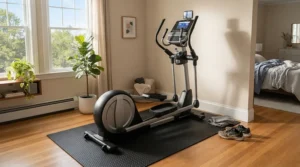
Equipment footprint measurement sounds simple until you compare three sources. Fortune’s 2026 elliptical roundup lists the NordicTrack X16 at about 58.5 inches long by 29.5 inches wide, and the Sole E25 at about 70 inches long by 24 inches wide. Those are two very different shapes: the X16 is shorter and wider, the E25 longer and narrower.
That distinction drives the mat choice. A shorter, wider machine like the X16 pairs naturally with a 4×6 mat, because the width is what you need. A longer, narrower one like the E25 leans toward a 3×6.5 or 3×7, because length is the bottleneck.
Numbers also drift between sources. The Sole E25 has been listed at 70, 71, and 73.75 inches long depending on where you look, and some listings include the pedal’s travel while others don’t. Always use the manufacturer’s published dimensions and a tape measure on the real machine.
Two rules help. First, measure the largest value you can find and treat it as the footprint. Second, add working space, since the mat should cover where you stand, not just where the frame sits.
Choosing Mat Size for Elliptical Trainers
Choosing mat size for elliptical trainers is where the 4×6 vs 3×6 debate gets real. Ellipticals are long and heavy, and their rear stabilizer bars are exactly where floors take punishment.
Consumer Reports’ spec listing for the Sole E25 calls for an unobstructed area of about 75.25 by 23 inches, with extra space added as a safety buffer. That’s longer than a standard 72-inch mat. Retailers seem to know this: one floor-mat seller lists 3×7 foam and 3×7.5 rubber options specifically as “elliptical” mats, while its 3×6 mats are labeled for treadmills.
So what’s the call? For an elliptical in the 70-to-75-inch range, a true 3×6 is borderline at best. You have three cleaner options:
- 3×6.5 or 3×7: best for narrow machines in tight rooms.
- 4×6: best when width matters more than length and the machine is shorter.
- 4×8 or larger: best for long machines plus a step-off zone.
I’d lean 3×6.5 for slim ellipticals and 4×6 for shorter, wider models. If your machine is both long and wide, don’t force a 4×6 to work. Step up to a longer size.
✨ Don’t Miss These Exclusive Deals!
🔍 Take your home gym to the next level with these carefully selected mats. Click on any highlighted item to check current pricing and availability. These mats will help you build a safer, quieter workout zone your floors will thank you for!
Mat Overhang Recommendations: How Much Is Enough?
Mat overhang recommendations are not set by a universal standard I could find, so what follows is practical judgment, not gospel. Overhang is how much mat extends past the machine’s frame, and you want enough to be useful without becoming a trip hazard.
- Rear and front: aim for a couple of inches at minimum, more if you step on and off at the rear.
- Sides: a few inches each side keeps stabilizer feet and leveling pads on the mat. More if you need standing room.
- Entry/exit side: this is where you want the most extra mat, because that’s where you step.
- Keep it even: an off-center mat creates a one-sided lip that catches toes.
Thin mats like the 1/4-inch options create a small edge lip, while thicker ones are more noticeable. Always follow your manufacturer’s clearance guidance, since a mat should never block ventilation or moving parts.
If you’re undecided, favor even overhang and a straight edge. A mat that looks centered usually is easier to live with.
Small Space Gym Mats: Fitting Fitness Into Less Floor
Small space gym mats are about trade-offs, and the biggest one is coverage versus convenience. In apartments, studios, and shared rooms, a 3×6 can be the difference between “I can do this” and “I can’t even get past it.”
Compact options exist beyond the standard sizes. Walmart’s category guide mentions walking-pad mats around 24 by 68 inches, and bike or rower mats from 24 by 46 to 30 by 60 inches. Foldable mats like the BalanceFrom 3×6.5 tuck away when the machine does.
Modular tiles solve different problems. The SUPERJARE Tiles can be arranged into a 4×6 grid, a long runner, or an L-shape around a corner, which a single sheet can’t do. For renters, that flexibility is gold.
Three small-space tips:
- Choose the narrowest mat that still protects the floor, usually a 3-footer.
- Prefer foldable or rollable mats if you store the machine upright.
- Skip oversized mats unless you’ll use the extra space for exercise.
4×6 vs 3×6 Mats vs Traditional Alternatives
How do these mats stack up against flooring options you might also be considering?
| Option | Coverage | Strength | Weakness | Best For |
|---|---|---|---|---|
| 3×6 PVC mat | 18 sq ft | Light, compact | Short for long machines | SuperMats 14GS for long treadmills |
| 4×6 PVC mat | 24 sq ft | Roomy, forgiving | Takes floor space | Fitvids 4×6 for general use |
| Interlocking tiles | Any shape | Reshapable | Seams, shifting | SUPERJARE Tiles for odd rooms |
| Rubber roll flooring | Whole room | Max coverage | Heavy, less portable | Dedicated gym rooms |
| No mat | None | Free | Floor damage, dust | Not recommended |
The table shows why standard mats keep winning in small rooms: they’re cheap, portable, and quick. Roll flooring only makes sense once you’ve committed a whole room. If you’re renting, mats or modular tiles beat anything that has to be glued down.
How to Choose Between a 4×6 and a 3×6 Mat
- Measure the machine first. Use the longest and widest points, including stabilizers and handles.
- Add working space. Mat length and width should exceed the footprint, especially where you step on and off.
- Pick the width. If the machine is under 30 inches wide and the room is tight, a 3-foot mat works. If you want side clearance, choose 4 feet.
- Pick the length. If the machine is longer than about 70 inches, go to 6.5 feet or more rather than a true 72 inches.
- Match thickness to weight. 1/4 inch is fine for light-to-moderate gear; 3/8 inch suits heavier machines.
- Check the floor. Hardwood and carpet benefit most, concrete less so.
- Plan for storage. If you’ll move the mat often, foldable or tiled options help.
Here’s the shortcut as a decision framework: if the machine is narrow and the room is tight, choose a 3×6.5. If you want side clearance or an exercise zone, choose a 4×6. If the machine is long and heavy, choose thicker PVC.
Real-World Scenarios: Matching Mats to Rooms
These are hypothetical profiles built from the specs above, to show how the logic plays out.
Scenario 1: The apartment renter with a slim elliptical. A 70-by-24-inch machine, a bedroom corner, and a security deposit to protect. The BalanceFrom 3×6.5 gives six inches of extra length, fits the narrow footprint, and folds away. Budget-friendly and renter-proof.
Scenario 2: The family basement with a treadmill and weights. A heavier treadmill, a bench nearby, and kids who treat the room like a playground. The SuperMats GymMat brings 3/8-inch solid PVC and 4-foot width, so there’s room to step off and a surface that wipes clean.
Scenario 3: The spare-room hybrid. An exercise bike by day, yoga on the floor by night. The Gorilla Mats 4×6 works as both a base and a workout surface, so one purchase covers both jobs.
In every case, the winning move was measuring first and buying second.
Problem → Solution: Fixing Common Mat Headaches
Problem 1: The mat slides. Most mats stay put under a heavy machine, as one manufacturer notes, because the weight does the work. If it still slides on slick hardwood, check that the machine is level and that the mat sits flat.
Problem 2: It smells. New PVC and rubber can have a strong odor at first. Air the mat out in a ventilated space before moving the machine on, and choose odor-free options like the SuperMats GymMat if you’re sensitive.
Problem 3: The edges curl. Rolled mats need time to relax. Unroll them flat for a day, with a few books on the edges if needed.
Problem 4: The mat is too short. This is the most common regret. The fix is a longer size, like the SuperMats 14GS 3×6.5, or a modular set you can extend.
Problem 5: Dents from heavy feet. Thicker, denser mats distribute load better. If a single leg carries lots of weight, add a small load-spreading pad underneath.
Common Mistakes When Buying an Equipment Mat
The most common mistake is buying by sticker size without measuring the machine. A “3×6” mat sounds right, but it’s 72 inches, and plenty of machines run past that. Second is ignoring width: a mat that barely matches the frame gives you no step-off zone.
Third is chasing thickness at the expense of fit. A thick, too-small mat is still too small. Fourth is assuming a workout mat is an equipment mat. Foam workout surfaces are great for floor exercise but may not suit concentrated machine loads.
Finally, many buyers forget about the room itself. A 4×6 mat can swallow a small room, block a closet, or make the space feel crowded. Tape out the outline first and live with it for a day.
Long-Term Cost & Maintenance
A mat is a cheap insurance policy. If a mat in the budget tier lasts five years, the yearly cost is a small fraction of repairing scratched hardwood or stained carpet. That’s an illustration, not a quote, but the logic holds: protection pays for itself fast.
Maintenance is easy. Wipe with a damp cloth or mild soap, as most PVC mats recommend. For rubber, Greatmats’ guide to equipment mats says rubber gym mats can be cleaned with a neutral pH cleanser. Skip harsh solvents, which can degrade material.
Check under the mat every few months for trapped grit or moisture. Rotate or flip when possible to even out wear. And remember that thicker, commercially rated mats like the SuperMats 14GS cost more upfront but tend to last longer under heavy use.
FAQ
❓ Is a 4x6 mat too big for a treadmill?
❓ How thick should an equipment mat be?
❓ Do I need a mat on a concrete floor?
❓ What size mat does a rowing machine need?
❓ Will a mat stop treadmill noise?
Conclusion
Here’s the short version of this 4×6 vs 3×6 exercise equipment mat size guide for home gym: measure first, buy second. A 3×6 (or better, 3×6.5) is the space-saver for slim ellipticals and treadmills. A 4×6 is the comfort pick when width, step-off space, or mixed use matters.
If budget is tight, the BalanceFrom 3×6.5 and Fitvids 4×6 cover the basics. If your machine is heavy, the SuperMats GymMat and SuperMats 14GS are the sturdier options. For awkward rooms or renters, the SUPERJARE Tiles give you layout flexibility, while the Gorilla Mats 4×6 and BalanceFrom 4×6 suit people who want a roomy, versatile zone.
The right mat quietly does its job: no sliding, no smell, no short ends. Tape out the outline, check the manual, and pick the size that lets you move.
Recommended for You
- Floor Mat For Quiet Home Workouts In Apartment: 7 Best Picks 2026
- Foam Floor Mat For Home Gym On A Budget: 7 Picks For 2026
- Carpet Protector For Exercise Bike On Carpet: 7 Proven Picks (2026)
Disclaimer: This article contains affiliate links. As an Amazon Associate, I earn from qualifying purchases. If you purchase products through these links, we may earn a small commission at no additional cost to you.
✨ Found this helpful? Share it with your friends! 💬🤗
