
In This Article
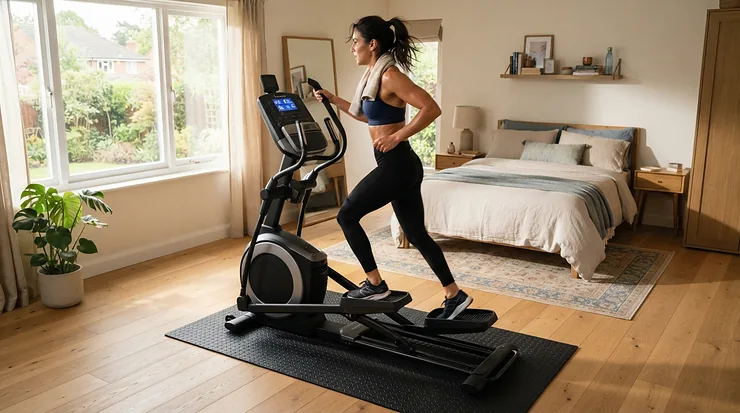
Here’s a scene that plays out in living rooms everywhere: somebody finally commits to the elliptical, wedges it into the corner of the den, gets three good workouts in — and then notices a faint constellation of hairline scratches spreading out from where the machine’s feet sit. A hardwood floor protection mat for elliptical machine setups exists specifically to stop that scene before it starts, sitting between the machine’s feet and your finish as a buffer against pressure marks, grit, sweat, and the slow creep of vibration that hardwood simply wasn’t built to absorb.
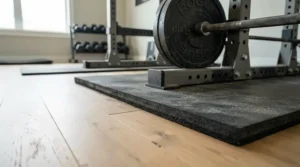
What is a hardwood floor protection mat for elliptical machine use? It’s a dense rubber, PVC, vinyl, or high-grade foam pad placed under the machine’s full footprint (or under just its feet) to prevent scratching, dimpling, sliding, and moisture damage — while also quieting the rhythmic thump that travels straight through wood joists to the room below.
The tricky part is that not every mat marketed for “gym equipment” is actually safe for hardwood. Some rubber compounds off-gas plasticizers that stain finished wood. Some vinyl mats are so grippy they act like suction cups on polyurethane coatings. Below, we’ve dug into seven real, purchasable options — budget corner pads, mid-range foam and PVC mats, and heavier commercial-grade rubber — so you can pick one that actually fits your elliptical, your floor, and your patience for assembly.
Quick Comparison Table
| Product | Type | Best Size Available | Best For |
|---|---|---|---|
| IMPRESA 6-Pack Equipment Pads | Rubber corner pads | 4″ x 4″ squares | Renters and small footprints |
| TOBWOLF Compact Mat | Foam/silicone under-desk mat | 23.6″ x 17″ | Compact/seated ellipticals |
| Sunny Health & Fitness Equipment Mat | High-density EVA foam | Up to 6′ x 3′ | Apartments needing quiet |
| GymCope 6mm Elliptical Mat | Textured PVC | Up to 7′ x 3′ | Full-size ellipticals |
| Stamina Fold-to-Fit Mat | Sectioned closed-cell foam | 84″ x 36″ | Odd-shaped machine bases |
| SuperMats Heavy Duty Equipment Mat | Solid vinyl | 36″ x 90″ | Long-term daily use |
| SuperMats High Density Commercial Mat | Reinforced vinyl composite | 36″ x 102″ | Heavy commercial-style ellipticals |
Looking at the spread here, the real decision isn’t “which is best” in the abstract — it’s how much floor you’re trying to cover and how loud your workouts get. The IMPRESA and TOBWOLF picks solve a narrower problem (feet and small-footprint machines) at a lower price, while the SuperMats entries are built for people who want one mat to disappear under the whole machine and stay there for years. The GymCope and Stamina mats sit in the middle, trading a bit of size flexibility for a friendlier price tag.
💬 Bookmark this table — you’ll want to scroll back to it once you’ve read the honest breakdown below.
Top 7 Hardwood Floor Protection Mats for Ellipticals: Expert Analysis
1. IMPRESA 6-Pack Exercise Equipment Pads — cheapest way to protect four contact points
If your elliptical only touches the floor at four small feet, you don’t necessarily need a giant mat — you need something exactly this focused. The IMPRESA pads are small moisture-resistant rubber squares, roughly 4 inches across and half an inch thick, sold in a six-pack so you’ve got spares for a second machine or a wobbly stepper. Because they’re rubber rather than vinyl, they grip hardwood without the tacky residue some PVC pads leave behind over time.
Based on the spec comparison, this is really a “spot protection” product rather than a full floor-protection system — it won’t do anything about sweat pooling in the middle of the machine or vibration traveling through a large glide track. Reviewers consistently report that these pads work best under recliners, pianos, and small stationary bikes as much as ellipticals, which tells you the audience skews toward small-footprint gear rather than full-size trainers. They’re a smart budget layer under a compact elliptical, especially for renters who can’t commit to a large mat taking over the room.
Pros:
- ✅ Rubber composition won’t leave sticky vinyl residue on finish
- ✅ Six-pack covers two machines or extra furniture feet
- ✅ Cheap enough to replace without a second thought
Cons:
- ❌ Too small to protect against sweat drips or a shifting glide track
- ❌ Offers no noise-dampening for the machine’s main body
At around the $15-$25 range, this is the lowest-commitment entry on the list, and a genuinely reasonable one if your elliptical is compact and your main worry is just the feet.
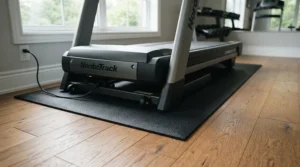
2. TOBWOLF Compact Under-Desk Elliptical Mat — built specifically for small seated ellipticals
Under-desk and mini pedal ellipticals have a totally different footprint problem than full-size machines, and the TOBWOLF mat is one of the few products actually designed around that. At 23.6 by 17 inches, it’s sized for compact and seated ellipticals rather than oversized for no reason, with a triple-layer composite and a silicone grip layer that keeps the machine from creeping forward — a genuinely common complaint with small pedal exercisers that “walk” across a room during a session.
What most buyers overlook about this style of mat is that it’s reversible: flipping to the white side engages a different texture for extra grip, which matters if your particular machine tends to slide more than most. On the practical side, its low 3mm profile means it won’t create a trip hazard under a desk, which matters if you’re using this at a standing desk setup rather than a dedicated gym corner.
Reviewers note it holds up on both hardwood and thin carpet without visible wear after weeks of regular use, and that the non-slip base performs consistently even for lighter users who put less downward pressure through the pedals.
Pros:
- ✅ Purpose-built size for compact and seated ellipticals
- ✅ Low 3mm profile avoids trip hazards near desks
- ✅ Reversible surface for extra grip when needed
Cons:
- ❌ Too small for standard full-size elliptical trainers
- ❌ Flipping the mat for grip feels like a workaround, not a fix
Expect to pay in the $20-$30 range — reasonable for a mat this targeted, though it’s a poor fit if your machine is anything larger than a compact model.
3. Sunny Health & Fitness Equipment Mat — the quiet-apartment pick
Sunny Health & Fitness built a strong reputation on affordable home cardio gear, and their equipment mat carries the same value-first approach. It’s a 4.2mm high-density EVA foam mat with a textured, waterproof rubber surface, available in four sizes so you can match it to anything from a compact elliptical to a full-size trainer.
The foam base does something vinyl mats can’t: it compresses slightly under weight, which absorbs impact and cuts down on the low rhythmic thump that travels through floor joists to the apartment below. Reviewers consistently report that this mat holds up well against sweat and general wear thanks to its waterproof finish, and the brand backs it with a genuinely large review base — tens of thousands of ratings averaging in the mid-4-star range, which is a meaningful signal in a category full of thin review counts.
On a hardwood floor specifically, the textured, non-abrasive foam surface is gentler on finish than harder rubber compounds, making it a solid pick for anyone worried about scuffing.
Pros:
- ✅ Foam base absorbs impact better than flat vinyl mats
- ✅ Waterproof surface handles sweat without staining
- ✅ Backed by an unusually large, consistently positive review base
Cons:
- ❌ EVA foam compresses over years of heavy daily use
- ❌ Largest size still shorter than full-length rubber commercial mats
Pricing typically falls in the $30-$45 range depending on size — solid mid-tier value, especially for apartment dwellers prioritizing quiet over maximum durability.
4. GymCope 6mm Thick Elliptical & Treadmill Mat — the density-per-dollar pick
Thickness is the spec that actually matters most for impact absorption, and the GymCope mat leans into that harder than most budget options by offering a full 6mm of dense PVC — noticeably thicker than the 3-4mm mats that dominate this price bracket. That extra material does real work: it’s the difference between a mat that visibly compresses under an elliptical’s weight and one that stays flat and stable through months of use.
The textured top surface adds grip for your feet if you step on and off frequently, while the anti-skid backing keeps the whole mat from creeping during a hard interval session. It’s sold in five sizes running from a compact 48 x 24 inches up to a generous 84 x 36 inches, so it scales from a small stepper to a full-length elliptical without wasted material.
Reviewers frame it as one of the better options for people who’ve already ruined a thinner mat and want something that won’t curl at the edges or flatten out within a season.
Pros:
- ✅ 6mm thickness noticeably outperforms typical 3-4mm budget mats
- ✅ Five size options scale from compact to full-length machines
- ✅ Textured top plus anti-skid bottom resists shifting
Cons:
- ❌ Thicker PVC ships with a stronger initial odor than thinner mats
- ❌ Heavier and bulkier to roll and store than foam alternatives
You’ll typically find it in the $40-$55 range, which is genuinely competitive given the extra millimeter or two of density over comparable options.
5. Stamina Fold-to-Fit Folding Equipment Mat — best for odd-shaped machine bases
Ellipticals aren’t rectangles, and neither are their footprints — the rear stabilizer bar sticks out, the front wheels sit wider than the console post, and a flat rectangular mat often leaves awkward gaps. The Stamina Fold-to-Fit solves that with a genuinely clever structure: a closed-cell foam mat split into seven separate 12-inch sections that fold independently, letting you shape the mat around your machine’s actual base instead of just laying flat underneath it.
At roughly a quarter-inch thick and about 7 pounds, it’s light enough to reposition without help, and the textured pebble surface keeps it from sliding once it’s shaped correctly. Here’s what the spec sheet won’t tell you, but reviewers note: the folding segments also make storage dramatically easier than a stiff rectangular mat, since it collapses down into a stack rather than needing to be rolled. It’s rated for treadmills, ellipticals, rowers, and even Pilates reformers, which speaks to how universal the folding-panel concept really is.
Pros:
- ✅ Folding sections adapt to irregular elliptical footprints
- ✅ Lightweight 7-lb build is easy to reposition solo
- ✅ Collapses flat for storage instead of needing to be rolled
Cons:
- ❌ Segmented seams are slightly less stable than one solid mat
- ❌ Quarter-inch thickness offers less cushioning than 6mm+ options
Expect the $45-$60 range — a fair premium for a shape-adaptive design that solves a problem flat mats genuinely can’t.
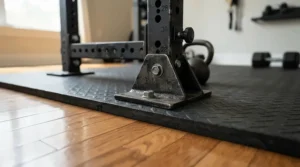
6. SuperMats Heavy Duty Equipment Mat (36″ x 90″) — the long-haul daily driver
SuperMats has been a fixture in this category for close to two decades, and the Heavy Duty Equipment Mat is the version most people land on once they’ve decided they want a mat that lasts, not one they’ll replace next year. It’s made of odor-free, heavy-duty vinyl reinforced with thick PVC backing, manufactured in the USA, and sized at a full 36 by 90 inches — enough to comfortably swallow the footprint of a full-size elliptical with room to spare on either side.
What most buyers overlook about this mat is that its density does double duty: it’s thick enough to blunt vibration transfer through hardwood joists, but flat enough that it doesn’t create a noticeable step-up lip you’ll trip over getting on and off the machine.
Reviewers specifically call out that it doesn’t move or cause damage on either hardwood or carpet, and one commonly cited use case is exactly this — a portable elliptical placed directly on the mat over finished wood floor. The tradeoff for that durability is stiffness: this isn’t a mat you casually roll up and stash in a closet between uses.
Pros:
- ✅ Made in the USA from odor-free, heavy-duty vinyl
- ✅ Full 36″ x 90″ size comfortably covers most elliptical footprints
- ✅ Reviewers confirm zero hardwood damage after extended daily use
Cons:
- ❌ Stiffer and harder to roll up for storage than foam mats
- ❌ Heavier to maneuver alone during initial setup
Pricing generally lands in the $70-$95 range, positioning it as a mid-premium buy that’s earned its reputation through longevity rather than flashy specs.
7. SuperMats High Density Commercial Grade Solid Equipment Mat (36″ x 102″) — the premium, gym-grade option
For anyone running a full-size elliptical with serious daily mileage — or genuinely commercial-style equipment in a home gym — the SuperMats High Density Commercial Grade mat is the heaviest hitter on this list, literally. At 25 pounds and a generous 36 by 102 inches, it’s built from a reinforced vinyl composite specifically engineered for high-traffic, high-vibration equipment rather than light home use.
Based on the spec comparison, the added weight and density aren’t just marketing — a heavier mat naturally resists shifting and curling at the edges better than a lighter one, and it dampens low-frequency vibration more effectively, which matters if your elliptical sits above a bedroom or a downstairs neighbor. It carries a strong review average built on more than a thousand ratings, with buyers specifically noting its use under treadmills, ellipticals, and rowers in home gyms that see near-daily use. This is the mat you buy once and stop thinking about — assuming you have the floor space and budget to justify it.
Pros:
- ✅ Commercial-grade density built for heavy, near-daily use
- ✅ Extra length comfortably covers larger elliptical trainers
- ✅ Backed by a large, consistently strong review average
Cons:
- ❌ At 25 lbs, it’s genuinely awkward to unbox and position alone
- ❌ Premium price puts it out of reach for casual, occasional users
This one runs in the $140-$180 range — the most expensive pick here, but arguably the last mat you’ll need to buy for a heavily used machine.
Practical Usage Guide: Setting Up Your Elliptical Mat the Right Way
Getting the mat is only half the job — placement and first-30-days habits determine whether it actually protects your floor. Start by measuring your elliptical’s full footprint, including the rear stabilizer bar, and add at least 6 inches of margin on every side; a mat that just barely covers the machine’s feet will still let sweat and grit migrate onto exposed hardwood at the edges. Before you set the machine down, vacuum the bare floor thoroughly — trapped grit under a mat acts like sandpaper every time the machine shifts even slightly, and this is genuinely the single most common cause of scratches people blame on the mat itself. Once the mat is down, let it acclimate flat for 24-48 hours before loading the machine on top, since vinyl and PVC mats often ship rolled and need time to relax fully; putting weight on a mat that’s still trying to curl at the edges creates uneven pressure points. In the first month, check underneath the mat every week or two for trapped moisture or debris, and wipe both the mat and the floor beneath it if you notice any dampness — sweat that sits against a mat’s underside for weeks is exactly the scenario that can dull a hardwood finish over time.
Non-Marking Equipment Pads and Corner Protectors: Solving the Problems a Full Mat Can’t Fix
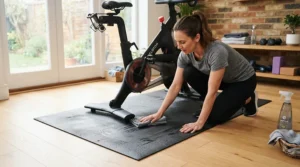
Even a well-chosen mat has blind spots, and this is where smaller non-marking equipment pads earn their keep. Problem one: a large mat covers the machine’s footprint but often leaves the console post’s rear foot or a protruding stabilizer bar hanging just off the edge — the fix is a set of small non-marking pads placed under that specific contact point, layered on top of or beside your main mat. Problem two: some ellipticals include leveling feet with hard plastic or metal contact surfaces that a soft foam mat alone won’t fully cushion — swapping in rubber non-marking pads at those exact points prevents point-load dimpling even when the rest of the machine sits on a thinner mat. Problem three: seasonal humidity swings cause hardwood to expand and contract, and a mat that fit perfectly in July can pinch or gap by January — the practical solution is choosing pads and mats with a little flex built in, and re-checking mat fit each season rather than assuming a one-time setup will hold indefinitely. None of these are dramatic fixes, but each one closes a gap that a single flat mat, however good, simply wasn’t designed to cover on its own.
Real-World Scenarios: Which Mat Fits Your Home Gym
Picture three different households. First, there’s the apartment renter with a compact seated elliptical wedged into a home office corner, more worried about noise complaints from downstairs than heavy-duty durability — the TOBWOLF compact mat or Sunny Health & Fitness foam mat both make sense here, prioritizing sound dampening and a small footprint over raw density. Second, there’s the family with a full-size elliptical in a converted dining room, used daily by two or three people with varying workout intensity — this calls for something in the GymCope or Stamina Fold-to-Fit range, where a bit more size and shape flexibility earns its keep against heavier, more frequent use. Third, there’s the serious home-gym owner who’s invested in commercial-style equipment and treats their elliptical like a permanent fixture rather than a New Year’s resolution — for that household, the SuperMats Heavy Duty or High Density Commercial Grade mats are the only options built to match that level of daily wear without needing replacement within a year or two.
How to Choose a Scratch-Proof Exercise Mat for Hardwood Floors
- Confirm the backing material first. Look specifically for rubber, EVA foam, or non-marking vinyl backings rather than generic “anti-slip” claims, since some grippy coatings can actually stain or haze polyurethane finishes over time.
- Match thickness to your floor’s vibration sensitivity. Thinner floors over open joists benefit from 5-6mm+ mats; solid concrete subfloors under hardwood can get away with thinner 3-4mm options.
- Size the mat to the full footprint, not just the base. Add margin for stabilizer bars and pedal swing so sweat and grit never reach exposed wood at the edges.
- Check the odor and off-gassing timeline. New vinyl and rubber mats often need 24-72 hours of airing out before use — mats with lingering strong odor for weeks are a signal of lower-grade material.
- Prioritize a flat, non-curling design. Mats that won’t lie flat create uneven pressure that concentrates weight on smaller contact points, which is often worse for a scratch-proof finish than no mat at all.
- Weigh portability against permanence. If you’ll move the mat often, foam and folding designs win; if it’s staying put for years, heavier vinyl composite mats justify their extra weight.
- Read for actual hardwood-specific reviews, not just general “gym equipment” feedback. A mat that performs great on carpet doesn’t automatically behave the same way on a finished wood surface.
Elliptical Mat for Wood Floors vs. Standard Gym Flooring
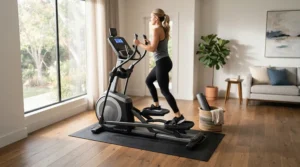
It’s tempting to assume any gym flooring will do, but an elliptical mat for wood floors and general-purpose gym flooring are solving genuinely different problems. Standard gym flooring — think interlocking rubber tiles or thick foam squares meant for weightlifting areas — is optimized for impact absorption against dropped weights and high-traffic foot tread, often at the cost of a rougher, more aggressive surface texture. On a finished hardwood floor, that aggressive texture and the adhesives sometimes used to seal tile seams can be exactly what causes discoloration or haze over months of contact. A dedicated hardwood-safe elliptical mat, by contrast, is typically engineered with a smoother, non-reactive backing and sized as a single sheet rather than interlocking pieces — fewer seams means fewer trap points for grit and moisture. The tradeoff is coverage: gym flooring tiles can cheaply blanket an entire room, while a single-sheet elliptical mat is deliberately sized just for the machine, which is usually the smarter, more targeted approach for anyone protecting a finished floor rather than converting a whole room into a rubber-floored gym.
Felt-Backed Mats vs. Rubber-Backed Mats: Which Actually Protects Hardwood?
Felt genuinely shines in one specific job: as small self-adhesive pads under furniture legs and light equipment feet, where its soft fiber surface glides without scratching and doesn’t compress into a permanent dent the way rubber sometimes can under static weight. But felt-backed pads aren’t built for the job a full elliptical mat needs to do — they don’t absorb meaningful vibration, they don’t resist moisture from sweat, and they’re not designed to sit under sustained lateral pressure from a machine’s gliding motion. Rubber and dense vinyl backings, like the ones in most of the mats above, trade that gentle glide for genuine grip and shock absorption, which is exactly what a moving cardio machine needs to stay put and avoid grinding grit into the finish beneath it. The practical takeaway: use felt pads for stationary furniture and equipment feet that never move, and reserve rubber or vinyl-backed mats for anything with motion, weight-bearing cycles, or vibration — trying to make felt do a rubber mat’s job usually ends with a machine slowly creeping across the room.
What to Expect: How Hardwood Floors Actually Get Scratched Under an Elliptical
The damage rarely comes from the machine’s weight alone — hardwood floors are more resilient to static pressure than most people assume. What actually causes hardwood floor scratches is the combination of movement and trapped grit: an elliptical’s glide motion creates constant micro-shifts, and any dust, sand, or debris caught between the machine’s feet and the floor acts like sandpaper with every stride. Add sweat into that mix and you get a second failure mode — moisture that seeps into hairline gaps in the finish and slowly clouds or lifts it, especially in machines used for high-intensity, high-sweat sessions. Vibration compounds both problems over time, gradually working grit deeper into the finish and loosening any wax or polyurethane coating at the contact points. Understanding this mechanism is exactly why the mats above emphasize sealed edges, moisture resistance, and anti-shift backing — a scratch-proof exercise mat for hardwood floors isn’t really fighting the elliptical’s weight, it’s fighting the grit and moisture that weight and motion stir up.
Non-Slip Mat for Hardwood Floor Gym Equipment: Common Mistakes When Buying
The single most common mistake is buying based on price per square foot alone and ending up with a mat too thin to actually cushion vibration — a wider, thinner mat looks like better value on paper but often performs worse than a smaller, denser one. A close second is ignoring the odor and off-gassing profile of cheaper PVC mats, then being surprised when a chemical smell lingers in a small room for weeks. Buyers also frequently skip measuring their machine’s actual footprint, including protruding stabilizer bars, and end up with a mat that leaves inches of exposed hardwood at exactly the point where sweat drips land. Another overlooked issue: assuming “non-slip” claims apply equally to both the floor side and the equipment side of a mat, when in reality most non-slip texturing is designed for one surface, not both — check that the specific non-slip mat for hardwood floor gym equipment you’re considering actually grips your particular floor finish, not just generic tile or carpet. Finally, many buyers never check underneath their mat after the first few weeks, missing early signs of trapped moisture that are far easier to address early than after months of contact.
Long-Term Cost & Maintenance: Is a Premium Mat Worth It?
Running the numbers, a $20 corner-pad set that needs replacing every year costs roughly the same over five years as a single $100 commercial-grade mat that lasts the whole stretch without curling, cracking, or needing replacement — and that’s before accounting for the labor of repeatedly setting up and breaking down a cheaper mat. The real total cost of ownership calculation isn’t just the sticker price; it’s how many times you’ll be moving your elliptical to swap out a worn mat, and what risk that repositioning poses to the floor underneath. Maintenance itself is fairly light across the board: a monthly wipe-down with a damp cloth and mild soap keeps most vinyl and rubber mats performing like new, while foam mats benefit from occasional airing out to prevent moisture buildup in the material itself. For light or occasional users, a mid-tier mat in the $40-$60 range genuinely delivers solid value without over-investing; for anyone putting daily mileage on a full-size elliptical, spending more upfront on a denser, heavier mat tends to work out cheaper per year of actual protection.
FAQ
❓ Does an elliptical need a mat on hardwood floors?
❓ What thickness mat is best for hardwood floor protection?
❓ Can rubber mats stain or discolor hardwood floors?
❓ How big should an elliptical floor mat be?
❓ Do felt pads work under an elliptical machine?
Conclusion
There’s no single “best” hardwood floor protection mat for elliptical machine setups — there’s only the best match for your specific machine, floor, and how often you actually use it. If you’ve got a compact or seated elliptical tucked into a small apartment, the TOBWOLF or Sunny Health & Fitness options solve the real problems you’re facing without over-investing. Families running a full-size machine daily will get more mileage out of the GymCope or Stamina Fold-to-Fit mats, while anyone treating their home gym like a long-term investment should seriously consider the SuperMats Heavy Duty or High Density Commercial Grade mats — genuinely built to be the last mat you buy for that machine. Whichever you choose, remember that the mat is only half the equation: clean floors before setup, a settling period before loading weight, and periodic checks underneath will do as much for your hardwood as the mat itself. Protecting a floor you love shouldn’t be complicated — just informed.
Recommended for You
- 7 Best Anti-Vibration Mat For Treadmill In Upstairs Apartment (2026)
- 7 Best Extra Large Equipment Mats For Multiple Gym Machines (2026)
- 3×6 Equipment Mat For Elliptical Machine: 7 Best Picks In 2026
Disclaimer: This article contains affiliate links. As an Amazon Associate, I earn from qualifying purchases. If you purchase products through these links, we may earn a small commission at no additional cost to you.
✨ Found this helpful? Share it with your friends! 💬🤗
