
In This Article
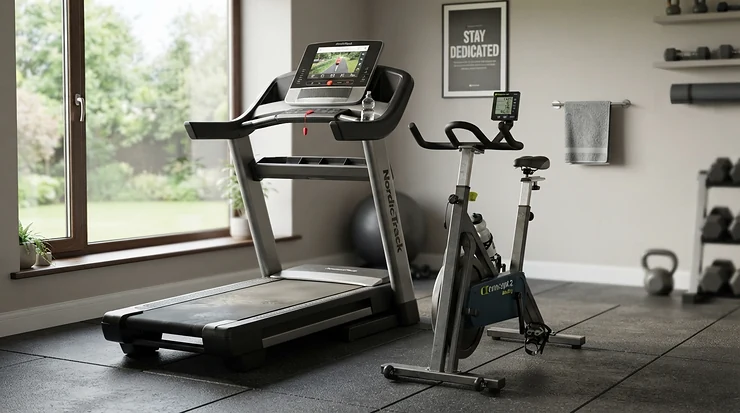
Somewhere between “I’ll just put a yoga mat under the treadmill” and “why does my ceiling fan rattle every time I drop a dumbbell,” most home gym owners hit the same wall. One mat under one machine works fine — until you add a second machine, then a rack, then a rower wedged into the corner, and suddenly your basement looks like a patchwork quilt of mismatched foam squares that slide apart every time you walk across them. That’s the exact problem an extra large equipment mat for multiple gym machines is built to solve: one continuous, heavy-duty surface engineered to sit under two, three, or more machines at once, instead of a scavenger hunt of leftover pieces.
This guide walks through seven real, currently available products — from budget interlocking tiles to made-in-USA rubber mats — and breaks down what actually matters when you’re protecting a basement, garage, or spare room from treadmills, racks, rowers, and everything in between. You’ll get honest analysis grounded in real specs and aggregated review sentiment, not marketing copy lifted straight from a product listing. Expect specific guidance on thickness, sizing, and layout, plus a look at what a floor can (and can’t) safely handle once you start stacking heavy equipment on top of it.
What Is an Extra Large Equipment Mat for Multiple Gym Machines?
An extra large equipment mat for multiple gym machines is a single oversized rubber or foam mat, or a connected system of interlocking tiles, sized to cover the footprint of two or more pieces of exercise equipment at once. Instead of separate small mats per machine, it creates one seamless, non-slip surface that protects flooring, absorbs impact, and reduces noise across an entire workout zone.
Quick Comparison: 7 Extra Large Equipment Mats at a Glance
Before diving into the details, here’s a fast snapshot of how these seven picks stack up on thickness, format, and who they’re really built for.
| Product | Format | Thickness | Best For |
|---|---|---|---|
| IncStores 8mm Rubber Tiles | Interlocking tiles | 8mm | Budget DIY basements |
| SUPERJARE Extra-Thick Tiles | Interlocking tiles | 0.79″ | Cushioned mixed-use floors |
| ProsourceFit Puzzle Mat | Interlocking tiles | 1″ | Quiet apartment-style gyms |
| Gorilla Mats Premium Large Exercise Mat | Single oversized mat | 0.25″–0.31″ | Fast, no-install coverage |
| Rubber-Cal Eco-Sport | Interlocking tiles | 3/4″–1″ | Heavy multi-machine zones |
| REP Fitness 4’x6′ Floor Mats | Modular mats | 3/4″ | Power racks and barbell work |
| Life Fitness Premium Large Equipment Mat | Single oversized mat | Commercial-grade | Premium cardio equipment |
Looking at the spread above, the split really comes down to format first, thickness second. The IncStores 8mm Rubber Tiles and SUPERJARE Extra-Thick Tiles win on affordability and DIY flexibility, but neither matches the raw crush-resistance of Rubber-Cal Eco-Sport or REP Fitness 4’x6′ Floor Mats under a loaded rack. If your top priority is “unbox it and walk away,” the Gorilla Mats Premium Large Exercise Mat and Life Fitness Premium Large Equipment Mat skip installation entirely — at the cost of being harder to reconfigure later.
💬 Just one click — help others make better buying decisions too!😊
Top 7 Extra Large Equipment Mats for Multiple Gym Machines: Expert Analysis
1. IncStores 8mm Thick Strong Rubber Interlocking Floor Tiles — budget-friendly DIY interlocking tiles
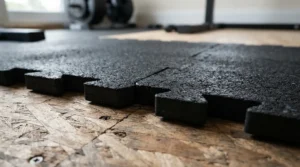
IncStores built its reputation on flexible, no-fuss flooring, and this tile system is the clearest expression of that idea. The 8mm recycled rubber tiles snap together with a puzzle-edge design, letting you cover an oddly shaped basement corner without cutting anything to size.
At 8mm thick, these tiles land squarely in the “protect the floor, not the joints” category — they’re built to guard hardwood or concrete from scuffing under a treadmill or bike, rather than to cushion dropped plates. Based on the spec comparison with thicker options later in this list, this is the pick for someone whose main enemy is scratches and vibration, not barbell drops. It’s a smart call for renters or first-time home gym builders who want a modular flooring for a basement, home gym, shed, or trailer, and might need to expand or relocate the setup later.
Reviewers consistently report that the interlocking edges fit snugly and resist sliding once a few rows are connected, though some aftermarket sellers list inconsistent piece counts, so double-check total square footage before checkout. A common complaint centers on minor rubber odor in the first week, which typically fades with ventilation.
Pros:
- ✅ Puzzle-edge tiles fit irregular basement layouts easily
- ✅ Budget-friendly per-square-foot cost for large areas
- ✅ Recycled rubber construction holds up outdoors too
Cons:
- ❌ 8mm thickness isn’t ideal for dropped free weights
- ❌ Some listings report inconsistent tile counts on arrival
Priced in the $150–$250 range for a starter multi-machine area, this is the entry point of the list — a good value pick if your machines are cardio-focused rather than heavy iron.
2. SUPERJARE 0.79″ Extra-Thick Exercise Equipment Mats — thickest cushioning under $200
SUPERJARE’s 48-square-foot interlocking set pairs a rubber top layer with high-density EVA foam underneath, which is a smart hybrid: rubber resists tearing under machine feet, while foam absorbs shock better than rubber alone.
The 0.79-inch thickness is one of the deepest in this roundup, and what that means practically is more forgiving support under stationary bikes, ellipticals, and rowers where subtle vibration is the enemy of a quiet household. What most buyers overlook about foam-core tiles is that the extra cushioning also makes floor work — planks, stretching, core routines between machine sets — noticeably more comfortable than on rubber alone.
Aggregated customer sentiment on this style of tile skews positive for stability once assembled, with reviewers noting the rubber top resists slipping even under repeated cardio machine motion. A recurring theme in feedback for foam-core interlocking tiles broadly is that individual tiles can show wear at connector seams faster than solid rubber after a couple of years of heavy daily use.
Pros:
- ✅ Rubber-and-foam hybrid softens impact for mixed workouts
- ✅ 48 sq ft covers a genuine multi-machine footprint
- ✅ Interlocking system needs no adhesive or tools
Cons:
- ❌ Foam core wears faster than solid rubber at seams
- ❌ Not rated for heavy barbell or plate drops
Expect a price in the mid-$100s to around $180 for the 12-tile set, making it a strong mid-tier choice for cardio-heavy basement home gym layouts.
3. ProsourceFit Extra Thick Exercise Puzzle Mat (1-inch) — quietest option for apartment gyms
ProsourceFit has built a long track record in the puzzle-mat category, and the 1-inch EVA foam version is the thickest true foam option here. That extra half-inch over the SUPERJARE tiles translates into noticeably better sound dampening — a detail that matters enormously if your “basement gym” is actually a room above someone else’s bedroom.
Here’s what to weigh: 1-inch EVA foam compresses more than rubber under heavy static loads, so a loaded squat rack sitting in one spot for months can leave a visible depression. On paper this means ProsourceFit is best suited to elliptical trainers, spin bikes, rowers, and light dumbbell work rather than a fully loaded power rack parked in the same six square feet indefinitely.
Reviewers consistently note the tiles are comfortable underfoot and genuinely reduce noise transfer to rooms below, which lines up with the extra thickness. A common complaint in user reviews for foam mats generally is a mild chemical smell out of the box, usually gone within a few days of airing out.
Pros:
- ✅ 1-inch foam offers the best noise reduction here
- ✅ Comfortable enough for floor exercises between machines
- ✅ Interlocking tiles adapt to non-rectangular rooms
Cons:
- ❌ Compresses under sustained heavy static loads over time
- ❌ Less suited to barbell or free-weight drops
Typical pricing runs in the $150–$220 range for a 24–48 sq ft set, positioning it as a smart pick when quiet matters more than crush resistance.
4. Gorilla Mats Premium Large Exercise Mat — best all-rounder for wall-to-wall coverage
Gorilla Mats takes a completely different approach: instead of tiles, it’s one continuous mat, available in 6’x4′ and 7’x5′ sizes, that you unroll and you’re done. No connector pins, no gaps, no weak seams between panels — which, based on the spec comparison, is the single biggest functional difference between this and every interlocking product on this list.
At roughly a quarter-inch to just under a third of an inch thick depending on size, this isn’t the thickest mat here, but the dense ProFoam material is engineered specifically to balance stability with comfortable cushioning across a full workout area. What most buyers overlook is that the textured, patterned underside is doing real work — it’s specifically designed to grip most floor types without tape or adhesive, which matters when you’re covering enough square footage for two or three machines side by side.
Reviewer sentiment is largely positive on size and value, with buyers commonly using it under a treadmill and elliptical combination, or as a large HIIT and stretching zone. Some reviewers have flagged slipping on certain carpet types, and the surface can get slick when wet, so it’s a stronger match for hard flooring or low-pile carpet than deep-pile carpeting.
Pros:
- ✅ Single-piece design eliminates seams and gaps entirely
- ✅ Grippy underside works without tape on most floors
- ✅ Ships with storage straps and a cleaning towel
Cons:
- ❌ Can slip on certain thick carpet types
- ❌ Not as thick as dedicated rubber tile systems
At around $100–$150 depending on size, it’s genuinely competitive with tile systems while saving you the installation time entirely.
5. Rubber-Cal “Eco-Sport” Interlocking Rubber Tiles — toughest recycled rubber for heavy machines
Rubber-Cal’s Eco-Sport line is built from recycled tire rubber in a 3/4-inch or 1-inch gauge, and it’s the most industrial-feeling product on this list. Reviewers and the manufacturer alike position it specifically for spaces that see heavy foot traffic, dropped weights, dampness, and heavy equipment — in other words, exactly the scenario a multi-machine basement gym creates daily.
The thickness here isn’t for show: at 3/4 to a full inch, the interlocking tiles are engineered to withstand dropped weight in a weight room, heavy machinery on equipment flooring, and general floor protection duty. What that means in practice is this is one of the few products on this list genuinely rated for a rack-and-cardio combination rather than cardio alone. The recycled-rubber build also holds up in damp conditions and works well for outdoor use, a bonus if your basement occasionally gets humid.
Honest tradeoff: recycled crumb-rubber flooring is well documented to carry a stronger rubber smell out of the box than virgin rubber or foam alternatives, something worth planning for with ventilation during the first few weeks. Installation uses a plastic connector-pin system with five pins per tile, requiring no glue or professional installer.
Pros:
- ✅ 3/4″–1″ gauge handles dropped weights confidently
- ✅ Performs well even in damp basement conditions
- ✅ Pin-connector install needs no adhesive or tools
Cons:
- ❌ Stronger initial rubber odor than foam alternatives
- ❌ Heavier tiles make DIY cutting more labor-intensive
Pricing scales with coverage, typically landing in the $350–$600 range for enough tiles to cover a genuine multi-machine footprint — a fair tradeoff for the added durability.
6. REP Fitness 4’x6′ Floor Mats — best made-in-USA pick for power racks
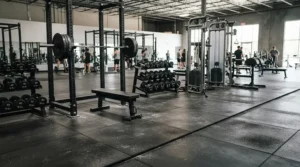
REP Fitness built its name on garage-gym equipment, and its flooring follows the same philosophy: dense, no-nonsense, and designed in the USA. The 4’x6′ mats use a 3/4-inch urethane-bound rubber that’s noticeably heavier per square foot than the interlocking tile options above.
That density matters because it’s engineered for the worst-case scenario in a multi-machine setup — a power rack anchoring one side of the room while a rower or bike runs on the other. Based on the spec comparison, the untextured top surface trades a bit of grip for a smoother, more comfortable stance during lifts, while the 3/4-inch thickness handles noise and vibration transfer noticeably better than thinner tile products.
Reviewers consistently praise the mats’ thickness, weight, and durability, describing them as providing excellent stability for home gyms and comparing the cushioning favorably to professional gym flooring. Some feedback does note occasional inconsistency in individual mat dimensions and mild curling at the edges over time, which is worth checking for during unboxing.
Pros:
- ✅ Dense 3/4″ rubber built specifically for rack loads
- ✅ Designed and manufactured in the USA
- ✅ Minimal odor reported compared to imported alternatives
Cons:
- ❌ Higher price per square foot than tile systems
- ❌ Occasional edge curling reported after months of use
Expect roughly $90–$140 per mat, meaning a full multi-machine layout using several mats becomes a meaningful investment — justified if your setup includes serious free-weight work.
7. Life Fitness Premium Large Equipment Mat — best for commercial-grade cardio equipment
Life Fitness makes this mat specifically to pair with its own commercial cardio lineup, and that specialization shows. It’s designed for use under Club Series+ treadmills, Run CX, T3, F3 models, and Total Body and Lower Body Arc trainers — equipment that’s meaningfully heavier and more powerful than typical consumer-grade machines.
What most buyers overlook here is that this mat isn’t trying to be a general-purpose flooring solution; it’s a precision accessory sized and engineered around the vibration profile of commercial-spec cardio equipment. If your basement gym includes a genuinely commercial treadmill or elliptical — the kind built for daily heavy use rather than occasional home workouts — this is the mat category matched to that machine’s actual footprint and shake pattern, rather than a generic oversized rubber sheet.
Because this is a specialty accessory tied to a specific equipment brand rather than a mass-market Amazon staple, independently aggregated customer review data is limited compared to the other six picks; what’s verifiable comes from the manufacturer’s own product specifications rather than a large third-party review pool, and that’s worth being upfront about rather than inventing sentiment that doesn’t exist.
Pros:
- ✅ Purpose-built for heavy commercial cardio machines
- ✅ Matches machine footprint precisely, reducing wasted mat space
- ✅ Backed by an established commercial fitness brand
Cons:
- ❌ Premium price relative to general-purpose mats
- ❌ Limited independent review data outside manufacturer specs
Pricing for this category typically runs well above general-purpose mats — check current price directly, as commercial accessory pricing varies more than mass-market flooring.
Practical Usage Guide: Installing Your Oversized Home Gym Floor Mat
Getting an oversized home gym floor mat down correctly the first time saves you from redoing it later, and it starts before the mat even arrives.
Before you unbox anything, sweep and vacuum the subfloor completely — trapped grit under rubber tiles is the number one cause of premature surface wear, since every footstep grinds debris into the underside. If you’re working over unfinished concrete, check for moisture with a simple taped-plastic-sheet test overnight; standing moisture can warp interlocking edges over months.
During layout, work from the center of the room outward rather than starting at a wall, especially with interlocking tiles — this keeps cut pieces at the room’s edges where they’re least visible and easiest to trim around outlets or support posts. For single-piece mats like the Gorilla Mats option, let the mat sit unrolled for 24–48 hours in the room before final positioning; foam and rubber both relax into flatness faster in the actual room temperature and humidity than in shipping.
Common first-30-days mistakes include skipping a moisture barrier under rubber on concrete (leading to a faint mildew smell later), over-tightening interlocking tabs so the puzzle edges bow upward instead of lying flat, and placing machines before the mat has fully off-gassed its initial rubber scent, which traps odor underneath equipment feet.
For ongoing maintenance, a monthly damp-mop with mild soap keeps both rubber and foam surfaces performing as designed, and rotating tiles occasionally under stationary bikes prevents uneven compression in one spot.
🚀 Ready to gear up your basement gym? Check out today’s top-rated mats and lock in your floor protection before your next workout! ⚡
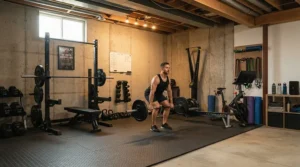
Real-World Scenarios: Matching a Mat to Your Basement Home Gym Layout
Not every basement home gym layout has the same demands, so here’s how three common setups map to the picks above.
The cardio-and-core apartment gym: A spare bedroom or apartment corner with a bike, a rower, and floor space for stretching, where noise to the room below is the top concern. The ProsourceFit 1-inch puzzle mat is the strongest match here — its extra foam depth genuinely dampens vibration transfer better than thinner tile or rubber options.
The unfinished basement all-rounder: A concrete basement housing a treadmill, an elliptical, and an open floor zone for HIIT work, where budget matters and floor dampness is a real concern. The IncStores 8mm tiles or Rubber-Cal Eco-Sport tiles both handle basement humidity well, with Eco-Sport winning if any dropped-weight work is planned alongside cardio.
The serious home lifter’s garage-basement hybrid: A power rack, a bench, and a rower or bike sharing one room, with real barbell drops expected regularly. This is squarely REP Fitness 4’x6′ mat or Rubber-Cal Eco-Sport territory — both are rated for genuinely heavy static and impact loads that thinner foam products aren’t built to absorb.
How to Choose an Extra Large Equipment Mat for Multiple Gym Machines
- Measure the full footprint first, not just one machine. Add up the combined length and width of every machine you’ll place, plus at least 12–18 inches of buffer around each for safe movement.
- Match thickness to your heaviest use case. If any free-weight or barbell drops are planned anywhere in the room, size up to 3/4-inch or thicker rubber, even under cardio machines nearby.
- Decide between tiles and a single mat early. Interlocking mat tiles adapt to odd room shapes and expand later; single mats install faster but are harder to reconfigure.
- Check subfloor type before ordering. Concrete basements handle heavier rubber gauges better structurally than upper-floor rooms — more on this below.
- Factor in noise transfer if neighbors or family are nearby. Foam-core products generally outperform pure rubber for sound dampening, at some cost to load durability.
- Confirm total coverage math, not just per-tile price. A cheaper per-tile cost can still mean a higher total once you calculate the square footage a multi-machine layout actually requires.
- Read aggregated reviews for slip and odor complaints specifically, since these are the two most commonly reported issues across nearly every mat category in this space.
Interlocking Mat Tiles vs. a Single Oversized Mat vs. Rubber Rolls
Interlocking mat tiles, single continuous mats, and rubber rolls solve the same core problem — protecting the floor under multiple machines — through genuinely different tradeoffs.
Interlocking mat tiles, like the IncStores, SUPERJARE, ProsourceFit, and Rubber-Cal picks above, win on adaptability. You can shape coverage around support posts, expand the layout later as you add equipment, and replace a single damaged tile instead of an entire mat. The cost is visible seams, which can shift slightly over years of heavy foot traffic and occasionally need re-snapping.
Single oversized mats, like Gorilla Mats and the Life Fitness option, win on installation speed and seamless coverage — there’s no seam for dirt or moisture to work into, and setup is measured in minutes. The tradeoff is fixed sizing; if your equipment layout changes significantly, you may need an entirely new mat rather than adding a few extra tiles.
Rubber rolls split the difference: continuous coverage over long, narrow footprints without the segmenting of tiles, but they’re heavier and harder for one person to maneuver during installation, and cutting around obstacles is less forgiving than trimming a modular tile.
Multi-Machine Flooring Protection vs. Traditional Gym Flooring
| Factor | Multi-Machine Flooring Protection | Traditional Single-Purpose Mats |
|---|---|---|
| Coverage | One continuous surface under several machines | Separate mat per machine, with gaps between |
| Noise reduction | Consistent across the whole zone | Uneven — bare floor still exposed between mats |
| Cost efficiency | Lower cost per sq ft at scale | Higher cumulative cost buying multiple small mats |
| Reconfiguration | Tiles adapt; single mats are fixed-size | Easy to move, but leaves protection gaps |
| Best For | Basement or garage gyms with 2+ machines | Single-machine setups or apartments |
The efficiency gap here is the real story: buying three or four small mats separately typically costs more per square foot than one properly sized multi-machine flooring protection system, and it leaves bare floor exposed in the walking lanes between machines — exactly where dropped weights and shifting equipment feet do the most damage.
Common Mistakes When Buying an Extra Large Exercise Mat for a Basement Gym
Buying too thin for the intended use is the most frequent and costly mistake — a 1/4-inch mat under a machine that occasionally sees dropped dumbbells will show damage within months. A close second is ignoring total square footage math and ending up with a mat that covers 80% of the intended zone, leaving one machine corner exposed. Buyers also commonly underestimate moisture from concrete basements, skipping a barrier layer that would have prevented a musty smell developing under rubber after a year. Finally, many people order based on listed dimensions alone without checking real-world tolerance — interlocking tiles from different batches can vary by a fraction of an inch, which matters when precisely tiling a fixed-size room.
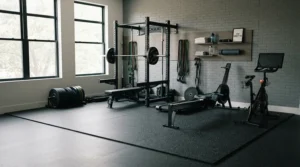
What to Expect: Real-World Performance Under Heavy Equipment
Specs on a listing rarely translate directly to lived experience, so here’s the practical version. Thinner mats (under 1/2 inch) genuinely do reduce scuffing and light vibration from cardio machines, but they won’t meaningfully soften the sound of a loaded barbell hitting the floor — for that, you’re relying on 3/4-inch-plus rubber gauge, full stop. Interlocking tiles under stationary bikes and ellipticals settle in within the first week or two, after which slight seam gaps from initial installation typically close up as the tiles compress slightly under machine feet. Single-piece mats show the opposite pattern — they’re at their flattest on day one and can develop very slight ripples near the edges over the first month as the material acclimates, which generally settles with foot traffic.
Extra Large Exercise Mats for Small vs. Large Basement Gyms
A smaller basement or spare-room gym — think one cardio machine plus light dumbbell work — is better served by a single Gorilla Mats-style product or a compact ProsourceFit tile set; the goal is maximum coverage without wasted material or awkward cutting. A larger multi-machine basement, especially one built around a rack, bench, and multiple cardio pieces, benefits far more from a modular tile system like Rubber-Cal Eco-Sport or REP Fitness mats, since the room can be built out in stages and individual sections replaced without redoing the whole floor.
Long-Term Cost & Maintenance
| Product Type | Typical Lifespan | Maintenance Need |
|---|---|---|
| EVA foam tiles (SUPERJARE, ProsourceFit) | 2–4 years under moderate use | Low — occasional wipe-down |
| Recycled rubber tiles (IncStores, Rubber-Cal) | 5–10+ years | Low — sweep and mop |
| Solid rubber mats (REP Fitness, Life Fitness) | 8–10+ years | Very low — highly wear resistant |
| Single foam/rubber mats (Gorilla Mats) | 3–5 years | Low — wipe clean, rotate periodically |
The pattern here is straightforward: foam-based products cost less upfront but typically need replacing two or three times over the lifespan of a single solid rubber purchase, which narrows the total cost-of-ownership gap significantly over a 10-year horizon. For a genuinely long-term multi-machine setup, the higher upfront cost of rubber tiles or REP-style mats often pencils out cheaper per year than repeatedly replacing thinner foam tiles.
Safety, Floor Loading & Regulations Guide for Basement Home Gyms
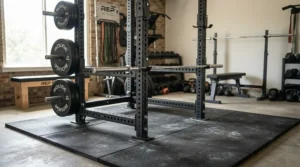
Flooring protection solves surface-level damage, but it doesn’t change what’s underneath it — and that’s where basement home gym layout planning gets genuinely important. Standard residential floor codes are generally built around everyday living loads, not concentrated gym equipment weight, and a loaded rack or a stack of plates in one spot creates a very different load pattern than furniture spread across a room. If your gym sits on a wood-framed floor above another level rather than directly on a concrete basement slab, it’s worth having a structural engineer confirm the floor can handle concentrated equipment loading before committing to heavy machines — a concrete slab basement generally sidesteps this concern entirely.
Separately, mat choice intersects with injury prevention in a more direct way than most buyers expect. The U.S. Consumer Product Safety Commission’s hazard screening data on exercise equipment consistently shows that dropped weights, machine instability, and slick surfaces are recurring causes of home gym injuries — all factors a properly sized, non-slip, adequately thick mat directly addresses. If you’re weighing recycled rubber tiles for their durability, it’s also worth knowing that independent testing of recycled tire rubber has found it can release detectable volatile organic compounds during and shortly after manufacturing, which is one more reason to ventilate a new rubber floor for a few days before heavy daily use, especially in an enclosed basement.
FAQ
❓ How thick should an extra large equipment mat be for multiple machines?
❓ Can interlocking mat tiles be used under a treadmill?
❓ Do I need a moisture barrier under rubber mats in a basement?
❓ How do I clean a large gym floor mat?
❓ Are oversized single mats better than interlocking tiles?
Conclusion
Choosing an extra large equipment mat for multiple gym machines really comes down to matching format and thickness to how hard your equipment actually works the floor. Budget interlocking tiles like IncStores or SUPERJARE handle cardio-focused rooms well and keep costs down. If quiet matters most, ProsourceFit’s extra-thick foam earns its place. For anyone mixing in real free-weight training, Rubber-Cal Eco-Sport and REP Fitness’s made-in-USA mats are built for that load, while Gorilla Mats offers the fastest path to full coverage with zero installation. Life Fitness rounds things out as the specialty pick for commercial-grade cardio machines specifically.
Whichever direction you go, the floor beneath your equipment is one of the few home gym investments that quietly protects everything else you’ve spent money on — the machines, the subfloor, and honestly, your joints too.
✨ Don’t Miss These Exclusive Deals!
🔍 Take your basement home gym layout to the next level with these carefully selected mats. Click on any highlighted product to check current pricing and availability, and build a floor that can actually keep up with your training.
Recommended for You
- 3×6 Equipment Mat For Elliptical Machine: 7 Best Picks In 2026
- Rubber Mat for Heavy Exercise Equipment: 7 Picks That Survive 2026
- 7 Best Commercial Elliptical for University Recreation Center (2026)
Disclaimer: This article contains affiliate links. As an Amazon Associate, I earn from qualifying purchases. If you purchase products through these links, we may earn a small commission at no additional cost to you.
✨ Found this helpful? Share it with your friends! 💬🤗
