
In This Article
Buy the wrong treadmill and one student notices. Buy the wrong elliptical fleet and your facilities director hears about it for the next seven years — because that’s roughly how long a properly specified commercial elliptical for university recreation center use is supposed to last before it earns a spot in the surplus auction. That’s not a typo. Real commercial-grade units, the kind with welded steel frames and generator-based resistance systems, routinely outlive the warranty period by a decade when they’re maintained on schedule.

So what actually counts as one? A commercial elliptical for university recreation center deployment is a cross-trainer engineered for continuous, unsupervised, multi-user daily traffic — typically rated for 12+ hours of use per day, a 400-pound user capacity, and a frame warranty measured in decades rather than years, unlike consumer models built for a handful of weekly sessions…
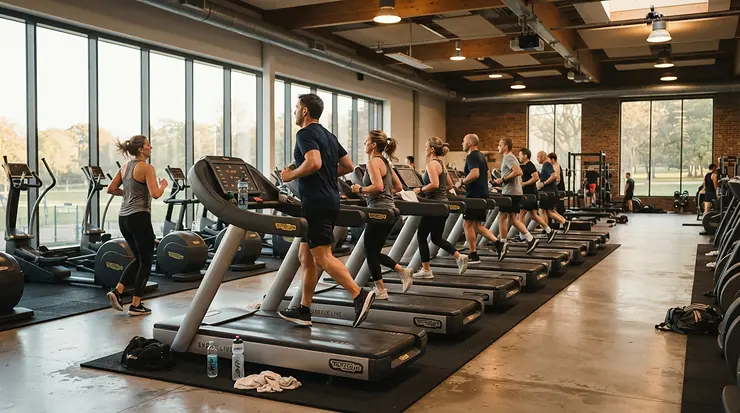
The stakes here aren’t cosmetic. According to the CDC’s current physical activity guidelines, adults need roughly 150 minutes of moderate-intensity aerobic activity a week, and for a huge share of a campus population, the rec center elliptical row is where that happens — or doesn’t, if half the fleet is down for repairs during finals week. This guide walks through seven real, currently available commercial ellipticals, how they stack up on the specs that matter for a staffed, high-traffic facility, and how to actually get them purchased without blowing a semester’s equipment budget.
Quick Comparison Table
| Model | Stride Length | Max User Weight | Best For |
|---|---|---|---|
| Precor EFX 835 | 20″ adjustable CrossRamp path | 400 lbs | Best overall biomechanics |
| Life Fitness Integrity Series CLSX | 18″ | 400 lbs | Best mid-range workhorse |
| Matrix E7xi Suspension Elliptical | 21″ | 350 lbs | Best touchscreen/entertainment |
| Star Trac 8 Series Rear Drive | 18″ | 400 lbs | Best for accessibility & open-step entry |
| True Fitness CS900 | 21″ (13″-30″ adjustable) | 400 lbs | Best compact footprint |
| Technogym Excite+ Vario | 0-33″ variable stride | 440 lbs | Best for varied movement patterns |
| MERACH Commercial-Style Elliptical | 19″ | 400 lbs | Best budget bulk-buy option |
Looking at this lineup, the spread runs from a satellite-gym budget pick under $1,000 to premium international units that clear five figures per machine — and stride length turns out to be less about “bigger is better” and more about matching your actual user population. A campus with a lot of shorter-statured or older adult users (faculty/staff wellness hours, for instance) doesn’t automatically benefit from the Technogym Excite+ Vario‘s 33-inch stride ceiling the way a varsity-adjacent training room might. Machines rated at 400 lbs user weight capacity aren’t just a nod to bigger athletes — they’re a proxy for frame-grade steel and bearing quality that determines how the machine holds up under six or eight hours of daily rotation, not just how much any single rider weighs.
Just one click — help others make better buying decisions too!😊
Top 7 Commercial Ellipticals for University Recreation Centers: Expert Analysis
1. Precor EFX 835 — best all-around biomechanics for high-traffic gyms
The Precor EFX 835‘s patented Converging CrossRamp is the detail that actually separates it from a generic front-drive machine. Precor built the first commercial elliptical back in 1995, and the EFX 835 is essentially the same DNA that’s been refined across three decades of health club installations, resorts, and — per Precor’s own marketing — university fitness centers specifically. The CrossRamp adjusts from roughly 13 to 40 degrees, and because the footpath converges toward the body’s midline the way a real walking or running gait does, users spend less time compensating for an unnatural motion and more time actually training. That matters enormously in a self-serve campus environment where nobody’s coaching first-time users on form.
Based on the spec comparison against rear-drive competitors, the 835’s moving handlebars and 20 resistance levels give it real workout variety without needing a touchscreen subscription to unlock it — the P31/P30 console keeps things LED-based and refreshingly simple to operate and to service. Facility managers and remanufacturers who work on these machines consistently flag the covered ramp and rear-drive housing as easier to keep clean and serviceable than more exposed designs, which is a real consideration when custodial staff — not fitness technicians — are doing daily wipe-downs.
This is the pick for programs where “will it survive four years of unsupervised undergraduate use” outranks “does it have a 16-inch touchscreen.”
Pros:
- ✅ Converging CrossRamp mimics natural walking/running gait
- ✅ Self-powered — no outlet or wiring needed for placement
- ✅ Long documented track record in university and hotel installs
Cons:
- ❌ LED console feels dated next to touchscreen competitors
- ❌ Larger 80-inch footprint demands real floor planning
New units run in the $7,000-$8,500 range, while remanufactured EFX 833/835 units — a legitimate option many campus buyers overlook — typically land around $2,500-$3,500, making the 835 one of the stronger value plays in this list once you factor in used/remanufactured channels.
2. Life Fitness Integrity Series CLSX — most durable self-powered workhorse
The Life Fitness Integrity Series CLSX is built for exactly the scenario campus rec directors dread most: a machine that gets used by three different students back-to-back with zero downtime for adjustment. Its 18-inch stride length and 25 resistance levels give it enough range to serve a mixed-fitness-level student body without pigeonholing it as an entry-level unit. What most buyers overlook about a self-powered elliptical like this one is that it removes an entire category of electrical-install headaches — no dedicated circuit, no outlet planning, which matters a lot when you’re retrofitting an older rec building rather than building from scratch.
Life Fitness has been the top-selling brand in commercial health clubs for years, largely because its full-commercial warranty structure (versus the “light commercial” tier some competitors quietly apply) assumes the exact dues-paying, all-day-usage pattern a university recreation center represents. Support handlebars and oversized non-slip pedals are the kind of unglamorous details that reduce injury-liability exposure more than any marketing spec sheet line item.
Reviewers and facility techs consistently describe the Integrity line as the “no surprises” tier of the Life Fitness catalog — less flash than the Elevation Series, but fewer electronic failure points to troubleshoot at 11pm on a Tuesday.
Pros:
- ✅ Full commercial warranty tier, not “light commercial”
- ✅ Self-powered design simplifies facility electrical planning
- ✅ 25 resistance levels cover beginner-to-advanced users
Cons:
- ❌ No touchscreen option limits entertainment integration
- ❌ 18″ stride is shorter than several premium competitors
Expect new pricing in the $4,000-$5,500 range per unit, with meaningful volume discounts available through cooperative education contracts — more on that below.
3. Matrix E7xi Suspension Elliptical — best for entertainment and student engagement
If retention data on your campus shows students bail on cardio after ten boring minutes, the Matrix E7xi Suspension Elliptical‘s 16-inch touchscreen and Virtual Active scenic routes are a legitimate engagement lever, not just a shiny upsell. Matrix eliminated the traditional wheel-and-track system in favor of a suspension design, and the practical result — according to Matrix’s own engineering documentation and reseller technical manuals — is a quieter glide with fewer wear components that degrade over thousands of daily strides.
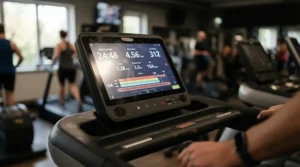
The 21-inch stride length is the longest fixed stride on this list outside the Technogym’s variable-path design, which benefits taller students and staff without excluding shorter users, since the suspension geometry adapts more forgivingly than older wheel-and-track Matrix models. What the spec sheet won’t tell you, but service technicians note, is that the WiFi-enabled Matrix Asset Management system lets a facilities team monitor machine uptime and usage remotely — genuinely useful when one staffer is responsible for forty pieces of cardio equipment across two buildings.
On the downside, that same touchscreen is the first thing to fail under heavy dorm-adjacent humidity and traffic, and console repairs on interactive consoles run more expensive than LED equivalents.
Pros:
- ✅ 21″ suspension stride reduces wear-part fatigue over time
- ✅ Remote asset-management console aids small maintenance teams
- ✅ Virtual Active content genuinely improves workout adherence
Cons:
- ❌ Touchscreen console is the priciest component to repair
- ❌ New-unit pricing sits well above Life Fitness or Star Trac peers
New E7xi units list well into five figures, but remanufactured, off-lease E7xi units — cleaned, serviced, and warrantied — typically run $3,000-$4,500, which is where most campus buyers actually land on this model.
4. Star Trac 8 Series Rear Drive Elliptical — best for accessibility and mixed-ability users
Recreation centers serve a genuinely wider range of bodies and abilities than a boutique studio does — faculty in their sixties, students recovering from an ACL repair, staff wellness participants who’ve never used a cross-trainer. The Star Trac 8 Series Rear Drive Elliptical‘s rear-approach, open-step entry design is built specifically for that reality: users mount from behind rather than stepping over a raised frame, which reduces trip-and-fall risk in a way that matters far more in a self-serve gym than in a personal-training studio with staff hovering nearby.
Star Trac’s Soft Trac cushioned pedals are a genuine ergonomic upgrade over rigid plastic platforms, and facility operators report the cushioning meaningfully reduces joint-strain complaints from users with existing knee or hip sensitivity — exactly the population an inclusive campus wellness program is trying to keep active rather than sideline. The OpenHub console architecture is also modular: you can start with a basic LCD and add touchscreen or entertainment modules later, which is a smart hedge against a tight opening-year budget that expects a technology refresh in year three.
Star Trac’s warranty structure explicitly distinguishes “commercial” (dues-paying, 8+ hours/day) from “light commercial” tiers, and a university rec center should insist on the commercial-tier warranty language in writing before signing.
Pros:
- ✅ Open-step rear-approach entry reduces fall risk
- ✅ Soft Trac pedals cut joint strain for sensitive users
- ✅ Modular OpenHub console upgrades without full replacement
Cons:
- ❌ Entertainment features cost extra beyond the base LCD
- ❌ 400 lb rating requires the commercial warranty tier specifically
New units generally run $6,500-$8,500 depending on console configuration, with the base LCD version anchoring the lower end of that range.
5. True Fitness CS900 — best compact footprint for tight floor plans
Not every campus rec center got a shiny new building; plenty are shoehorning modern cardio rows into 1980s-era gyms with awkward column spacing. The True Fitness CS900‘s 67-inch by 34-inch footprint is meaningfully smaller than most commercial ellipticals on this list while still delivering a 21-inch stride via TRUE’s Core Drive system, which keeps the user centered over the machine’s balance point rather than shifting weight forward like some front-drive designs do.
True’s proprietary Side Steps are a legitimately unusual feature: they let a user dismount the pedals and drive the machine using only the moving handlebars, converting it into an upper-body-only cardio station — a genuinely useful option for students in a lower-body rehab window who still want cardio access. The lifetime frame warranty (parts and labor typically at 3 years) reflects True’s positioning as a long-cycle capital asset rather than a lease-and-replace unit, which lines up well with how universities actually budget for equipment — as depreciating capital, not disposable inventory.
Reviewers consistently flag the CS900 as punching above its price bracket on build quality, particularly the reinforced frame and moisture-resistant grips that hold up under heavy sweat exposure.
Pros:
- ✅ Smallest footprint of the full-size commercial units here
- ✅ Side Steps enable upper-body-only rehab-friendly training
- ✅ Lifetime frame warranty signals long-term capital confidence
Cons:
- ❌ Console options at the low end feel basic for the price
- ❌ Fewer used/remanufactured units on the market than Life Fitness
MSRP sits around $6,600, with most campus buyers negotiating into the mid-$6,000s to $7,500 range depending on console tier and delivery terms.
6. Technogym Excite+ Vario — most versatile stride pattern on the market
The Technogym Excite+ Vario does something none of the other six machines on this list attempt: it lets the user actively define their own stride path in real time, ranging from a vertical stepping motion up to an 83-centimeter (roughly 33-inch) running-length glide, without stopping the machine to adjust a setting. For a university population that spans a first-year student training for a half-marathon and a retiring staff member doing low-impact rehab work, that adjustability functionally replaces two or three separate cardio machines with one.
Technogym, the Italian brand behind Olympic Village fitness equipment for multiple Games cycles, builds the Excite+ line with a biomechanical philosophy around eliminating bounce and promoting proper form automatically — the ramp and pedal geometry lock in at the safest starting position on power-up, which reduces the “first three seconds are always a little sketchy” problem some ellipticals have. On the fly Fast Track controls on the handlebars let users shift resistance and stride without breaking rhythm, a small but real usability win in a self-serve setting.
The tradeoff is straightforward: this is a premium international import, and both acquisition cost and parts lead times run higher than domestic brands, which matters if your facilities team needs same-week service turnaround during a busy semester.
Pros:
- ✅ Continuously variable stride replaces multiple machine types
- ✅ Automatic safe-start pedal positioning aids first-time users
- ✅ Global brand reputation from decades of elite-facility use
Cons:
- ❌ Highest acquisition cost of any model on this list
- ❌ Parts and service lead times run longer than domestic brands
New Excite+ Vario units typically price in the $9,000-$13,000 range depending on console selection, positioning it firmly as a flagship-row purchase rather than a fleet-wide standard.
7. MERACH Commercial-Style Elliptical — best budget option for satellite and dorm gyms
Not every square foot of campus fitness space needs a $7,000 machine, and pretending otherwise is how equipment budgets blow up before the main rec center even gets funded. The MERACH Commercial-Style Elliptical is honestly positioned as light-duty rather than full-commercial grade, but for a residence-hall satellite gym or a small departmental wellness room with lighter daily traffic, its specs are genuinely competitive: a magnetic drive system rated under 15 decibels, a 400-pound user capacity, and a self-powered design that needs no outlet — meaning it can go in spaces without existing electrical infrastructure.
Reviewers who’ve tested it against pricier competitors note the roughly 90% pre-assembled shipping configuration cuts setup time dramatically, which matters when a facilities crew is installing a dozen units before a fall semester deadline with no room in the schedule for a full-day assembly job per machine.
Here’s what to weigh honestly: the fixed ramp angle limits the muscle-targeting variety that adjustable-incline machines like the Precor or Star Trac offer, and this is not the unit you want absorbing 10+ hours a day of continuous high-traffic use in your flagship building — it’s the smart choice for secondary spaces where budget-per-unit matters more than premium biomechanics.
Pros:
- ✅ Under-15dB operation suits noise-sensitive shared spaces
- ✅ Self-powered, no-outlet design eases satellite-gym installs
- ✅ 90% pre-assembled cuts multi-unit setup time significantly
Cons:
- ❌ Fixed ramp angle limits muscle-targeting variety
- ❌ Not rated for flagship-facility, 10+ hour daily traffic
Pricing typically falls in the $600-$900 range per unit, making it the only model here where a satellite gym could realistically afford three or four units for the price of one premium commercial machine.
Practical Usage Guide: Running Ellipticals in Staffed Fitness Facilities
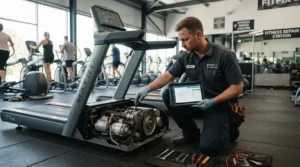
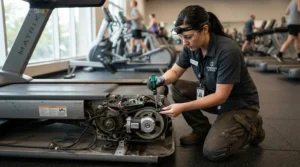
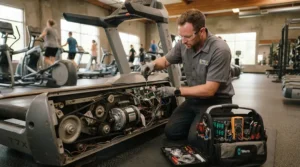
Getting the machines delivered is the easy part; keeping them running is where most campus equipment budgets actually leak. In staffed fitness facilities, the first 30 days after installation matter disproportionately — this is when floor staff learn each machine’s quirks and when small assembly errors surface as squeaks, drift, or console glitches. Build a simple daily wipe-down and weekly bolt-check rotation into student staff duties from day one; loose stabilizer bolts are the single most common early-life failure point on commercial ellipticals, and catching them costs nothing compared to a warranty claim later. Schedule a lubrication pass on wheel-and-track models (older Matrix and Life Fitness units especially) every 90 days, and log console error codes rather than just power-cycling them, since a pattern of repeat codes usually flags a part that needs replacing before it fails completely mid-semester. One optimization trick facilities managers rarely mention: stagger your delivery and installation across brands rather than deploying seven identical units, so a single parts shortage or recall doesn’t take out your entire cardio row at once — a real risk in staffed fitness facilities that can’t afford a week with zero elliptical access during peak January enrollment traffic.
Real-World Scenario: Matching Machines to Campus Recreation Budgets
Consider three real campus profiles. A mid-size public university with 15,000 students and a recently renovated rec center, operating on campus recreation budgets in the $150,000-$250,000 annual equipment range, is well-served leading with two or three Precor EFX 835 or Life Fitness Integrity Series CLSX units as flagship pieces, supplemented by remanufactured Matrix or Star Trac units to round out the row — spreading brand risk while keeping the marquee machines under full warranty. A smaller liberal arts college with under 3,000 students and a much tighter facilities budget might reasonably skip the premium tier entirely, anchoring their small fitness room with two True Fitness CS900 units for their compact footprint and one or two MERACH units in a residence-hall satellite space where daily traffic is lighter. A large research university managing multiple satellite facilities across a sprawling campus — main rec center, two residence-hall gyms, a graduate student wellness room — benefits most from the Technogym Excite+ Vario‘s versatility in the flagship building specifically, since one variable-stride machine there can serve varsity-adjacent training as well as general student use, while budget units handle the lower-traffic satellite spaces. In every case, the mistake to avoid is buying seven identical premium units when three tiers of equipment, matched to three tiers of actual usage intensity, stretch the same dollars considerably further.
Problem → Solution: Common Campus Elliptical Headaches
Five problems show up on nearly every campus rec center’s maintenance log, each with a specific, addressable fix. First, squeaking pedals within the first semester almost always trace back to under-lubricated pivot points rather than a defective unit — a 90-day lubrication schedule solves this before it becomes a service ticket. Second, console failures cluster on touchscreen models like the Matrix E7xi in humid, high-traffic locker-room-adjacent spaces; the fix is either better HVAC dehumidification near the cardio row or simply favoring LED-console models like the Life Fitness Integrity Series in those specific locations. Third, uneven wear across a fleet — where three machines get pounded and four sit idle — is a placement problem, not an equipment problem; rotating “featured” machine placement near entrances every semester evens out usage hours across the fleet and extends average fleet lifespan. Fourth, accessibility complaints usually stem from step-height and entry design, which the Star Trac 8 Series‘s open-step approach directly solves without requiring a facility redesign. Fifth, and most expensive to fix reactively: warranty lapses that go unnoticed until a major component fails — building a simple spreadsheet tracking install date, warranty term, and renewal windows for every machine in the bulk equipment procurement order prevents a five-figure surprise repair bill landing outside coverage.
How to Choose a Commercial Elliptical for University Recreation Center Equipment
Selecting the right commercial elliptical for university recreation center use comes down to seven weighted criteria, roughly in this order of importance for a high-traffic institutional buyer:
- Warranty tier language — confirm the contract explicitly says “commercial, dues-paying, unlimited hours,” not “light commercial,” since the latter can void coverage under actual campus usage patterns.
- Frame and drive-system durability — steel-welded frames with sealed or self-generating resistance systems outlast belt-and-pulley designs by years under continuous multi-user rotation.
- User weight and stride range — a 400 lb capacity and adjustable stride serve the widest realistic student, faculty, and staff population without excluding anyone.
- Serviceability — covered components, modular consoles, and availability of local or regional service technicians matter more once the one-year installation warranty expires.
- Accessibility design — open-step entry and ADA-compliant clear floor space aren’t optional extras for a public institution; they’re compliance requirements.
- Total cost including delivery and install — freight, white-glove installation, and any electrical work can add 10-20% to the sticker price and belong in the budget from the start.
- Vendor track record with higher education specifically — brands with documented university installs (Precor, Life Fitness, and Matrix all cite this explicitly) tend to have sales and service teams who understand procurement cycles, RFP requirements, and academic-year delivery windows better than vendors focused purely on boutique studios.
Bulk Commercial Elliptical Purchase University: A Procurement Playbook
A bulk commercial elliptical purchase university-wide almost never goes through the same channel as a single home-gym order, and treating it that way is the single biggest reason campus buyers overpay. Most public and many private institutions can access cooperative purchasing contracts specifically negotiated for education buyers — E&I Cooperative Services, for instance, maintains a competitively solicited fitness equipment contract covering major commercial brands, bundling discounted list pricing with delivery, installation, and multi-year parts-and-labor warranties into a single negotiated agreement your institution can use without running its own RFP from scratch. That matters because it often satisfies a public institution’s competitive-bidding requirements automatically, which can shave months off a procurement timeline that would otherwise require posting and evaluating a formal solicitation. Before committing to a bulk order, get itemized quotes covering freight class (commercial ellipticals often ship freight rather than parcel, given weights well over 150 lbs per unit), room-of-choice versus curbside delivery, and installation labor separately — bundling these into one line item makes it much harder to compare vendor quotes apples-to-apples later. It’s also worth explicitly asking any vendor whether remanufactured or certified pre-owned units are available on the same contract; a genuinely bulk equipment procurement — say, replacing an entire twelve-machine cardio row — can often mix two or three premium new units with the rest remanufactured, stretching a fixed capital budget considerably further without functionally compromising the user experience.
Campus Recreation Center Equipment Guide: Specs That Matter for Staffed Fitness Facilities
Beyond stride length and price, a handful of specs consistently separate machines that thrive in staffed fitness facilities from those that quietly become maintenance headaches. Duty-cycle rating is the most overlooked: a machine rated for genuine 12-16 hour daily commercial use — as most units on this list are — tolerates the reality of a rec center that opens at 6am and closes near midnight during finals week, while a “light commercial” unit rated for 4-6 hours simply wasn’t engineered for that load pattern, regardless of how similar the spec sheet looks on paper. Console power requirements matter more than they seem: self-generating, self-powered units (the Life Fitness Integrity Series, MERACH, and base Precor EFX 835 among them) sidestep electrical retrofit costs entirely, which is a meaningful line item when converting older gym space that wasn’t originally wired for a dozen networked touchscreen consoles. Q-factor — the lateral distance between pedals — affects long-session comfort more than most buyers realize; a narrower Q-factor like True’s 1.9 inches reduces hip strain on longer cardio sessions, a small detail that becomes significant across thousands of cumulative student workout-hours per semester. Finally, a genuinely useful equipment guide for any staffed fitness facility should account for asset-management connectivity: WiFi-enabled consoles that report usage hours and error codes remotely, like Matrix’s system, let a lean facilities team triage a forty-machine cardio row without physically inspecting every unit daily — a real efficiency gain for programs that are staffed but not overstaffed.

Common Mistakes When Buying Ellipticals for Campus Rec
The most expensive mistake campus buyers make is treating “commercial-grade” as a marketing label rather than a warranty-and-engineering distinction, and buying based on console flash rather than duty-cycle rating — a beautiful touchscreen bolted to a residential-grade frame will fail under real campus traffic regardless of how it looks on a showroom floor. A close second is skipping the accessibility review until after purchase; retrofitting clear floor space or adding an accessible unit after the fact costs meaningfully more than specifying it correctly in the original order. Underbudgeting delivery and installation is a near-universal error — freight and white-glove install on a dozen 300-450 lb machines routinely adds thousands of dollars that catch procurement offices off guard when it’s not itemized upfront. Buying every machine from a single vendor also concentrates risk unnecessarily; if that brand has a parts shortage or a recall, an entire cardio row can go dark at once, whereas a mixed fleet keeps the facility partially operational during any single vendor’s supply hiccup. Finally, plenty of campuses skip the warranty-tier verification step entirely, assuming “commercial” on a spec sheet automatically means full commercial coverage — always get the exact warranty language, including the specific hours-per-day and dues-paying-facility qualifiers, in writing before signing.
Commercial Elliptical vs Home-Grade Elliptical: Why the Difference Matters for High-Traffic Use
| Factor | Commercial-Grade | Home-Grade |
|---|---|---|
| Frame material | Welded steel, reinforced | Bolted aluminum/composite |
| Typical duty cycle | 12-16+ hrs/day | 1-2 hrs/day |
| Warranty structure | Multi-year commercial, dues-paying tier | Home-use only, voided in commercial settings |
| User weight capacity | 350-440 lbs | 250-300 lbs |
| Best For | University recreation centers, staffed gyms | Individual home users |
The gap here isn’t marketing exaggeration — several home-grade elliptical warranties, including some Life Fitness consumer models, are explicitly voided the moment the unit is placed in a commercial setting, meaning a university that buys residential units to save money isn’t just risking premature failure, it’s likely buying equipment with zero warranty coverage from day one. Bearing quality is the less visible half of that gap: commercial units use sealed, higher-load-rated bearings designed for continuous rotation across dozens of daily users, while home-grade bearings are engineered around a lighter, intermittent-use assumption that simply doesn’t hold up once a machine sees six or eight different riders a day, every day, for a full academic year.
What to Expect: Real-World Performance in a High-Traffic Campus Gym
On paper, most of these machines look similar — resistance levels, stride length, a handful of preset programs. In practice, the everyday experience diverges quickly once real student traffic hits. Self-powered units like the Precor EFX 835 and Life Fitness Integrity Series genuinely do feel more “instant on” than networked touchscreen machines, which sometimes take a few seconds to boot or reconnect after a power blip — a small thing that matters when there’s a line forming during peak 5-7pm traffic. Suspension-based designs like the Matrix E7xi noticeably reduce the mechanical clunk that older wheel-and-track ellipticals develop after a year or two of heavy use, which is the kind of wear pattern that quietly convinces students a machine is “broken” even when it’s still functionally safe. Open-step models like the Star Trac 8 Series measurably speed up machine turnover during busy periods simply because mounting and dismounting takes less time and coordination than stepping over a traditional raised frame. And variable-stride units like the Technogym Excite+ Vario genuinely do get used differently by the same student across a semester — short, quick sessions between classes early on, longer varied-stride sessions once they’re comfortable adjusting the motion on the fly — which speaks well of the machine’s actual adoption curve rather than just its spec sheet.
Long-Term Cost & Maintenance: Bulk Equipment Procurement and Total Cost of Ownership
The purchase price is genuinely the smaller number over a machine’s working life. A rough total-cost-of-ownership model for bulk equipment procurement should stack acquisition cost against roughly 8-12% of that price annually in parts, labor, and preventive maintenance for well-maintained commercial units — lower for self-powered, mechanically simpler machines like the Life Fitness Integrity Series, higher for touchscreen-console models like the Matrix E7xi or Technogym Excite+ Vario, where console repairs run disproportionately expensive relative to the mechanical drivetrain underneath them. Extended warranty options, often available at purchase for a fraction of a later out-of-pocket repair, are worth pricing into the original bulk equipment procurement order rather than treated as an optional add-on decided later — vendors routinely quote 3-year and 5-year parts-and-labor extensions at a meaningful discount compared to buying coverage retroactively, if that’s even offered. Cost-per-use math favors commercial-grade units decisively once you run the numbers across their genuinely longer service life: a $7,500 unit used by 40 students a day for eight years amortizes to pennies per session, while a cheaper unit that fails at year three and needs replacement mid-cycle often ends up costing more per actual workout delivered, even though the sticker price looked better on day one.
Safety, Regulations & ADA Compliance Guide
Public and most private universities are legally required to meet ADA accessibility standards for exercise equipment under Title II or Title III, and the technical requirement is specific: at least one machine of each equipment “type” — cardio, in this case — needs a minimum 30-by-48-inch clear floor space served by an accessible route, expanding to 36-by-48 inches if that space is enclosed on three sides. This isn’t a vague suggestion; it’s a documented compliance obligation, and it should be part of the floor plan before the first elliptical ships, not an afterthought discovered during a facilities audit. Beyond the legal floor, several practical safety measures matter specifically for a self-serve, largely unsupervised campus environment: heart-rate contact grips and telemetry compatibility give users a way to self-monitor exertion without staff intervention, transport wheels reduce staff injury risk during periodic deep cleaning or repositioning, and — as covered above — open-step entry designs like the Star Trac 8 Series meaningfully reduce trip-and-fall incidents compared to older raised-frame designs. Finally, don’t skip the electrical inspection step for any networked console model; retrofitting older gym buildings with adequate, code-compliant power for a dozen WiFi-enabled touchscreens is a real project, not a footnote, and it belongs in the same procurement conversation as the machines themselves.
FAQ
❓ How much does a commercial elliptical cost for a university gym?
❓ What's the difference between commercial and light commercial elliptical warranties?
❓ Do university recreation centers need ADA-compliant ellipticals?
❓ How long do commercial ellipticals last in a college gym?
❓ Is it cheaper to buy remanufactured commercial ellipticals in bulk for a university?
Conclusion
There’s no single “best” commercial elliptical for university recreation center use — there’s a best fit for your specific building, budget, and user population, and that’s exactly why a mixed fleet across these seven models so often outperforms a uniform order of one machine repeated a dozen times. Lead with warranty-tier verification and duty-cycle rating over console flash, budget delivery and installation as real line items rather than afterthoughts, and use cooperative education purchasing contracts to stretch a bulk order further than a solo RFP typically can. Whether you’re outfitting a flagship rec center or a modest residence-hall satellite gym, matching machine tier to actual traffic intensity — rather than buying the flashiest option available — is what actually protects the budget over the full decade-plus service life these machines are built for. Get the specs right once, and this is a purchase your facilities team won’t have to revisit for a very long time.
Recommended for You
- Commercial Elliptical For Apartment Complex Gym: 7 Top Picks 2026
- Commercial Elliptical For Apartment Complex Gym: 7 Best Picks (2026)
- Elliptical for Corporate Wellness Room: 7 Best Picks 2026
Disclaimer: This article contains affiliate links. As an Amazon Associate, I earn from qualifying purchases. If you purchase products through these links, we may earn a small commission at no additional cost to you.
✨ Found this helpful? Share it with your friends! 💬🤗
