
In This Article
Walk into any leasing tour these days and you’ll notice the script has changed. Nobody’s asking about granite countertops anymore — they want to see the gym. A commercial elliptical for apartment complex gym use has quietly become one of the highest-leverage purchases a property manager makes all year, because it’s the one piece of equipment that gets touched by a marketing coordinator, a maintenance tech, and a 6 a.m. resident before their first cup of coffee, all before lunch. That’s a lot of pressure for one machine to carry.
Here’s the short version, in case you need to skim this before a budget meeting: a commercial elliptical for apartment complex gym environments is a low-impact cardio machine built with a heavier frame, a longer duty-cycle warranty, and simpler serviceable parts than the ellipticals sold for a single household, because it has to survive dozens of different bodies a day instead of one. That distinction — residential-grade versus something rated for shared, semi-public use — is the whole ballgame, and it’s what separates a machine that limps along for eighteen months from one that’s still spinning smoothly when your next lease-renewal survey goes out.
This guide walks through seven real, currently available models spanning entry-level to full commercial-grade, plus the practical stuff nobody puts in a spec sheet: how to actually set the thing up, what residents complain about, how leasing offices turn it into a marketing asset, and where multifamily property management teams tend to overspend or underspend. We pulled specs and aggregated review sentiment from manufacturer pages, dealer listings, and independent review sites — where something couldn’t be verified, we’ll say so plainly instead of guessing. Let’s get into it.
Quick Comparison Table
| Model | Category | Weight Capacity | Best For |
|---|---|---|---|
| Sunny Health & Fitness SF-E3912 | Budget | 330 lbs | Small clubhouses, tight capital budgets |
| Matrix Fitness E30 | Light Commercial | ~350 lbs (frame-rated) | Compact amenity rooms |
| Life Fitness E1 | Light Commercial | 400 lbs | Noise-sensitive, mixed-use buildings |
| Precor EFX 835 | Full Commercial | 400+ lbs | Large communities, 24-hour access gyms |
Reading this table, notice the split isn’t really about price — it’s about duty cycle. The Sunny Health & Fitness SF-E3912 covers a modest fitness room with light foot traffic, while the Precor EFX 835 is engineered for a machine that might get used by forty different residents in a single week without complaint. The Matrix Fitness E30 and Life Fitness E1 sit in the sweet spot most mid-size communities actually need: sturdier than home-grade, without the price tag of a big-box health club. If your leasing office fitness perks strategy depends on residents actually using the equipment, that middle tier is usually where the real return on investment lives.
💬 Just one click — help others make better buying decisions too!😊
Top 7 Commercial Ellipticals for Apartment Complex Gyms: Expert Analysis
Property managers researching a commercial elliptical for apartment complex gym setup are usually balancing three things at once: sticker price, expected lifespan under shared use, and how much resident traffic the machine can absorb before something rattles loose. The seven picks below span that entire range, from a genuinely budget-friendly starter unit to a full commercial-grade machine built for high-occupancy communities.
1. Sunny Health & Fitness SF-E3912 — budget pick with real weight capacity
The standout here is simple: it’s one of the few sub-$500 ellipticals that doesn’t feel flimsy the moment someone over 200 pounds steps on. The machine runs on 16 levels of programmable magnetic resistance driven by a 13.2-pound flywheel and belt-drive system, with a 330-pound weight capacity and front-and-rear floor stabilizers to keep it planted on tile or vinyl-plank clubhouse flooring. A 15.5-inch stride is on the shorter side, which matters more than people expect — anyone on your resident roster over roughly 5’10” will likely feel cramped mid-stride.
Based on the spec comparison against other entry-level machines, the SF-E3912’s belt-drive-plus-magnetic-brake combo is what keeps the price down without sacrificing basic durability, though it’s clearly built for moderate, not heavy, daily traffic. This is the right call for a smaller property — a 40-to-80-unit complex with one modest fitness room — rather than a 300-unit community where the elliptical might see back-to-back use most mornings.
Aggregated buyer feedback on major retail platforms consistently describes the build as sturdy for the price, easy enough to assemble in under two hours, and reasonably quiet, though a handful of reviewers note occasional squeaking developing over time and recommend having two people on hand for assembly. No major recurring complaints about the resistance system show up across verified reviews.
Pros:
- ✅ Genuinely low upfront cost for a shared-use space
- ✅ 330-lb weight capacity is solid for this price tier
- ✅ Straightforward assembly and simple LCD console
Cons:
- ❌ Short 15.5″ stride limits taller residents
- ❌ Not rated for heavy, all-day multifamily traffic
At around $350-$500, this is a value verdict, not a forever machine: budget it as a starter unit or a second machine in a larger fitness room, not the sole elliptical for a high-traffic property.
2. Matrix Fitness E30 — purpose-built for apartment and condo fitness rooms
What stands out immediately is that Matrix explicitly markets this unit to property managers outfitting apartment and condominium fitness centers, not just home buyers — that’s a meaningfully different design target. The E30 uses Matrix’s Suspension Elliptical Technology paired with an ECB (eddy current brake) magnetic resistance system across 20 electronic resistance levels, with a compact static footprint of about 58″ x 29″ x 65″ that expands to roughly 69″ x 29″ x 68″ in motion.
What most buyers overlook about this model is the warranty structure: a 2-year bumper-to-bumper policy stacked with 3 additional years on parts and a lifetime frame guarantee signals Matrix expects this machine to see real commercial wear, not just a spouse and two kids taking turns. On paper, that combination of a compact footprint and commercial-grade frame warranty makes it a strong fit for the tight equipment rooms common in mid-rise multifamily buildings where square footage is at a premium.
Dealer and installer sentiment consistently frames the E30 as quieter than comparable machines thanks to the suspension design, with the console options (XR, XER, XIR) mainly differing in entertainment and connectivity features rather than core mechanics — reviewers note the base XR console is plenty for most shared-gym use cases.
Pros:
- ✅ Marketed specifically for apartment and condo gyms
- ✅ Compact footprint fits tight amenity rooms
- ✅ Strong multi-year parts warranty plus lifetime frame
Cons:
- ❌ Fixed stride length limits customization for varied heights
- ❌ Entry console (XR) is fairly basic if residents expect touchscreens
Expect a price landing in the $1,800-$2,400 range depending on console choice, which is a fair value trade for a machine explicitly engineered around properties like yours.
3. Life Fitness E1 — quietest ride for early-morning and late-night residents
The headline feature is WhisperStride technology — maintenance-free ball bearings that make this one of the quieter ellipticals in its class, which matters enormously in mixed-use buildings where the fitness room sits near or below residential units. It has a fixed 20-inch stride, 20 resistance levels controlled from the moving handlebars, and a 400-pound max user weight on a 211-pound frame, which is a meaningfully higher capacity ceiling than most home-market machines in this price bracket.
Here’s what the spec sheet won’t tell you, but property managers who’ve installed it note anyway: the choice between the basic Go Console and the upgraded Track Connect 2.0 isn’t just about app connectivity — the Go Console’s simplicity actually reduces support calls in shared-use environments where residents don’t want a learning curve before their morning cardio. Life Fitness’s reputation was built on club-grade equipment, and the E1 is the closest thing to that DNA at a light-commercial price point.
Reviewers across independent elliptical review sites consistently praise the near-silent operation and the lifetime frame warranty (backed by 5 years on parts, 1 year on labor), with the most common critique being the fixed stride and a flywheel some testers describe as lighter than expected, though nobody reports it affecting smoothness in practice.
Pros:
- ✅ Near-silent operation ideal for shared or mixed-use buildings
- ✅ 400-lb weight capacity, above-average for the tier
- ✅ Industry-leading warranty backed by a major commercial brand
Cons:
- ❌ Fixed 20″ stride, no adjustability for varied resident heights
- ❌ Console upgrade adds a meaningful jump in price
Budget roughly $2,000-$2,600 depending on console, and treat the upgraded console as optional rather than essential for shared amenity spaces.
4. Sole E98 — the one Sole model built for actual light-commercial duty
Sole makes six ellipticals in its E-series, and five of them are residential-only — the E98 is the outlier, carrying an actual light-commercial warranty designation rather than home-use-only coverage, which is exactly what a shared amenity space needs on paper. It builds on the same platform as Sole’s well-reviewed E95 (a 20+ level resistance and incline system, oversized cushioned pedals, a heavy flywheel, and a lifetime frame and flywheel warranty) but adds the magnetic resistance refinements and commercial-use rating that Sole reserves for this single model.
Based on the spec comparison with the rest of Sole’s lineup, this is the difference between a machine engineered to survive one household’s routine and one engineered to survive forty different strides a week without the resistance system degrading — a distinction property managers frequently miss when they see “Sole” and assume any E-series model will do for a shared gym.
Sole’s E-series consistently earns strong aggregate praise on independent review sites for fitting a wide range of user heights and for an unusually generous warranty package (Sole often beats competitors on labor coverage specifically), with the main criticism across the lineup being footprint — these aren’t the machines to squeeze into a converted closet.
Pros:
- ✅ Only Sole E-series model rated for light-commercial use
- ✅ Class-leading warranty, including labor coverage
- ✅ Accommodates a wide range of resident heights
Cons:
- ❌ Larger footprint than the Matrix E30 or Life Fitness E1
- ❌ Premium pricing relative to Sole’s residential-only models
Expect a price range in the $2,800-$3,600 area — a reasonable value verdict if your property genuinely needs commercial-duty coverage rather than a residential machine wearing a shared-gym label.
5. Octane Fitness Q37xi — best biomechanics fit across different resident heights
The Q37xi’s calling card is its close 1.8-inch pedal spacing combined with a fixed 20.5-inch stride, engineered around real human gait mechanics rather than a generic oval path — Octane’s Converging Path handlebars follow the natural arm swing of walking or running instead of moving in a straight parallel line. That’s paired with a lifetime frame warranty, 5 years on parts, and 1 year on labor, plus a compact standing-elliptical footprint that clears low ceilings better than many rear-drive alternatives.
What most buyers overlook about the Q37xi is that its Workout Boosters (X-Mode, GluteKicker, ArmBlaster) aren’t just marketing fluff — they’re structured interval programs that give residents a reason to come back to the same machine instead of drifting toward a treadmill, which matters if your leasing office fitness perks messaging leans on variety as a selling point.
Independent review aggregators rate the Q37 highly overall (an 87.8 score on FitRated, multiple past Best Buy award mentions) for comfort and biomechanics, though it’s worth noting honestly that at least one dealer review flagged slow or unresponsive customer support after a purchase — something a property manager evaluating a bulk purchase should factor into vendor selection, not just machine quality.
Pros:
- ✅ Biomechanically engineered stride reduces joint strain
- ✅ Compact footprint works under lower ceiling clearances
- ✅ Strong lifetime frame and multi-year parts warranty
Cons:
- ❌ Fixed stride length, no adjustability
- ❌ At least one documented report of slow post-purchase support
Pricing typically runs $3,000-$3,800, which puts it squarely in premium territory — justified if biomechanical comfort is a priority for a resident base with a wide age range.
6. 3G Cardio Elite EM X — best tech integration for compact fitness rooms
Trade publications reviewing commercial-grade ellipticals consistently single out the Elite EM X as the better fit than heavier club-style machines specifically for smaller gyms, apartment complexes, and hotel fitness rooms, where space efficiency and connectivity matter more than the biomechanical nuance a large health club might prioritize. It’s built with commercial-grade components and includes connectivity features aimed at keeping shared-use residents engaged during a workout.
Here’s an honest caveat, in keeping with actually telling you the truth: publicly available third-party spec sheets and consumer review volume for this model are thinner than for legacy brands like Life Fitness or Sole, so treat exact stride length and flywheel weight as something to confirm directly with a dealer before purchase rather than something we can verify with full confidence here. What we can say with more certainty is the positioning — reviewers who cover commercial equipment specifically recommend it over larger-format machines when space and tech integration outrank biomechanical refinement, which describes most apartment amenity rooms.
Pros:
- ✅ Purpose-recommended for apartment and hotel fitness rooms
- ✅ Commercial-grade build quality for shared-use durability
- ✅ Strong connectivity and tech features for resident engagement
Cons:
- ❌ Less independent review volume than legacy commercial brands
- ❌ Confirm exact stride and flywheel specs directly with a dealer
Expect a price in the $3,500-$4,200 range — reasonable for the category, provided you verify current specs before committing capital budget.
7. Precor EFX 835 — full commercial-grade build for high-traffic communities
This is the machine you buy when “light commercial” isn’t quite enough — the EFX 835 uses Precor’s patented Converging CrossRamp technology and a biomechanically refined stride path designed to mimic a natural running gait more closely than most competitors attempt. Full commercial-grade ellipticals in this class are typically built around frames and drive systems rated for tens of thousands of hours of use, a different engineering standard entirely from anything marketed for home use.
Based on the spec comparison with the light-commercial tier above it, the jump in price buys duty cycle, not just polish: this is the machine for a 300-plus-unit community with a 24-hour access fitness center where the elliptical might see continuous use across three shifts of residents. On paper, that’s overkill for a small boutique property — but exactly right for a large multifamily portfolio asset where equipment downtime translates directly into resident complaints and maintenance tickets.
Commercial fitness equipment reviewers frequently cite the CrossRamp system and natural stride path as best-in-class for motion quality, with the tradeoff being size, weight, and price relative to every other machine on this list — this is not a unit you casually relocate between amenity spaces.
Pros:
- ✅ True full-commercial-grade frame and drive system
- ✅ Best-in-class biomechanics via Converging CrossRamp
- ✅ Built for continuous, high-traffic community use
Cons:
- ❌ Highest price range of any model on this list
- ❌ Large footprint and weight complicate relocation or resale
Pricing generally lands in the $6,000-$8,500 range at the time of research — a serious capital outlay, but the right one for large, high-occupancy communities where a lighter-duty machine would fail within a year or two.
Apartment Amenity Gym Equipment List: Where the Elliptical Fits
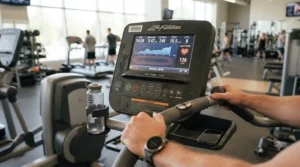
Every apartment amenity gym equipment list follows a rough pecking order, and it’s worth understanding where a commercial elliptical for apartment complex gym use actually sits in it. According to NMHC’s renter preferences research, fitness centers consistently rank among the most valued community amenities apartment residents consider before signing a lease, right alongside package delivery and community internet access — which is a bigger deal than it sounds, since a fitness center’s perceived value depends heavily on the equipment actually being usable and current.
Within that fitness room, ellipticals typically sit in the “must-have cardio” tier alongside treadmills and stationary bikes, rather than the “nice-to-have” tier occupied by things like a spin bike wall-mount or a rowing machine. That’s largely because ellipticals serve the broadest range of fitness levels and physical limitations — low-impact enough for an older resident or someone recovering from a knee injury, intense enough for a resident training for a 5K. A property that skips the elliptical in favor of two more treadmills is usually underserving a meaningful chunk of its resident base.
The practical takeaway for a multifamily property gym setup: budget for at least one elliptical per 75-100 units in any fitness center that’s expected to handle real morning-and-evening rush traffic, and lean toward the light-commercial tier (Matrix E30, Life Fitness E1, or similar) rather than a residential-grade machine the moment your unit count crosses roughly 150 doors.
Multifamily Property Gym Setup: Practical Usage Guide
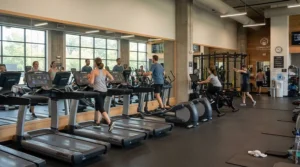
Getting a commercial elliptical for apartment complex gym use up and running correctly is less about the machine itself and more about the twenty small decisions that surround it. Start with floor prep: most light-commercial and full-commercial ellipticals weigh 200-300+ pounds fully assembled, and putting one directly on hard tile without a rubber gym mat underneath will transmit vibration into walls faster than you’d expect, especially in mixed-use or wood-frame buildings. Budget for a proper equipment mat before delivery day, not after your first noise complaint.
First-use setup matters more in a shared environment than a home one. Have a maintenance tech confirm the machine is level, torque all bolts to spec (most manufacturers list a specific ft-lb value in the assembly manual, and skipping it is the single most common cause of early squeaking), and post a simple laminated card with basic operating instructions and a maintenance contact — residents using unfamiliar equipment for the first time generate more support tickets than a five-minute orientation card would prevent.
For maintenance schedules, plan on a monthly visual inspection (loose bolts, worn pedal grips, console function), a quarterly deep clean of the drive mechanism and rails, and an annual professional service check for anything in the light-commercial or full-commercial tier — most manufacturer warranties actually require documented maintenance to stay valid, which is an easy thing for a busy property team to accidentally skip. Common first-30-days mistakes include placing the machine too close to a wall (residents need real clearance for mounting and dismounting), forgetting to register the warranty at all, and skipping resident communication about proper shoe use, which extends pedal life considerably.
Resident Fitness Center Equipment Guide: How to Choose the Right Elliptical
A resident fitness center equipment guide really comes down to answering seven questions before you spend a dollar, and doing it in order matters:
- Estimate real daily traffic. Count units, not square footage — a 250-unit property needs a very different duty-cycle rating than a 40-unit boutique building.
- Set a weight-capacity floor. Anything under a 350-pound capacity is a liability in a shared space serving unknown numbers of residents.
- Decide your warranty non-negotiables. A lifetime frame warranty should be table stakes; parts coverage under 3 years is a red flag for commercial use.
- Measure the actual room, not the brochure footprint. Active-use dimensions (arms and stride extended) are usually larger than static dimensions listed first on spec sheets.
- Weigh noise tolerance against building layout. A fitness room directly above or beside residential units should prioritize quiet-drive technology over touchscreen extras.
- Match stride length to your demographic. A student-heavy or luxury high-rise property skews different heights than a 55-plus community — check the actual stride range, not just “adjustable.”
- Confirm service response times before, not after, purchase. A dealer who’s slow to answer a pre-sale question is unlikely to speed up for a warranty claim.
Working through this list in order avoids the single most common purchasing mistake: buying based on console features before confirming the frame, warranty, and duty-cycle rating actually fit your property’s real usage pattern.
Real-World Scenario: Matching Ellipticals to Resident Types
Consider a 60-unit boutique property in a college town, mostly leased to students and young professionals working irregular hours. Traffic is bursty — quiet most of the day, then a rush between 7-9 a.m. and 8-10 p.m. A budget-conscious pick like the Sunny Health & Fitness SF-E3912 or the compact Matrix Fitness E30 covers this well; duty cycle demands are modest, and the smaller footprint suits a converted unit turned fitness room.
Now picture a 280-unit garden-style community with a 24-hour fitness center and a resident base skewing toward families and long-term renters. Traffic is heavier and more consistent across the day, noise complaints from adjacent units are a real risk, and residents expect equipment that feels current. Here, the Life Fitness E1 or Sole E98 earns its higher price tag — the quiet drive systems and stronger warranties are built for exactly this kind of steady, all-day resident traffic.
Finally, a 400-plus-unit high-rise with amenity space marketed heavily in leasing materials and a fitness center that functions almost like a small commercial gym. This is where the Precor EFX 835 or Octane Fitness Q37xi makes financial sense — the capital outlay is real, but so is the resident-retention value of amenity space that never feels worn out during a prospective tenant’s tour.
Common Mistakes Property Managers Make When Buying Commercial Ellipticals
The most expensive mistake is buying residential-grade equipment because it looked identical to commercial-grade in a catalog photo — the difference lives in the warranty language and duty-cycle rating, not the finish. A close second is underestimating footprint: active-use dimensions with the stride and arms extended are frequently 10-15% larger than the static footprint printed first on a spec sheet, which leads to cramped rooms where residents bump elbows mid-workout.
Property managers also commonly skip warranty registration entirely, assuming the dealer handles it — most manufacturers require the property to register the unit directly, and failing to do so can void coverage exactly when it’s needed most. A less obvious mistake is buying the flashiest console available without checking whether it requires an ongoing subscription (some interactive touchscreen ellipticals do), which turns a one-time equipment purchase into a recurring line item nobody budgeted for. Finally, teams frequently buy for the amenity photo rather than the resident who’ll actually use the machine at 6 a.m. in December — durability and noise level matter more day-to-day than console flash.
Commercial Elliptical vs Residential Elliptical: What’s the Real Difference
| Factor | Residential Elliptical | Commercial Elliptical |
|---|---|---|
| Typical Warranty | 1-2 yr parts, limited frame | Lifetime frame, 3-5 yr parts |
| Weight Capacity | 250-300 lbs | 350-400+ lbs |
| Expected Weekly Use | ~5 hours | 40-70+ hours |
| Best For | Single household | Shared, multi-resident use |
Looking at the comparison above, the gap isn’t cosmetic — it’s structural. A residential elliptical is engineered around roughly five hours of use per week from one household, while commercial-rated models are built and warrantied for use volumes several times higher, which is exactly the traffic pattern a shared amenity space generates. Buying residential-grade equipment for a shared fitness center isn’t really saving money; it’s usually just moving the cost from the purchase order to next year’s replacement budget.
Long-Term Cost & Maintenance for Multifamily Property Management
| Cost Factor | Budget Tier | Light Commercial | Full Commercial |
|---|---|---|---|
| Upfront Price Range | $300-$500 | $1,800-$3,600 | $6,000-$8,500 |
| Realistic Lifespan (shared use) | 1-2 years | 4-7 years | 8-15+ years |
| Annual Service Cost | Minimal, but frequent replacement | Low-moderate | Moderate, budgeted |
The math here rewards patience: a budget-tier elliptical that needs replacing every 12-18 months under real shared-use traffic can easily cost more over a five-year window than a light-commercial machine purchased once and properly maintained. For multifamily property management teams building a capital expenditure plan, it’s worth modeling total cost of ownership rather than sticker price alone — a $2,200 light-commercial elliptical amortized over five years often beats three separate $400 budget units purchased in succession, once you factor in delivery, assembly labor, and downtime between replacements.
Resident Amenities That Actually Drive Lease Renewals
Not all resident amenities carry equal weight at renewal time, and fitness equipment condition is a surprisingly consistent factor. A worn, squeaky, or out-of-service elliptical does more reputational damage than having no elliptical at all, because it signals neglect rather than absence — residents notice broken equipment far more than they notice equipment that was never purchased in the first place. This is especially visible in online reviews, where “gym equipment always broken” shows up as a recurring, specific complaint on property review sites far more often than generic amenity gripes.
The practical implication for a leasing team: treat the fitness center’s equipment condition as an ongoing marketing asset, not a one-time capital purchase. A commercial elliptical for apartment complex gym use that’s properly maintained for years photographs well for leasing materials, holds up during prospect tours, and quietly reduces the maintenance tickets that erode staff time and resident goodwill alike.
Leasing Office Fitness Perks: Turning Equipment Into a Marketing Tool
Problem: Prospective residents tour the fitness center, see equipment that looks tired or dated, and mentally subtract value from the whole property — even if the units themselves are excellent. Solution: invest in commercial-grade equipment that photographs and performs well for years, and feature it specifically in leasing materials rather than a generic “fitness center on-site” bullet point.
Problem: Current residents don’t know how to use the equipment correctly and either avoid it or get hurt. Solution: a laminated quick-start card plus an occasional resident event (a free trainer-led session, for instance) turns underused equipment into a genuine amenity residents talk about.
Problem: Maintenance requests for fitness equipment pile up because nobody owns the follow-up. Solution: assign one staff member as the equipment point of contact and put warranty and service contact info directly on the machine, not buried in a filing cabinet.
Problem: Budget cycles treat fitness equipment as an afterthought line item. Solution: build equipment replacement into a multi-year capital plan tied to the cost-of-ownership math above, rather than reacting only after something breaks.
Safety, ADA & Liability Considerations for Shared Fitness Equipment
Shared fitness spaces carry different liability considerations than a home gym, and it’s worth building basic safety practices into your setup rather than treating them as an afterthought. Clear signage about proper use, a visible emergency contact, and adequate clearance around each machine (per manufacturer active-footprint specs, not static ones) reduce both injury risk and liability exposure. Regular physical activity, including low-impact cardio like elliptical training, is recommended by the CDC as part of a healthy weekly routine, which is worth referencing in resident-facing wellness communications tied to your fitness center.
Accessibility is also worth genuine attention, not just a checkbox — leave enough clear floor space around equipment for residents using mobility aids to navigate the room safely, and consider at least one lower-impact option (a recumbent bike or a shorter-stride elliptical) alongside standard units. On the medical side, it’s worth noting for resident-facing materials that Harvard Health has documented how elliptical training places meaningfully less stress on knee, hip, and ankle joints compared to running, which makes it a genuinely good fit for a resident population spanning a wide range of ages and physical conditions.
Buyer’s Decision Framework: Which Elliptical Fits Your Property
If your property has under 100 units and a modest capital budget, choose a budget or light-commercial model like the Sunny Health & Fitness SF-E3912 or Matrix Fitness E30, because duty-cycle demands are naturally lower. If your property sits between 100-250 units with steady daily traffic, choose a light-commercial machine like the Life Fitness E1 or Sole E98, because the warranty and noise profile match sustained, moderate shared use. If your property exceeds 250 units, runs a 24-hour fitness center, or markets amenities heavily in leasing materials, choose a premium or full-commercial machine like the Octane Fitness Q37xi or Precor EFX 835, because anything lighter-duty will likely need replacement well before your next capital cycle.
Frequently Asked Questions
❓ What's the difference between a commercial elliptical for apartment complex gym use and a home elliptical?
❓ How many ellipticals does an apartment fitness center need?
❓ Do apartment gym ellipticals need special maintenance?
❓ Is a light-commercial elliptical enough, or do I need full commercial-grade?
❓ Can residents get injured using apartment gym equipment, and who's liable?
Conclusion
Choosing a commercial elliptical for apartment complex gym use isn’t really a fitness-equipment decision — it’s a resident-retention decision wearing a fitness-equipment costume. The seven models here cover a genuinely wide range: the Sunny Health & Fitness SF-E3912 for tight budgets and small properties, the Matrix Fitness E30 and Life Fitness E1 for the mid-size properties that make up most of the multifamily market, the Sole E98 for a genuinely light-commercial warranty at a fair price, and the Octane Fitness Q37xi, 3G Cardio Elite EM X, and Precor EFX 835 for properties where amenity space is a serious competitive differentiator.
The honest throughline across all seven: match the machine’s duty-cycle rating to your property’s real traffic, not to your budget’s comfort zone or a spec sheet’s marketing language. Get that match right, and the elliptical you buy this year is quietly still earning its keep — and earning lease renewals — five years from now.
✨ Ready to compare current pricing on today’s picks? Check availability now and give your fitness center the upgrade residents will actually notice! 🏋️♀️💪
Recommended for You
- Commercial Elliptical For Apartment Complex Gym: 7 Best Picks (2026)
- Elliptical for Corporate Wellness Room: 7 Best Picks 2026
- 7 Best Elliptical for Hotel Fitness Center Options in 2026
Disclaimer: This article contains affiliate links. As an Amazon Associate, I earn from qualifying purchases. If you purchase products through these links, we may earn a small commission at no additional cost to you.
✨ Found this helpful? Share it with your friends! 💬🤗
