
In This Article
A 45-pound plate slips out of a sweaty hand. It lands. Your floor either shrugs it off or tells the whole house about it. That moment is where the rubber vs foam mat for home gym flooring debate stops being theory and becomes a very loud, very expensive lesson. 🏋️♂️
Here’s the setup. Rubber and foam both get called “gym mats.” They show up side by side in search results, and one can cost half as much as the other. But they behave nothing alike once real weight, real sweat and real months pile up. The right pick depends on three things: what you lift, what’s under the mat, and how long you want to avoid thinking about your floor again.
This guide sticks to real specs, aggregated tester and retailer feedback, and plain-English analysis. It has no invented lab results and no fake “I tested it for a year” stories. Along the way we’ll weigh rubber mat durability vs foam, run a foam vs rubber mat cost comparison, decode mat weight capacity and tackle the mat off-gassing smell nobody warns you about.
The short version: if you rack barbells, drop weights or park a treadmill, choose rubber. If you do yoga, bodyweight circuits or light dumbbell work, foam can be a smart, cheap call. Hybrids sit in between and come with caveats. ⚡
Rubber vs Foam Mat for Home Gym Flooring at a Glance
Before the deep dive, here’s the cheat sheet. Costs are approximate ranges drawn from published roundups and retailer listings at the time of research, so check current price before buying.
| Type | Typical Thickness | Heavy-Lift Ready? | Approx. Cost per Sq Ft | Example Products | Best For |
|---|---|---|---|---|---|
| Solid rubber rolls/tiles | 1/4″–3/4″ | Yes (3/8″+) | ~$2–$5 | American Floor Mats 3/8″ Vulcanized Rubber Roll, Rubber Flooring Inc 1/2″ Mega Rubber Rolls | Barbells, racks, treadmills |
| Rubber-top hybrid tiles | ~0.56″–3/4″ | Moderate | ~$3–$4 | ProsourceFit Rubber Top Puzzle Mat (3/4″), SUPERJARE 0.56″ Rubber-Top Tiles | Mixed lifting and cardio, renters |
| EVA foam tiles | 1/2″–1″ | Light use only | ~$2 | ProsourceFit Extra Thick Puzzle Mat (3/4″), BalanceFrom 3/4″ Puzzle Mat | Yoga, bodyweight, play areas |
The pattern is clear. Cost per square foot looks similar between foam and many rubber options, and the real gap shows up in what each can survive. If heavy weights are in your future, the American Floor Mats 3/8″ Vulcanized Rubber Roll class of product is where value lives. If your training is mostly floor work, the foam tiles do the job for less drama.
💬 Just one click — help others make better buying decisions too!😊
What Is the Difference in Rubber vs Foam Mat for Home Gym Flooring?
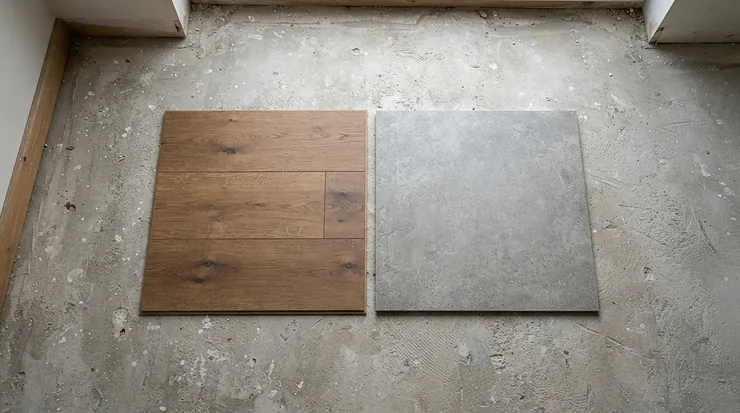
Rubber vs foam mat for home gym flooring is a comparison between two material families. One is dense vulcanized or recycled-tire rubber that resists compression and impact. The other is lightweight closed-cell EVA foam that cushions comfortably but permanently flattens under concentrated loads. Rubber suits heavy lifting and machines. Foam suits low-impact training.
The foam in most puzzle tiles is ethylene-vinyl acetate (EVA), an elastomeric copolymer that feels “rubber-like” in softness and flexibility. That softness is the whole point and the whole problem. Soft means kind to knees and quiet underfoot. It also means a squat rack’s feet will press dimples that don’t spring back.
Solid rubber, usually made from recycled tires, trades plushness for toughness. It’s heavier, denser and less forgiving to your joints. It also tolerates dropped weights, rolling equipment and years of foot traffic far better.
Then there’s the hybrid: a rubber skin glued over an EVA core. It borrows traction and some wear resistance from rubber and weight from foam. Whether it behaves more like one or the other depends on thickness, density and how hard you train. Keep that trade-off in mind, because the products below sit all along this spectrum.
Top 7 Rubber and Foam Mats for Home Gym Flooring: Expert Analysis
I haven’t touched these products, and I won’t pretend otherwise. What follows blends manufacturer specs, retailer-listed ratings, and the consensus of independent roundups. Where I couldn’t verify a pool of real buyer reviews, I say so. Prices appear as ranges only, so check current price on the listing before you buy.
1. American Floor Mats 3/8″ Vulcanized Rubber Roll — best all-round rubber floor
Think of this as the Goldilocks roll: thick enough to matter, thin enough to afford.
The 4′ x 8′ roll is 3/8 inch (about 9 mm) of vulcanized rubber, a denser, more thoroughly cured material than loosely bonded budget tiles. In practice, that thickness absorbs the thud of dumbbells and Olympic plates without the “two people and a forklift” hassle of 3/4-inch slabs. One ten-roll roundup recommends it for a setup with a power rack, Olympic plates and dumbbells up to roughly 100 pounds.
Based on the spec comparison, it’s built for the lifter who deadlifts a few times a week, not someone ripping loaded barbells off the floor from overhead every session. What buyers overlook: 32 square feet isn’t much. A full garage bay means several rolls and some deliberate seam planning.
Reviewer sentiment is consistent. Independent roundups place it at or near the top for value and shock absorption, and one flags it as Prime-eligible. I couldn’t verify a large current pool of individual buyer reviews, so treat the consensus as directional.
Pros:
- ✅ 3/8-inch thickness balances protection and price
- ✅ Dense vulcanized rubber resists denting
- ✅ Roll format means fewer seams than tiles
Cons:
- ❌ Fresh-rubber smell can linger for weeks
- ❌ Too thin for repeated heavy-bar drops
Price: rolls in this class commonly run around $2–$4 per square foot, so check current price. Strong value for most home lifters.

2. Rubber Flooring Inc 1/2″ Mega Rubber Rolls — premium, near-seamless heavy-lifting floor
Half an inch of rubber in one long strip is what separates a “gym floor” from a “pile of tiles.”
These 4-foot-wide rolls are cut to a custom length (one reviewer notes a 15-foot minimum) and come in several fleck colors. In real terms, fewer seams mean fewer edges for plates to catch, fewer cracks for dust to hide and less chance of curling corners. At roughly 12 mm thick, it sits in the zone where barbell drops stop feeling frightening.
The honest take: this suits a dedicated strength room you won’t redo for years. A reviewer at King of the Gym calls it better rubber than stall mats and recommends it for medium to large setups, while admitting installation is difficult. Trimming heavy rolls around racks isn’t a casual Saturday task.
For sentiment, I’m leaning on a single reviewer (who scores it 4.7 out of 5) plus another roundup naming it a top premium roll for heavy lifting. That’s expert opinion, not an aggregated buyer pool.
Pros:
- ✅ Professional look with minimal seams
- ✅ Rolls arrive cut to custom lengths
- ✅ Better rubber quality than stall mats, per one reviewer
Cons:
- ❌ Heavy, tricky installation
- ❌ Costs more than stall mats
Price: premium tier, above the roughly $2 per square foot stall-mat benchmark, so check current price. Amazon availability varies by seller, so confirm the listing matches the spec. Worth it if you lift heavy and plan to stay put.
3. Traxxon FlooringInc 1/4″ Rubber Roll — budget rubber for lighter training
Sometimes you don’t need armor. You need something better than concrete that won’t flatten like a pancake.
This 4′ x 10′ roll (40 square feet) is recycled rubber at 1/4 inch, around 6 mm. One roundup highlights the American-made build, a five-year warranty and fade resistance, and calls it a versatile “jack-of-all-trades.” Thin rubber won’t cushion a dropped barbell. But it protects floors from scuffs and equipment, and unlike foam, it won’t permanently compress under a treadmill or bench.
My read: this is the smartest cheap rubber for dumbbell, kettlebell, bench and cardio setups. If your heaviest lift is a loaded dumbbell press, you don’t need to pay for half an inch.
Sentiment comes mostly from roundup commentary. I couldn’t verify an aggregated buyer review pool for this exact roll, so weigh it accordingly.
Pros:
- ✅ 40 sq ft per roll keeps seams low
- ✅ Doesn’t permanently dent like foam
- ✅ Warranty and durability positioning in roundups
Cons:
- ❌ Thin, so limited impact absorption
- ❌ Recycled-rubber odor at the start
Price: lower-cost rubber, often in the ballpark of $2 per square foot, so check current price. Excellent value for light-to-moderate home gyms.
4. ProsourceFit Rubber Top Puzzle Mat (3/4″) — grippy rubber face over foam cushion
This one wears a textured rubber skin over a high-density EVA foam core. It’s foam with armor on top. 🛡️
Each 24″ x 24″ x 3/4″ tile interlocks, with 6 tiles plus 12 border pieces covering 24 square feet. The manufacturer lists about 17 pounds for that kit. That’s light enough to carry downstairs alone, but also light enough to shift if installed carelessly.
Who is it for? Renters, mixed-use rooms and anyone who wants better grip and wear resistance than plain foam without committing to rubber rolls. Based on the spec comparison, the foam core still limits it under concentrated loads like rack feet.
Retailer feedback is positive but mixed. One listing shows 4.7 stars from about 56 ratings, with 86% giving five stars. One reviewer reports heavy equipment sitting on it for 12 months without trouble, while another says it looks great in a garage gym but disappointed on durability.
Pros:
- ✅ Textured rubber top gives reliable grip
- ✅ Lightweight, easy to move or reconfigure
- ✅ Interlocking tiles adapt to odd room shapes
Cons:
- ❌ Foam core can still dent under racks
- ❌ Mixed long-term durability reports
Price: roughly $3–$4 per square foot depending on kit size, so check current price. Fair for flexibility, not for heavy drops.
5. SUPERJARE 0.56″ Rubber-Top Tiles — most rubber-like foam tile
Think of it as the foam tile that’s trying very hard to feel like rubber.
At about 0.56 inches (roughly 14 mm), it’s thinner than the 3/4-inch tiles but uses a dual-layer build with a rubber top. In practice, that denser surface helps resist scuffing and gives a firmer feel under foot. One 2026 roundup calls it the best dual-layer option for homes that mix lifting and cardio, and says it’s the closest you can get to a rubber roll without freight costs.
My analysis: this is a sweet spot for a 48-square-foot rack-and-bench corner where you lift moderately and don’t drop loaded bars. Past that, the foam core is still foam.
For sentiment, I’m relying on one roundup. I couldn’t verify a large, current buyer review pool, so confirm recent reviews on the listing.
Pros:
- ✅ Dual-layer build feels firmer than plain foam
- ✅ 48 sq ft kit covers a typical lifting zone
- ✅ Interlocking tiles install without tools
Cons:
- ❌ Foam core still compresses under concentrated loads
- ❌ Limited independent testing data available
Price: mid-range for rubber-top tile sets, so check current price. Good value if your lifting stays moderate.
6. ProsourceFit Extra Thick Puzzle Mat (3/4″) — comfort-first foam for bodyweight work
Plain EVA, done well. If your workouts happen mostly on your hands, knees and back, this is the soft landing.
Each 24″ x 24″ x 3/4″ tile interlocks, and a kit includes 6 tiles plus 12 border pieces for 24 square feet. A 1-inch version exists too. Listings show about 7.6 pounds for the 24-square-foot set. The manufacturer says it’s phthalate-free and water-resistant, but the Amazon listing itself warns that surface compression may occur with heavy equipment. That warning matters.
Here’s what the spec sheet won’t tell you, but common sense will: a squat rack’s four small feet concentrate a lot of weight on very little foam. Expect dimples. For yoga, mobility, kids’ play or a bodyweight corner, though, it’s hard to beat on price.
Sentiment is solid. A retailer listing shows 4.7 stars across roughly 226–265 ratings. A few complaints concern missing or short shipments rather than material quality.
Pros:
- ✅ Thick 3/4-inch cushioning for floor work
- ✅ Tool-free jigsaw assembly
- ✅ Wipes clean with soap and water
Cons:
- ❌ Dents under heavy equipment
- ❌ Unsuitable for dropped weights
Price: about $45–$55 for a 24-square-foot kit at the time of research, so check current price. Great value for light use.
7. BalanceFrom 3/4″ Puzzle Mat — big-coverage budget foam
When square footage is the problem, this is the answer.
It’s a 3/4-inch EVA puzzle mat sold in large kits, with a 96-square-foot option appearing in roundup listings. That’s enough for roughly an 8′ x 12′ room in a single order. One roundup labels it the best budget foam flooring. Another ranks it mid-range for all-around home gym use.
The honest analysis: it suits a spare-room workout zone, a playroom or a basement corner where noise reduction and comfort matter more than load rating. Like every foam tile here, it dents under racks. Park heavy gear on a rubber pad.
I couldn’t verify a current pool of individual buyer reviews, so I’m relying on roundup placement.
Pros:
- ✅ Large kits cover entire rooms
- ✅ Soft, quiet surface for low-impact work
- ✅ Easy to expand or rearrange
Cons:
- ❌ Not built for racks or machines
- ❌ Shorter lifespan than rubber
Price: budget foam tier, so check current price. Excellent value for coverage, poor value for heavy equipment.
Here’s the round-up in one view:
| Product | Type | Thickness | Price Tier | Evidence Basis | Best For |
|---|---|---|---|---|---|
| American Floor Mats 3/8″ Vulcanized Rubber Roll | Rubber roll | 3/8″ | Mid | Multiple roundups | All-round home lifting |
| Rubber Flooring Inc 1/2″ Mega Rubber Rolls | Rubber roll | 1/2″ | Premium | Reviewer + roundup | Dedicated heavy-lifting rooms |
| Traxxon FlooringInc 1/4″ Rubber Roll | Rubber roll | 1/4″ | Budget | Roundup | Dumbbells and cardio |
| ProsourceFit Rubber Top Puzzle Mat (3/4″) | Hybrid tile | 3/4″ | Mid | Retailer ratings | Renters, mixed use |
| SUPERJARE 0.56″ Rubber-Top Tiles | Hybrid tile | 0.56″ | Mid | Roundup | Moderate lifting corners |
| ProsourceFit Extra Thick Puzzle Mat (3/4″) | EVA foam | 3/4″ | Budget | Retailer ratings | Bodyweight, yoga |
| BalanceFrom 3/4″ Puzzle Mat | EVA foam | 3/4″ | Budget | Roundups | Large low-impact rooms |
Looking at the table, the rubber rolls cost more upfront but are the only picks suited to serious weight, with Rubber Flooring Inc 1/2″ Mega Rubber Rolls at the top end. The hybrids, ProsourceFit Rubber Top Puzzle Mat (3/4″) and SUPERJARE 0.56″ Rubber-Top Tiles, make sense when flexibility matters more than brute durability. Pure foam like ProsourceFit Extra Thick Puzzle Mat (3/4″) and BalanceFrom 3/4″ Puzzle Mat should stay where the loads are light.
Setup Guide: Installing Your Mats Without Regret in the First 30 Days
Great flooring installed badly is just expensive frustration. Here’s a practical timeline that Amazon listings don’t give you. 🛠️
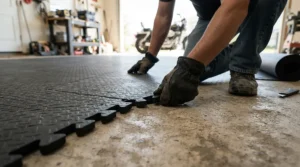
Day 0: Prep. Sweep and degrease the subfloor, and let concrete dry fully. Measure the footprint, then plan seam placement before you cut anything.
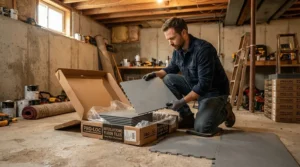
Days 1–3: Air it out. Unroll rubber flat in a ventilated space. One manufacturer suggests airing new mats 24–72 hours before installing, and that’s a sensible minimum. The reason is simple: new rubber releases volatile organic compounds. The EPA’s overview of VOCs and indoor air quality notes that indoor levels of many organic compounds average two to five times outdoor levels, and that effects can include eye, nose and throat irritation and headaches.
Install day. Stagger seams, and leave a small perimeter gap for foam tiles in garages, since foam can expand and contract with temperature. Place a plywood or rubber pad beneath rack feet so concentrated loads spread out.
Weeks 1–4. Run a fan, crack a window, and mop with mild soap and water. Rubber rolls that arrive curled usually relax after a day or two flat. Check seams weekly for the first month, since that’s when shifting shows up.
Real-World Scenarios: Who Should Pick Which Mat
These are hypothetical profiles built to show the reasoning, not real customers.
The apartment renter. Picture someone doing kettlebell and HIIT sessions four times a week on a second-floor unit with a modest budget. Weight capacity isn’t the issue; noise and grip are. A hybrid like the SUPERJARE 0.56″ Rubber-Top Tiles or ProsourceFit Rubber Top Puzzle Mat (3/4″) gives cushioning, traction and easy removal.
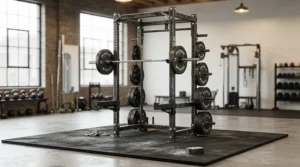
The garage lifter. Six days a week, a power rack, a barbell and bumper plates, with a floor that must survive years. This person should skip foam and start with American Floor Mats 3/8″ Vulcanized Rubber Roll. If deadlift drops are part of the program, step up to Rubber Flooring Inc 1/2″ Mega Rubber Rolls, and put a rack pad under the feet.
The family basement. A treadmill, a yoga corner and kids tumbling around. Zone it: Traxxon FlooringInc 1/4″ Rubber Roll under the treadmill, and BalanceFrom 3/4″ Puzzle Mat or ProsourceFit Extra Thick Puzzle Mat (3/4″) where the soft landings matter. Different zones, different materials, no wasted money.
Material for Gym Flooring: How to Choose the Right One
Here’s a six-step framework for picking the right material for gym flooring without overthinking it.
- List your heaviest regular lift. Barbells above roughly 88 pounds (40 kg) are where one vendor’s guidance says rubber becomes strongly preferable. Under that, foam can cope.
- Decide if weights will drop. Dropped plates demand rubber, ideally 3/4 inch or thick stall mats for heavy deadlifts.
- Map your equipment. Racks, treadmills and machines concentrate weight. Foam dents under them, and the dents can be permanent.
- Check your subfloor. Concrete handles anything. Hardwood or upstairs rooms need extra care for noise and protection.
- Judge your ventilation. A sealed garage keeps rubber odor longer, so plan for airflow.
- Do the cost-per-year math. Compare lifespan, not just price per square foot (see the cost section below).
Rubber Mat Durability vs Foam: What Happens After Year One
Rubber mat durability vs foam is the biggest reason this decision matters. Rubber deforms elastically and rebounds. Foam’s closed cells collapse under repeated stress, and once they do, the thickness doesn’t come back.
Retailer and blog sources broadly agree on lifespans. One guide cites EVA foam at roughly one to three years with light use, while another UK supplier puts EVA at one to five years against 10–25 years for rubber. A tile maker’s article says foam is prone to indenting, punctures and compression, while recycled rubber holds shape under heavy loads. Another vendor notes that foam can show indentations that become permanent, with only super high-density EVA doing noticeably better.
A fair caveat: many of these claims come from companies that sell rubber, so read them as directional. Buyer reports back this up in places. One ProsourceFit rubber-top reviewer praised a year of equipment use while another called garage durability terrible. Conditions matter, including load, temperature and tile quality.
My read: foam can last for light training, but rubber is the only material here that reliably maintains its performance past year three under real weight.
Long-Term Flooring Durability: Maintenance and Total Cost of Ownership
Long-term flooring durability isn’t just about material. Maintenance habits can add or subtract years.
For rubber, a damp mop with mild soap and a synthetic mop works well, according to a flooring retailer’s guidance, followed by air-drying. Recycled rubber that includes EPDM is described by one seller as UV and ozone resistant, though sunlight exposure in a garage still deserves attention. For foam, the manufacturer recommends warm water and soap on a soft cloth.
Here’s a simple routine:
- Weekly: sweep or vacuum grit, because grit acts like sandpaper on any surface
- Monthly: damp-mop and check seams
- Quarterly: rotate foam tiles away from rack zones and inspect for tears
- Annually: lift an edge and check for moisture under the mat
Total cost of ownership favors rubber on any timeline longer than a couple of years. A cheap floor you replace twice isn’t cheap. A good rubber floor installed once, with a rack pad and basic cleaning, quietly pays for itself.
Foam vs Rubber Mat Cost Comparison: Price Per Year, Not Per Square Foot
A foam vs rubber mat cost comparison looks different when you divide by years. Using price ranges from published roundups and listings plus lifespan estimates from the sources above, here’s the illustrative math. These are my own calculations from those ranges, not guarantees.
| Material | Approx. Cost per Sq Ft | Estimated Lifespan | Approx. Cost per Sq Ft per Year | Best For |
|---|---|---|---|---|
| EVA foam tiles | ~$2 | 1–3 years (light use) | ~$0.67–$2.00 | Yoga, bodyweight, play |
| Rubber-top hybrids | ~$3–$4 | Varies widely | Unclear | Moderate mixed training |
| Rubber rolls | ~$2–$3.50 | 10+ years | ~$0.20–$0.35 | Lifting and machines |
| Horse stall mat (3/4″ rubber) | ~$2 | 10+ years | ~$0.20 | Value-focused heavy lifters |
Read it like this: at similar upfront prices, rubber’s per-year cost can land at a fraction of foam’s. For a 100-square-foot gym, the sticker difference might be small, yet over a decade, replacing foam repeatedly makes it the pricier choice. The exception is a temporary or rental setup, where cheap foam makes sense because you won’t keep it long.
Mat Weight Capacity: What the Numbers Really Mean
Here’s the awkward truth about mat weight capacity: almost no home gym mat publishes a universal rating. What you get is guidance, and it usually distinguishes between static load (a rack sitting still) and dynamic load (a plate dropping). Dynamic is the harsher one. A UK rubber supplier estimates a 20 kg plate dropped from waist height produces a peak impact of roughly 800–1,200 newtons. That’s vendor data, but it illustrates the point.
Practical guidance from the sources:
- Foam: one supplier considers 12 mm EVA acceptable only for light barbells under about 60 kg and bodyweight work. ProsourceFit’s own Amazon listing warns of compression under heavy equipment.
- Thin rubber (1/4″): fine for dumbbells and cardio machines, but not dropped bars.
- 3/8″ rubber: reviewers cite racks, Olympic plates and dumbbells up to around 100 pounds.
- 3/4″ rubber or stall mats: the common recommendation for heavy deadlift and Olympic lifting.
The overlooked variable is footprint. A rack’s feet or a machine’s small base press with enormous pounds per square inch. Spread the load with a plywood or rubber pad and any mat performs better.
Mat Off-Gassing Smell: How Long It Lasts and What to Do
Let’s talk about the mat off-gassing smell. New rubber smells like a tire shop. It’s normal, and it’s also worth managing.
The odor comes from volatile organic compounds released from the material. Timelines vary. One manufacturer says most off-gassing happens within two to four weeks, while another says it usually passes around 30 days. A sealed garage can hold odor for months, per a UK supplier. Retailer reviewers of one rubber-top tile product reported different experiences: one said the smell faded after two weeks, another still couldn’t escape it after a month.
Is it harmful? It’s debated. Industry sources say normal levels aren’t harmful. A flooring retailer notes California’s CalRecycle found some rubber products exceeding recommended thresholds for around 28 days, depending on the binder. That agrees with California’s tire-derived rubber flooring emissions study, which recycling officials have summarized as finding that recycled and virgin products can both emit chemicals of concern and that low-emitting options exist and should be tested to CDPH 01350 protocols.
My advice: air mats out, run fans, wipe with mild soap, and look for FloorScore or low-VOC certification. Foam isn’t odorless either, but reports of long-lasting odor cluster around rubber.
Common Mistakes When Choosing Rubber vs Foam Mat for Home Gym Flooring
Most regrets come from the same handful of errors.
- Shopping by price per square foot alone. A floor you replace twice costs more than one you install once.
- Confusing thickness with density. A thick soft tile isn’t the same as a thin dense rubber roll.
- Ignoring the rack footprint. Small feet carry huge pressure. Use a pad.
- Skipping ventilation planning. Installing rubber in a sealed room invites weeks of odor.
- Trusting “heavy duty” labels. Check actual material and thickness, and note that Amazon’s own listing for one foam mat warns of compression.
- Forgetting subfloor prep. Moisture and grit under any mat shorten its life.
Rubber and Foam Mats vs Other Home Gym Flooring Options
Rubber and foam aren’t your only choices, so here’s how the alternatives stack up.
| Option | Impact Protection | Heavy-Lift Ready? | Approx. Cost | Best For |
|---|---|---|---|---|
| Bare concrete | None | Hard on plates, bars and joints | $0 | Temporary dumbbell work |
| Horse stall mat (3/4″ rubber) | High | Yes | ~$2 per sq ft | Value-minded heavy lifters |
| Carpet tiles | Low | No | Varies | Rentals, light training |
| Rubber rolls | High | Yes (3/8″+) | ~$2–$5 per sq ft | Serious home gyms |
| EVA foam tiles | Cushion only | No | ~$2 per sq ft | Bodyweight and play |
Bare concrete is cheap until a plate cracks or a bar bounces. Horse stall mats are the value hero, though they’re heavy and smell strongly, and seams are more visible than with rolls. Carpet tiles suit rentals and light work. The takeaway: stall mats and rubber rolls dominate for lifting, while foam owns the comfort-and-budget corner.
FAQ
❓ How thick should rubber gym flooring be for deadlifts?
❓ Can I put a treadmill or power rack on foam tiles?
❓ How do I get the smell out of new rubber mats?
❓ Are horse stall mats good home gym flooring?
❓ Do foam mats flatten permanently over time?
Conclusion
So, rubber vs foam mat for home gym flooring: who wins? If your gym involves barbells, racks, treadmills or any chance of dropped weights, rubber wins, and it isn’t close. The American Floor Mats 3/8″ Vulcanized Rubber Roll is the strongest all-round pick, the Rubber Flooring Inc 1/2″ Mega Rubber Rolls suit a dedicated lifting room, and the Traxxon FlooringInc 1/4″ Rubber Roll covers lighter setups on a budget.
If your training is bodyweight, yoga, mobility or kids’ play, foam like the ProsourceFit Extra Thick Puzzle Mat (3/4″) or BalanceFrom 3/4″ Puzzle Mat is a smart, comfortable and cheap choice. Hybrids such as the ProsourceFit Rubber Top Puzzle Mat (3/4″) and SUPERJARE 0.56″ Rubber-Top Tiles work for mixed use, as long as you respect their limits.
Keep one thing in mind: the cheapest floor is the one you only buy once. Think in cost per year, plan for ventilation, protect your rack zone with a pad, and your floor will outlast your next three PRs.
Recommended for You
- 4×6 vs 3×6 Exercise Equipment Mat Size Guide For Home Gym 2026
- Floor Mat For Quiet Home Workouts In Apartment: 7 Best Picks 2026
- Foam Floor Mat For Home Gym On A Budget: 7 Picks For 2026
Disclaimer: This article contains affiliate links. As an Amazon Associate, I earn from qualifying purchases. If you purchase products through these links, we may earn a small commission at no additional cost to you.
✨ Found this helpful? Share it with your friends! 💬🤗
