
In This Article
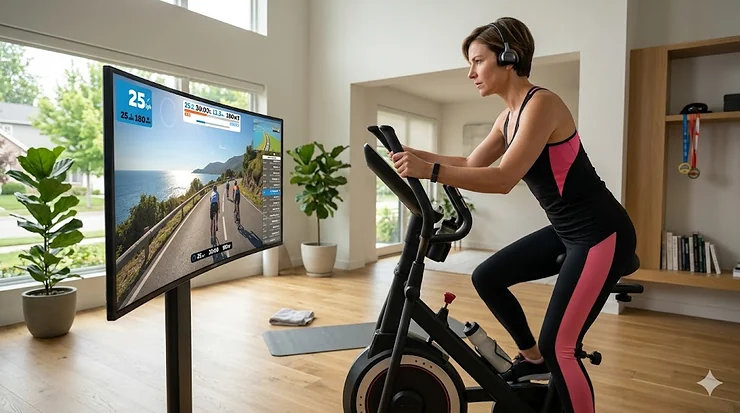
You know that particular brand of dread — the one that sets in around minute four on a plain elliptical, staring at a wall while the calorie counter creeps up like it’s being counted by hand? Yeah. That feeling has a cure. It’s called a virtual cycling elliptical, and it’s quietly becoming the most exciting piece of home fitness tech you can buy in 2026.
A virtual cycling elliptical is a Bluetooth-enabled elliptical trainer that connects to immersive fitness apps like Zwift, iFIT, JRNY, or SunnyFit, letting you stride through alpine villages, race strangers across Europe, or follow a trainer through the Scottish Highlands — all without leaving your living room. What separates these machines from a dusty elliptical gathering gym towels isn’t just the connectivity. It’s the sense of going somewhere. Your cadence controls your avatar on-screen. Your resistance changes with the virtual terrain. Your heart rate becomes part of a story. That’s the difference between staring at a wall and actually looking forward to your 6 AM cardio session.
The global virtual fitness market was valued at over $16 billion in 2024 and continues to climb sharply, driven largely by demand for connected home equipment (Statista). Meanwhile, research published in peer-reviewed journals consistently shows that gamified exercise increases workout duration and frequency significantly over passive exercise (JMIR Serious Games). In plain English: when your workout is fun, you actually do it.
This guide breaks down the 7 best virtual cycling elliptical options currently available on Amazon — covering everything from a budget-friendly Zwift-ready starter to a 3-in-1 powerhouse that replaces three machines. Whether you’re a busy parent with 20 minutes to sweat, a casual cyclist who can’t face outdoor cold, or a competitive soul who wants to race real people in virtual races, there’s a machine on this list built exactly for you. Let’s get into it.
Quick Comparison: Top Virtual Cycling Elliptical Machines at a Glance
| Machine | Flywheel | Resistance Levels | App Compatibility | Virtual Courses | Best For | Price Range |
|---|---|---|---|---|---|---|
| SNODE E20I | 22 lbs | 16 | Zwift, iConsole | Zwift worlds | Budget Zwifters | $300–$400 |
| Schwinn 470 | 20 lbs | 26 | Explore the World, Zwift | 200+ routes | Mid-range versatility | $900–$1,100 |
| ProForm Carbon EL | 15 lbs | 18 | iFIT (Google Maps routes) | 16,000+ workouts | Interactive coaching fans | $750–$900 |
| Sunny Health & Fitness Smart Upright | 13 lbs | 24 | SunnyFit app | Scenic rides | Beginners & casual users | $350–$500 |
| Bowflex Max Trainer M9 | N/A (hybrid) | 20 | JRNY, Zwift, Rouvy | 200+ scenic routes | Calorie-crushing efficiency | $1,200–$1,500 |
| NordicTrack FS10i FreeStride | 20 lbs | 24 | iFIT (auto-adjust) | 16,000+ global sessions | Versatile households | $1,799–$2,200 |
| Horizon 7.0 AE | 23 lbs | 20 | Zwift, Peloton, Rouvy | All compatible app routes | Open-app freedom | $900–$1,100 |
What the table really tells you: The SNODE E20I wins on value for pure Zwift use, but if you want the most flexibility — the ability to hop between Zwift today and a Peloton class tomorrow — the Horizon 7.0 AE is the only machine here that plays nicely with almost every platform without locking you in. Mid-range buyers who want trainer-led virtual rides will get the most from ProForm or NordicTrack’s iFIT ecosystem, while the Bowflex M9’s hybrid stepper-elliptical design is in a class by itself if maximum calorie burn is your primary goal.
💬 Just one click — help others make better buying decisions too! 😊
Top 7 Virtual Cycling Elliptical Machines: Expert Analysis
1. SNODE E20I Programmed Elliptical — Best Budget Zwift-Compatible Option
If your main goal is getting into Zwift without spending four figures, the SNODE E20I is the honest answer most review sites won’t give you — because it doesn’t pay big affiliate commissions. But here it is anyway.
The E20I pairs with Zwift and iConsole via Bluetooth, giving you full access to Zwift’s virtual racing world at a fraction of the cost of premium machines. Its 22-pound magnetic flywheel — notably heavier than many competitors in this price class — provides the smooth, momentum-rich stride that cheaper 12–15 lb flywheels simply can’t replicate. Sixteen levels of magnetic resistance cover a decent training range, though serious athletes will notice the ceiling isn’t as high as mid-range machines.
Here’s what the spec sheet won’t tell you: the E20I’s Bluetooth FTMS (Fitness Machine Service Profile) compatibility is the real selling point. Most budget ellipticals claim “app connectivity” but mean they support a proprietary app nobody uses. The SNODE E20I genuinely connects to Zwift’s cadence and resistance data stream, meaning your on-screen avatar responds to how hard you’re actually pedaling. That’s rare below $400.
A 300 lb weight capacity and included pulse sensors, tablet holder, and transport wheels round out a surprisingly complete package. Customer reviewers on Amazon consistently praise the straightforward assembly — most report under an hour — and the responsive after-sales support from SNODE’s team.
✅ Pros:
- Genuine Zwift + iConsole Bluetooth compatibility
- Heavy 22 lb flywheel for smooth momentum at this price
- Solid 300 lb weight capacity
- Fast assembly, responsive seller support
❌ Cons:
- Resistance ceiling lower than mid-range competitors
- Slight wobble reported by some users on uneven floors
Best for: Apartment dwellers and first-time home gym builders who want a real Zwift experience without a four-figure investment. If budget is your primary constraint but virtual cycling is your goal, start here. Price range: around $300–$400.
2. Schwinn 470 Elliptical — Best for Virtual Scenic Exploration
The Schwinn 470 is a machine that’s been earning recommendations from fitness editors since well before the virtual fitness boom — and it’s earned them the right way, through consistent performance rather than marketing spend.
At its core, the 470 offers a 20-inch motorized stride length, 26 levels of resistance with digital one-touch controls, and a powered 10-degree incline — the kind of spec combination that makes virtual terrain simulation feel authentic. When you’re climbing a virtual mountain pass on Explore the World, the incline adjustment is what transforms the experience from “watching a screensaver” to “genuinely feeling the grade.” The 26 resistance levels also mean you won’t run out of challenge as your fitness improves; cheaper machines often max out well before experienced users do.
What makes the Schwinn 470 special for virtual cycling is its compatibility with Explore the World, which unlocks 200+ virtual outdoor routes. Unlike app-locked ecosystems, the 470’s open Bluetooth protocol also works with Zwift. The dual LCD display panels track all key metrics, and four built-in user profiles make it practical for households with multiple users at different fitness levels.
Customers regularly cite the quiet belt drive and stable frame as standout features — a big deal when you live in a multi-story home or have a sleeping child one floor below your 5 AM workout.
✅ Pros:
- 26 resistance levels + powered 10° incline for realistic terrain
- 200+ virtual routes via Explore the World, plus Zwift compatibility
- Quiet operation — suitable for apartment or shared-wall settings
- Four user profiles for household sharing
❌ Cons:
- App ecosystem less immersive than iFIT or JRNY
- Display looks dated compared to newer touchscreen models
Best for: The workout enthusiast who wants real virtual terrain experience with solid hardware and isn’t wedded to one specific platform. Price range: $900–$1,100.
3. ProForm Carbon EL Elliptical — Best for Trainer-Led Virtual Cycling
ProForm is owned by Icon Health & Fitness — the same parent company as NordicTrack — and the Carbon EL benefits enormously from that shared R&D. At its price point, it delivers iFIT capability that would have cost twice as much five years ago.
The Carbon EL’s headline feature is iFIT Bluetooth Smart connectivity, which opens access to a library of over 16,000 on-demand workouts including virtual global destinations where real trainers remotely adjust your machine’s resistance as you stride through, say, the Swiss Alps. That remote control feature is something you genuinely have to experience to appreciate — your elliptical suddenly feels like it has a mind of its own, and it’s working hard to make the route feel real. The 19-inch adjustable stride accommodates a wide range of user heights, the 15 lb inertia-enhanced flywheel provides smooth momentum, and 18 levels of Silent Magnetic Resistance handle everything from casual recovery sessions to lung-burning interval training.
The Carbon EL doesn’t include a built-in screen — you bring your own tablet and mount it on the integrated shelf. For some, this is a frustration. In practice, it means you’re using a current-gen tablet with a better display than most built-in consoles, and you’re not locked into a resolution that’ll feel outdated in three years.
Users on Amazon frequently mention how well the iFIT integration works and how quickly trainers can change their experience mid-workout.
✅ Pros:
- iFIT smart connectivity with trainer-controlled resistance
- 19″ adjustable stride for mixed-height households
- 10-year frame warranty — unusually strong for this price
- Bring-your-own-screen means better display than built-in models
❌ Cons:
- iFIT subscription required for full features (~$39/month)
- 300 lb weight capacity is lower than some competitors
Best for: Motivated beginners and intermediate users who thrive with coach-led instruction and want the immersion of global destination workouts without stepping into a gym. Price range: $750–$900.
4. Sunny Health & Fitness Smart Upright Elliptical — Best for Beginners & Casual Users
Not everyone needs to race strangers through virtual Watopia. Sometimes you just want a reliable, app-connected elliptical that doesn’t demand a subscription, a tech degree, or a second mortgage. That’s exactly where the Sunny Health & Fitness Smart Upright Elliptical lives — and it does it very well.
The machine ships with the free SunnyFit app, which offers guided workout programs, progress tracking, and scenic ride content without charging you monthly. In a market where nearly every competitor locks its best features behind a recurring fee, “free, forever” is a bigger selling point than it sounds. The 24 levels of magnetic resistance offer more granular control than most machines in this price bracket — many competitors offer only 16 — and the built-in pulse sensors in the handlebars keep your heart rate monitoring passive and effortless.
The 13 lb flywheel is lighter than competitors higher on this list, and you’ll feel that difference at the upper end of the resistance range — the stride becomes slightly less fluid under maximum load. But for 80% of casual users exercising at moderate intensity 3–5 times per week, it’s perfectly adequate. The folding design and compact footprint make it a practical choice for apartments and spare rooms.
Customers consistently mention how smooth the initial experience is and how appreciated the no-subscription model is once they realize what competitors charge.
✅ Pros:
- Free SunnyFit app — no subscription fees, ever
- 24 resistance levels — more granularity than most budget options
- Compact footprint suitable for apartments
- Built-in pulse sensors, device holder
❌ Cons:
- 13 lb flywheel is lighter than mid-range alternatives
- Virtual content less immersive than Zwift or iFIT ecosystems
Best for: New home gym builders, older adults getting back into cardio, and anyone who wants connected fitness without commitment to a subscription. Price range: $350–$500.
5. Bowflex Max Trainer M9 — Best for Maximum Calorie Burn with Virtual Motivation
Here’s the honest truth about the Bowflex Max Trainer M9: it’s not a traditional elliptical. It’s a stepper-elliptical hybrid, and that distinction matters enormously. The natural motion is more vertical — think of it as combining the calorie-burning intensity of a stair climber with the low-impact footprint of an elliptical. Bowflex claims you burn 2.5× more calories than traditional ellipticals in the same timeframe. That figure is contested, but the underlying principle is sound — stair-climbing patterns recruit more glute and hamstring muscle than horizontal gliding does.
The M9 connects to the JRNY app via its built-in 10-inch HD touchscreen, giving you access to 200+ scenic virtual cycling routes, adaptive coaching, and — crucially — compatibility with Zwift and Rouvy for those who want full virtual racing. The JRNY platform also integrates Netflix, Hulu, and other streaming services directly on the console, which is a genuinely thoughtful feature for longer, lower-intensity sessions. Twenty resistance levels and four-grip handlebars with built-in heart rate sensors complete the hardware picture.
What most buyers overlook: the compact 49″ x 30″ footprint makes the M9 one of the smallest machines on this list by floor area — ideal for tight home gym spaces. The vertical motion also dramatically reduces knee stress compared to traditional elliptical strides, making this a surprisingly good option for runners with knee issues.
✅ Pros:
- Hybrid stepper-elliptical burns significantly more calories per session
- Built-in 10″ HD touchscreen with JRNY, Zwift, and Rouvy compatibility
- Netflix/Hulu streaming built in
- Compact footprint despite premium specs
❌ Cons:
- Not a traditional elliptical stride — needs adjustment time
- JRNY subscription adds ongoing cost (~$19/month)
Best for: Busy people with limited workout time who want maximum calorie burn with virtual motivation, particularly those managing knee sensitivity. Price range: $1,200–$1,500.
6. NordicTrack FS10i FreeStride Trainer — Best Premium 3-in-1 Virtual Cycling Elliptical
If you’ve ever wished one machine could replace an elliptical, a treadmill, and a stair climber — and deliver a stunning virtual cycling experience on top of all three — the NordicTrack FS10i FreeStride Trainer is what you’ve been looking for. This thing doesn’t compromise; it just does more.
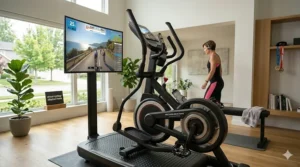
The FS10i’s defining feature is its auto-adjustable stride, which extends up to 32 inches — more than most front-drive ellipticals even attempt. You can stride short and steep for stair-climbing simulation, mid-range for natural elliptical motion, or long and flat for a running-like cadence. Each mode connects to iFIT’s library of over 16,000 on-demand sessions, where trainers use Google Street View to take you through real geographic locations while the machine’s 10% powered incline auto-adjusts to match the actual terrain gradient. That last part is genuinely extraordinary — the FS10i literally reads the gradient of the virtual road you’re on and changes the machine’s angle to match it in real time.
A 20 lb flywheel, 24 resistance levels, 375 lb weight capacity, and a 10-inch Smart HD touchscreen round out the specs. The iFIT subscription (required for the virtual experience) costs extra, but the breadth of content — live classes, global destination rides, trainer-guided programs — justifies the investment for serious users.
Reviewers consistently describe it as “the smoothest stride I’ve ever used” and highlight the iFIT terrain auto-adjustment as a game-changer.
✅ Pros:
- Auto-adjustable 32″ stride works as elliptical, treadmill, or stair climber
- iFIT terrain auto-adjustment — incline changes with virtual route in real time
- 375 lb weight capacity — best on this list
- 10″ Smart HD touchscreen built in
❌ Cons:
- iFIT subscription required for full experience
- Higher price point may not suit casual users
- Switching between stride modes mid-workout takes practice
Best for: Dedicated fitness users who want a single machine to replace multiple cardio options, with premium virtual terrain immersion that self-adjusts while you ride. Price range: $1,799–$2,200.
7. Horizon 7.0 AE Elliptical — Best Open-Ecosystem Virtual Cycling Elliptical
Every other machine on this list serves you well — as long as you’re committed to its specific app ecosystem. The Horizon 7.0 AE is the one that doesn’t care which platform you love. It talks to Zwift. It talks to Peloton. It talks to Rouvy. It connects to the free Horizon companion app and pushes data to your favorite fitness trackers. In a market full of walled gardens, the Horizon 7.0 AE is a refreshingly open door.
The hardware is serious. A 23 lb flywheel — the heaviest on this list — delivers the kind of weighted, predictable momentum that makes long virtual cycling sessions feel genuinely satisfying rather than mechanical. Twenty levels of both resistance and incline mean you have granular control over terrain simulation across a wide range. The Six-Star ergonomic frame positions your body more naturally than budget machines, which matters enormously when you’re logging 45–60 minute virtual rides several times a week. Advanced Bluetooth speakers integrated into the frame let you hear your app’s audio without headphones.
The lifetime frame warranty is worth calling out specifically: Horizon’s warranty is among the strongest in home fitness, and for a machine you’re planning to use daily, that’s meaningful long-term value that competitors charging similar prices don’t match.
Customers who tried multiple platforms before settling on the Horizon consistently report relief at not being locked in — and surprise at how robust the hardware feels at this price.
✅ Pros:
- Compatible with Zwift, Peloton, Rouvy, and more — true open ecosystem
- 23 lb flywheel — heaviest on this list for maximum ride smoothness
- Lifetime frame warranty
- Bluetooth speakers built into the frame
❌ Cons:
- No built-in touchscreen (requires your own device)
- Horizon’s companion app is functional but not as immersive as iFIT or JRNY
Best for: Platform-agnostic users who want premium hardware and the freedom to use whatever virtual cycling app suits their mood — without being penalized for it. Price range: $900–$1,100.
✨ Don’t Miss These Exclusive Deals!
🔍 Take your virtual cycling elliptical experience to the next level with these carefully selected machines. Click on any highlighted product to check current pricing and availability on Amazon. Your future self — the one who actually looks forward to cardio — will thank you.
How to Set Up Your Virtual Cycling Elliptical for Maximum Immersion (Practical Usage Guide)
Buying the machine is step one. Getting the experience to feel genuinely immersive — rather than like using a treadmill with prettier graphics — takes a little intentional setup. Here’s what most guides don’t tell you.
Step 1: Place the machine strategically. Proximity to your router matters more than most people realize. A Bluetooth signal between your elliptical and tablet or TV needs to stay strong under load. If you’re more than 15 feet from your router, consider a Wi-Fi extender or a dedicated mesh node in your workout space. Dropped connections mid-Zwift ride are as demoralizing as they sound.
Step 2: Set up your app account before you sweat. Create your Zwift, iFIT, or JRNY account on a desktop first. Fill in your weight, height, and FTP (if using Zwift). These numbers determine how hard the virtual terrain hits and how accurately your avatar responds to your effort.
Step 3: Pair all sensors, not just the machine. Most virtual cycling elliptical setups benefit enormously from a Bluetooth heart rate chest strap (Wahoo TICKR or Polar H10 work with everything). Heart rate data unlocks training zones, and some iFIT programs use it to auto-adjust intensity. Handgrip sensors are convenient but less accurate during hard efforts.
Step 4: Do your first 10 minutes manually. Before launching any virtual session, spend 10 minutes warming up without the app open. This calibrates your muscles to the stride pattern of your specific machine and prevents the jarring transition when you go from cold to chasing a virtual rider uphill at 300 watts.
Step 5: Avoid the “max resistance” trap in week one. Common mistake among new virtual elliptical users: cranking resistance to 20 immediately because the virtual road looks steep. Your joints — particularly your hips and lower back — need 2–3 weeks to adapt to the stride pattern before high-resistance sessions become safe for extended periods. Build gradually.
First 30-day maintenance checklist:
- Tighten all bolts after the first 5 sessions (normal settling)
- Wipe pedal rails and flywheel area weekly — sweat is corrosive to metal over time
- Re-lubricate the flywheel axle at 30 days if manufacturer recommends it
- Update firmware via your app at day 7 and day 30
Who Should Buy Which Virtual Cycling Elliptical? (Real-World Scenarios)
The spec sheet tells you what a machine does. This section tells you who it’s actually built for.
Profile 1 — The Apartment Renter Who Wants Zwift on a Budget Meet the person who’s already paying for a Zwift subscription on a borrowed smart trainer and wants their own dedicated machine. They have maybe $400 to spend, a 9th-floor apartment, and a neighbor below who works nights. The SNODE E20I is the answer. Its Bluetooth FTMS compatibility talks directly to Zwift, the quiet belt drive won’t disturb anyone below, and the price leaves money for a Wahoo heart rate strap.
Profile 2 — The Recreational Cyclist Stuck Indoors in Winter This person rides outdoors from April to October and needs a winter cardio solution that doesn’t make them feel like they’re missing out on real cycling. The Horizon 7.0 AE is the pick here — Zwift integration turns their winter months into structured training that actually improves their outdoor performance come spring, and the open ecosystem means they can also use Rouvy to virtually ride cycling routes they’re planning to do in person.
Profile 3 — The Time-Crunched Parent Who Needs 20 Minutes to Count Limited to 5 AM sessions before the household wakes up. Efficiency is everything; 20 minutes needs to feel like 45. The Bowflex Max Trainer M9 was designed for exactly this person. The hybrid stepper-elliptical motion maximizes calorie burn per minute, and JRNY’s adaptive coaching builds those short sessions into a coherent program over months.
Profile 4 — The Premium Buyer Who Wants It All Works out six days a week, wants trainer-led sessions, virtual terrain, and a machine that won’t feel obsolete in three years. The NordicTrack FS10i is the answer. The auto-adjusting incline, 3-in-1 versatility, and depth of the iFIT library mean this machine grows with the user rather than becoming limiting as their fitness advances.
Virtual Cycling Elliptical vs Traditional Elliptical: What You Actually Gain
| Feature | Traditional Elliptical | Virtual Cycling Elliptical |
|---|---|---|
| Workout motivation | Depends on willpower | App-driven, goal-based |
| Terrain simulation | None | Incline auto-adjusts to route |
| Social element | Solo only | Multiplayer racing & group rides |
| Progress tracking | Basic console metrics | Detailed data, training plans |
| Variety | Limited pre-set programs | Thousands of global destinations |
| Long-term adherence | Often drops after 3 months | Significantly higher |
| Cost | Lower upfront | Higher, plus app subscription |
The research is compelling here. A study in the Journal of Medical Internet Research found that gamified fitness experiences improved exercise adherence by up to 48% compared to standard cardio. Put differently: the best workout machine is the one you actually use, and virtual cycling elliptical machines make you want to use them.
That said, the table above isn’t a one-sided win for virtual machines. If you have zero interest in apps, multiplayer features, or virtual routes — if you just want to stride in silence while listening to a podcast — a traditional elliptical with a heavy flywheel will serve you perfectly well at a lower price. The virtual features only add value if you’ll actually engage with them.
✨ Ready to Level Up Your Cardio Game?
🎯 The machines in this guide are live on Amazon right now. Click through to any highlighted product, compare current pricing with the ranges listed here, and read the most recent buyer reviews for real-world validation. A connected elliptical is a long-term investment — take the few minutes to get it right.
How to Choose a Virtual Cycling Elliptical: 7 Criteria That Actually Matter
Buying a virtual cycling elliptical is a bigger decision than most people treat it. You’re choosing a training partner for the next 5–10 years. Here’s what to weigh, in order of importance.
1. App ecosystem compatibility — lock-in risk. This is the single most important factor most buyers overlook. Zwift, iFIT, JRNY, and SunnyFit are all solid platforms — but they’re different experiences with different content libraries. More importantly, some machines only work natively with one platform. NordicTrack and ProForm machines are iFIT-native, and while you can technically sideload other apps, the experience is suboptimal. If you already use (or love) a specific platform, start there. If you’re undecided, choose an open-ecosystem machine like the Schwinn 470 or Horizon 7.0 AE and try multiple apps before committing.
2. Flywheel weight — the feel that specs don’t capture. The flywheel is what makes an elliptical feel smooth or choppy. Heavier flywheels maintain momentum better through the full stride cycle, which reduces the mechanical “dead spot” at the top and bottom of each pedal stroke. Below 18 lbs, most users notice a slightly mechanical, uneven feel during hard efforts. Above 20 lbs, the stride becomes noticeably more fluid. For virtual cycling specifically — where you’re simulating road riding — a heavier flywheel dramatically improves immersion.
3. Stride length — fit matters more than specs suggest. The standard recommendation is a 20-inch stride for users under 5’9″ and a longer adjustable stride for taller users. But stride length affects more than just comfort: it determines which muscle groups dominate the motion. Shorter strides emphasize the quads; longer strides engage more of the glutes and hamstrings. For virtual cycling simulation, a 20-inch stride most closely replicates outdoor cycling biomechanics.
4. Incline range — the key to realistic terrain. Flat virtual routes are pleasant. Hilly virtual routes are transformative. Machines without powered incline can’t simulate climbing, which means your virtual mountain stage on Zwift feels nothing like an actual mountain stage. A motorized incline range of at least 0-10% makes the terrain simulation meaningful.
5. Subscription cost — total cost of ownership. The machine’s sticker price is not the total price. A $1,000 elliptical tied to a $39/month iFIT subscription costs $1,468 in year one. Budget accordingly. Machines compatible with free apps (Horizon’s open ecosystem, Sunny’s SunnyFit) or with cheaper subscription tiers are worth serious consideration for budget-conscious buyers.
6. Weight capacity — future-proofing your investment. Most home ellipticals are rated for 250–350 lbs. If you’re buying for multiple household members or anticipate weight fluctuation, prioritize machines rated at 300 lbs or higher. The NordicTrack FS10i’s 375 lb capacity is the most generous option here.
7. Warranty — what “budget” really costs long-term. A lifetime frame warranty (Horizon 7.0 AE) or 10-year frame warranty (ProForm Carbon EL) is worth far more than the spec sheet number suggests. These machines get used hard, and a warranty claim on a 4-year-old frame saves you hundreds versus buying new. Short warranties on budget machines aren’t always deal-breakers, but budget for potential replacement cost in your decision.
Common Mistakes When Buying a Virtual Cycling Elliptical (And How to Avoid Them)
Even well-researched buyers make these missteps. Don’t let them be yours.
Mistake 1: Buying for the app instead of the hardware. App content libraries come and go — companies get acquired, subscriptions change price, platforms add and drop features. The hardware you’re striding on will be in your home for a decade. Prioritize flywheel quality, stride feel, and frame warranty over which app has a prettier interface this year.
Mistake 2: Ignoring assembly complexity. A significant number of negative reviews for every elliptical on this list trace back to assembly frustration rather than product quality. Most virtual cycling elliptical machines arrive in two or more boxes and require 1–3 hours of assembly. Check whether your preferred machine offers in-home assembly (usually $100–$200 through Amazon’s service partners) before deciding assembly complexity is a dealbreaker.
Mistake 3: Assuming “Bluetooth compatible” means “Zwift compatible.” These are not the same thing. A machine that connects to a generic heart rate monitor via Bluetooth is not the same as a machine that broadcasts FTMS (Fitness Machine Service Profile) data — the specific protocol Zwift uses to read cadence and control resistance. Always verify FTMS compatibility specifically, not just “Bluetooth” in general.
Mistake 4: Underestimating subscription dependency. The Bowflex M9’s touchscreen is largely non-functional without a JRNY subscription. The NordicTrack FS10i’s auto-incline feature requires iFIT. Read the fine print on what works in “manual mode” before assuming the hardware is usable without paying monthly.
Mistake 5: Prioritizing quiet specs over your actual floor. “Whisper quiet” is a relative term. All magnetic flywheel ellipticals are quiet at low resistance. At high resistance, moving parts, frame flex, and pedal friction all generate noise. If you live in an apartment, add a high-quality anti-vibration mat under any machine regardless of brand noise claims — your neighbors will appreciate you for it.
Long-Term Cost & Value: What Your Virtual Cycling Elliptical Actually Costs Over 5 Years
Let’s do math most buying guides skip.
| Machine | Purchase Price | Annual Subscription | 5-Year Total Cost |
|---|---|---|---|
| SNODE E20I + Zwift | ~$350 | $240/year (Zwift) | ~$1,550 |
| Schwinn 470 + Explore the World | ~$1,000 | $99/year | ~$1,495 |
| ProForm Carbon EL + iFIT | ~$800 | $468/year | ~$3,140 |
| Sunny Health & Fitness + SunnyFit | ~$450 | $0 | ~$450 |
| Bowflex M9 + JRNY | ~$1,350 | $228/year | ~$2,490 |
| NordicTrack FS10i + iFIT | ~$2,000 | $468/year | ~$4,340 |
| Horizon 7.0 AE + Zwift | ~$1,000 | $240/year | ~$2,200 |
The five-year total cost column is the most honest comparison in this article. A NordicTrack FS10i + iFIT runs nearly three times the five-year cost of a Schwinn 470 + Explore the World subscription. That premium is justified by the NordicTrack’s superior content and auto-adjust incline — but only if you’ll fully use those features consistently for five years.
The real value winner for casual users? The Sunny Health & Fitness Smart Upright Elliptical with the free SunnyFit app. No subscription, ever. For serious virtual racers, the Schwinn 470 + Explore the World combination delivers strong value relative to the iFIT-platform alternatives.
FAQ: Virtual Cycling Elliptical Questions Answered
❓ What is a virtual cycling elliptical?
❓ Can I use Zwift with any elliptical machine?
❓ What's the best gamified workout elliptical for weight loss?
❓ Do virtual cycling elliptical machines work without a subscription?
❓ Are multiplayer fitness elliptical machines worth the investment?
Conclusion: Your Best Virtual Cycling Elliptical Is the One You’ll Actually Use
Here’s the most important truth in this entire guide: a $2,000 elliptical that’s a clothes rack in six months is worth exactly zero dollars. A $350 SNODE E20I that you Zwift on five days a week is worth everything.
The best virtual cycling elliptical for you sits at the intersection of your actual budget, your preferred platform, and the specific experience that makes you want to get on it. Zwift racers should look seriously at the SNODE E20I or Horizon 7.0 AE. iFIT devotees will love the ProForm Carbon EL or the NordicTrack FS10i. Platform-agnostic buyers who want maximum hardware quality without ecosystem lock-in will be happiest with the Horizon 7.0 AE. And if sheer calorie efficiency is your metric, the Bowflex M9 makes every other machine on this list work harder for the same result.
Virtual fitness isn’t a gimmick anymore. It’s the reason millions of people are consistently exercising indoors who couldn’t sustain it before — because fun, it turns out, is the most underrated fitness feature of all. Whatever machine you choose from this list, you’re not just buying an elliptical. You’re buying a reason to show up.
✨ Don’t Miss These Exclusive Deals!
🔍 Click through to any highlighted machine to check current pricing and availability on Amazon. The right virtual cycling elliptical is waiting — go find the one that’ll make you actually look forward to cardio.
Recommended for You 📖
- Best Peloton App Elliptical Machine 2026: 7 Top Picks Reviewed
- 7 Best NordicTrack iFit Elliptical Machines for 2026
- 7 Best High Definition Screen Elliptical Machines of 2026
Disclaimer: This article contains affiliate links. As an Amazon Associate, I earn from qualifying purchases. If you purchase products through these links, we may earn a small commission at no additional cost to you.
✨ Found this helpful? Share it with your friends! 💬🤗
