
In This Article
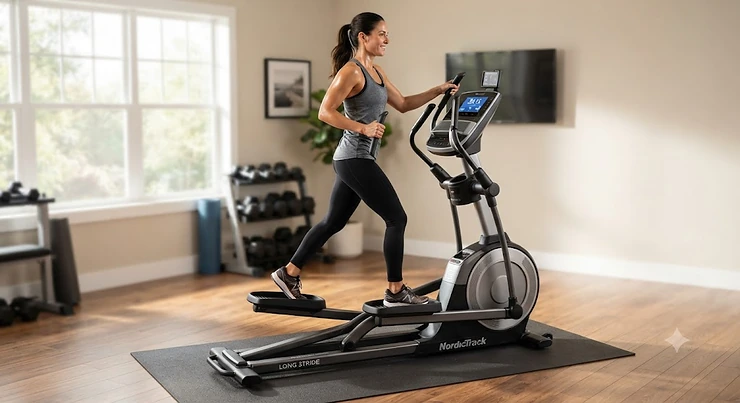
Ever hopped on an elliptical and felt like you were doing the world’s smallest tap dance? That choppy, clipped feeling isn’t in your head — it’s math. If your legs are built for a bigger arc than the machine offers, every rotation fights your natural gait instead of working with it. A long stride length elliptical solves that problem by giving your legs room to actually finish the movement they’re trying to make, instead of getting cut off mid-stretch.
Here’s the quick answer: a long stride length elliptical is a cross-trainer with a foot-path arc of roughly 20 inches or more, built specifically for users over about 5’7″ whose natural walking or running gait needs more room than the 16-18 inch strides found on entry-level machines. The result is a smoother, more running-like motion with less strain on the knees, hips, and ankles.
This guide dives into seven real, currently available machines — from a compact $600 workhorse to a flagship trainer with a stride that stretches to 32 inches — plus the biomechanics behind why stride length matters more than almost any other spec on the spec sheet. Whether you’re 6’4″ and done cramping your calves on a bargain-bin elliptical, or you’re shopping for a household with wildly different heights, there’s a machine on this list built for you. Let’s get into it.
Quick Comparison Table
Before we go deep on any single machine, here’s the bird’s-eye view. This table strips away the marketing fluff and shows you what actually separates these seven long stride length elliptical trainers.
| Product | Stride Length | Drive Type | Price Range | Best For |
|---|---|---|---|---|
| FED Fitness Yosuda EM1 | 18.91″-20.09″ (dual mode) | Compact/magnetic | Around $550-$700 | Small apartments, multi-height households |
| Nautilus E614 | 20″ fixed | Rear-drive | Around $600-$750 | Budget shoppers wanting a no-frills 20″ stride |
| Sole E25 | 20″ fixed | Front-drive | Around $900-$1,150 | Tall users on a moderate budget |
| Schwinn 470 | 20″ fixed | Front-drive | Around $950-$1,050 | Mid-range buyers who want power incline |
| Sole E95 | 20″ fixed | Front-drive | Around $2,000-$2,200 | Heavier users, serious home-gym builds |
| Sole E95S | 18″-24″ adjustable | Front-drive | Around $2,700-$3,000 | Households with very different heights |
| NordicTrack FS14i | 0″-32″ adjustable | Center-drive | Around $2,900-$3,300 | Runners who want elliptical, stepper, and treadmill motion in one |
Looking at the spread above, the split between fixed 20-inch machines and power-adjustable models is really a split in who’s using the equipment. If you’re the only person who’ll ever touch this machine, a fixed 20″ stride like on the Schwinn 470 or Sole E95 is plenty, and you’ll save real money. But if your household ranges from a 5’2″ partner to a 6’4″ teenager, the adjustable stride on the Sole E95S or NordicTrack FS14i stops being a luxury and starts being the only way everyone gets a comfortable workout.
Compare specs side by side, then pick the one that fits your body — not just your budget! 💪
Top 7 Long Stride Length Ellipticals: Expert Analysis
Stride length is the headline spec, but it’s never the whole story. Below, each machine gets the full treatment: what the numbers mean in practice, who it’s actually built for, and what real buyers are saying once the box is unpacked and the batteries are in.
1. FED Fitness Yosuda EM1 — most stride packed into the smallest footprint
The standout here is genuinely unusual: a machine that squeezes a proper long stride into roughly 8 square feet of floor space, something almost no other elliptical in this category manages. The Yosuda EM1 offers two stride settings — an 18.91-inch “Glide” mode for easy, daily cardio, and a 20.09-inch “Glide Select” mode built for a more running-like feel. That dual-mode setup means a household spanning 4’11” to 6’5″ can each dial in their own comfort zone without buying two machines.
Based on the spec comparison, what makes this compelling isn’t raw power — it’s the engineering trade-off. Most compact ellipticals shrink the stride to shrink the footprint, leaving tall users with that cramped, marching-in-place feeling. The EM1 keeps the stride intact and shrinks everything else around it instead, which is the harder (and more useful) problem to solve. This is a magnetic-resistance machine, so expect a quieter ride than the belt-driven budget ellipticals of a decade ago, though it won’t have the flywheel heft of the front-drive machines further down this list.
Aggregated coverage of the EM1 since its early-2026 launch frames it as a genuine category disruptor for small-space shoppers, with reviewers highlighting the dual-stride system as the headline feature worth the price jump over basic compact ellipticals.
Pros:
- ✅ Dual stride settings fit users from 4’11” to 6’5″
- ✅ Tiny footprint compared to full-size long-stride machines
- ✅ Newer magnetic resistance design runs quietly
Cons:
- ❌ Lighter-duty build than heavier front-drive competitors
- ❌ Fewer long-term owner reviews since it’s a newer release
Price sits around $550-$700 depending on retailer promotions at the time of research — check current price before buying. For anyone who assumed a real stride meant a real footprint, this is the value pick that proves otherwise.
2. Nautilus E614 — long-stride basics without the premium price tag
The standout feature is simplicity done right: a 20-inch “Precision Path” stride length on a machine that regularly sells for less than half of what the premium models on this list cost. The Nautilus E614 pairs that stride with 20 resistance levels and 22 workout programs, so you’re not sacrificing variety just because you kept the budget tight.
What most buyers overlook about a machine at this price point is how much the flywheel and frame quality actually matter for long-term comfort — the stride number gets you in the door, but the ride quality is what keeps you coming back. Reviewers note the E614 delivers a genuinely smooth 20-inch motion with articulating footplates that move naturally underfoot, and taller users consistently report the stride feels appropriately long rather than cramped. On the flip side, the incline here is a six-position manual ramp, meaning you have to step off and adjust it by hand rather than tapping a button mid-workout.
Aggregated review sentiment is mixed on build longevity — some testing outlets have flagged the frame steel as lighter-gauge than competitors like the Schwinn 470, while other reviewers call it a legitimate budget pick for casual to moderate use. This is a case where honest expectations matter: light-to-moderate users tend to be happy, while daily heavy-use households may outgrow it faster.
Pros:
- ✅ Full 20-inch stride at a genuinely budget price
- ✅ 22 workout programs and 20 resistance levels
- ✅ DualTrack display holds a tablet while you train
Cons:
- ❌ Manual incline requires stopping to adjust
- ❌ Some reports of lighter-duty frame components
Expect this one in the $600-$750 range at the time of research, making it one of the most accessible ways to get a genuine 20-inch stride into your home.
3. Sole E25 — the budget incline option for taller users
What stands out on the Sole E25 is that it undercuts most 20-inch-stride competitors on price while still including a 20-level motorized incline — a feature usually reserved for pricier machines. Garage Gym Reviews’ testing panel rated it highly for ergonomics specifically because of that longer stride paired with large, textured pedals and both fixed and moving handles.
Here’s what the spec sheet doesn’t fully convey: a quiet front-drive system combined with a full 20-inch stride means users over six feet consistently describe the motion as natural rather than forced, which is the entire point of buying a long-stride machine in the first place. On paper, this means you’re getting E95-level stride comfort at a fraction of the price, though you are trading away some of the flywheel heft and console sophistication that the premium Sole models offer.
Based on aggregated tester feedback, the main friction point is the incline mechanism itself — you have to physically get off the machine, power it down, and manually reset the ramp height to change incline levels, which discourages most users from adjusting it mid-workout at all. Reviewers also flag the footprint as sizable for a sub-$1,200 elliptical, so measure your space before ordering.
Pros:
- ✅ Full 20-inch stride at a genuinely accessible price
- ✅ 20 levels of incline, unusual at this price tier
- ✅ Quiet front-drive motion praised for ergonomics
Cons:
- ❌ Incline changes require manually stopping the machine
- ❌ Larger footprint than compact alternatives like the Yosuda EM1
Pricing typically lands around $900-$1,150 depending on current promotions, positioning the E25 as the value bridge between rock-bottom budget machines and the mid-range crowd.
4. Schwinn 470 — the mid-range all-rounder with power incline
The headline advantage is balance: a 20-inch stride, a 20-pound flywheel, and — unlike most machines under $1,000 — a motorized power incline that adjusts with the touch of a button instead of a manual ramp. The Schwinn 470 uses what the brand calls Precision Path foot motion technology, engineered specifically to mimic a natural running stride rather than a stiff, mechanical ellipse.
What most buyers overlook is that 20 inches of stride paired with a heavier flywheel (20 pounds is respectable for this price bracket, where 14-18 pound flywheels are common) changes the entire feel of the machine — momentum stays smooth through the full rotation instead of jerking at the top and bottom of the stride. Reviewers consistently point out that this is one of the few sub-$1,000 ellipticals where the incline is automated rather than manual, which matters enormously if you like to vary intensity without interrupting your workout.
Aggregated customer sentiment is genuinely split on two specific points: several reviewers found the footpads “squishy,” reporting their feet sliding slightly forward during longer sessions, and multiple buyers noted missing hardware during assembly (resolved by contacting Schwinn directly for replacement parts). Everything else — resistance range, display, overall stride feel — draws consistently positive marks.
Pros:
- ✅ Motorized power incline, rare under $1,000
- ✅ 20-inch stride with Precision Path motion tech
- ✅ 25-26 resistance levels for serious intensity range
Cons:
- ❌ Footpads reported as soft, causing foot slide
- ❌ Some buyers received incomplete hardware kits
At around $950-$1,050 at the time of research, the 470 is arguably the single best value-per-dollar pick on this list if power incline matters to you.
5. Sole E95 — the heavy-duty front-drive stride specialist
The Sole E95 stands out for sheer physical presence: a 27-pound flywheel, a 400-pound weight capacity, and a fixed 20-inch stride delivered through oversized pedals that tilt to a comfortable 2-degree inward slope. This is a machine built to feel identical on day 1,000 as it did on day one.
Here’s what the spec sheet won’t tell you, but reviewers consistently note: that flywheel weight translates directly into stride smoothness. A heavier flywheel resists the natural deceleration between pedal strokes, so the 20-inch arc feels continuous rather than segmented — which is exactly the sensation long-legged users are chasing when they upgrade from an 16-18 inch stride machine. The “worm drive” pedal adjustment system lets you angle the footplates through 10 positions, directly addressing the numb-toe and sore-Achilles complaints common on fixed-pedal ellipticals.
Based on aggregated review data, taller users (six feet and up) repeatedly cite the E95 as the machine that finally made an elliptical feel like running rather than shuffling. The tradeoffs are real, though: at 236 pounds, this is not a machine you casually relocate, and the fixed 20-inch stride means shorter users in a shared household may prefer the adjustable E95S below.
Pros:
- ✅ Heavy-duty 27-lb flywheel smooths the entire stride
- ✅ Worm-drive pedal adjustment fixes foot-angle discomfort
- ✅ 400-lb weight capacity built for serious daily use
Cons:
- ❌ 236-lb machine weight makes relocation difficult
- ❌ Stride is fixed at 20 inches, not adjustable
Price at the time of research runs around $2,000-$2,200, positioning the E95 as the serious home-gym choice for anyone who wants commercial-grade durability behind that long stride.
6. Sole E95S — power-adjustable stride for mixed-height households
The single feature that defines this machine is right there in the name: a power-adjustable stride ranging from 18 to 24 inches, a spread Sole markets as unmatched in its own lineup, where every other model (from the entry-level E25 up through the flagship E98) ships with a fixed 20-inch stride instead.
What this means in practice is a genuine running motion on the long end of the range without the joint strain of overstretching — you can dial the stride down for a shorter user or a recovery day, then stretch it back out to 24 inches when a taller athlete wants a more aggressive, ground-covering motion. Based on the spec comparison against its sibling, the E95, this adjustability comes at the cost of dropped incline capability — a trade Sole apparently made to fit the stride-adjustment mechanism into the frame. For households where multiple people with meaningfully different heights share one machine, that trade is usually worth it.
Reviewers who’ve spent real time on the E95S describe the stride adjustment as more useful for finding your ideal fixed setting than for changing on the fly mid-workout, since shifting the arc while pedaling takes some coordination. Aggregated sentiment also praises the 13.3-inch touchscreen and Bluetooth connectivity as genuine upgrades over the standard E95’s console.
Pros:
- ✅ 18-24″ power-adjustable stride, rare in this category
- ✅ Large 13.3″ touchscreen with WiFi and screen mirroring
- ✅ Ideal for households with very different user heights
Cons:
- ❌ No incline capability, unlike the standard E95
- ❌ Premium price compared to fixed-stride Sole models
Expect a price range around $2,700-$3,000 at the time of research — a meaningful jump over the fixed-stride E95, but one aimed squarely at multi-user homes and taller athletes who outgrow a standard 20-inch arc.
7. NordicTrack FS14i — the flagship with a 32-inch variable stride
Nothing else on this list comes close to the NordicTrack FS14i‘s party trick: a stride that adjusts from essentially 0 inches (functioning like a stair-stepper) all the way out to a full 32 inches, transforming the same machine into an elliptical, a stepper, or a low-impact treadmill depending on how you move the pedals. It’s genuinely a different category of machine wearing an elliptical’s clothing.
On paper this means unmatched versatility for runners who miss a real running stride but need something gentler on the joints — the FS14i’s center-drive design and bow-shaped legs let the pedal path extend far beyond what any traditional front- or rear-drive elliptical can offer. The tradeoff, and it’s a significant one, is footprint and ceiling height: reviewers recommend at least 8-foot ceilings and note the working length of the machine effectively grows to 70-75 inches once you’re using the longer stride settings, even though the base footprint reads as compact on paper.
Aggregated owner feedback consistently flags one learning curve: controlling exactly where the stride lands takes practice, and several reviewers wished for a way to lock the stride to one specific length rather than have it float freely. The included iFit-powered incline and decline (a rare -10% to +10% range) draws consistently strong praise, as does the 14-inch HD touchscreen — though iFit requires an ongoing subscription beyond the free trial period to unlock the trainer-led programming.
Pros:
- ✅ Stride adjusts across a genuinely unmatched 0″-32″ range
- ✅ 3-in-1 design covers elliptical, stepper, and treadmill motion
- ✅ Motorized incline and decline (-10% to 10%)
Cons:
- ❌ Requires extra ceiling height and floor clearance
- ❌ Full functionality depends on an ongoing iFit subscription
Pricing typically runs around $2,900-$3,300 at the time of research, before factoring in the iFit membership — positioning this as the splurge pick for anyone who wants maximum stride flexibility in one machine.
Benefits vs Traditional (Short-Stride) Ellipticals
| Factor | Long Stride (20″+) Elliptical | Traditional Short-Stride (16-18″) Elliptical |
|---|---|---|
| Best fit | Users over 5’7″, especially 6’0″+ | Users under 5’7″ |
| Gait feel | Natural, running-like extension | Can feel choppy or cramped for taller users |
| Joint strain risk | Lower, when stride matches height | Higher for tall users forced into a short arc |
| Price | Generally $600-$3,300 | Often more affordable, $200-$600 |
| Household fit | Better for mixed heights (with adjustable models) | Best when all users are shorter-statured |
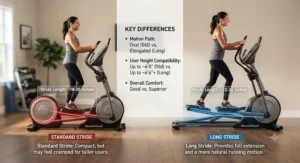
The core takeaway from this comparison is that stride length isn’t a “bigger is always better” spec — it’s a fit spec, much like shoe size. A 5’2″ user forcing a 32-inch stride on the NordicTrack FS14i is just as uncomfortable as a 6’4″ user cramped on an 16-inch budget machine, so match the stride to the body, not the marketing claims. Traditional short-stride machines still make sense for shorter households or anyone prioritizing rock-bottom price over long-term joint comfort.
One tap could save your knees years of unnecessary strain — see which stride fits your height below! 🦵
Practical Usage Guide: Setting Up and Optimizing Your Long-Stride Elliptical
Getting a long stride length elliptical into your home is only step one — dialing it in correctly determines whether you actually use it. Start with placement: these machines need meaningfully more clearance than short-stride models, both in front-to-back floor space and, on variable-stride machines like the FS14i, in ceiling height. Measure your space before assembly day, not after.
During setup, take the extra ten minutes to adjust pedal angle if your machine offers it (the worm-drive system on the Sole E95 and Sole E95S is a good example). Getting foot angle wrong is the single most common cause of numb toes and sore Achilles tendons in the first two weeks of ownership — far more common than stride length itself being “wrong.” If your machine has adjustable stride, resist the urge to max it out on day one; start closer to the middle of the range and lengthen gradually as your hip flexors and hamstrings adapt.
A simple maintenance schedule prevents most long-term issues: wipe down rails and pedal hinges weekly, check bolt tightness monthly (especially on heavier flywheel machines like the E95), and lubricate moving joints per the manufacturer’s schedule, typically every three to six months. The most common first-30-days mistake is skipping this entirely and only addressing squeaks once they become genuinely annoying — by then, dry components have often already begun to wear.
Real-World Scenarios: Who Actually Needs a Long Stride Elliptical
Consider three profiles. First, the 6’3″ former runner recovering from knee surgery, working out five days a week in a converted garage: this person benefits most from the Sole E95‘s heavy flywheel and full 20-inch stride, since consistent daily use rewards durability over adjustability. Second, a family of four spanning 5’1″ to 6’4″ sharing one machine in a shared basement: here, the Sole E95S or NordicTrack FS14i‘s adjustable stride earns back its higher price tag fast, since a fixed-stride machine would leave someone uncomfortable every single session. Third, a budget-conscious renter in a studio apartment who works out three times a week and needs the machine to disappear into a corner afterward: the compact-footprint Yosuda EM1 solves a problem the other six machines on this list can’t touch.
Matching the machine to the actual pattern of use — not just the person’s height — is what separates buyers who use their elliptical for years from buyers whose machine becomes an expensive coat rack by March.
What Is a Long Stride Length Elliptical?
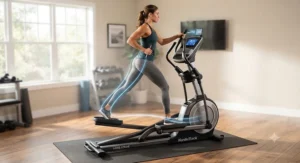
A long stride length elliptical is a cross-trainer whose foot pedals travel a path of roughly 20 inches or more at the widest point of the ellipse, compared to the 16-18 inch stride found on standard or compact machines. This longer arc lets taller users — generally those over 5’7″ — complete a fuller, more natural leg extension during each rotation, reducing the cramped, choppy feeling that comes from a stride too short for their gait.
The elliptical trainer itself dates back to the 1990s, when Precor first brought the design to market, and the motion is produced by a four-bar linkage mechanism where the pedals attach to a floating link that traces roughly an elliptical shape as it moves. Stride length is simply the size of that path, and matching it to your body is the single biggest factor in whether the machine feels natural or fights you the entire workout. For a deeper look at how the mechanism itself works, Wikipedia’s overview of the elliptical trainer covers the drive-type variations (rear, front, and center) referenced throughout this guide.
How to Choose the Right Stride Length for Your Height
Picking a stride length isn’t guesswork — it follows a fairly reliable relationship between height and comfortable range of motion. Here’s the expert-reasoned process:
- Measure your height honestly — stride comfort correlates with height more than any other single factor, so start here before looking at any specific product.
- Match the general bands — users under 5’3″ typically do best with 16-18 inches, those between 5’3″ and 5’7″ with 18-20 inches, and users above 5’7″ generally need 20-22 inches or more.
- Consider household variation — if multiple heights will share the machine, prioritize adjustable-stride models like the Sole E95S or NordicTrack FS14i over fixed-stride options.
- Check the drive type — front-drive machines (like the Sole E95) tend to handle incline better, while center-drive designs (like the FS14i) often deliver a more natural, less mechanical feel at longer strides.
- Weigh flywheel weight against stride length — a heavier flywheel smooths out a long stride’s natural momentum shifts, so don’t evaluate stride in isolation from the flywheel spec.
- Test the pedal angle adjustability — models with adjustable foot pedals, like the worm-drive system on Sole’s lineup, reduce numb-toe and Achilles strain regardless of your exact stride length.
- Budget for the full range you need, not just the average — if you’re 6’2″ and shopping the standard 20-inch machines, confirm the specific stride number rather than assuming “long stride” always means the same thing across brands.
Elliptical with 20 Inch Stride vs Shorter Machines
The 20-inch stride has become something of an industry standard for a reason: it’s the point at which most adults between roughly 5’4″ and 6’5″ report a genuinely comfortable, natural-feeling motion, according to multiple manufacturer and reviewer height-to-stride charts. Below that, in the 16-18 inch range common on budget and compact machines, taller users consistently describe the sensation as cramped or “marching in place” rather than striding.
The practical difference shows up most clearly in joint strain. An elliptical with 20 inch stride length gives a 6’0″ user’s leg enough room to complete a natural arc, distributing effort evenly through the hip, knee, and ankle. Force that same user onto a 16-inch machine, and the leg either overcompensates with more hip flexion than it wants, or the user simply shortens their natural gait to match the machine — neither of which feels good after 30 minutes. On the flip side, someone under 5’3″ forcing themselves onto a 22-24 inch machine (like the top end of the Sole E95S‘s range) risks overstretching, which carries its own injury profile. The lesson holds across every product on this list: bigger isn’t universally better, matched is better.
Natural Gait Elliptical Motion: What the Biomechanics Say
“Natural gait” gets thrown around a lot in elliptical marketing, but there’s real biomechanical research behind why stride length specifically affects how natural the motion feels. Elliptical exercise constrains the feet to follow a fixed elliptical trajectory, and research presented through the International Society of Biomechanics in Sports has specifically examined how different step lengths change lower-limb joint loading during elliptical exercise, since a mismatched step length can produce exactly the kind of disadvantageous joint loads and overuse patterns that a well-fitted long stride length elliptical is designed to avoid.
What this means in practice: proper stride selection isn’t just about comfort in the moment, it’s about the joint forces accumulating over hundreds of repetitions per workout, thousands per month. A stride that’s even a couple inches short of ideal for your height forces a lower-limb compensation pattern that most people won’t consciously notice — until it shows up as knee or hip discomfort weeks later. This is exactly why models like the Sole E95S and NordicTrack FS14i build in stride adjustability rather than treating one universal length as sufficient for every body.
Ready to move like your body actually intends to? Explore the long-stride picks above and find your match. ✨
Stride Adjustment Fitness Machines: Are They Worth the Premium?
Adjustable-stride machines carry a real price premium — often $700 to $1,000 more than a comparable fixed-stride model from the same brand, as seen comparing the Sole E95 to the Sole E95S. Whether that premium is worth paying comes down almost entirely to how many different bodies will use the machine.
For a single user of a known, stable height, a stride adjustment fitness machine is largely paying for flexibility you won’t use — a fixed 20-inch stride like the Schwinn 470 or Nautilus E614 delivers the same comfortable motion for a fraction of the cost. But for households with a genuine height spread, or for anyone recovering from injury who needs to shorten their stride temporarily before working back up to a longer range, the adjustability on the Sole E95S or the extreme 0-32 inch range on the NordicTrack FS14i earns its keep fast. The honest analysis here: buy adjustability because you need it, not because it sounds impressive on a spec sheet.
Ergonomic Pedal Path Elliptical: Why Foot Angle Matters As Much As Stride
Stride length gets most of the attention, but the ergonomic pedal path — meaning how the footplate tilts and angles through the rotation — deserves nearly equal billing. A machine can have a perfect 20-inch stride and still cause discomfort if the pedals sit at a fixed, unnatural angle throughout the motion.
This is precisely the problem Sole’s worm-drive pedal adjustment addresses on the Sole E95 and Sole E95S, letting users dial the footplate angle through multiple positions to reduce the numb-toe and sore-Achilles complaints common on fixed-pedal machines. Similarly, the Schwinn 470‘s Precision Path technology and the Nautilus E614‘s articulating footplates are both attempts to solve the same underlying problem: a straight stride length number tells you the distance traveled, but not the comfort of the path taken to get there. When comparing machines, ask specifically whether pedals are fixed or adjustable — it’s a smaller line item on most spec sheets than stride length, but it affects comfort just as directly.
Common Mistakes When Buying a Long Stride Elliptical
The most frequent mistake is buying based on stride length alone without checking flywheel weight — a long stride paired with a light flywheel can feel jerky rather than smooth, since there’s less rotational momentum carrying you through each phase of the motion. The second common error is skipping measurements of your actual workout space; machines like the NordicTrack FS14i need meaningfully more floor and ceiling clearance than their boxed dimensions suggest once the full 32-inch stride is in use. Third, buyers frequently assume “adjustable stride” and “adjustable incline” are the same feature — they’re not, and the Sole E95S specifically sacrifices incline to gain stride adjustability, a tradeoff worth understanding before purchase. Finally, many buyers underestimate assembly complexity; multiple models on this list, including the Schwinn 470 and the Sole E25, have documented reports of lengthy assembly times or missing hardware, so budget an afternoon rather than an hour.
Long-Term Cost & Maintenance
Total cost of ownership extends well past the sticker price. Budget machines like the Nautilus E614 and Yosuda EM1 carry lower upfront costs but may require part replacement sooner if usage is heavy and daily, based on aggregated reports of lighter-gauge frame components at this price tier. Mid-range and premium machines like the Schwinn 470 and Sole E95 generally carry stronger multi-year frame warranties (often 10 years on the frame itself), reflecting heavier-duty construction meant to survive years of daily use without major part swaps.
Subscription costs matter too — the NordicTrack FS14i‘s full feature set depends on an ongoing iFit membership beyond its included trial period, which adds a genuine recurring cost that pure hardware pricing doesn’t reflect. When calculating true value, factor in warranty length, expected part-replacement frequency based on your usage volume, and any required software subscriptions, not just the number on the price tag.
Safety and Joint Health Guide
Choosing the right stride length isn’t just about comfort — it’s genuinely a joint-health decision. According to guidance from the Mayo Clinic, low-impact activities such as elliptical trainer workouts are specifically recommended for people managing arthritis or joint sensitivity, since they reduce stress on the hips, knees, and ankles compared to higher-impact cardio. You can review that Mayo Clinic guidance on low-impact exercise for arthritis directly for more detail on which activities are generally recommended.
If you’re returning from injury or managing a chronic joint condition, start on the shorter end of any adjustable stride range and lengthen gradually, and consider a fixed 20-inch machine over an extreme-range model like the FS14i until you’ve confirmed your comfortable ceiling. For general aerobic health guidance while using any of these machines, the CDC’s physical activity guidelines for adults recommend at least 150 minutes of moderate-intensity aerobic activity per week — a target any of the seven ellipticals above can help you hit comfortably.
Frequently Asked Questions
❓ What stride length is best for a 6-foot person?
❓ Can a stride length be too long?
❓ Is a longer stride length always better for weight loss?
❓ What's the difference between fixed and adjustable stride ellipticals?
❓ Do long stride ellipticals take up more space than regular ones?
Conclusion
Stride length is one of those specs that sounds like a minor technical detail until you’re the one gritting your teeth through a cramped, mechanical-feeling workout. The good news is that the fix is straightforward: match the machine to your actual height and household, not to whichever number sounds most impressive in an ad. For a single tall user chasing durability, the Sole E95 delivers a heavy-duty 20-inch stride built to last. For mixed-height households, the Sole E95S or the genuinely remarkable NordicTrack FS14i earn their premium price tags. And if floor space is your real constraint, the Yosuda EM1 proves a long stride doesn’t require a long room.
Whichever machine you land on, the underlying principle from the biomechanics research holds true across every price point on this list: a stride that fits your body reduces joint strain, feels more natural, and — critically — is the version of the workout you’ll actually stick with for years, not weeks.
✨ Don’t Miss These Exclusive Deals!
🔍 Take your home cardio setup to the next level with these carefully selected long stride length elliptical picks. Click on any highlighted model to check current pricing and availability. The right stride fit could be the difference between a machine you use daily and one gathering dust by spring!
Recommended for You
- Best Elliptical for People Over 6 Feet: 7 Tall-Frame Picks (2026)
- Best Elliptical for Tall Person: 7 Top Picks for 2026
- Best Elliptical for Weight Loss: 7 Top Picks Tested for 2026
Disclaimer: This article contains affiliate links. As an Amazon Associate, I earn from qualifying purchases. If you purchase products through these links, we may earn a small commission at no additional cost to you.
✨ Found this helpful? Share it with your friends! 💬🤗
