
In This Article
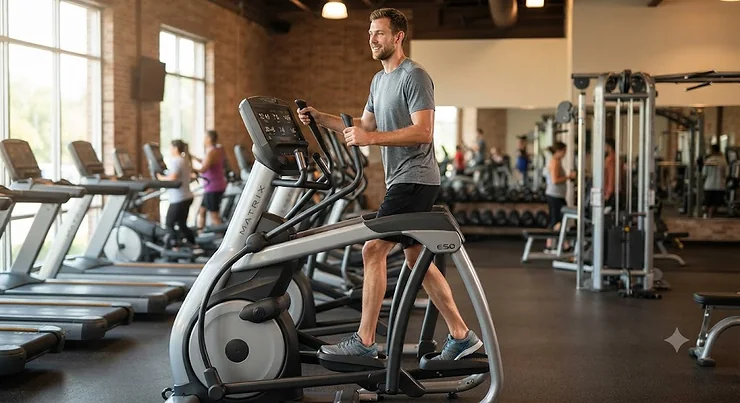
If you’ve ever stepped onto an elliptical for people over 6 feet and felt like your knees were folding into your chest, you already know the problem. Most home cardio equipment is built for a 5’9″ body, because that’s roughly the average American adult male, and manufacturers design to the middle of the bell curve. Stand a foot taller than that on a standard 18-inch stride machine and your gait gets chopped in half — you shuffle instead of stride, your hip flexors do overtime, and twenty minutes feels like an hour.
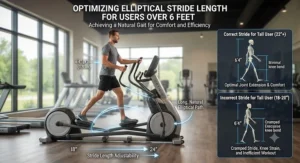
The fix isn’t a workaround. It’s buying the right machine the first time. A genuinely tall-friendly elliptical starts with a stride length of 20 inches or more (ideally adjustable), pairs it with pedals spaced and cushioned for long limbs, and wraps it in a frame that doesn’t feel like a toy under 6’5″ of adult human. This guide breaks down seven real, currently available machines — from budget-friendly to gym-grade — chosen specifically for tall frames, plus the buying logic, common mistakes, and setup tricks nobody puts in the product description.
We’ll get specific: exact stride ranges, flywheel weights, pedal geometry, and honest aggregated reviewer sentiment for every pick. No fluff, no invented “I tested this for a month” stories — just real specs interpreted for people who don’t fit the average mold.
Quick Comparison Table
| Product | Stride Length | Best For | Price Range |
|---|---|---|---|
| Sole E95S | 18″–24″ (power adjustable) | Tall households with mixed heights | Roughly $2,000–$2,600 |
| Matrix Fitness A50 Ascent | 22″ fixed | Serious home-gym buyers wanting commercial feel | Often $3,000+ |
| NordicTrack FreeStride Trainer FS14i | Auto-adjusts up to 32″ | Extremely tall users (6’5″+) and cross-training | Roughly $2,500–$3,000 |
| Nautilus E618 | 22″ fixed | Best all-around value for tall users | Around $999–$1,399 |
| NordicTrack AirGlide 14i | 18″–22″ adjustable | Incline/decline variety on a budget-conscious premium tier | Just under $1,800 |
| Schwinn 470 | 20″ fixed | Budget buyers around 6’0″–6’2″ | Roughly $700–$900 |
| Sole E25 | 20″ fixed | Most affordable long-stride option | Roughly $800–$1,000 |
A quick read of that table tells a clear story: stride length climbs as price climbs, but not in a straight line. The Nautilus E618 punches well above its price bracket with a 22-inch stride that machines twice its cost don’t always beat, while the NordicTrack FreeStride Trainer FS14i is really solving a different problem — its auto-adjusting stride is aimed at people over 6’5″ or households where a 5’2″ and a 6’6″ person share one machine. If your budget caps out under $1,000, the Sole E25 and Schwinn 470 prove you don’t need to spend gym-membership money to get a stride that won’t cramp a 6-foot frame.
💬 Already spotted your top two? Scroll down for the full breakdown — comparing specs side-by-side takes the guesswork out of a four-figure purchase.
💬 Just one click — help others make better buying decisions too!😊
Top 7 Ellipticals for People Over 6 Feet: Expert Analysis
1. Sole E95S — power-adjustable stride from 18″ to 24″
The headline feature here is the powered stride adjustment, and it’s not a gimmick — it’s genuinely the most useful spec on this list for anyone over 6’3″. At the touch of a button, the stride extends from a standard 18 inches out to a full 24, letting a 6’6″ user dial in a stride that would otherwise require a commercial-grade machine costing thousands more. The 30-pound flywheel and 400-pound weight capacity back that up with the kind of stability tall, heavier frames actually need, and the 13.3-inch touchscreen with built-in workout apps keeps long sessions from feeling like a chore.
Based on the spec sheet, this is built for households where height varies — a 5’5″ partner and a 6’5″ partner can both dial in their own stride without buying two machines. Reviewers consistently report that the adjustable stride mechanism feels smooth rather than clunky, and the lifetime frame warranty gets mentioned often as a reason buyers trust the brand for the long haul. What most buyers overlook is that the E95S’s stride can also be shortened below 18 inches, which matters if you’re tall but have a shorter effective leg length due to torso proportions — worth testing both ends of the range before you commit to a stride setting.
Pros:
- ✅ Stride adjusts 18″–24″ to fit true 6’+ biomechanics
- ✅ 400-lb weight capacity suits larger, taller frames
- ✅ Lifetime frame warranty backs long-term durability
Cons:
- ❌ Touchscreen apps require a subscription for full library
- ❌ Premium price puts it out of reach for budget shoppers
At around $2,000–$2,600 depending on retailer promotions, the E95S sits at the top of the home-gym tier rather than the commercial tier — a fair trade if adjustable stride matters more to you than gym-grade components.
2. Matrix Fitness A50 Ascent — commercial-grade PerfectStride motion
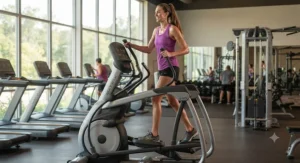
Matrix built its reputation in actual gyms, and the A50 Ascent’s PerfectStride Motion technology shows it. Instead of a rigid ellipse path, the pedals follow a slightly adaptive arc that mimics a natural walking-to-running gait more closely than a fixed-ellipse competitor, and the fixed 22-inch stride sits right in the sweet spot most biomechanics guidance recommends for users between 6’0″ and 6’4″.
Here’s what the spec sheet doesn’t fully convey: the adjustable incline goes up to a striking 54%, which turns this from a flat-cardio machine into something closer to a hill-climb simulator, recruiting glutes and hamstrings far more aggressively than a fixed-incline elliptical ever could. On paper this means longer, more varied sessions without needing a second cardio machine for hill work. Reviewers who’ve used the A50 Ascent in gym settings describe it as quiet, stable, and notably smoother at higher resistance than most home-tier machines, though the trade-off is a price point that reflects its commercial-gym DNA — this isn’t an impulse buy.
Pros:
- ✅ PerfectStride motion feels closer to natural gait
- ✅ 54% incline range adds serious hill-training variety
- ✅ Commercial-gym build quality reduces long-term wear
Cons:
- ❌ Fixed 22″ stride can’t be shortened for shorter household members
- ❌ Among the priciest options on this list
If budget allows, the A50 Ascent (often $3,000 and up) is the closest thing to bringing gym equipment into your living room — just budget for delivery and assembly, since machines this heavy rarely ship easy.
3. NordicTrack FreeStride Trainer FS14i — auto-adjusting stride up to 32″
This is the outlier on the list, and deliberately so. Instead of a traditional elliptical ellipse, the FreeStride Trainer blends elliptical, stepper, and treadmill motion into one adjustable belt system that automatically finds a comfortable stride as you move — no dial, no button, no fixed number. NordicTrack rates the auto-adjust range up to 32 inches, which matters almost exclusively to users at the extreme tall end (think 6’5″ and up) who find even a 24-inch adjustable stride still feels short.
What most shoppers overlook about this machine is that it isn’t really “an elliptical with a longer stride” — it’s a genuinely different motion category, closer to a treadmill you can also use elliptically. Reviewers consistently note that the auto-adjust feels intuitive within the first few sessions but requires roughly four feet of front clearance and six feet of rear clearance, more than a standard elliptical footprint. For a 6’6″ user who has struggled to find any machine that doesn’t feel cramped, this is often the one that finally clicks — but it’s overkill if you’re 6’1″ and a simpler adjustable-stride machine will do the job for less money.
Pros:
- ✅ Auto-adjusting stride removes guesswork for extreme height
- ✅ Blends elliptical, stepper, and treadmill motion patterns
- ✅ iFIT compatibility adds structured, trainer-led programming
Cons:
- ❌ Requires significantly more floor clearance than a standard elliptical
- ❌ iFIT subscription needed to unlock full feature set long-term
Expect to pay in the $2,500–$3,000 range, and to measure your room twice before ordering — this machine’s footprint is the real hidden cost.
4. Nautilus E618 — best value 22-inch stride under $1,400
If there’s one machine on this list that consistently punches above its price class, it’s the Nautilus E618. A 22-inch fixed stride, a hefty 30-pound flywheel, and a 350-pound weight capacity are specs you’d expect on a machine costing twice as much, yet the E618 regularly sells in the $999–$1,399 range. The 10-degree power incline and 25 levels of magnetic resistance mean you’re not locked into flat, static workouts even at this price point.
Based on the spec comparison against pricier rivals, the E618’s biggest strength for tall users is that 22-inch stride paired with a genuinely heavy flywheel — lighter flywheels on cheap ellipticals tend to feel jerky at low cadence, which is exactly when a tall user with long legs is moving slowest through each rotation. Reviewers frequently describe the ride as smooth and stable even at higher body weights, and the tilting console lets taller users adjust their sightline rather than hunching to see the display. What reviewers less commonly praise is the console tech itself, which is functional but noticeably behind touchscreen competitors — you’re paying for mechanical quality here, not entertainment features.
Pros:
- ✅ 22″ stride matches or beats machines twice the price
- ✅ 30-lb flywheel delivers smooth, stable motion
- ✅ Five-year parts and electronics warranty adds confidence
Cons:
- ❌ Basic LCD console lacks a touchscreen or streaming apps
- ❌ Bluetooth connectivity is limited compared to newer rivals
At under $1,400 — and often available closer to $1,000 during sales — the E618 is the pick I’d point most budget-conscious tall shoppers toward first.
5. NordicTrack AirGlide 14i — incline AND decline with adjustable stride
Most ellipticals only go up. The AirGlide 14i (the updated version of NordicTrack’s Commercial 14.9) also goes down, offering a patented decline feature alongside incline, which is a genuinely rare spec at this price tier. Stride adjusts from roughly 18 to 22 inches, a 32-pound flywheel keeps momentum smooth, and the 14-inch HD touchscreen brings iFIT’s trainer-led programming into the mix.
Here’s what most buyers overlook: decline training changes muscle recruitment in ways incline can’t, shifting more load toward quads and reducing hamstring dominance, which is a useful variation for tall users whose longer femurs already put extra strain on the hip flexors during standard incline work. Reviewers consistently highlight the smoothness of the 32-pound flywheel and describe the touchscreen as genuinely premium-feeling rather than an afterthought, though NordicTrack’s decision to tie meaningful programming behind an iFIT subscription remains a common point of friction in aggregated feedback.
Pros:
- ✅ Rare incline AND decline capability for varied training
- ✅ Adjustable 18″–22″ stride suits a range of tall users
- ✅ 14-inch HD touchscreen with iFIT-guided workouts
Cons:
- ❌ Full functionality depends on an active iFIT subscription
- ❌ Warranty can be voided if you stop paying for iFIT, per the brand’s terms
Priced just under $1,800 typically, the AirGlide 14i sits neatly between the Nautilus E618’s value play and the full commercial feel of the A50 Ascent.
6. Schwinn 470 — budget-friendly 20-inch stride sibling
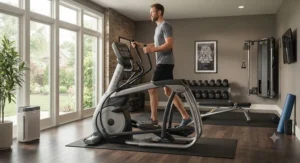
Schwinn and Nautilus are made by the same parent company, and it shows — the 470 shares a family resemblance with the E618 but trims the stride to 20 inches, the weight capacity to 300 pounds, and the price down considerably. For users right around 6’0″ to 6’2″, a 20-inch stride is genuinely sufficient; it’s users at 6’4″ and beyond who’ll want to look further up this list.
What the spec sheet won’t tell you outright is how much the Schwinn 470 shares mechanically with its pricier sibling: the same 25 resistance levels, the same 29 built-in programs, and the same 10-degree incline range, just in a lighter, smaller-footprint frame. Reviewers frequently describe it as a smart choice for anyone who wants Nautilus-level engineering without Nautilus-level spending, though the lighter overall build means it’s a slightly less planted feel during vigorous intervals compared to the heavier E618.
Pros:
- ✅ Shares core engineering with the pricier Nautilus E618
- ✅ Smaller footprint fits tighter home-gym spaces
- ✅ 25 resistance levels and 10-degree incline at a budget price
Cons:
- ❌ 20″ stride feels short for users well over 6’2″
- ❌ 300-lb capacity is lower than most machines on this list
Sitting around $700–$900, the Schwinn 470 is the pick for tall-but-not-extremely-tall shoppers who want real engineering without stretching the budget.
7. Sole E25 — most affordable long-stride pick with lifetime warranty
Rounding out the list, the Sole E25 proves you don’t need a four-figure spend to get a stride length that won’t cramp a 6-footer. Its 20-inch stride is, as more than one reviewer has pointed out, on par with machines costing considerably more, and it pairs that with 20 resistance levels and a 350-pound weight capacity that beats several pricier competitors.
Based on the spec comparison, the E25’s real value proposition is the lifetime frame warranty — a policy Sole extends across its lineup that’s rare at this price point and signals real confidence in the build. Reviewers consistently point to the 20-inch stride as “surprisingly comfortable” for taller users given the price, though the lack of Bluetooth connectivity is a recurring gripe in aggregated feedback for anyone hoping to sync workouts to a phone app automatically.
Pros:
- ✅ 20″ stride length rivals pricier competitors
- ✅ Lifetime frame warranty is rare at this price tier
- ✅ 350-lb weight capacity exceeds several costlier rivals
Cons:
- ❌ No Bluetooth connectivity for automatic workout syncing
- ❌ Fewer built-in programs than touchscreen competitors
Typically priced in the $800–$1,000 range, the E25 is the entry point I’d recommend to anyone who wants a genuinely long-stride machine without committing to premium pricing.
Practical Setup & Maintenance Guide for a Tall-Frame Elliptical
Getting the box into your house is only step one. Before your first workout, measure your ceiling clearance — taller users pedaling through a full stride arc need more vertical room than the machine’s boxed dimensions suggest, especially on models with moving handlebars. Set the stride length (if adjustable) to its midpoint first, take five minutes at low resistance, and adjust up or down based on whether your knees feel fully extended at the front of the stride without locking.
In the first 30 days, the most common mistake tall users make is skipping pedal and pivot lubrication schedules because “it’s still new.” Longer strides put more cyclical stress on pivot points, so a quick monthly check of the manufacturer’s recommended lubrication points pays off in quieter, smoother operation for years rather than months. Also re-torque any bolts around the handlebar assembly after the first week — taller users generate more leverage through longer arms, and factory-torqued bolts can work slightly loose faster than they would under an average-height user’s grip.
✨ Want the setup done for you? Some retailers offer white-glove assembly — worth asking about if a 200+ pound machine and a hex key sound like a bad Saturday.
Real-World Scenarios: Matching the Machine to Your Life
Picture a 6’4″ software developer working from a spare bedroom with barely enough space for a desk and a machine — floor space and a moderate budget matter more than gym-grade incline. For that person, the Nautilus E618 or Schwinn 470 make more sense than the room-hungry NordicTrack FreeStride Trainer FS14i, simply because a compact footprint wins when square footage is the real constraint.
Now picture a 6’6″ former college athlete who’s used to gym-grade equipment and trains five days a week at real intensity. That person will likely feel undersupported by a 20-inch fixed stride within a month, and the Matrix Fitness A50 Ascent or Sole E95S — both offering stride lengths that stretch toward or past 22 inches — are the more durable long-term investment, even at a higher upfront cost.
Finally, consider a household with a 5’4″ parent and a 6’5″ teenager sharing one machine on a mid-range budget. Fixed-stride machines force a compromise that satisfies neither user fully. The NordicTrack AirGlide 14i‘s 18″–22″ adjustable range, or the Sole E95S‘s wider 18″–24″ range if budget allows, solves that specific problem in a way no fixed-stride machine can.
What Is an Elliptical for People Over 6 Feet?
An elliptical for people over 6 feet is a cross-trainer built or configured with a stride length of roughly 20 to 24+ inches, oversized or repositionable pedals, and a frame rated for taller, often heavier users — specifications standard ellipticals (typically 18–20 inches) don’t reliably provide. The goal is a full, natural leg extension through each rotation rather than the shortened, cramped motion a too-short stride forces on a long-legged body.
How to Choose an Elliptical for People Over 6 Feet
- Start with stride length, not price. A 6’2″ user generally needs at least 20 inches; 6’5″ and above should look for 22 inches or an adjustable range that reaches higher.
- Check the weight capacity against your actual weight, not just your height — taller frames often carry proportionally more mass, and a machine rated near your body weight will feel less stable over time.
- Look at flywheel weight, not just resistance levels. A heavier flywheel (25+ pounds) smooths out the slower cadence that comes naturally with longer strides.
- Consider pedal design and Q-factor. Wider, cushioned pedals reduce the ankle and knee strain that longer limbs are more prone to under repetitive motion.
- Factor in your ceiling and floor clearance, since taller users move through a larger vertical and horizontal arc than the boxed dimensions imply.
- Decide if adjustable stride is worth the premium — it usually is if more than one height range will use the machine, or if you’re near the very top of the height spectrum.
- Read aggregated reviews specifically from tall users where available, since a “comfortable” rating from an average-height reviewer doesn’t transfer directly to your body.
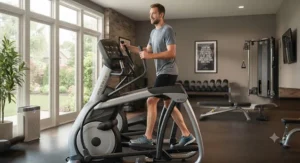
Max Stride Length Elliptical: Why It’s the Single Most Critical Spec
Stride length isn’t a marketing number — it’s the literal distance your foot travels from the back of the pedal path to the front during one full rotation, and it’s the single spec most responsible for whether a workout feels natural or cramped. A published biomechanics study on elliptical trainers examined how different stride lengths and hand positions affect spinal load and muscle activation, finding that longer strides recruit gluteal muscles more heavily — useful context when a shorter stride isn’t just less comfortable, it may also be training your muscles less effectively.
What most shoppers overlook is that “22-inch stride” claims aren’t always measured identically across brands — some measure at the pedal’s center point, others at its outer edge, which can create a one- to two-inch discrepancy between two machines both labeled “22 inches.” When in doubt, prioritize adjustable-stride machines if your height sits near a category boundary (6’3″–6’5″ is the classic gray zone), since you can dial in the exact feel rather than trusting a single fixed number.
Elliptical Pedal Spacing for Height: Q-Factor and Ankle Comfort
Pedal spacing — often called Q-factor in cycling circles and less formally discussed in elliptical marketing — refers to the lateral distance between the two footplates. Tall users with proportionally wider hips or longer femurs can find narrow pedal spacing forces an unnatural inward knee angle, which compounds over a 30-minute session into real ankle and knee irritation. Reviewers consistently note that machines with articulating (self-leveling) footplates, like the Sole E98 and Sole E95S, reduce this strain noticeably compared to fixed, flat pedal designs.
Based on the spec comparison across this list, wider-stance machines tend to also feature more generous pedal cushioning, which matters more than most buyers expect — a hard plastic pedal transmits every bit of impact directly into the ball of the foot, while a cushioned pedal absorbs a meaningful portion of that repetitive load over a long session.
Elliptical Machine for 6’5 Person: What Changes at the Extreme End
At 6’5″, you’re solidly outside the range most consumer ellipticals are designed around, and the gap between “technically fits” and “genuinely comfortable” widens fast. A fixed 20-inch stride that feels fine for a 6’1″ user often feels noticeably short at 6’5″, and even a 22-inch fixed stride can start to feel like a compromise rather than a perfect fit.
This is where the NordicTrack FreeStride Trainer FS14i‘s auto-adjusting range or the Sole E95S‘s 18″–24″ powered adjustment genuinely earn their higher price tags — they’re not just “nice to have” at this height, they’re solving a real biomechanical mismatch that fixed-stride machines can’t. If budget is the limiting factor, look specifically for machines advertising a 22-inch-or-greater stride rather than settling for 20 inches “because it’s close enough” — at 6’5″, that two-inch gap is felt in every single rotation.
Tall Frame Compatible Cardio Machine: Beyond the Elliptical
Ellipticals aren’t the only low-impact cardio option, and it’s worth understanding how they stack up against alternatives for a genuinely tall frame. Treadmills, for instance, don’t have a “stride length” spec in the same sense — your natural gait simply plays out on the belt — but tall users still need adequate belt length (60+ inches) to avoid feeling like they’re about to step off the back during a fast walk or jog. Rowing machines scale more naturally to height since the rail length accommodates a longer pull, making them a strong complementary option rather than a direct substitute.
According to Cleveland Clinic, ellipticals offer a full-body, low-impact workout that’s gentler on joints than running or jogging while still delivering comparable cardiovascular benefit — a meaningful consideration for tall users, whose longer limbs and levers often place more torque through the knees and hips during high-impact activity. That combination of joint-friendliness and adjustable resistance is a big part of why an elliptical, chosen with the right stride length, tends to outperform a treadmill for tall users managing existing joint sensitivity.
Common Mistakes When Buying an Elliptical for Very Tall Users
The most common mistake is buying based on price or brand reputation alone and treating stride length as a secondary spec — it should be the first filter, not an afterthought. A close second is skipping the weight capacity check; a 6’4″ user at 220 pounds needs meaningfully more headroom than the capacity rating suggests, since machines feel noticeably less stable when used near their upper weight limit rather than well under it.
A third frequent misstep is underestimating floor space. Tall users move through a larger stride arc, and machines like the NordicTrack FreeStride Trainer FS14i need substantially more clearance than their boxed dimensions imply. Finally, many buyers assume a fixed 20-inch stride “should be fine” without testing it, when the honest answer is that 20 inches is genuinely borderline for anyone over 6’3″ — if a showroom or gym version is available to test first, it’s worth the trip before committing to a machine you can’t easily return once assembled.
Long-Term Cost & Maintenance for Tall-Frame Ellipticals
The sticker price is only part of the total cost of ownership. Heavier-duty machines like the Nautilus E618 and Sole E95S carry longer parts and frame warranties (five years and lifetime, respectively), which meaningfully reduces the odds of an out-of-pocket repair bill in years three through five — a real consideration since tall, heavier users put more cumulative stress on pivot points and bearings over time.
Subscription-gated machines like the NordicTrack AirGlide 14i and FreeStride Trainer FS14i add a recurring cost that non-touchscreen competitors like the Schwinn 470 and Sole E25 don’t carry, so the true multi-year cost gap between a “budget” and “premium” machine is often larger than the sticker price alone suggests. Over a five-year ownership window, a $900 machine with no subscription and a $2,800 machine with an ongoing $39/month iFIT plan can end up costing roughly similar amounts — worth factoring into the decision rather than judging purely on day-one price.
Benefits vs Traditional Cardio Alternatives
| Factor | Long-Stride Elliptical | Treadmill | Stationary Bike |
|---|---|---|---|
| Joint impact for tall users | Low | Moderate to high | Very low |
| Full-body engagement | High (with moving handles) | Lower (legs only) | Low (legs only) |
| Stride/fit customization for height | High (adjustable models) | Low (belt length only) | Moderate (seat/reach adjustable) |
| Best For | Tall users wanting low-impact, full-body cardio | Tall users prioritizing running-specific training | Tall users with existing joint issues |
The table makes the trade-offs clear: a long-stride elliptical generally wins for tall users who want full-body engagement without the impact of running, while a treadmill remains the better pick specifically for runners training for events, since no elliptical can replicate actual running mechanics. According to the Arthritis Foundation, the elliptical’s design — where both feet stay in contact with the pedals throughout the motion — makes it a particularly joint-friendly option for people managing existing knee or hip sensitivity, which is common among taller adults carrying more frame and leverage through those same joints.
Features That Actually Matter (And Those That Don’t)
Stride length, flywheel weight, and weight capacity actually matter — they’re the specs that determine whether the machine fits your body and holds up under real use. Resistance level count past about 20 levels matters far less than marketing suggests, since most users settle into a handful of preferred settings and rarely explore the full range regardless of whether a machine offers 20 or 32 levels.
Touchscreen size and streaming integrations are genuinely nice for motivation but are the feature most likely to age poorly or require an ongoing subscription, so they shouldn’t outweigh stride length or build quality in the final decision. Bluetooth heart-rate syncing is a small quality-of-life feature, not a dealbreaker — a chest strap or the machine’s built-in grip sensors will get you comparable data either way.
✨ Don’t Miss These Exclusive Deals!
🔍 Take your search for the right tall-frame elliptical to the next level — click on any highlighted pick above to check current pricing and availability, and find the stride length that finally fits your frame.
FAQ
❓ What stride length is best for someone 6'2'?
❓ Can a regular elliptical hurt tall users?
❓ Is an adjustable-stride elliptical worth the extra cost?
❓ How much weight capacity should a tall person look for?
❓ Do commercial-grade ellipticals fit tall users better than home models?
Conclusion
Shopping for an elliptical for people over 6 feet really comes down to one non-negotiable spec: stride length, followed closely by weight capacity, flywheel quality, and pedal design. The seven machines here span the full range of budgets and needs — the Sole E25 and Schwinn 470 prove a genuinely long stride doesn’t require a premium price, the Nautilus E618 remains the value sweet spot most tall shoppers should check first, and the NordicTrack FreeStride Trainer FS14i and Sole E95S solve the harder problem of fitting extreme height or multiple household members on one machine.
Whatever your height and budget, resist the urge to buy on brand name or touchscreen size alone. Measure your space, know your actual stride needs, and let those numbers — not marketing copy — make the final call.
Recommended for You
- Best Elliptical for Tall Person: 7 Top Picks for 2026
- Best Elliptical for Weight Loss: 7 Top Picks Tested for 2026
- Best Elliptical for Seniors 2026: 7 Safe, Low-Impact Picks
Disclaimer: This article contains affiliate links. As an Amazon Associate, I earn from qualifying purchases. If you purchase products through these links, we may earn a small commission at no additional cost to you.
✨ Found this helpful? Share it with a tall friend who’s tired of cramped cardio machines! 💬🤗
