
In This Article
There’s a very specific kind of dread that comes with living on the third floor and owning a treadmill. It’s the mental math you do every time you step onto the belt at 6 a.m. — is this going to wake up the guy below me? That thumping isn’t your imagination, and it isn’t really about how loud the motor is, either. What is an anti-vibration mat for treadmill in upstairs apartment use, exactly? It’s a dense rubber, vinyl, or foam pad placed beneath the machine that absorbs impact energy and motor vibration before it can travel into the subfloor and radiate as noise in the unit below.
The physics here matter more than most shoppers realize. Environmental noise from sources like foot traffic and mechanical equipment has been linked to negative health outcomes including sleep disturbances and poor mental health, so a stomping treadmill overhead isn’t just an annoyance — it’s a legitimate quality-of-life issue for your downstairs neighbors, which means it’s also a legitimate risk to your lease. We dug into seven real, currently available mats — from dense commercial vinyl to interlocking foam tiles — and broke down what actually dampens vibration versus what just protects your floor from scuffs. Stick around, because the difference between those two things is where most people waste their money.
Quick Comparison Table: Best Anti-Vibration Mats at a Glance
| Product | Material | Thickness | Best For |
|---|---|---|---|
| SuperMats Heavy Duty Commercial Vinyl | Solid vinyl | ~1/8″ | Best overall stability for heavier treadmills |
| Rubber-Cal Treadmill Mat | 100% recycled rubber | 3/16″ | Best pure vibration dampening |
| Second Skin Stomp Mat | Recycled rubber isolation pad | 1/4″–1/2″ | Serious noise isolation in upstairs units |
| BalanceFrom GoFit High Density Mat | High-density PVC | 1/4″ | Best budget full-size mat |
| ProsourceFit Extra Thick Puzzle Tiles | EVA foam, interlocking | 1″ | Custom-fit rooms and multipurpose gyms |
| Impresa Rubber Floor Protectors | Solid rubber pucks | 0.5″ | Minimalist foot-pad setup |
| BestXD Treadmill Mat Pads | High-density rubber squares | 0.5″ | Lightest footprint for tiny apartments |
Looking at the spread above, there’s a clear split between full-platform mats — the SuperMats Heavy Duty Commercial Vinyl, Rubber-Cal Treadmill Mat, Second Skin Stomp Mat, BalanceFrom GoFit High Density Mat, and ProsourceFit Extra Thick Puzzle Tiles — and point-load foot pads like the Impresa Rubber Floor Protectors and BestXD Treadmill Mat Pads. Full mats generally win on vibration dampening because they spread motor energy across a wider surface area, while foot pads win on cost and storage in genuinely tiny apartments. If your downstairs neighbor has already knocked once, skip straight to the thicker rubber options — thin vinyl alone won’t cut it.
💬 Already dealing with a noise complaint? Skip to the Second Skin Stomp Mat below — it’s the one purpose-built for exactly that situation.
Top 7 Anti-Vibration Mats for Treadmill in Upstairs Apartment: Expert Analysis
1. SuperMats Heavy Duty Commercial Grade Solid Vinyl — most trusted commercial-grade build
The standout here is durability under real load, and SuperMats has been building this exact vinyl formulation since 1985. This model comes in sizes running up to 36″ x 102″ (Model #29GS), made from solid, phthalate-free vinyl composite designed for commercial and residential fitness floors alike.
Because the vinyl is a single dense sheet rather than a foam laminate, it won’t compress into permanent divots the way cheaper foam mats do under a 200-pound treadmill frame — that matters because a mat that develops a permanent dip actually starts transmitting more vibration to the floor, not less, since the machine is no longer sitting level. Based on the spec comparison, this mat is built more for stability and floor protection than for maximum acoustic isolation; it’s the right call if your primary worry is a shifting or wobbling treadmill rather than a downstairs noise complaint. Reviewers consistently note that it doesn’t curl at the edges and lies flat immediately out of the box, which isn’t true of every vinyl mat in this price range.
Pros:
- ✅ Solid vinyl construction resists permanent compression dents
- ✅ Made in the USA with non-toxic, phthalate-free materials
- ✅ Lies flat immediately, no curling at the corners
Cons:
- ❌ Thinner profile means less pure vibration absorption than rubber
- ❌ Heavier and bulkier to store when not in use
Expect to pay in the $50-$90 range depending on size, at the time of research — check current price before buying, since SuperMats offers several length options. For the money, it’s a strong value pick if floor protection and no-slip stability are your priority.
2. Rubber-Cal Treadmill Mat — best pure vibration dampening from recycled rubber
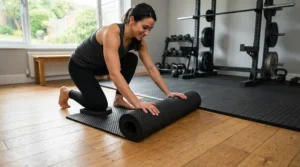
What most buyers overlook about this mat is the material science behind it: it’s made from 100% recycled tire rubber with a high EPDM content, which is the same elastomer used in industrial vibration-isolation mounts. That’s not marketing fluff — recycled rubber crumb has a naturally higher internal damping coefficient than vinyl or foam, meaning it converts more of the mechanical energy from your treadmill’s footfalls and motor into heat instead of passing it straight into your subfloor.
At 3/16″ thick and sized at 4ft x 6.5ft (or 4ft x 7.5ft for larger machines), the Rubber-Cal Treadmill Mat is thick enough to matter but not so bulky it dominates a small apartment gym corner. The spec sheet won’t tell you this, but user reports suggest the rubber odor common to recycled-rubber products fades within a week or two of unboxing and airing out — worth knowing if you’re sensitive to that “new tire” smell. This is the mat to choose if your building has hardwood or laminate over a wood-joist subfloor, since that construction type transmits impact noise more readily than concrete.
Pros:
- ✅ High EPDM rubber content offers genuine vibration damping
- ✅ Works well on both hardwood and outdoor-adjacent surfaces
- ✅ Doesn’t shift once the treadmill’s weight settles onto it
Cons:
- ❌ Initial rubber odor noticeable for the first week or two
- ❌ Heavier to maneuver during setup than foam alternatives
Priced in the $75-$90 range at the time of research, this sits solidly mid-pack — a reasonable premium over vinyl for a real jump in dampening performance.
3. Second Skin Stomp Mat — best for serious upstairs noise isolation
If you’ve already gotten a knock on the door, this is the mat built specifically for that conversation. The Stomp Mat comes from a company whose core business is automotive and home sound-deadening products, not fitness gear, and it shows: this is explicitly engineered as an impact-noise isolation pad, sold in 4ft x 6ft sheets in either 1/4″ or 1/2″ thickness.
Here’s what to weigh: the 1/2″ version is the recommended pick for anyone dealing with real vibration concerns or heavier equipment, since more mass and thickness directly translate to more absorbed impact energy before it reaches the floor joists. On paper this means the difference between “my neighbor can faintly hear I’m exercising” and “my neighbor has no idea I’m running.” The tradeoff is weight and price — the 1/2″ mat is noticeably heavier than anything else on this list and costs meaningfully more, which is the fair price of admission for genuine isolation performance rather than incremental noise reduction.
Pros:
- ✅ Purpose-built for impact-noise isolation, not just floor protection
- ✅ Available in 1/2″ thickness for serious vibration control
- ✅ Sticky-backed variant stays firmly pinned to any floor type
Cons:
- ❌ Noticeably more expensive than general-purpose treadmill mats
- ❌ The 1/2″ version is heavy and awkward to reposition alone
Expect pricing near the top of this list — around $150-$200 for the 1/2″ thickness, at the time of research. For someone in a genuinely noise-sensitive building, this is the mat that earns its premium.
4. BalanceFrom GoFit High Density Mat — best budget full-size mat
The standout feature here is simple: real floor coverage at a genuinely low price. The BalanceFrom GoFit High Density Mat (Model BFTM-01BLK) measures 3ft x 6.5ft and is built from high-density PVC roughly 1/4″ thick — enough to cover the full footprint of most folding and compact apartment treadmills in one piece.
Based on the spec comparison, this mat trades some of the density of dedicated rubber options for accessibility — it’s noticeably lighter and easier to roll up and stash in a closet, which matters if you’re in a studio apartment without a dedicated workout corner. Reviewers consistently report that it does a solid job absorbing everyday footfall vibration and motor hum, though it’s not marketed as an industrial isolation product the way the Second Skin Stomp Mat is. What most buyers overlook is that this is genuinely a multi-use mat — it doubles fine as a yoga or bodyweight-training surface on days you’re not on the treadmill, which is a real value-add for anyone tight on square footage.
Pros:
- ✅ Full 3×6.5ft coverage at a budget-friendly price point
- ✅ Lightweight enough to roll and store easily
- ✅ Doubles as a general floor-exercise mat
Cons:
- ❌ Thinner profile than dedicated rubber isolation mats
- ❌ Can develop slight curling at the edges over time
At around $30-$45 depending on the retailer, this is the mat to grab if your budget is the deciding factor and your treadmill is on the lighter, foldable side.
5. ProsourceFit Extra Thick Puzzle Tiles — most customizable interlocking setup
The standout advantage is flexibility: these are 24″ x 24″ interlocking EVA foam tiles, 1″ thick, sold in sets that scale from 24 up to 144 square feet of coverage. Unlike a fixed-size mat, you’re not stuck with a rectangle that may or may not match your treadmill’s actual footprint — you build the coverage area tile by tile, including bordered edge pieces for a finished look.
What the spec sheet won’t tell you, but reviewers note, is that the 1″ foam thickness genuinely outperforms thinner options for shock absorption underfoot, though EVA foam behaves differently from rubber under sustained point loads — it’s excellent at spreading impact energy from running strides but can compress slightly under a treadmill’s stationary feet over months of use. Reviewers consistently mention this as the most comfortable option if you’re doing bodyweight or floor work in the same space, which makes sense given ProsourceFit’s roots in general gym flooring rather than treadmill-specific mats. It’s the pick for anyone setting up a genuine multi-purpose home gym corner rather than a single-machine footprint.
Pros:
- ✅ Fully customizable to any room shape or equipment footprint
- ✅ 1″ foam thickness cushions joints during floor exercises too
- ✅ Interlocking tiles are simple to assemble and disassemble
Cons:
- ❌ Foam can compress under sustained point loads over time
- ❌ Less pure vibration damping than dense rubber for motor hum
Pricing lands around $40-$95 depending on coverage size, at the time of research — a reasonable range for the flexibility you’re buying into.
6. Impresa Rubber Floor Protectors — best minimalist foot-pad solution
Rather than a full mat, the Impresa Rubber Floor Protectors take the point-load approach: four individual 4″x4″x0.5″ solid rubber pucks, each placed under one foot or leg of the treadmill frame. The standout logic here is concentrated mass — because all the rubber’s damping capacity is focused directly under the treadmill’s actual contact points rather than spread across a large mat, you get meaningful vibration absorption exactly where the impact happens.
Here’s what to weigh: this approach genuinely shines in small apartments where a full-size mat simply won’t fit under furniture or in a tight room, and it’s also the easiest option to hide when guests come over. On the flip side, on paper this means you lose the floor-protection benefit for the space around the treadmill — sweat, dust, and belt debris that would normally land on a full mat instead lands directly on your floor. If you’re on carpet, that’s less of an issue; on hardwood, plan to vacuum more often.
Pros:
- ✅ Compact footprint fits tight apartment layouts
- ✅ Concentrates rubber damping directly at contact points
- ✅ Easiest option to store or hide when not needed
Cons:
- ❌ No floor coverage around the treadmill’s perimeter
- ❌ Less effective against airborne belt-motor noise than a full mat
At roughly $15-$25 for a set, this is one of the cheapest genuinely functional entries on this list.
7. BestXD Treadmill Mat Pads — lightest footprint for tiny apartments
Similar in concept to the Impresa pucks, the BestXD Treadmill Mat Pads are sold in sets of 4 or 6, each measuring roughly 3.94″ x 3.94″ x 0.5″, made from high-density rubber rated to support significant weight per pad. The standout feature is sheer minimalism — these are designed to disappear under the treadmill’s feet rather than announce themselves as gym equipment in your living room.
Based on the spec comparison, the six-pack configuration gives you more placement flexibility than a standard four-pad set, useful if your treadmill has an odd number of contact points or a wider stance than average. Reviewers consistently point out that these pads excel at stopping the “walking treadmill” problem — where a machine slowly creeps across the floor during use — because the rubber grips both the treadmill foot and the floor surface simultaneously. What most buyers overlook is that individual foot pads like this are meaningfully less effective against motor-borne vibration specifically (as opposed to footfall impact), since the motor housing itself isn’t sitting directly on a pad in most treadmill designs — something to weigh if motor hum, not stomping, is your primary noise source.
Pros:
- ✅ Extremely compact and easy to store or relocate
- ✅ Prevents treadmill creep during vigorous workouts
- ✅ Budget-friendly at a low per-set price point
Cons:
- ❌ Minimal coverage means no dust or debris protection
- ❌ Less effective against motor-housing vibration specifically
Typically priced under $20 for a set, this is the most accessible entry point on the list for anyone who just wants to stop their machine from sliding and take a small bite out of impact noise.
Practical Usage Guide: Setting Up Your Mat for Maximum Noise Reduction
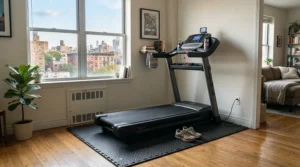
Buying the right mat is half the equation — placement and setup do the rest of the work. Start by measuring your treadmill’s actual footprint, including the console overhang, before ordering; a mat that’s even two inches too narrow lets the front feet sit directly on bare floor, which defeats the purpose entirely. Once your mat arrives, let it fully uncurl and acclimate to room temperature for 24 hours before placing the treadmill on top — this prevents edge lift that can create a slight rocking motion under load.
A common first-30-days mistake is forgetting to re-level the treadmill after the mat compresses slightly under its weight; check your machine’s built-in level indicator (most modern treadmills have one) a week after setup and adjust the leveling feet if needed. For maintenance, vacuum foam and rubber mats weekly to prevent dust buildup that can migrate into the treadmill’s belt mechanism, and wipe rubber mats with a damp cloth rather than harsh solvents, which can degrade EPDM rubber over time. One optimization trick that Amazon listings rarely mention: placing a thin sheet of dense rubber underlayment beneath your primary mat — even a scrap yoga mat works — adds a second damping layer that meaningfully improves low-frequency vibration control for a few extra dollars.
Real-World Scenarios: Matching the Mat to Your Living Situation
Consider three common upstairs-apartment profiles. First, the studio-apartment runner with a foldable treadmill and zero dedicated gym space — this person should lean toward the Impresa Rubber Floor Protectors or BestXD Treadmill Mat Pads, since both store flat in a closet and don’t demand a permanent floor commitment. Second, the serious home-gym builder in a converted spare bedroom who runs 5-6 days a week on a full-size treadmill — this profile benefits most from the Second Skin Stomp Mat or Rubber-Cal Treadmill Mat, where the extra thickness pays for itself in genuine noise reduction over hundreds of workout hours.
Third, the budget-conscious renter who’s had one noise complaint already and needs a fast, affordable fix before the next lease renewal — the BalanceFrom GoFit High Density Mat paired with the underlayment trick above hits a sensible middle ground between cost and performance. In each case, the deciding factor isn’t really the brand — it’s matching mat thickness and material to how many hours per week the treadmill actually runs, and how directly your workout space sits above another unit’s living or bedroom space.
How to Choose an Anti-Vibration Mat for Treadmill in Upstairs Apartment
- Measure your treadmill’s full footprint first. Include the console base and any side rails — undersized mats are the single most common return reason.
- Prioritize thickness over price when noise is the main concern. Reviewers and manufacturers alike point to roughly 6-10mm (about 1/4″-3/8″) as the threshold where real dampening starts.
- Match material to your subfloor. Wood-joist and laminate floors transmit impact noise more readily and benefit most from dense rubber; concrete slabs need less extreme mats.
- Check for a non-slip backing. A mat that shifts during a run reintroduces the exact vibration and noise problem you’re trying to solve.
- Factor in storage if you’re in a small unit. Foot-pad options trade some performance for the ability to disappear when not in use.
- Consider a layered approach for heavy use. Stacking a thin underlayment beneath your main mat compounds vibration absorption for a small added cost.
- Read for real vibration claims, not just “noise reduction.” Some mats primarily protect floors from scratches without meaningfully addressing sound transmission — the two aren’t always the same thing.
Treadmill Noise Reduction Mat vs Vibration Dampening Mat Apartment: What’s the Real Difference?
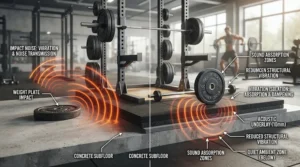
These two phrases get used interchangeably in product listings, but they describe genuinely different engineering goals, and understanding the distinction will save you money. A treadmill noise reduction mat is often optimized primarily for airborne sound — muffling the whir of the motor and belt — through surface texture and moderate cushioning. A vibration dampening mat apartment dwellers actually need is engineered around structure-borne sound: the impact energy from footfalls and motor housing that travels directly into the floor joists and radiates as noise in the unit below, regardless of how quiet the machine sounds in your own living room.
Structure-borne sound results from an impact on, or vibration against, a building’s fabric, causing sound to radiate from an adjacent vibrating surface — which is precisely why a mat can look identical to a bystander but perform completely differently depending on its density and thickness. Thin vinyl mats mostly address the first category; dense rubber options like the Rubber-Cal Treadmill Mat and Second Skin Stomp Mat are engineered for the second, tougher problem. If your downstairs neighbor complains despite your machine “sounding quiet” to you, this is almost always the gap — you’ve solved airborne noise but not structure-borne vibration.
Common Mistakes When Buying a Quiet Treadmill Mat for Upstairs Unit
The single biggest mistake is assuming any treadmill mat automatically means a quiet treadmill mat for upstairs unit use — many budget mats are designed purely for floor scratch protection and barely touch vibration transmission. A close second is buying based on thickness alone without checking material density; a thick but low-density foam can actually perform worse than a thinner, denser rubber sheet. Shoppers also frequently skip measuring their actual treadmill footprint, ending up with a mat where the front or back feet hang off the edge entirely, which reintroduces direct floor contact and defeats the purchase.
Another overlooked error is neglecting the underlayment beneath the mat itself — hardwood over a hollow subfloor cavity amplifies vibration more than a slab foundation, so the same mat performs differently depending on what’s underneath your floor to begin with. Finally, plenty of buyers assume a heavier treadmill automatically needs a thicker mat, when in reality it’s less about the machine’s total weight and more about how concentrated the impact force is at each contact point during use.
Understanding Treadmill Motor Vibration and Why It Travels Through Floors
Treadmill motor vibration comes from two distinct sources that often get lumped together: the DC motor’s rotational hum, and the mechanical impact of your footfalls striking the belt roughly 1.5-2.5 times per second while running. Impact sound occurs when an object impacts on another, generating structural vibration that results in sound radiating from an adjacent vibrating surface — in a treadmill’s case, that “adjacent vibrating surface” is your apartment’s floor, which then acts almost like a speaker cone for the unit below. This is why a treadmill sitting directly on hard flooring, with no isolating layer, transmits far more energy downward than one on a properly rated mat — the machine’s feet become an efficient, direct energy pathway into the building’s structure.
The frequency range matters too: motor hum tends to sit in a higher, more continuous frequency band that’s easier to dampen with basic rubber or foam, while the low-frequency thud of footfalls is harder to isolate and requires genuine mass and density to absorb effectively. Noise exposure has been linked to multiple health outcomes including cardiovascular effects and sleep disturbance, which underscores why solving both frequency ranges — not just the audible motor whine — actually matters for the person living below your workout space.
💬 One click helps other apartment runners find a fix before their first noise complaint — thanks for reading this far!
Sound Dampening Pad vs Anti-Vibration Mat: Features That Actually Matter
Marketing copy throws around “sound dampening pad” and “anti-vibration mat” almost interchangeably, but a few features genuinely separate effective products from placeholders. Material density matters more than almost anything else — solid rubber and dense vinyl outperform lightweight foam at absorbing low-frequency impact, even at comparable thickness. Surface texture matters for grip and stability but does very little for actual sound transmission, despite how often it’s highlighted in listings. Total mat mass is an underrated factor too: a heavier mat, all else equal, simply moves less in response to impact energy, which means less of that energy gets converted into secondary vibration.
Features that don’t matter nearly as much as marketing suggests include color, aesthetic pattern, and “multi-purpose” branding claims — a mat that also works for yoga doesn’t necessarily mean it’s optimized for vibration control, since those two use cases prioritize different physical properties (cushioning comfort versus rigid energy absorption). When comparing a sound dampening pad against a true anti-vibration mat, ask specifically about density (measured in kg/m³ where available) and thickness together — either spec alone can be misleading.
Benefits vs Traditional Alternatives
| Approach | Noise Reduction | Cost | Setup Effort |
|---|---|---|---|
| No mat (bare floor) | None | $0 | None |
| Generic yoga/exercise mat | Minimal | Low ($10-$25) | Easy |
| Dedicated anti-vibration mat (e.g. Rubber-Cal Treadmill Mat) | Significant | Moderate ($40-$100) | Easy |
| Isolation pad + underlayment combo (e.g. Second Skin Stomp Mat) | Best available | Higher ($100-$200) | Moderate |
The gap between a generic yoga mat and a purpose-built option like the Rubber-Cal Treadmill Mat is larger than most people expect, mainly because general exercise mats are optimized for grip and joint comfort rather than density-driven vibration absorption. Stepping up to a layered isolation setup with something like the Second Skin Stomp Mat delivers the best real-world results, but it’s genuinely only worth the extra cost if you’re running multiple times a week in a building where noise complaints are a real, ongoing risk rather than a hypothetical one.
Long-Term Cost & Maintenance
A quality anti-vibration mat typically lasts 3-5 years of regular use before compression or edge wear meaningfully reduces its dampening performance, which works out to roughly $10-$25 per year of ownership for most mid-range options — a genuinely small line item against the cost of a lease violation or a strained neighbor relationship. Rubber mats like the Rubber-Cal Treadmill Mat tend to outlast foam and vinyl in raw years of service because rubber resists compression set better over time, though they do require occasional cleaning to prevent grime buildup in the textured surface.
| Mat Type | Est. Lifespan | Annual Cost (approx.) | Maintenance Level |
|---|---|---|---|
| Vinyl (SuperMats) | 4-6 years | $10-$18/yr | Low — damp cloth |
| Recycled Rubber (Rubber-Cal) | 5-7 years | $12-$16/yr | Low — occasional wipe-down |
| Isolation Rubber (Second Skin) | 6-8+ years | $20-$30/yr | Low — very durable |
| EVA Foam Tiles (ProsourceFit) | 2-4 years | $10-$25/yr | Moderate — watch for compression |
Looking at the table above, rubber-based options generally offer the best cost-per-year of ownership despite a higher sticker price upfront, since they resist the compression and cracking that eventually ends a foam or thin vinyl mat’s useful life. If you’re budgeting for a multi-year apartment stay, the Second Skin Stomp Mat‘s higher initial cost effectively amortizes down to a very reasonable annual figure given its durability.
Safety, Building Codes & Lease Compliance Guide
Most residential leases don’t specify exact noise thresholds for home exercise equipment, but many include general “quiet enjoyment” clauses that landlords can invoke if neighbors file repeated complaints — practically speaking, this means proactive noise mitigation protects you even without a specific rule being broken. Floor impact noise is a significant issue in multi-unit buildings, and floating floor systems with resilient isolators between the structural slab and the upper floor layer have historically been used to control this transmission — a home anti-vibration mat is essentially a consumer-scale version of that same engineering principle.
From a safety standpoint, always confirm your mat’s weight rating exceeds your treadmill’s actual operating weight (machine plus user), since an undersized mat can compress unevenly and create a tripping hazard at the edges. If you’re renting, it’s worth documenting your mat setup with a photo — should a noise dispute ever arise, showing you took reasonable mitigation steps is genuinely useful. For more detail on how impact noise moves through building structures, the Institute of Acoustics’ research on floor impact sound offers a deeper technical look at how construction type affects transmission.
Buyer’s Decision Framework
If you live above a unit you know is occupied and you run more than three times a week, choose a dense rubber isolation mat like the Second Skin Stomp Mat because the cost is justified by consistent, heavy use over years. If you’re in a smaller studio with limited storage and run occasionally, choose foot pads like the Impresa Rubber Floor Protectors because minimal footprint outweighs marginal performance gains. If your budget is the primary constraint and your treadmill is lightweight or foldable, choose the BalanceFrom GoFit High Density Mat because it delivers full coverage at the lowest realistic cost. And if you want flexibility to reconfigure your space or share it with other workouts, choose the ProsourceFit Extra Thick Puzzle Tiles because the modular design adapts as your setup changes.
Frequently Asked Questions
❓ Do anti-vibration mats actually work for upstairs apartments?
❓ How thick should a treadmill mat be for noise reduction?
❓ Will a yoga mat work instead of a dedicated vibration mat?
❓ Can I stack two mats for better noise reduction?
❓ Do these mats also work for other exercise equipment?
Conclusion
If there’s one takeaway here, it’s that “treadmill mat” and “anti-vibration mat” aren’t automatically the same product, even when they’re sold in the same Amazon category. The mats that actually solve an upstairs-apartment noise problem — the Rubber-Cal Treadmill Mat, the Second Skin Stomp Mat, and to a lesser extent the SuperMats Heavy Duty Commercial Vinyl — share dense, mass-heavy construction that genuinely absorbs impact energy rather than just cushioning your footsteps. Budget options like the BalanceFrom GoFit High Density Mat and foot-pad solutions like the Impresa Rubber Floor Protectors and BestXD Treadmill Mat Pads still have a real place, especially for lighter treadmills or storage-constrained apartments, but they trade some performance for cost and convenience.
Whichever option fits your situation, the underlying goal is the same: protect your relationship with your downstairs neighbor, protect your floors, and protect your lease. A $40-$150 mat is a genuinely small investment against the cost of a noise complaint escalating into something more serious.
Recommended for You
- 7 Best Extra Large Equipment Mats For Multiple Gym Machines (2026)
- 3×6 Equipment Mat For Elliptical Machine: 7 Best Picks In 2026
- Rubber Mat for Heavy Exercise Equipment: 7 Picks That Survive 2026
Disclaimer: This article contains affiliate links. As an Amazon Associate, I earn from qualifying purchases. If you purchase products through these links, we may earn a small commission at no additional cost to you.
✨ Found this helpful? Share it with your friends! 💬🤗
