
In This Article
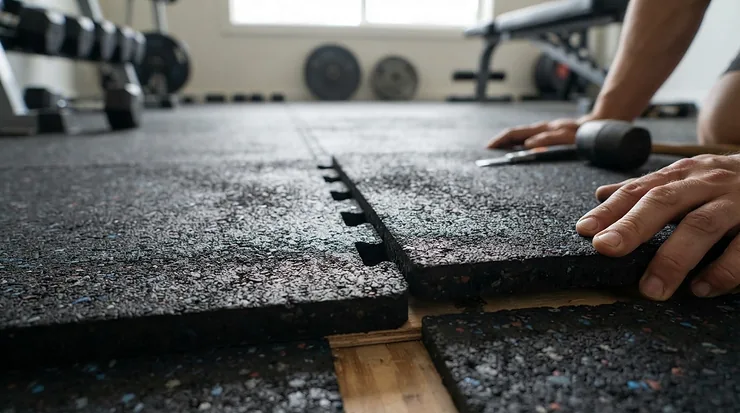
A rubber mat for heavy exercise equipment is a thick rubber flooring layer — usually 3/8″ to 1″ — placed under weight racks, benches, and machines to absorb impact, dampen noise, and stop dropped iron from turning your concrete into gravel. Sounds simple. It is not, because “rubber mat” gets used as a catch-all term for products that behave nothing alike under a loaded power rack.

Here’s the thing nobody tells you at the hardware store: a mat that’s perfect under a treadmill will get crushed flat under a loaded barbell within a season. Thickness, density, and rubber composition all matter more than the marketing copy suggests, and the difference between “handles a dropped 45-pound plate” and “cracks your subfloor” often comes down to a quarter inch of material you can’t even see in a product photo.
This guide skips the fluff. We researched real products — from feed-store stall mats that lifters have quietly used for decades to premium vulcanized rubber built for commercial gyms — and broke down exactly which rubber mat for heavy exercise equipment fits your setup, your budget, and your downstairs neighbor’s patience. Whether you’re protecting a $3,000 power rack in a finished garage gym setup or just trying to keep a treadmill from walking across the basement, there’s a real, verifiable option below — no invented reviews, no guesswork, just spec sheets and honest analysis.
Quick Comparison Table
| Product | Thickness | Best For | Price Range |
|---|---|---|---|
| Rubber-Cal Shark Tooth | 3/4″ | Weight rack floor protection | $35-$90 |
| IncStores 4×6 Premium Vulcanized Mat | 3/4″-1″ | Premium/commercial durability | $150-$230 |
| Tractor Supply Rubber Stall Mat | 3/4″ | Budget rubber mat for weight equipment | $40-$65 |
| SUPERJARE Dual-Layer Interlocking Tiles | 1″ | Heavy barbell drops | $130-$190 |
| AIRHOP Hybrid Rubber-Top Tiles | 0.56″ | Garage gym setup, moderate loads | $60-$85 |
| ProsourceFit Rubber-Top Puzzle Mat | 3/4″ | Budget, easy DIY install | $60-$95 |
| Recycled Rubber Rolled Flooring (8mm) | 0.31″ (8mm) | Wall-to-wall recycled rubber flooring | $460-$930/roll |
Looking at the spread above, thickness alone doesn’t tell the whole story — a 3/4″ horse stall mat from Tractor Supply Rubber Stall Mat and a 3/4″ Rubber-Cal Shark Tooth mat are both technically “heavy duty,” but density and rubber composition change how each one behaves under a loaded barbell. If your budget is tight and you have a truck to haul it, the stall mat route wins on cost-per-square-foot every time. If you want something that ships flat to your door and looks intentional in a finished space, the purpose-built gym mats justify their higher price with cleaner edges and better warranties.
💬 Just one click — help others make better buying decisions too!😊
Top 7 Rubber Mats for Heavy Exercise Equipment: Expert Analysis
1. Rubber-Cal Shark Tooth — best all-around weight rack floor protection
The textured “shark tooth” surface on this mat isn’t just cosmetic — that raised pattern channels sweat and grip dust away from your feet, which matters more than you’d think when you’re pulling a heavy deadlift in socks on a humid August afternoon. At 3/4″ thick and made from a high-EPDM recycled rubber compound, it covers 12 square feet per mat (48″ x 36″) and weighs around 50 pounds, so it stays put under a squat rack without tape or adhesive.
Based on the spec comparison, this sits in the sweet spot for anyone who wants dedicated protection under a single station rather than wall-to-wall coverage — a rack, a bench, or an isolated deadlift zone. Reviewers at Home Depot rate it around 4.3 out of 5 stars across dozens of reviews, with the most consistent praise centered on how well it holds up to repeated dropped-plate abuse without denting or splitting at the seams. The recurring complaint in that same review pool is the “new tire” smell, which several buyers say faded within a couple of weeks of airing it out in a garage.
Pros:
- ✅ High-EPDM recycled rubber resists UV and ozone damage outdoors
- ✅ 3-year limited warranty backs up the heavy-duty claim
- ✅ Textured surface improves grip during sweaty sessions
Cons:
- ❌ Strong rubber odor for the first week or two
- ❌ Single mats leave visible seams when covering a large area
At around $35-$90 depending on size and retailer promotions, the Rubber-Cal Shark Tooth mat delivers real commercial-grade material at a price that doesn’t require a second mortgage — solid value for spot protection.
2. IncStores 4×6 Premium Vulcanized Rubber Mat — best premium build for daily heavy use
Vulcanization matters here, and it’s worth explaining why: unvulcanized rubber softens and degrades with heat and repeated compression, while the vulcanization process cross-links the rubber’s molecular structure so it holds its shape under sustained pressure — like a fully loaded rack sitting in the same spot for years. That’s the entire premium pitch of this 4-foot by 6-foot mat, and it’s a legitimate one.
What most buyers overlook about vulcanized rubber mats is that the odor-resistance and density improvements aren’t just about comfort — they directly affect how long the mat resists permanent compression under a rack’s feet. Independent testing referenced by flooring review sites lists this model as a repeat top pick after extended six-week trials, citing its resistance to odor and its 5-year warranty as standout differentiators against cheaper reclaimed-rubber competitors. That warranty length alone tells you the manufacturer expects this thing to outlast several generations of home gym equipment.
Pros:
- ✅ True vulcanized rubber resists long-term compression set
- ✅ 5-year warranty, longest in this comparison
- ✅ Minimal off-gassing odor compared to reclaimed rubber mats
Cons:
- ❌ Premium price point compared to stall mats or rolled options
- ❌ Heavy (over 100 lbs per mat) — difficult for one person to move alone
In the $150-$230 range per mat, the IncStores 4×6 Premium Vulcanized Rubber Mat is the pick for anyone treating their home gym as a permanent fixture rather than a phase — the cost per year of use is genuinely competitive once you factor in the warranty.
3. Tractor Supply Rubber Stall Mat — best budget rubber mat for weight equipment
Here’s an open secret in the lifting community: the mats designed to withstand a 1,200-pound horse stomping on them all day are, functionally, nearly identical to purpose-branded “gym” rubber mats — just sold through a farm supply store instead of a fitness retailer. At 3/4″ thick and roughly 4 feet by 6 feet, this stall mat gives you 24 square feet of genuinely heavy-duty rubber for less than half of what an equivalent-sized gym-branded mat costs.
The trade-off is entirely logistical, not qualitative. These mats are dense — often 90 to 100 pounds each — and most stores don’t ship them affordably because of that weight, so you’ll likely need a truck or a large SUV and a friend to help carry it. Deal-tracking communities have flagged this exact stall mat repeatedly as “the best value” for home gym flooring, with the recurring caveat that buyers should expect a noticeable rubber smell for the first several days that fades with ventilation.
Pros:
- ✅ Lowest cost per square foot of any option in this list
- ✅ Built to handle 1,000+ lb loads, massive overkill margin for home use
- ✅ Widely available at Tractor Supply locations nationwide
Cons:
- ❌ Requires vehicle transport due to weight — limited/no cheap shipping
- ❌ Noticeable off-gassing smell during the first week
At roughly $40-$65 per 4’x6′ mat, the Tractor Supply Rubber Stall Mat is the single best answer if someone asks for a genuinely budget rubber mat for weight equipment that still holds up under an Olympic barbell.
4. SUPERJARE Dual-Layer Interlocking Rubber-Top Tiles — best for heavy barbell drops
Dual-layer construction means this tile isn’t just one material doing double duty — a dense rubber top layer handles direct impact and grip, while a high-density EVA foam base underneath adds a spring-back cushioning effect that single-layer mats can’t replicate. At a full 1 inch thick, this is the thickest tiled option in this roundup, and that extra material is exactly what you want directly under an Olympic platform or a heavy dumbbell rack.
Based on the spec comparison against thinner tiles in this same product line (0.56″ and 0.79″ variants), the 1-inch version is specifically positioned by reviewers as the pick for “serious Olympic lifters” and anyone regularly dropping loaded barbells from overhead. The interlocking edges install without tools in under an hour for a typical home gym footprint, and unlike single-slab mats, damaged tiles can be replaced individually instead of needing to buy a whole new mat.
Pros:
- ✅ Thickest tile option, ideal for repeated barbell drops
- ✅ Interlocking tiles replace individually if damaged
- ✅ Dual-layer rubber-top-over-EVA improves shock absorption
Cons:
- ❌ More expensive per square foot than single-layer EVA tiles
- ❌ Visible seams between tiles versus a single rolled sheet
Priced around $130-$190 for a 24-square-foot set, the SUPERJARE Dual-Layer Interlocking Rubber-Top Tiles earn their premium over basic puzzle mats specifically because of that extra half-inch of rubber where it counts.
5. AIRHOP Hybrid Rubber-Top Tiles — best for a compact garage gym setup
At 0.56 inches thick, this tile occupies the middle ground between flimsy exercise mats and full heavy-duty flooring — thick enough for moderate weight training, thin enough to install in six tiles covering 24 square feet without eating into ceiling clearance in a low garage. The rubber-top-over-EVA-foam hybrid design gives it a grippier feel underfoot than plain foam puzzle mats, which matters during high-rep dumbbell circuits where you’re pivoting and shifting weight constantly.
What the spec sheet won’t tell you, but buyer feedback consistently does, is that this model holds up well for moderate loads — think dumbbell racks, adjustable benches, and general strength training — but isn’t rated for the same abuse as thicker dedicated platforms. Verified buyer ratings sit around 4.7 out of 5 stars across dozens of reviews, with the color options (it ships in black, blue, purple, and white combinations) frequently mentioned as a plus for anyone trying to make a garage gym setup feel less like a garage.
Pros:
- ✅ Strong 4.7-star buyer rating across dozens of verified reviews
- ✅ Rubber-top surface improves grip over plain foam tiles
- ✅ Compact 0.56″ profile preserves garage ceiling clearance
Cons:
- ❌ Not rated for repeated heavy barbell drops
- ❌ Foam core can compress under stationary heavy equipment over time
In the $60-$85 range for a 24-square-foot set, the AIRHOP Hybrid Rubber-Top Tiles are a smart middle-tier pick for a garage gym setup built around dumbbells, kettlebells, and machines rather than max-effort barbell work.
6. ProsourceFit Rubber-Top Puzzle Mat — best easy-install rubber flooring for home gym equipment
This is the best-selling exercise equipment mat on Amazon for a reason that has nothing to do with luck: the puzzle-edge interlocking system lets anyone install a full room’s worth of flooring in under an hour with zero tools, and the rubber-top-over-EVA-foam construction gives it noticeably better grip and durability than the all-foam version of the same product line. Available in both 1/2″ and 3/4″ thicknesses, it’s genuinely one of the more flexible rubber flooring for home gym equipment options on the market.
The honest trade-off, and it’s an important one: the thinner 1/2″ version is well-suited to bodyweight training, yoga, and light dumbbell work, but reviewers and independent testers both note that heavier stationary equipment — a loaded power rack, a commercial treadmill — can leave permanent compression marks over time. The 3/4″ version narrows that gap considerably and is the one worth the upcharge if you’re placing actual heavy exercise equipment on top of it rather than just training beside it.
Pros:
- ✅ Tool-free interlocking install, beginner-friendly
- ✅ Water-resistant surface wipes clean after sweaty sessions
- ✅ 3/4″ version handles moderate-to-heavy equipment loads
Cons:
- ❌ 1/2″ version can develop permanent dents under heavy stationary gear
- ❌ Rubber-top speckled finish shows chalk dust more than solid colors
Running $60-$95 for a 24-square-foot set depending on thickness, the ProsourceFit Rubber-Top Puzzle Mat remains the easiest on-ramp into rubber flooring for home gym equipment for people who want results without a learning curve.
7. Recycled Rubber Rolled Flooring (8mm) — best wall-to-wall recycled rubber flooring
Sold in continuous 4-foot-wide rolls rather than individual tiles, this option is built from vulcanized, reclaimed rubber material — meaning it’s manufactured largely from recycled sources like end-of-life tires rather than virgin rubber compound, similar in spirit to how the EPA’s scrap tire management programs track and repurpose the millions of tires that would otherwise sit in landfills. At 8mm (about 0.31″) thick, it’s thinner than the tiled and slab options above, but it makes up for that with zero seams across an entire room.
Here’s the honest trade-off most rolled-flooring listings gloss over: at roughly 10% force reduction per independent product specs, this is rated for moderate weight impacts — dumbbell racks, machines, general equipment — rather than repeated max-effort barbell drops from height. If your plan is genuinely heavy Olympic lifting, this roll works best as a base layer with thicker stall mats placed strategically under the rack itself. For anyone prioritizing a continuous, professional-looking recycled rubber flooring surface across a whole room, though, nothing on this list matches it for a seamless finish.
Pros:
- ✅ Seamless coverage across large rooms, no visible tile lines
- ✅ Made substantially from reclaimed/recycled rubber material
- ✅ Self-install possible with double-sided tape or adhesive
Cons:
- ❌ Thinner profile than tiles — not ideal alone under max-effort lifting
- ❌ Higher upfront cost for large rolls, plus optional pro installation fee
At roughly $460-$930 per roll depending on length (25 vs. 50 linear feet), the Recycled Rubber Rolled Flooring (8mm) option is a premium-feeling, environmentally conscious choice for anyone flooring an entire room rather than a single equipment zone.
Garage Gym Setup: A Practical Installation & Maintenance Guide
Getting your garage gym setup right starts before the mats even arrive. Measure your space in exact square footage, then round up by about 10% — interlocking tiles and mats rarely fit a room perfectly, and you’ll want overlap to trim rather than gaps to patch. Sweep and vacuum the concrete thoroughly; even small grit trapped under a mat will telegraph through as bumps and accelerate wear from underneath, which is a failure mode almost nobody thinks to check.
For the first 30 days, resist the urge to permanently glue anything down. Let mats acclimate to your garage’s temperature and humidity for 24-48 hours before final placement — rubber expands and contracts more than people expect, and mats installed too tightly against walls in cold weather can buckle when summer heat arrives. If odor is a concern, prop up a fan and crack the garage door for a few days; nearly every recycled-rubber product on this list ships with some off-gassing smell that fades with airflow.
Maintenance afterward is minimal but not zero: sweep or vacuum weekly, mop with a mild soap-and-water solution monthly, and avoid petroleum-based cleaners, which can degrade rubber compounds over time. Rotate high-traffic sections if you’re using individual tiles — swapping a worn tile from under your bench with a barely-used one from a corner extends the whole system’s life by years.
Real-World Scenarios: Matching the Mat to the Lifter
Consider a college student setting up a first apartment gym with a $600 budget for an adjustable bench, dumbbells, and flooring combined. For that profile, the AIRHOP Hybrid Rubber-Top Tiles or the ProsourceFit Rubber-Top Puzzle Mat make the most sense — both stay under $100, install without tools, and comfortably handle dumbbell work and bodyweight training without eating the whole equipment budget.
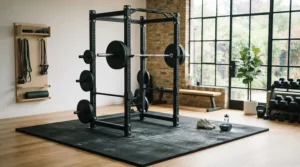
Now picture a serious home lifter with a power rack, an Olympic barbell, and a habit of dropping 300+ pounds from shoulder height during failed attempts. That’s precisely the scenario the SUPERJARE Dual-Layer Interlocking Rubber-Top Tiles or a doubled-up layer of the Rubber-Cal Shark Tooth mat under the rack itself was built to survive — thickness and density matter more than price here, and skimping leads to cracked concrete, not just a worn mat.
Finally, think about a homeowner converting a two-car garage into a permanent, finished training space — the kind of project where resale value and long-term durability matter. The IncStores 4×6 Premium Vulcanized Rubber Mat or the Recycled Rubber Rolled Flooring (8mm) for wall-to-wall coverage both make sense financially once you’re amortizing the cost over a decade rather than a single lifting cycle — the higher upfront price stops looking so steep.
Problem → Solution: Fixing Common Rubber Mat Headaches
Problem: The mat smells like a tire shop. This is nearly universal with reclaimed and recycled rubber products. Solution: air it out in a garage or well-ventilated space for 3-7 days before moving it into a finished basement, and run a fan directly across the surface to speed off-gassing.
Problem: The floor still shakes when I drop weight. A single thin mat rarely solves vibration transfer into floor joists on its own, especially with cardio equipment. Solution: layer a thicker rubber base — like the 3/4″ Rubber-Cal Shark Tooth — directly under equipment feet, since mass and density absorb vibration far better than surface texture alone.
Problem: My mat is sliding around on a tile or hardwood floor. Rubber-on-rubber grips well, but rubber-on-polished-tile can slip surprisingly easily. Solution: add a thin non-slip rug pad underneath, or choose a rolled option that can be adhered with double-sided tape for full-coverage installations.
Problem: I’m seeing dents where my rack’s feet sit. This happens most with thinner EVA-foam-based tiles under stationary heavy equipment. Solution: switch to a full-rubber option in that specific zone — a small cut section of stall mat under each foot solves this without replacing the whole floor.
Problem: Tiles are shifting apart at the seams over time. Interlocking edges loosen slightly with repeated equipment vibration. Solution: check seams monthly, and consider a bead of clear silicone caulk along high-traffic seam lines for a semi-permanent fix that still allows future removal.
How to Choose a Rubber Mat for Heavy Exercise Equipment
- Start with your heaviest realistic drop weight. If you’re never dropping more than a 25-pound dumbbell, 0.5-0.56″ tiles are plenty; for barbell work above 200 pounds, go 3/4″ minimum.
- Check your subfloor material. Concrete tolerates thinner mats better than wood-frame floors, which benefit from extra density to control vibration transfer between joists.
- Decide between tiles, mats, and rolls based on your room shape. Odd angles and columns favor interlocking tiles you can cut; large open rectangles favor rolled flooring for a seamless look.
- Weigh shipping cost against local pickup. Heavy stall mats and rolled flooring often cost more to ship than to buy, so factor in truck access before assuming online is cheaper.
- Read the warranty length as a durability signal. A 5-year warranty, like the one on the IncStores 4×6 Premium Vulcanized Rubber Mat, tells you something real about expected compression resistance.
- Factor in odor tolerance and installation timeline. If you need a space usable within days, budget time for off-gassing before your first heavy session.
- Match thickness to noise sensitivity, not just impact protection. Apartment or upstairs installations benefit disproportionately from extra thickness because of how it dampens transmitted sound, not just physical shock.
Heavy Duty Rubber Gym Mat vs. Standard Exercise Mats
The phrase “heavy duty rubber gym mat” gets slapped on products that range wildly in actual capability, so it’s worth drawing a hard line. A standard exercise mat — thin EVA foam, typically under 1/2″ — is designed for stretching, yoga, and bodyweight work; it was never engineered to absorb repeated impact from iron plates or bear the concentrated point-load of a loaded rack’s feet for months at a time.
A genuine heavy duty rubber gym mat, by contrast, uses either vulcanized or high-density reclaimed rubber at 3/4″ or greater thickness specifically because that combination resists permanent compression under sustained weight. Based on the spec comparison across this list, the practical dividing line sits right around that 3/4″ mark: below it, you’re buying comfort and light protection; at or above it, you’re buying genuine structural protection for both your equipment and your floor. If a listing calls something “heavy duty” but lists a thickness under 1/2″ with no mention of rubber density or composition, treat that as a marketing label rather than a technical claim.
Rubber Flooring for Home Gym Equipment: Rolls vs. Tiles vs. Mats
Choosing rubber flooring for home gym equipment usually comes down to three formats, and each solves a different problem. Rolled flooring, like the recycled option covered above, wins on seamless appearance and is the natural choice for finished rooms where aesthetics matter as much as function — but it requires more effort to cut around obstacles and typically costs more per square foot upfront.
Interlocking tiles, represented here by the SUPERJARE and AIRHOP options, win on flexibility. You can reconfigure a room, replace a single damaged section, and expand coverage incrementally as your equipment collection grows — genuinely useful for anyone still building out their setup rather than furnishing a finished space all at once. Individual mats, like the Rubber-Cal Shark Tooth or a stall mat, win on targeted, heavy-duty protection under a single high-load zone without paying to cover an entire room in premium material you don’t need everywhere.
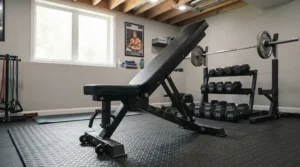
Budget Rubber Mat for Weight Equipment: What You Actually Get
Chasing the lowest price on a budget rubber mat for weight equipment isn’t automatically a mistake — it’s a mistake only if you don’t know what you’re trading away. At the low end, represented well by the Tractor Supply Rubber Stall Mat, you’re getting genuinely dense, functional rubber, just without the polished branding, custom sizing, or manufacturer warranty of purpose-built gym products.
What you do give up: consistent sizing (stall mats can vary slightly between batches), curb appeal (they look exactly like what they are — feed store flooring), and easy shipping (most retailers won’t ship them affordably due to weight). What you don’t give up, based on the spec sheets, is load capacity — a mat rated for a half-ton animal standing on four small hooves handles a barbell’s distributed weight without breaking a sweat. For genuinely tight budgets, this remains the highest-value entry point in the entire category.
Recycled Rubber Flooring: Eco Credentials and Real Performance
Recycled rubber flooring earns its “eco-friendly” label honestly in most cases — products like the rolled flooring covered earlier are manufactured from reclaimed rubber, frequently sourced from end-of-life tires that would otherwise require disposal. That’s a genuinely different manufacturing input than virgin EPDM rubber, and it matters for anyone weighing sustainability alongside performance.
Where honesty matters most is in setting expectations: recycled rubber products can have slightly more batch-to-batch color and density variation than virgin rubber compounds like EPDM (ethylene propylene diene monomer), and the recycling process sometimes leaves a stronger initial odor as residual compounds off-gas. Performance-wise, though, well-made recycled rubber flooring holds up comparably to virgin rubber for moderate-to-heavy home gym use — the environmental benefit doesn’t come at a meaningful durability cost for most buyers.
Weight Rack Floor Protection: What Actually Matters
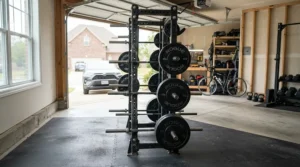
Weight rack floor protection is a narrower, more demanding job than general gym flooring, because a loaded rack applies sustained, concentrated pressure through just four contact points rather than distributing weight across a whole footprint. That concentration is exactly what causes permanent denting in thinner foam-based products and why specialists like the flooring experts at commercial gym flooring suppliers consistently recommend dedicated high-density rubber specifically under rack feet, even when surrounding flooring is thinner.
The practical fix, if you already own thinner flooring elsewhere, is targeted reinforcement rather than a full re-floor: cut small sections of 3/4″ stall mat or Rubber-Cal Shark Tooth material to sit precisely under each rack foot. This costs a fraction of re-flooring an entire room and solves the actual point-load problem directly. Skipping this step is the single most common reason home gym owners end up with cracked concrete or permanently dented flooring within a year of setup.
Common Mistakes When Buying a Rubber Mat for Heavy Exercise Equipment
The most frequent mistake is buying based on square footage alone without checking thickness — a large, thin mat looks like more value on paper but fails exactly where it matters most, under concentrated weight. A close second is assuming all “gym” branded products outperform generic or agricultural rubber; as covered above, a stall mat and a gym mat of equal thickness often perform nearly identically.
Buyers also frequently underestimate installation timeline, ordering flooring the same week they plan to start heavy lifting and then dealing with lingering rubber odor in an enclosed space. Finally, many people skip reading the warranty terms entirely, missing useful signals about expected product lifespan that the price tag alone won’t reveal.
Long-Term Cost & Maintenance
Run the numbers over a five-year horizon and the calculus shifts meaningfully. A budget option like the Tractor Supply Rubber Stall Mat at roughly $50 covers a rack zone for a decade or more with essentially zero maintenance cost beyond occasional cleaning — an outstanding cost-per-year figure for anyone on a tight budget. A premium option like the IncStores 4×6 Premium Vulcanized Rubber Mat costs three to four times as much upfront, but its 5-year warranty and vulcanized construction mean it’s built for a similar or longer lifespan without the compression sag that cheaper reclaimed rubber can develop under constant heavy loads.
Where the math gets interesting is with tiled systems like SUPERJARE or AIRHOP — since individual tiles replace independently, the effective lifespan of the whole floor extends well beyond any single tile’s wear life, because you’re only ever replacing the specific worn section rather than the entire installation. Factor in that flexibility when comparing sticker prices across formats; the cheapest option per square foot isn’t always the cheapest option per year of actual use.
Frequently Asked Questions
❓ What thickness rubber mat do I need for heavy exercise equipment?
❓ Can I put a rubber mat directly on carpet?
❓ Do rubber gym mats smell permanently?
❓ Are horse stall mats actually safe for home gyms?
❓ How do I stop my rubber mat from sliding on tile floors?
Conclusion
Choosing the right rubber mat for heavy exercise equipment really comes down to being honest about what you’re actually going to do on it. A casual home gym with dumbbells and a bench doesn’t need the same investment as a garage built around max-effort barbell training, and pretending otherwise just wastes money in one direction or risks your floor in the other.
Across every product covered here — from the budget-friendly Tractor Supply Rubber Stall Mat to the premium IncStores 4×6 Premium Vulcanized Rubber Mat — the underlying principle holds steady: thickness and density protect your investment, and cutting corners on either one tends to show up as either a cracked slab or a dented, sagging mat within a year. Match the product to your actual load, budget for a short off-gassing period, and you’ll get flooring that quietly does its job for a decade rather than becoming next year’s replacement project.
Recommended for You
- 7 Best Commercial Elliptical for University Recreation Center (2026)
- Commercial Elliptical For Apartment Complex Gym: 7 Top Picks 2026
- Commercial Elliptical For Apartment Complex Gym: 7 Best Picks (2026)
Disclaimer: This article contains affiliate links. As an Amazon Associate, I earn from qualifying purchases. If you purchase products through these links, we may earn a small commission at no additional cost to you.
✨ Found this helpful? Share it with your friends! 💬🤗
