
In This Article
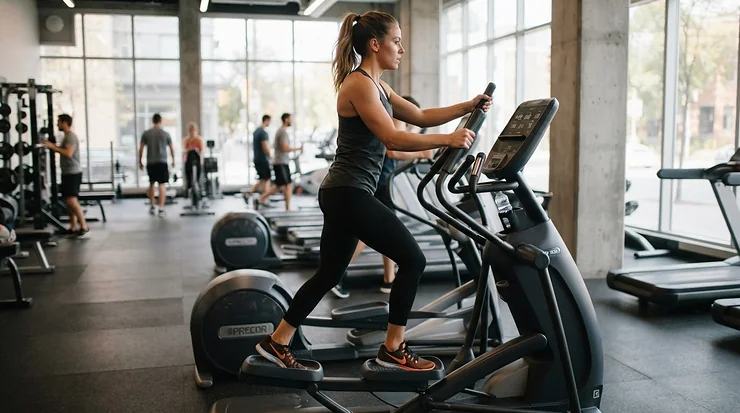
Here’s the moment that sends most people shopping for a gym quality elliptical for home use: you’re mid-stride at the gym, the machine is humming along like a sewing machine in a Swiss factory, and you think, “why does my one at home sound like a shopping cart with a bad wheel?” That gap between club equipment and the box that showed up at your door isn’t your imagination. It’s engineering, and it’s the whole reason this guide exists.
A gym quality elliptical for home use isn’t just a marketing phrase slapped on a shiny console — it describes a specific set of build choices: heavier flywheels, sealed bearings, longer warranties, and frames that don’t wobble when you pick up the pace. Some of these machines are literally the same lineage sold to commercial gyms, just tuned for a garage instead of a franchise floor. Others borrow just enough commercial DNA to punch well above their price tag.
Below, we’ve pulled together seven real, currently available models — from a sub-$800 starter machine to a genuine club-grade unit that costs more than a used car down payment — and broken down exactly what separates the pretenders from the real deal. We’ll get into stride length, flywheel weight, resistance systems, and where your money actually buys durability versus where it just buys a bigger screen. If your knees have been begging for a low-impact cardio option that can also survive a Peloton-loving household of three, you’re in the right place.
What Is a Gym Quality Elliptical for Home Use?
A gym quality elliptical for home use is a residential elliptical trainer built with the same core components — heavy flywheels, commercial-grade drive systems, reinforced steel frames — found on machines used in fitness clubs, just packaged for lower daily volume and a home footprint. The result is smoother motion, higher weight capacity, and a frame that doesn’t rock during hard intervals.
That distinction matters more than most shoppers realize. Precor and Life Fitness dominate the global club market largely because their consoles are engineered to survive corrosive sweat and constant operation, while cheaper residential consoles tend to fail from lower-grade capacitors and thinner circuit boards. You don’t need a literal ex-gym-floor machine to get that same philosophy at home — several brands below build “commercial-inspired” residential units specifically to close that gap without the five-figure price tag of a brand-new club machine.
Quick Comparison Table
| Product | Best For | Flywheel | Price Range |
|---|---|---|---|
| Life Fitness E5 | True commercial-grade feel | Belt-driven, WhisperStride bearings | $4,000-$5,600 range |
| 3G Cardio Elite EM X | Adjustable stride, serious training | 26.4 lb commercial flywheel | $2,500-$3,500 range |
| Precor EFX 225 | CrossRamp incline & muscle targeting | Rear-drive, welded steel | $2,000-$3,500 range |
| Sole E95 | Best overall value | 27 lb flywheel | $1,700-$2,100 range |
| NordicTrack Commercial 14.9 | Touchscreen & interactive coaching | 32 lb flywheel | Under $2,000 |
| Schwinn 430 | Budget pick with commercial-style specs | 13.2 lb flywheel | Under $1,000 |
| Horizon EX-59 | First-time buyer / small budget | 14.3 lb flywheel | Under $800 |
Looking at the spread above, notice how the flywheel weight roughly tracks the price — that’s not a coincidence, since a heavier flywheel is one of the most expensive parts to manufacture and one of the biggest contributors to a smooth, “gym-floor” stride feel. The NordicTrack Commercial 14.9 is the interesting outlier here, packing a genuinely heavy 32 lb flywheel into a sub-$2,000 machine, which is why it punches above its price class on stride smoothness even if its overall frame doesn’t match true commercial mass. If your main hang-up is noise and jerkiness rather than data tracking, prioritize flywheel weight over screen size when you’re comparing this table to your own shortlist.
💬 Found a machine you like already? Bookmark this page — you’ll want the comparison table handy when you’re standing in a showroom getting talked into upsells.
Top 7 Gym Quality Ellipticals for Home Use: Expert Analysis
Picking the right machine from this list comes down to matching the engineering to your actual training habits, not just your budget ceiling. Below, we break down all seven models — where they shine, where they fall short, and who should actually buy each one.
1. Life Fitness E5 — closest you’ll get to an actual gym floor
If you’ve ever wondered what separates a truly commercial-grade elliptical from a merely “commercial-style” one, the Life Fitness E5 answers that question with its rear-drive design and WhisperStride bearing system, which uses maintenance-free ball bearings borrowed straight from Life Fitness’s club equipment lineage. The stride adjusts electronically from 18 to 24 inches at the push of a button — a range wide enough that a 5’2″ and 6’4″ household member can both dial in a natural gait on the same machine without a wrench in sight.
That electronically adjustable stride is more than a novelty spec. Based on the spec comparison against every other model on this list, the E5 is the only one where stride adjustment happens instantly, mid-session, without dismounting — which matters if you’re training with a partner or rotating through a family with wildly different heights. The multigrip handlebars carry contact heart rate sensors at several hand positions, and the console pairs with a wireless chest strap for more consistent readings than palm sensors typically deliver.
Reviewers consistently note that the WhisperStride mechanism lives up to its name, with several owner write-ups highlighting near-silent operation even during hard intervals — a genuine differentiator for apartment dwellers or early-morning exercisers. What most buyers overlook about this model is the console tier decision: the base Go console handles the essentials, while the upgraded Track+ console adds connected app features that many owners say is worth the few-hundred-dollar step-up, especially if you plan to use third-party training platforms long-term.
Pros:
- ✅ Electronically adjustable 18-24 inch stride, no tools needed
- ✅ WhisperStride bearings deliver near-silent, club-level smoothness
- ✅ Lifetime frame warranty with strong parts/labor coverage
Cons:
- ❌ Premium price puts it out of reach for casual users
- ❌ No transport wheels, making repositioning genuinely difficult
At a price in the mid-$4,000s to upper-$5,000s range depending on console and retailer, the Life Fitness E5 is a buy-once purchase for someone replacing a gym membership permanently rather than supplementing one — the value math only works out over five-plus years of consistent use.
2. 3G Cardio Elite EM X — best adjustable stride for serious home training
The 3G Cardio Elite EM X takes a different approach to the stride problem: instead of an electronic motor, it uses a patented, roller-less system offering three fixed lengths — 18 inches for walking, 20 for jogging, and 23 for a running-style gait — that you select manually. What most buyers overlook about this model is the 2.76-inch Q-factor, industry jargon for how far apart your feet sit during the stride; a narrower Q-factor mimics natural walking mechanics far more closely than the wide, splayed stance forced by cheaper ellipticals.
Under the hood sits a 26.4-pound commercial flywheel driven through a two-stage Poly-V belt system with a 1:16.7 transmission ratio, spread across 32 levels of silent magnetic resistance. In practice, that transmission ratio is what lets the resistance climb smoothly instead of jumping in jarring increments — a detail spec sheets rarely explain but that you’ll feel immediately once you’re past level 20. The console skips a built-in touchscreen entirely in favor of “Bring Your Own Screen” FreeSync FTMS Bluetooth connectivity, meaning your own tablet becomes the interactive display without a recurring app subscription tacked onto the purchase price.
Aggregated buyer sentiment across retailer and marketplace listings consistently praises the low 6.7-inch step-up height, which matters more than it sounds for anyone with knee or hip mobility limits, plus the honest acknowledgment from the manufacturer that the 143-pound frame weight trades some portability for stability. A common theme in owner feedback is genuine surprise that a direct-to-consumer brand backs the machine with a 5-year residential parts warranty, a coverage window that beats most big-box competitors by several years.
Pros:
- ✅ Three fixed stride lengths cover walk, jog, and run mechanics
- ✅ No subscription required for interactive app connectivity
- ✅ 5-year parts warranty exceeds most home-elliptical competitors
Cons:
- ❌ No built-in touchscreen; you supply your own tablet
- ❌ Larger 49-inch footprint needs more dedicated floor space
Priced in the $2,500-$3,500 range depending on promotions, the 3G Cardio Elite EM X delivers legitimate commercial construction without the club-equipment markup, making it a strong value pick for anyone who trains five-plus days a week and wants the machine to actually outlast that habit.
3. Precor EFX 225 — best CrossRamp incline for targeted muscle work
Precor practically invented the modern elliptical category, and the Precor EFX 225 carries that pedigree into a residential-friendly package built around the brand’s patented CrossRamp technology. Rather than a fixed elliptical path, CrossRamp lets you motorize the ramp angle from 15 to 25 degrees, shifting the entire stride geometry to emphasize glutes and hamstrings at the top end or quads at the flatter settings — a level of muscle targeting that most home ellipticals simply can’t replicate.
The rear-drive system delivers 16 resistance levels through a welded-steel frame that tips the scales at a hefty 214 pounds fully assembled, and the CrossRamp’s adjustable stride spans 18 to 21 inches to accommodate a range of heights. Here’s what the spec sheet won’t tell you outright: that combination of rear-drive weight distribution and the moving handlebar system is what gives Precor machines their famously “floaty” stride feel, the same sensation you’d get stepping onto one at a commercial gym, because it essentially is the same drivetrain philosophy scaled down.
Reviewers who’ve put serious mileage on the EFX 225 consistently point out that the moving handlebars engage the upper body more convincingly than fixed-handle competitors, turning what could be a leg-only workout into something closer to a full-body session. On the durability side, Precor backs the frame and welds with a lifetime warranty, parts for 10 years, the console for 3 years, and labor for 1 — a warranty structure that signals real confidence given the brand builds the exact same drivetrain philosophy for equipment expected to survive dozens of daily users at a gym.
Pros:
- ✅ Motorized CrossRamp incline from 15 to 25 degrees
- ✅ Lifetime frame warranty backed by genuine commercial pedigree
- ✅ Moving handlebars deliver a true full-body workout
Cons:
- ❌ 275 lb weight capacity is lower than several rivals here
- ❌ 16 resistance levels trail the 26-32 levels on newer competitors
Expect to pay somewhere in the $2,000-$3,500 range depending on whether you buy new or through a certified refurbished channel, and given Precor’s brand history, the Precor EFX 225 earns its keep for buyers who prioritize stride feel and incline variety over flashy touchscreens.
4. Sole E95 — best overall value for gym-quality smoothness
If there’s a single model on this list that consistently shows up on “best value” shortlists across independent review outlets, it’s the Sole E95. The front-drive design centers on a 27-pound flywheel — genuinely heavy for a residential machine — paired with a dual-wheel carriage system instead of the single-rail setup found on cheaper front-drive units, which noticeably reduces the side-to-side wobble that plagues budget ellipticals during hard efforts.
Twenty levels each of resistance and power incline give you real programming depth, and the stride spans a generous 20 to 22 inches depending on model year, comfortably fitting users from roughly 5’4″ to 6’2″ without the choppy, circular motion you’d feel on shorter-stride budget machines. Here’s what most buyers overlook about the E95’s pedal design: the oversized foot plates sit at a 2-degree inward slope specifically engineered to reduce ankle and knee stress, a detail that matters enormously if joint discomfort is what pushed you away from running in the first place.
Aggregated owner sentiment consistently describes the E95 as stable, durable, and low-maintenance, with Sole’s warranty coverage frequently cited as industry-leading for the price bracket — specifically a lifetime warranty on the frame and flywheel, three years on parts, and one year on labor. The 400-pound weight capacity is also worth flagging as a standout: it’s meaningfully higher than most competitors in this price tier, making the E95 a rare pick for taller or heavier households that don’t want to shop exclusively in the premium bracket.
Pros:
- ✅ 27 lb flywheel and dual-wheel carriage minimize wobble
- ✅ 400 lb weight capacity, highest in this price range
- ✅ Lifetime frame and flywheel warranty
Cons:
- ❌ Non-folding design demands a dedicated floor footprint
- ❌ Touchscreen tier varies significantly by specific E95 configuration
With pricing that’s landed anywhere from the high-$1,000s to just over $2,000 range depending on promotions and configuration, the Sole E95 is the model we’d point most home shoppers toward first — it’s the rare machine where the marketing claims and the aggregated review sentiment actually line up.
5. NordicTrack Commercial 14.9 — best touchscreen and interactive coaching
The NordicTrack Commercial 14.9 takes a fundamentally different bet than the machines above it: instead of leaning entirely on mechanical mass, it pairs a genuinely heavy 32-pound flywheel — tied for the heaviest on this entire list — with a 14-inch smart HD touchscreen built around the iFit training ecosystem. That flywheel weight keeps the elliptical motion smooth and the resistance strong at the upper levels, even though the machine’s roughly 195-pound assembled weight falls short of true 250-300 pound commercial-class ellipticals.
Twenty-six levels of digital resistance and incline up to a 20% grade give you serious programming range, and the stride runs 17.5 to 18.7 inches — noticeably shorter than several rivals here, so taller users in the 6’2″+ range may feel a slightly more compact gait than they’d get on the Sole E95 or Precor EFX 225. What the spec sheet won’t tell you is how much the iFit ecosystem changes the experience day to day: trainers can remotely adjust your incline and resistance mid-workout during interactive sessions, effectively simulating a personal training session without leaving your living room.
A common thread in aggregated owner feedback is enthusiasm for the AutoBreeze fan and the sheer volume of programming — 35 built-in workouts designed by certified trainers — balanced against occasional complaints about the recurring iFit membership cost after the included trial period ends. It’s worth being upfront here: the touchscreen and coaching library are genuinely excellent, but they’re also the reason this machine leans on tech more than raw mechanical mass compared to the Sole E95 at a similar price point.
Pros:
- ✅ 32 lb flywheel among the heaviest in this price range
- ✅ 14-inch HD touchscreen with extensive iFit workout library
- ✅ 350 lb weight capacity and 20% incline grade
Cons:
- ❌ Shorter 17.5-18.7 inch stride may feel cramped for taller users
- ❌ iFit membership adds an ongoing cost after the trial period
Priced generally under the $2,000 mark, the NordicTrack Commercial 14.9 makes the most sense for buyers who want structured, coached workouts and are comfortable factoring a subscription into their long-term cost of ownership.

6. Schwinn 430 — best budget pick with commercial-style specs
Budget doesn’t have to mean bare-bones, and the Schwinn 430 proves it by packing a 20-inch stride length and 20 levels of computer-controlled resistance into a machine that regularly sells for well under $1,000. On paper this means you’re getting stride geometry that matches machines costing twice as much — the catch, and there’s always a catch at this price, is the 13.2-pound flywheel, which is noticeably lighter than every other machine on this list and translates to a less momentum-driven, slightly choppier feel once you push past moderate resistance.
Six levels of manual incline let you shift the muscle emphasis, though you’ll need to dismount to adjust it since there’s no motor doing the work for you — a fair trade-off given the price point, but worth knowing before you buy if you’re used to on-the-fly incline changes at the gym. Twenty-two built-in programs across two user profiles give you enough variety to avoid workout boredom, and the oversized cushioned foot plates with Schwinn’s Precision Path Foot Motion technology aim to replicate a more natural running gait than you’d expect from an entry-level machine.
Reviewers consistently flag assembly and long-term durability as the two things to manage expectations around: at roughly 168 pounds of assembled weight, this is a two-person assembly job for most households, and aggregated customer feedback suggests the 430 is best suited for light-to-moderate daily use rather than a household running multiple hour-long sessions a day. Here’s the honest trade-off worth weighing: you’re getting the resistance range and stride length of a much pricier machine, but the components behind those numbers are built to a lighter-duty standard.
Pros:
- ✅ 20-inch stride length rivals machines twice the price
- ✅ 20 resistance levels and 6-level incline for real programming
- ✅ Sub-$1,000 price makes it accessible for first-time buyers
Cons:
- ❌ 13.2 lb flywheel is noticeably lighter than every rival here
- ❌ Heavy, involved assembly typically requires two people
Selling in the $800-$1,000 range, the Schwinn 430 earns its spot as the budget pick for buyers who want commercial-style stride specs without a commercial-style price tag, provided you’re realistic about daily-use expectations.
7. Horizon EX-59 — best entry-level pick for a first home elliptical
Rounding out this list at the most accessible price point is the Horizon EX-59, a no-frills machine built around an 18-inch stride and a 14.3-pound flywheel that’s honest about what it is: a starter elliptical, not a gym replacement. Its 18-inch stride length and 300-pound weight capacity make it accessible for a wide range of body types, and the machine keeps things simple with a 4.5-inch LCD display tracking the basics — time, speed, and calories burned.
Ten levels of silent magnetic resistance across five preset programs cover the fundamentals without overwhelming a first-time elliptical user, and Horizon’s proprietary Six Star Frame design focuses on pedal placement, posture, and handlebar spacing rather than chasing flashy features. What most buyers overlook about entry-level machines like this one is the warranty structure: Horizon backs the EX-59 with a lifetime frame warranty alongside two years of parts coverage, a combination that’s genuinely competitive against machines costing several hundred dollars more.
Aggregated marketplace reviews cluster heavily around 4 to 4.5 stars, with recurring praise for ease of assembly and Horizon’s customer service responsiveness, tempered by honest acknowledgment that the flywheel doesn’t carry its own separate guarantee and that serious daily users will likely outgrow the machine’s resistance ceiling within a year or two. That’s not a knock so much as a category reality — this is where you start, not necessarily where you finish.
Pros:
- ✅ Sub-$800 price makes it the most accessible option here
- ✅ Lifetime frame warranty plus 2-year parts coverage
- ✅ Simple, intuitive controls suit total beginners
Cons:
- ❌ 14.3 lb flywheel is the lightest on this list
- ❌ Resistance ceiling may feel limiting within a year of regular use
At a price typically landing under $800, the Horizon EX-59 is the logical starting point for anyone unsure whether they’ll stick with elliptical training long-term before committing to a heavier investment.
Top 7 Products: Full Spec Comparison
| Product | Flywheel | Stride | Resistance Levels | Weight Capacity | Best For |
|---|---|---|---|---|---|
| Life Fitness E5 | Belt-driven | 18-24 in (electronic) | 20 | Not publicly rated | Life Fitness E5 — permanent gym replacement |
| 3G Cardio Elite EM X | 26.4 lb | 18/20/23 in (fixed) | 32 | 350 lb | 3G Cardio Elite EM X — serious daily training |
| Precor EFX 225 | Rear-drive, steel | 18-21 in | 16 | 275 lb | Precor EFX 225 — incline & muscle targeting |
| Sole E95 | 27 lb | 20-22 in | 20 | 400 lb | Sole E95 — best all-around value |
| NordicTrack Commercial 14.9 | 32 lb | 17.5-18.7 in | 26 | 350 lb | NordicTrack Commercial 14.9 — interactive coaching |
| Schwinn 430 | 13.2 lb | 20 in | 20 | 300 lb | Schwinn 430 — budget with commercial-style specs |
| Horizon EX-59 | 14.3 lb | 18 in | 10 | 300 lb | Horizon EX-59 — first-time buyers |
Scanning this table side by side, the split between “heavy flywheel, shorter stride” (NordicTrack Commercial 14.9) and “moderate flywheel, longer stride” (Sole E95, Schwinn 430) is the single most useful thing to notice before you buy. If you’re over 6 feet tall, prioritize stride length even if it means sacrificing some flywheel mass; if you’re training hard five-plus days a week, flywheel weight and resistance ceiling matter more than a few extra inches of stride.
✨ Don’t Miss These Exclusive Deals!
🔍 Take your home cardio setup to the next level with these carefully selected machines. Click on any highlighted model to check current pricing and availability, and start building the joint-friendly cardio routine your knees will actually thank you for.
Practical Usage Guide: Setting Up Your Gym Quality Elliptical Correctly
Getting a commercial-grade machine into your house is only half the battle — how you set it up in the first 30 days determines whether it delivers on that “gym quality” promise for years or starts wobbling within months. Start with flooring: even a 200-pound-plus elliptical needs a level, hard surface underneath it, and a dedicated equipment mat both protects your floor and dampens vibration transfer that can loosen bolts over time on carpeted surfaces.
During the first few sessions, resist the urge to max out resistance and incline immediately just because the machine can handle it. Commercial-style drive systems typically need a modest break-in period — usually a few hours of use — before belts and bearings settle into their smoothest operating range, and pushing hard resistance from day one can actually accelerate wear on brand-new components. Most manufacturers also recommend re-tightening visible bolts after the first week of use, since initial vibration naturally works fasteners loose even on well-built frames.
Maintenance from here is refreshingly simple compared to a treadmill: wipe down the frame and pedals after sweaty sessions to prevent corrosion around joints, check pedal arm bolts monthly, and lubricate any exposed rail or roller components per the manufacturer’s schedule — typically every three to six months depending on usage frequency. One mistake we see constantly in the first month: owners assume magnetic resistance systems are maintenance-free simply because there’s no belt to replace, but the bearings supporting that resistance mechanism still benefit from periodic inspection.
Real-World Scenarios: Who Actually Needs a Commercial Grade Elliptical at Home
Picture three different households shopping this exact list, because the “best” machine genuinely depends on who’s using it. First, there’s the returning runner recovering from a knee injury who needs a joint-friendly cardio option but still wants intensity — for that person, the Precor EFX 225‘s CrossRamp incline range and moving handlebars deliver the full-body challenge of running without the impact, making it worth the mid-range investment even on a tighter budget.
Second, consider the family of four sharing one machine across wildly different heights and fitness levels — a college student home for summer, two parents, and a teenager. Here, the Life Fitness E5‘s instant electronic stride adjustment solves a real logistical problem that fixed-stride machines can’t: nobody has to compromise on comfort just because someone else used the machine last. It’s an expensive solution, but for a household actually splitting the cost of a gym membership four ways, the math evens out faster than you’d think.
Third, there’s the budget-conscious remote worker squeezing in 30-minute lunch breaks who just needs reliable, low-impact cardio without the frills — for this person, either the Schwinn 430 or Horizon EX-59 makes more financial sense than overbuying commercial features they’ll rarely use at moderate, five-times-a-week intensity. That 150-minutes-a-week target lines up neatly with the current CDC physical activity guidelines for adults, which recommend at least 150 minutes of moderate-intensity aerobic activity weekly, and a budget elliptical is more than capable of hitting that mark reliably.
Commercial vs Consumer Specs: What the Numbers Actually Mean
The phrase commercial vs consumer specs gets thrown around loosely in fitness marketing, so it’s worth being precise about what actually changes between the two categories. Commercial-rated frames are typically tested and warrantied for multiple daily users logging several hours of combined use per day, while consumer-rated frames assume a single household using the machine for maybe 30-60 minutes daily — that’s the real engineering line, not just marketing language.
Flywheel weight is the clearest physical marker of that difference: commercial units routinely use 25-35+ pound flywheels because the added mass smooths out resistance transitions under sustained, high-frequency use, while budget consumer machines often cut costs with flywheels in the 10-15 pound range. Drive belt quality tells a similar story — commercial machines typically use reinforced Poly-V belt systems rated for tens of thousands of hours, whereas cheaper consumer belts are engineered around a lighter expected duty cycle.
Warranty length is honestly one of the most reliable proxies for build confidence you’ll find, since manufacturers price warranty coverage based on actual failure-rate data, not guesswork. When a brand backs a frame with a lifetime warranty and parts for 5-plus years, as several models on this list do, that’s the company betting real money that the components won’t fail under normal home use — a bet budget manufacturers with 1-year warranties simply aren’t willing to make.
How to Choose a Gym Spec Cardio Machine for House Use
What is a gym spec cardio machine for house use? In short, it’s a home elliptical built with the same flywheel mass, drive-system durability, and frame reinforcement standards used in commercial gym equipment, scaled appropriately for residential daily-use volume rather than club-level traffic. Here’s how to actually evaluate one before you buy:
- Measure your ceiling height and floor space first. Most gym-spec ellipticals need 6.5 to 7 feet of vertical clearance and a footprint of roughly 6 by 3 feet — measure before you fall in love with a spec sheet.
- Match stride length to your height, not the marketing copy. Users under 5’6″ generally do fine with an 18-20 inch stride, while anyone over 6 feet should prioritize 20-24 inch or adjustable-stride models.
- Prioritize flywheel weight over screen size. A heavier flywheel affects every single workout you’ll ever do on the machine; a bigger touchscreen affects convenience, not the actual mechanical quality of your stride.
- Check the weight capacity against your household’s heaviest user, with margin. Manufacturers rate capacity based on internal testing, so buying right at your exact weight limit isn’t ideal long-term.
- Read the warranty structure line by line. A “lifetime” frame warranty paired with only a 90-day parts warranty tells a very different quality story than lifetime frame plus 5-year parts.
- Factor in any recurring subscription costs. Interactive coaching platforms add real ongoing value for some buyers, but they change the total cost of ownership meaningfully over several years.
- Weigh assembly complexity honestly. Heavier, more commercial-grade machines often require two people and several hours to assemble — budget that time and possibly that help in advance.
Professional Elliptical vs Home Model: What Actually Changes When You Buy
The professional elliptical vs home model debate usually comes down to three things buyers don’t fully appreciate until they’re standing in their living room with the box open: duty cycle rating, service accessibility, and total footprint. Commercial ellipticals are designed to withstand multiple exercise sessions per day, every day, which is precisely why they’re much less likely to need repair than a budget home machine put through the same volume of use.
A genuine professional-grade unit, like the ones gyms buy new for club floors, is also engineered around a service contract — a technician visits on a schedule, parts get swapped preventatively, and the equipment rarely runs to failure before maintenance happens. Home models, even excellent ones like the 3G Cardio Elite EM X or Life Fitness E5, rely on the owner to notice wear and request service reactively, which is exactly why the pros-and-cons breakdowns above emphasize warranty length so heavily — it’s your safety net in the absence of a maintenance contract.
Footprint is the other major practical difference: true commercial machines are often built wider and heavier than any home model on this list specifically because club floors don’t worry about doorway clearance or moving the unit for cleaning. That’s actually good news for home buyers — you’re not sacrificing much real performance by choosing a home-scaled model, since brands like Precor and Life Fitness intentionally engineer their residential lines to preserve the stride feel while shrinking the footprint that a home simply doesn’t need.
Common Mistakes When Buying a Commercial Grade Elliptical Home Unit
The single most common mistake is buying based on resistance level count alone — a machine advertising 32 levels of resistance isn’t automatically better than one with 20 if the flywheel behind those levels is half the weight. Numbers on a spec sheet only matter in context of the mechanical system generating them, and that’s precisely the kind of nuance a rewritten Amazon listing will never explain to you.
A second frequent error is underestimating assembly and delivery logistics for genuinely heavy machines. Units like the Sole E95 or Precor EFX 225 ship in multiple heavy boxes and often require a two-person team plus several hours — some buyers pay for white-glove delivery specifically to avoid this, and it’s worth pricing that into your total budget upfront rather than discovering it on move-in day.
Third, plenty of shoppers ignore stride length entirely and regret it within weeks. A too-short stride for a tall user creates a choppy, unnatural gait that discourages consistent use — which defeats the entire purpose of buying commercial-grade smoothness in the first place. Finally, don’t skip reading the fine print on “lifetime” warranties; as covered above, lifetime frame coverage paired with a short parts warranty window is common, and it’s an easy detail to miss when you’re excited about a purchase.
Long-Term Cost & Maintenance: What Ownership Actually Costs
| Cost Category | Budget Machine (Horizon EX-59) | Mid-Range (Sole E95) | Premium (Life Fitness E5) |
|---|---|---|---|
| Upfront Price | Under $800 | $1,700-$2,100 range | $4,000-$5,600 range |
| Expected Lifespan (daily use) | 3-5 years | 7-10 years | 10-15+ years |
| Annual Maintenance | Minimal, DIY | Minimal, DIY | Occasional pro service recommended |
| Warranty Coverage | Lifetime frame, 2yr parts | Lifetime frame/flywheel, 3yr parts | Lifetime frame, 5yr parts |
Reading across this table, the cost-per-year math tells a more interesting story than the sticker price alone. A Horizon EX-59 replaced twice over a decade for roughly $1,600 total lands close to the Sole E95‘s upfront cost, but the E95 owner gets a smoother, quieter machine the entire time rather than two separate replacement-and-reassembly cycles. The Life Fitness E5, meanwhile, only wins the value argument if you genuinely keep it running for a decade or more — buy it and sell it after two years, and you’ve overpaid substantially relative to a mid-range machine.
Annual maintenance costs stay low across every tier here as long as you follow the basic upkeep outlined earlier, which is one of the genuine advantages ellipticals hold over treadmills — no belt replacement, no deck lubrication schedule, just bearings, bolts, and the occasional resistance-mechanism check.
Gym Equipment Brands Worth Trusting (And a Few Red Flags)
When you’re evaluating gym equipment brands for a home purchase, track record in the actual commercial fitness industry matters more than flashy marketing copy. Precor and Life Fitness built their reputations supplying equipment to full-scale fitness clubs before ever selling direct-to-consumer, which is exactly why their residential lines carry genuine commercial DNA rather than borrowed branding. Life Fitness in particular is frequently cited as having some of the very best commercial-grade ellipticals on the market, generally starting around $2,000 and climbing from there.
Brands like Sole, NordicTrack, and Schwinn occupy a different but equally legitimate lane: they don’t manufacture for commercial gym floors at scale, but they’ve built strong reputations specifically in the direct-to-consumer durability space, backing that reputation with warranties that would be hard to justify if failure rates were high. 3G Cardio takes a hybrid approach worth calling out — a smaller, Arizona-based manufacturer building genuinely commercial-spec components (heavy flywheels, multi-year parts warranties) but selling primarily to home buyers rather than gym chains.
The red flag worth watching for, regardless of brand name, is a mismatch between marketing language and actual warranty terms — any brand claiming “commercial grade” construction while offering only a 90-day or 1-year warranty on parts is a signal worth taking seriously before you buy, since warranty length is one of the few objective, hard-to-fake proxies for how confident a manufacturer actually is in its own components.
Features That Actually Matter (And Those That Don’t)
Flywheel weight, stride length matched to your height, and warranty depth are the three specs that genuinely predict whether a machine will feel and last like a gym-quality purchase — everything else is largely convenience layered on top. A heavier flywheel changes every single workout, a mismatched stride creates discomfort you’ll feel within the first week, and a shallow warranty tells you how much confidence the manufacturer itself has in the build.
On the other side of that line sits touchscreen size, the sheer number of preset programs, and Bluetooth speaker integration — all genuinely nice to have, none of them predictive of how the machine will hold up mechanically three years from now. A 14-inch touchscreen doesn’t make a light 13-pound flywheel feel any smoother, and 35 preset programs don’t matter much if you’re the type who defaults to manual mode anyway, which most consistent elliptical users eventually do.
Console-based calorie counters also deserve a dose of skepticism regardless of price tier — cardio equipment calorie estimates are notoriously imprecise across the entire industry, commercial machines included, so treat that number as a rough relative trend indicator across your own sessions rather than a precise figure to build a nutrition plan around.
Home Gym Upgrades That Pair Well With Your New Elliptical
A gym-quality elliptical is a strong centerpiece, but a few smart home gym upgrades around it noticeably improve both the workout experience and the machine’s longevity. A dedicated equipment mat is the single highest-value add — it protects flooring, reduces vibration-driven wear on bolts and joints, and makes the whole setup feel more intentional than a machine parked directly on carpet.
A wall-mounted or freestanding fan is worth adding even if your model includes a built-in one, since built-in fans are frequently criticized in aggregated reviews as underpowered compared to a dedicated unit. If you’re leaning toward one of the app-connected models like the NordicTrack Commercial 14.9, a sturdy tablet mount independent of the console frees you from being locked into the manufacturer’s specific ecosystem long-term. And for anyone stacking cardio with strength work, a compact rack or set of adjustable dumbbells nearby turns “elliptical corner” into an actual functional home gym rather than a single-purpose room.
It’s also worth remembering that elliptical machines offer an effective low-impact workout, and models equipped with handles or poles let you work your arms and legs at the same time — which is exactly why pairing a moving-handlebar model with light dumbbells for post-cardio arm work is such a natural fit rather than an afterthought.
Frequently Asked Questions
❓ Is a commercial grade elliptical worth it for home use?
❓ How long do gym quality ellipticals last at home?
❓ What stride length do I need for a home elliptical?
❓ Are ellipticals actually better than treadmills for joints?
❓ Do I need a subscription for a gym quality elliptical?
Conclusion
Choosing a gym quality elliptical for home use really comes down to being honest about your training frequency, your household’s height range, and how many years you actually want this purchase to last. If budget is the primary constraint, the Horizon EX-59 or Schwinn 430 deliver real value without pretending to be something they’re not. If you’re chasing genuine commercial durability without a five-figure price tag, the Sole E95 and 3G Cardio Elite EM X hit that sweet spot better than almost anything else currently on the market.
For households that want the closest possible replica of an actual gym floor — instant stride adjustment, incline that reshapes your entire workout, warranty coverage that assumes years of heavy daily use — the Life Fitness E5 and Precor EFX 225 justify their premium pricing through components you’ll still be able to feel the difference from a decade in. Whichever tier you land in, match flywheel weight and stride length to your actual body and habits before you get distracted by touchscreen size, and you’ll end up with a machine that earns its “gym quality” label every single morning you step onto it.
Recommended for You
- Commercial Grade Elliptical: 7 Real Picks for Small Gyms (2026)
- Heavy Use Elliptical for College Dorm Gym: 7 Picks for 2026
- Low Maintenance Elliptical for Apartment Fitness Center: 7 Picks 2026
Disclaimer: This article contains affiliate links. As an Amazon Associate, I earn from qualifying purchases. If you purchase products through these links, we may earn a small commission at no additional cost to you.
✨ Found this helpful? Share it with your friends! 💬🤗
