
In This Article
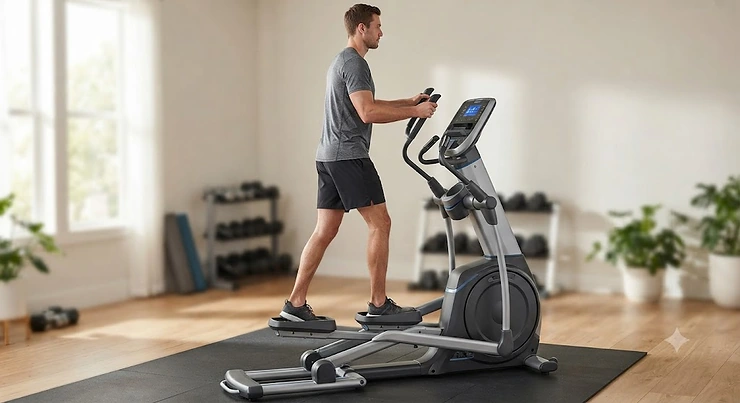
If you’ve ever climbed onto a standard elliptical and felt like a marionette with its strings cut too short, you already know why finding the best elliptical for tall person use is its own category of shopping, not just a footnote in a buying guide. Most machines on showroom floors are engineered around a stride length of 18 to 20 inches, a number that flatters someone who’s 5’8″ and quietly punishes anyone pushing past 6’1″. Your knees never fully unfold. Your hips twist to compensate. What should feel like gliding turns into something closer to shuffling in place.
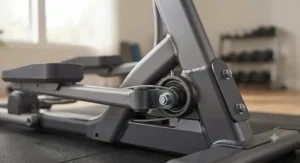
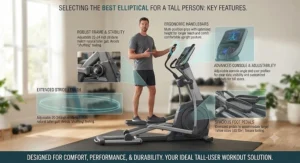
So what is the best elliptical for tall person use, in plain terms? It’s a machine with a stride length of 20 inches or more — ideally adjustable between 20 and 24 inches — paired with adjustable foot pedals, a longer overall frame, and a weight capacity that matches a bigger frame, so your natural gait is respected instead of chopped down to fit a machine built for someone else’s height.
This guide digs into seven real, currently available machines that solve that exact problem, from Sole’s flagship adjustable-stride monster to a scrappy Schwinn that punches above its price tag. We’ll cover elliptical machine tall users actually rely on day to day, break down comparative specs so you’re not squinting at spec sheets alone, and hand you a decision framework so the choice stops feeling like guesswork. According to the Centers for Disease Control and Prevention, adults need at least 150 minutes of moderate-intensity aerobic activity each week — and an elliptical that actually fits your body is what turns that recommendation from an obligation into something you’ll come back to on a Tuesday night without being nagged into it. Let’s find the machine that fits you, not the other way around.
Quick Comparison Table
Before we go deep on all seven machines, here’s the express version for anyone who wants the gist before committing to a full read.
| Elliptical | Stride Length | Best For |
|---|---|---|
| Sole E95S | 18″–24″ (power adjustable) | Households mixing tall and short users |
| Nautilus E618 | 22″ (fixed) | Best long stride under $1,500 |
| Sole E35 | 20″–22″ (extendable) | Touchscreen streaming plus a longer stride |
| Body Solid E300 Endurance | 21″ (fixed, center-drive) | Smallest footprint for a long stride |
| Schwinn 430 | 20″ (fixed) | Tightest budget without sacrificing stride |
Look at that spread for a second: three inches of stride separates the shortest and longest machines on this list, and three inches is precisely the difference between a stride that feels like a natural walk and one that feels like you’re being asked to jog in place with your knees still bent. Machines with adjustable stride, like the Sole E95S, cost more but solve the “who else uses this machine” problem outright — handy if you’re 6’4″ and your partner is 5’4″. Fixed-stride machines like the Body Solid E300 Endurance and Schwinn 430 are cheaper and simpler, but they lock you into one geometry, so measuring your own natural walking stride before buying matters more with these than with anything adjustable.
💬 Just one click — help others make better buying decisions too!😊
Top 7 Ellipticals for Tall Users: Expert Analysis
Below are seven real, currently sold machines spanning budget, mid-range, and premium territory. Every one of them addresses the core problem tall users run into: a stride path that’s too short for a natural gait.
1. Sole E95S — most versatile adjustable stride on the market
The standout here isn’t subtle: a power-adjustable stride that stretches from 18 to 24 inches at the touch of a button, mid-workout, no tools required.
That range matters more than any other spec on this list. Most tall-friendly ellipticals top out around 21 or 22 inches fixed, which is fine for someone at 6’1″ but starts to feel cramped again past 6’4″. A 30-pound flywheel keeps the motion smooth even at the longest stride settings, where lighter flywheels tend to feel jerky, and the 400-pound weight capacity means the frame isn’t the limiting factor for larger users the way it is on cheaper machines. Based on the spec comparison, this is the rare elliptical that can genuinely serve a 5’2″ user and a 6’6″ user in the same household without either person feeling like an afterthought. Reviewers consistently report that the adjustable stride is the single feature that sold them, particularly people who’d bounced off two or three shorter-stride machines before landing here. Aggregated sentiment also points to the 13.3-inch touchscreen and built-in apps as a pleasant bonus rather than the main draw — most buyers are here for the biomechanics, not the entertainment center.
Pros:
- ✅ Power adjustable stride fits users from average height to very tall
- ✅ 30-pound flywheel keeps long-stride motion smooth, not choppy
- ✅ 400-pound capacity suits larger and taller frames confidently
Cons:
- ❌ Premium price puts it out of reach for casual users
- ❌ Adjustable-stride mechanism adds long-term maintenance complexity
Expect a price in the $2,700-$3,000 range for the Sole E95S, and given that it functionally replaces two or three cheaper machines by serving multiple heights, the value case holds up better than the sticker price suggests.
2. Nautilus E618 — longest stride under $1,500
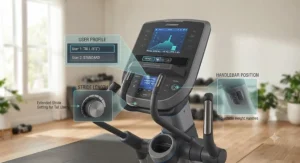
Twenty-two inches of fixed stride length, at a price point where most competitors are still stuck at 18 to 20 inches.
That extra two inches isn’t a rounding error. What most buyers overlook about this model is that Nautilus achieved that longer stride without ballooning the price into Sole E95S territory — a 30-pound flywheel and 350-pound weight capacity round out a spec sheet that reads like a machine costing several hundred dollars more. The power incline (0 to 10 degrees) adds workout variety that fixed-incline budget machines simply can’t offer. Reviewers frequently single out the build quality as surprisingly solid for the price, noting the machine feels planted and doesn’t wobble even during vigorous intervals, though the console itself is described as basic — no touchscreen, just LCD windows and Bluetooth data export. For someone over 6’2″ who doesn’t want to spend Sole-flagship money, this is consistently the machine research points to as the smartest fixed-stride compromise.
Pros:
- ✅ 22-inch stride rivals machines costing twice as much
- ✅ 30-pound flywheel delivers smooth motion at this price tier
- ✅ 350-pound capacity accommodates larger, taller users comfortably
Cons:
- ❌ No touchscreen, just basic LCD console displays
- ❌ Fixed stride won’t flex for much shorter household members
The Nautilus E618 typically lands in the $1,000-$1,400 range, and for tall users on a mid-tier budget, it’s hard to find a longer stride per dollar spent anywhere else on this list.
3. Sole E35 — best touchscreen for an extendable stride
A 20-inch base stride that extends to 22 inches, paired with a 10.1-inch touchscreen that punches well above its console-class competitors.
Here’s what to weigh: the extendable stride isn’t as dramatic as the E95S’s six-inch swing, but it’s enough to matter for users in the 6’0″-to-6’3″ range who want some flexibility without paying flagship prices. A 25-pound flywheel and roughly 350-pound weight capacity keep the ride stable, and the touchscreen supports streaming and mirrored content, which is a genuine draw for anyone who wants entertainment during longer sessions rather than staring at a wall. What the spec sheet won’t tell you, but reviewer patterns suggest, is that the adjustable foot pedals on this model reduce the ankle strain some tall users report on fixed-pedal machines — a detail that matters more the longer your sessions run. This is squarely a mid-premium pick for someone who wants Sole’s build quality and a genuinely longer stride, but doesn’t need the E95S’s full 24-inch ceiling.
Pros:
- ✅ Extendable 20″–22″ stride accommodates most tall users well
- ✅ 10.1-inch touchscreen with streaming beats most rivals nearby
- ✅ Adjustable pedals reduce ankle strain during longer sessions
Cons:
- ❌ Smaller stride range than the fully adjustable E95S
- ❌ Touchscreen apps may require a subscription for full access
Look for the Sole E35 in the $1,500-$1,700 range — a reasonable middle ground between the Nautilus E618’s value and the E95S’s flagship flexibility.
4. Body Solid E300 Endurance — smoothest center-drive glide
A patented center-drive design that delivers a natural 21-inch stride while keeping the machine’s footprint under seven feet, smaller than most front-drive competitors with similar stride lengths.
Here’s what most spec sheets don’t explain well: center-drive machines position the flywheel in the middle of the frame rather than the front or back, which lowers the center of gravity and produces a more upright, anatomically correct stride path. For tall users specifically, this matters because front-drive machines often force a slight forward lean that compounds discomfort over long strides — the Body Solid E300 Endurance sidesteps that by design. The tradeoff, and it’s a real one, is that the 21-inch stride is completely fixed, so users well past 6’4″ may still feel restricted, per aggregated reviewer sentiment. A 300-pound weight capacity and an 8-inch step-up height round out a machine built more for durability and stability than flashy features — there’s no incline here at all, which some buyers flag as a limitation given the price. Reviewers describe the ride as remarkably quiet and stable even during aggressive interval work.
Pros:
- ✅ Center-drive stride feels natural and reduces hip fatigue
- ✅ Compact footprint despite a generous 21-inch stride length
- ✅ Low 8-inch step-up height makes mounting easy for anyone
Cons:
- ❌ Stride length is fixed with no adjustability whatsoever
- ❌ No incline feature limits workout intensity variation
Budget the $1,700-$1,900 range for the Body Solid E300 Endurance, a fair ask for commercial-grade construction, provided your height comfortably fits its fixed 21-inch geometry.
5. Sole E25 — best value entry point from Sole
A 20-inch stride length on Sole’s most affordable model, wrapped in a footprint that’s noticeably smaller than competing front-drive machines at the same stride length.
Based on the spec comparison, the E25 is proof that a 20-inch stride doesn’t require flagship pricing — Sole simply stripped back the touchscreen and adjustable-stride mechanics found on the E35 and E95S while keeping the frame geometry that actually matters for comfort. Aggregated reviewer sentiment, including professional trainer assessments, rates the E25 highly on ergonomics specifically, citing the long stride, textured pedals, and clear speaker quality as standouts that punch above the entry-level price point. What most buyers overlook is that this is the base model in a six-machine Sole lineup, meaning the frame engineering and quality control benefit from the same manufacturing standards as pricier siblings. The main compromise: incline adjustment here requires manually repositioning the ramp, which means stepping off the machine, rather than a powered button-press adjustment.
Pros:
- ✅ 20-inch stride at a genuinely entry-level Sole price point
- ✅ Compact footprint compared with similar-stride competitors
- ✅ Strong ergonomics rating from independent trainer testing
Cons:
- ❌ Manual incline adjustment requires stepping off the machine
- ❌ No stride adjustability if household members vary in height
The Sole E25 typically runs in the $1,100-$1,300 range, making it one of the more approachable ways to get a genuinely tall-friendly stride without the premium sticker.
6. Schwinn 430 — best budget stride under $1,000
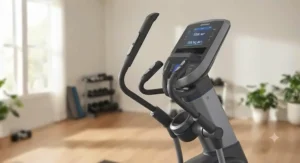
A 20-inch stride length on a machine that regularly retails for a few hundred dollars less than competitors offering the same measurement.
This is where value shopping gets interesting: cheaper ellipticals typically shave stride length down to 13 to 16 inches to hit a lower price point, but the Schwinn 430 holds the line at 20 inches, which is the threshold most guidance considers the minimum for comfortable use above roughly 5’7″. A 20-pound flywheel and magnetic resistance system keep things quiet, and a tester over 6’4″ reported the stride felt comfortable during months of near-daily use, which is a meaningful data point given how many budget ellipticals fall apart under sustained heavy use. Reviewers consistently note a tradeoff, though: build quality doesn’t match pricier machines, with some reports of components loosening or breaking after moderate use, and Consumer Reports testing specifically flagged that a tall user’s arms occasionally contacted moving parts of the frame — worth testing in person if you’re on the taller end of this machine’s comfortable range.
Pros:
- ✅ 20-inch stride rare at this price among budget ellipticals
- ✅ Six manual incline levels add workout variety cheaply
- ✅ Comfortable for testers over 6 feet during extended use
Cons:
- ❌ Build quality reports suggest shorter long-term durability
- ❌ Tall users may experience arm contact with frame parts
Expect the Schwinn 430 to sit in the $800-$1,000 range, an honest budget pick provided you treat it as a multi-year machine rather than a decade-long investment.
7. Sole E95 — best adjustable pedals for joint-sensitive striders
A fixed 20-inch stride paired with adjustable foot pedals that can be tweaked in both length and slope angle — a detail aimed squarely at reducing knee and ankle strain.
Here’s the nuance: this machine doesn’t extend its stride the way its sibling the E95S does, but what most buyers overlook is that pedal angle adjustability solves a different, equally real problem. The pedals ship with a standard two-degree inward slope, and reviewers with prior knee injuries specifically credit that adjustability with letting them fine-tune the angle until joint pain during workouts largely disappeared. A 27-pound flywheel and a weight capacity in line with Sole’s higher-end models keep the ride stable under heavier or more aggressive use. Based on the spec comparison, this sits as the practical middle option between the E25’s affordability and the E95S’s full stride adjustability — you’re paying more for durability, pedal customization, and Sole’s flagship-grade components, not for extra inches of stride.
Pros:
- ✅ Adjustable pedal angle reduces knee and ankle strain
- ✅ Heavy-duty 27-pound flywheel smooths out the ride
- ✅ Flagship-level build quality without full stride adjustability
Cons:
- ❌ Fixed 20-inch stride, shorter than several rivals here
- ❌ Costs more than fixed-stride competitors with similar specs
The Sole E95 typically runs in the $2,000-$2,300 range, a fair middle-tier price for buyers who value joint-friendly pedal engineering over maximum stride length.
Practical Usage Guide: Setting Up Your Elliptical for a Tall Frame
Getting the right machine is half the battle; setting it up correctly for your actual height is the other half, and it’s the part most people skip. Start by measuring your natural walking stride at home — mark ten steps on the floor, measure the average distance, and use that number as your target rather than relying on height alone, since leg length varies independently of overall height. If you’ve landed on an adjustable-stride machine like the Sole E95S or Sole E35, start at the shortest setting for your first week and extend gradually as your hips and knees adapt; jumping straight to 24 inches on day one is a common first-month mistake that leads to soreness that has nothing to do with cardio fitness.
Handlebar height matters just as much as stride length for tall users, and it’s frequently overlooked during setup. If your machine has adjustable handles, set them so your elbows sit at a slight bend, not locked straight, which reduces shoulder strain during longer sessions. For maintenance, wipe down the pedal tracks weekly to prevent dust buildup that causes uneven wear, and check bolt tightness monthly on any fixed-stride machine like the Body Solid E300 Endurance or Schwinn 430, since the longer lever arms involved in a tall user’s stride put more stress on frame connections than a shorter stride would. Most manufacturers recommend lubricating moving rail components every three to six months depending on usage frequency — skipping this is the single most common reason budget machines develop the squeaks and wobbles that show up in negative reviews after six months of ownership.
Real-World Scenarios: Which Elliptical Fits Your Height and Life
Picture three different tall users, because the “best” machine genuinely depends on who’s asking. First, imagine a 6’5″ home-gym enthusiast in a shared household with a 5’3″ partner — this is the textbook case for the Sole E95S, since its 18-to-24-inch power adjustable stride means neither person compromises, and the investment gets used by two people instead of one, which meaningfully improves the cost-per-use math over a few years of ownership.
Second, consider a budget-conscious 6’2″ graduate student setting up a first apartment gym with limited funds — the Schwinn 430 or Sole E25 both make sense here, offering genuine 20-inch strides without the premium price tag, accepting some tradeoffs in long-term durability or entertainment features in exchange for getting a properly fitted machine into a tight budget. Third, picture a 6’6″ former athlete managing an old knee injury who needs both a long stride and joint-friendly customization — the Sole E95 or Sole E95S fit this scenario specifically because of their adjustable pedal angles, a detail that matters more to this user than to someone without joint history. Matching your specific situation, not just your height number, to these seven machines will save you from buying based on stride length alone and discovering later that pedal design or handlebar geometry was actually your bigger comfort issue.
Buyer’s Decision Framework
If you’re over 6’4″ and sharing the machine with someone significantly shorter, choose the Sole E95S because its adjustable stride is the only feature on this list that genuinely serves both extremes of a height range without compromise. If you’re between 6’0″ and 6’3″ and want the longest stride possible without flagship pricing, choose the Nautilus E618, because its 22-inch fixed stride outperforms nearly everything else in its price bracket. If joint pain or a prior knee injury shapes your buying decision more than raw stride length does, choose the Sole E95 or Sole E35, since adjustable pedal angle addresses a different comfort variable than stride length alone.
If floor space is your binding constraint, choose the Body Solid E300 Endurance, since its center-drive design delivers a 21-inch stride in a noticeably smaller footprint than front-drive alternatives. And if budget is the deciding factor above all else, choose the Schwinn 430 first and the Sole E25 second, accepting that you’re trading some long-term durability and console sophistication for a genuinely comfortable 20-inch stride at a fraction of the flagship price. This simple checklist — height and household variance, joint history, floor space, budget ceiling — covers the four variables that actually separate these seven machines from one another.
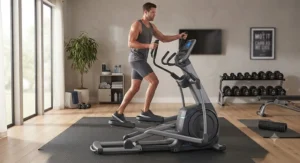
How to Choose an Elliptical Machine for Tall Users
- Measure your actual stride, not just your height. Two people at 6’2″ can have meaningfully different leg lengths, and stride comfort tracks leg length more precisely than overall height does.
- Prioritize stride length above almost every other spec. A touchscreen console doesn’t matter if your knees never fully extend during the pedal stroke.
- Decide whether adjustable stride is worth the premium. Single-user tall households can often save money on a well-fitted fixed-stride machine; multi-height households usually can’t.
- Check the weight capacity against your actual weight, not just your height. Taller users often weigh more, and frame stability suffers when capacity limits are pushed too close.
- Test pedal adjustability if you have any joint history. Angle and position adjustability, as seen on the Sole E95 and Sole E35, solves knee and ankle discomfort that stride length alone won’t fix.
- Consider your ceiling height if incline matters to you. Higher incline settings raise your head position, and tall users hit ceiling constraints faster than average-height users do.
- Read the return policy before you buy. Elliptical fit is genuinely hard to judge from spec sheets alone, and a workable return window protects you if the stride still feels wrong after a week of real use.
Common Mistakes When Buying an Elliptical for Tall Individuals
The most frequent mistake tall buyers make is shopping by height chart alone rather than measuring actual leg length, since two people of identical height can need strides that differ by two or three inches depending on torso-to-leg ratio. A close second is underestimating how much a fixed fatigue point matters: buyers assume a 20-inch stride will “probably be fine,” commit to a machine like the Schwinn 430 or Body Solid E300 Endurance, and then discover weeks later that their particular gait needed 22 inches all along, at which point returning a 150-pound machine is far less convenient than measuring correctly the first time.
Another recurring error is ignoring handlebar and console height in favor of obsessing over stride length alone — a machine with a perfect stride but a console positioned for someone six inches shorter creates a different but equally real discomfort. Buyers also frequently skip checking weight capacity against their actual body weight, assuming height and weight capacity scale together, when in fact many budget machines cap out around 300 pounds regardless of frame length. Finally, a subtler mistake: assuming the most expensive machine, like the Sole E95S, is automatically the right choice for any tall user, when in reality a single tall person living alone with no joint concerns is often better served, dollar for dollar, by the Nautilus E618 or Sole E25.
Adjustable Stride Elliptical vs Fixed Stride: What Actually Matters
An adjustable stride elliptical changes its foot-pedal geometry on the fly, typically via a motorized ramp mechanism, letting one machine serve a range of heights instead of locking in a single stride. The Sole E95S represents the top end of this category with its 18-to-24-inch range, while the Sole E35 offers a more modest but still useful 20-to-22-inch extension. Fixed-stride machines, by contrast — the Nautilus E618, Body Solid E300 Endurance, Schwinn 430, Sole E25, and Sole E95 on this list — lock in one geometry at the factory, which keeps costs down and mechanical complexity lower, since there’s no motorized adjustment system that can eventually wear out or malfunction.
The real-world tradeoff comes down to household composition and long-term maintenance risk. A single tall user living alone rarely benefits enough from adjustability to justify the premium — a well-matched fixed stride like the Nautilus E618’s 22 inches will serve just as well, and with one less mechanical system to eventually service. Multi-height households tell a different story: research on running biomechanics across different statures has found that stride length mismatches measurably change joint loading patterns during exercise, which is exactly the kind of finding that supports paying more for adjustability when a 6’5″ user and a 5’2″ user genuinely need different geometries from the same machine.
What to Expect: Real-World Performance on a Long-Stride Elliptical
Specs on paper translate into a specific everyday feeling once you’re actually on the machine, and it’s worth knowing what that feeling should be. On a properly fitted 20-to-22-inch stride, your legs should reach a near-full extension at the back of the stroke without locking your knee, and the motion should feel closer to a smooth glide than a stepping or shuffling sensation. If you still feel your knees banging into anything, or if your hips rock side to side to complete the stroke, that’s a sign the stride is still too short for your body, regardless of what the height chart on the box suggested.
Flywheel weight shapes the feel more than most buyers expect going in: heavier flywheels, like the 30-pound units on the Sole E95S and Nautilus E618, produce momentum that carries you smoothly between pedal strokes, while lighter flywheels under 20 pounds can feel choppier, particularly at longer stride settings where each stroke covers more distance and needs more inertia to stay smooth. Reviewers consistently note that comfortable elliptical for height sessions longer than 30 minutes reveal problems that a five-minute showroom test never will — pedal cushioning that felt fine initially can start causing foot numbness, and handlebar angles that seemed comfortable can start straining shoulders once fatigue sets in. Research on lower-extremity muscle engagement during elliptical exercise confirms that stride mechanics directly affect how effectively the glutes, hamstrings, and quadriceps are engaged through the full range of motion, which is precisely why a cramped stride doesn’t just feel bad — it measurably reduces the workout’s effectiveness.
Ergonomic Fitness Equipment for a Tall Body: Beyond the Elliptical
Stride length gets most of the attention in elliptical shopping, but ergonomic fitness equipment tall body considerations extend well past that single spec, and overlooking the rest can undercut an otherwise good purchase. Handlebar reach matters enormously — moving handlebars that are too short force a hunched posture that tall users often don’t notice until their lower back starts complaining after a few weeks of regular use. Step-up height is another underrated factor: a low step-up like the 8 inches on the Body Solid E300 Endurance makes mounting and dismounting easier for anyone with longer legs and a higher center of gravity, reducing the awkward high-step entry some taller machines require.
Console and display positioning deserves a look too, since a screen mounted low on the frame forces a tall user to hunch forward to read it clearly, undermining the upright posture the exercise is supposed to encourage in the first place. Pedal size matters as much as pedal count of adjustment positions — oversized footplates, like those on several machines in this roundup, accommodate the larger shoe sizes that often correlate with height without forcing an uncomfortable heel or toe overhang. None of these secondary factors show up prominently on spec sheets or marketing copy, but aggregated reviewer feedback across nearly every machine on this list circles back to them repeatedly once people have logged real hours on their purchase.
Features That Actually Matter (And Those That Don’t)
Marketing copy loves to lead with touchscreen size and app libraries, but for a tall buyer specifically, stride length and pedal adjustability matter more than nearly anything else on the spec sheet — a gorgeous 14-inch touchscreen bolted to an 18-inch stride still leaves your knees cramped, no matter how good the streaming picture looks. Flywheel weight matters more than most buyers initially assume, since it directly shapes how smooth a longer stride feels in practice, while resistance level count past roughly 20 settings tends to offer diminishing returns for anyone who isn’t training at an elite level.
Incline and decline features are genuinely useful for workout variety, but they’re a distant second priority behind stride fit for tall users specifically — a machine with 15% incline and a cramped stride is still a cramped stride. Bluetooth connectivity and app integrations are pleasant conveniences rather than must-haves; they don’t change how your body actually interacts with the machine during a workout. Warranty length, on the other hand, deserves more attention than it typically gets, since a longer stride under sustained heavier use — which taller, often heavier users generate — puts more cumulative stress on frame components than the average height and weight the machine was originally tested against.
Long-Term Cost & Maintenance for Your Elliptical Investment
Sticker price only tells part of the financial story, and cost-per-use math shifts considerably once you factor in expected lifespan and maintenance needs. A premium machine like the Sole E95S, priced in the $2,700-$3,000 range, amortizes to a genuinely reasonable daily cost if it serves a household of two or three people over five-plus years, particularly compared with a gym membership covering the same number of people over the same span. A budget pick like the Schwinn 430, priced in the $800-$1,000 range, looks far cheaper upfront but reviewer patterns suggesting shorter component lifespans mean the realistic cost-per-year gap between budget and mid-range machines is often smaller than the initial price tags suggest.
Maintenance costs matter too: fixed-stride machines like the Body Solid E300 Endurance and Nautilus E618 have fewer moving parts prone to failure than adjustable-stride machines, which carry an extra motorized mechanism that can eventually need service or replacement. Warranty coverage should factor directly into this math — a machine backed by a lifetime frame warranty effectively caps your worst-case replacement cost at parts and labor rather than a full frame replacement, which matters more for taller, heavier users putting above-average stress on frame components over years of regular use.
Frequently Asked Questions
❓ What stride length is best for a 6'2' person?
❓ Can a short person use an adjustable stride elliptical too?
❓ Do ellipticals with longer strides cost significantly more?
❓ Is a fixed or adjustable stride elliptical better for a single tall user?
❓ How do I know if my current elliptical's stride is too short?
Conclusion
Finding the best elliptical for tall person needs comes down to a short list of variables that matter far more than screen size or app libraries: stride length first, pedal and handlebar adjustability second, and weight capacity and build quality rounding out the picture. The Sole E95S earns its premium price by genuinely serving households with mixed heights, the Nautilus E618 delivers the best long stride relative to its price tag, and the Schwinn 430 proves a comfortable stride doesn’t have to break the bank.
Whichever of these seven machines fits your specific situation — height, budget, household composition, and joint history all play a role — the underlying principle stays the same: don’t let a shortened, cramped stride quietly rob you of the workout you’re actually trying to get. Measure your natural gait, match it against the specs above, and pick the machine that lets your body move the way it’s actually built to move.
✨ Don’t Miss These Exclusive Deals!
🔍 Take your home cardio setup to the next level with these carefully selected long-stride ellipticals. Click on any highlighted machine above to check current pricing and availability. The right fit will help you build a workout habit that actually sticks!
Recommended for You
- Best Elliptical for Weight Loss: 7 Top Picks Tested for 2026
- Best Elliptical for Seniors 2026: 7 Safe, Low-Impact Picks
- Best Elliptical For Beginners: 7 Picks Worth Your Money (2026)
✨ Found this helpful? Share it with your friends! 💬🤗
