
In This Article
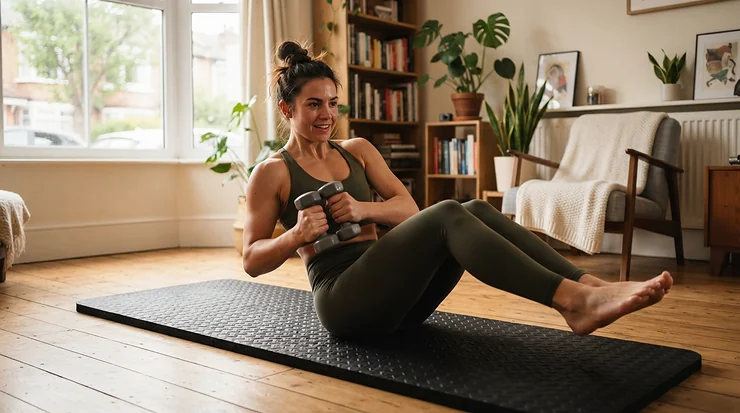
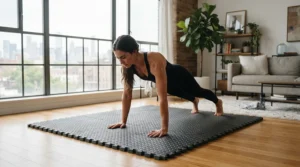
A floor mat for quiet home workouts in apartment living is a dense, shock-absorbing surface (EVA foam, rubber, or a layered mix of both) that cushions jumps, set-downs, and footfalls. Less vibration then travels through the building to the unit below. Think of it as a shock absorber for your living room.
Here’s what the fitness videos skip. Your burpee is a small earthquake. Sound in a multi-unit building travels through the structure itself, not just the air, which is why your downstairs neighbor can tell exactly when you start your jumping jacks. Engineers score that structure-borne racket with impact insulation class, a logarithmic rating of how well a floor-and-ceiling assembly muffles footsteps and other impacts. Adding a mat is a renter-friendly way to soften what reaches the ceiling below.
Let’s be honest about the limits, though. No mat turns a fourth-floor unit into a padded studio. A good apartment friendly workout mat takes the sharp, thudding edge off impacts. That edge is usually what triggers the knock on your door.
Below you’ll find seven real products. Each comes with aggregated review themes from published testing and roundups and with honest reasoning about who it suits. There are no invented customer quotes and no claims of personal testing. Your floor plan, workout style, and building construction pick the winner, so we’ll cover all three.
Quick Comparison: Apartment Friendly Workout Mat Options at a Glance
Here’s the fast version. The picks run from budget foam to premium drop pads, so skim for the row that matches your workouts.
| Product | Type & Thickness | Price Range | Best For |
|---|---|---|---|
| ProsourceFit Extra Thick Puzzle Exercise Mat (1-Inch) | EVA foam tiles, 1 in | Budget tier | Yoga, Pilates, bodyweight |
| ProsourceFit Rubber Top Exercise Puzzle Mat | Rubber top over EVA foam, ½ or ¾ in | Budget-to-mid tier | Light dumbbells, better grip |
| SUPERJARE 0.79-Inch Rubber Top Tiles | EPDM rubber over EVA foam, 0.79 in | Mid tier | Kettlebells, HIIT, shared walls |
| AIRHOP 0.79-Inch Rubber Top Tiles | Rubber over EVA foam, 0.79 in | Mid tier | Thick, grippy full-room floors |
| Gorilla Mats Premium Large Exercise Mat | One-piece ProFoam, 6 mm, 6 x 4 ft | Around $120-$160 | Plyometrics, dance, cardio |
| Titan Fitness Silencer Drop Pads | Foam blocks, 6 in, sold as a pair | Around $150-$175 | Overhead drops, step-ups |
| Bells of Steel Deadlift Pads | Foam blocks, 6 in, sold as a pair | Around $170-$200 | Deadlift set-downs |
Looking at the table, the two rubber-top tile options and the foam puzzle mat cover the whole floor. The Titan Fitness Silencer Drop Pads and Bells of Steel Deadlift Pads only guard the spot where weight lands. If your workouts are mostly bodyweight, the ProsourceFit Extra Thick Puzzle Exercise Mat (1-Inch) is the cheapest sensible start. Anyone lifting weights should look at the hybrids first, then add pads only if a barbell is involved.
💬 Just one click — help others make better buying decisions too!😊
Top 7 Picks for a Floor Mat for Quiet Home Workouts in Apartment Life: Expert Analysis
The trainers behind Garage Gym Reviews’ soundproof mat roundup make a point worth remembering. Mats absorb some impact and vibration, but they won’t completely silence a dropped bar. Treat every pick below as a volume knob, not a mute button.
1. ProsourceFit Extra Thick Puzzle Exercise Mat (1-Inch) — the budget cushion for bodyweight days
This is the entry ticket to a quieter workout, and it’s happily unpretentious. It’s six 24-by-24-inch EVA foam tiles covering 24 square feet, with border pieces for a finished edge. A ¾-inch version also exists.
The full inch of foam matters because more material means more compression distance for a landing foot. That softens the thump before it reaches the subfloor. The textured surface adds traction for push-ups and lunges, and the foam is water-resistant, so sweat wipes off. Based on the spec comparison, it suits beginners, yoga and Pilates fans, and anyone whose heaviest gear is a pair of light dumbbells.
What most buyers overlook is that foam alone is soft. The listing itself warns it may compress under heavy objects, so keep racks and benches off it. Garage Gym Reviews notes that puzzle edges can pull apart during fast, explosive moves. Another roundup found more sock-slide on pure foam than on rubber-top tiles.
Pros:
- ✅ Thick foam softens landings and floor exercises
- ✅ Lightweight tiles store easily in an apartment closet
- ✅ Easy-to-wipe, water-resistant surface
Cons:
- ❌ Puzzle edges can separate during explosive movements
- ❌ Compresses under heavy equipment
Price check: budget tier, varying by set size, so check current price. It’s great value for low-impact routines.
2. ProsourceFit Rubber Top Exercise Puzzle Mat (½-Inch or ¾-Inch) — foam comfort with a grippier rubber skin
This hybrid puts a rubber surface over an EVA foam base. It comes in ½-inch and ¾-inch thicknesses and in 24 or 48 square-foot sets.
The rubber layer is the upgrade over plain foam. It gives sturdier footing and stands up better to dumbbell set-downs and equipment feet. The foam underneath still does the shock absorbing. Take the ¾-inch version if quiet is the goal, because the ½-inch gives up cushioning that jumping and burpees will miss. Based on the specs, the rubber top makes it a smart step up for people who’ve outgrown bare foam but don’t want to spend hybrid-tile money.
An honest caveat: I couldn’t find a deep pool of independent published tests for this exact model. Roundups describe the rubber-top-over-EVA design generally as combining the strengths of both materials. Treat this one as promising on paper and read current buyer feedback before ordering.
Pros:
- ✅ Rubber top improves grip over bare foam
- ✅ Choice of two thicknesses and set sizes
- ✅ Foam base still cushions impact
Cons:
- ❌ Limited independent testing data available
- ❌ The ½-inch option gives up cushioning
Price check: budget-to-mid tier at the time of research, and prices vary by size. It’s decent value if you choose the ¾-inch.
3. SUPERJARE 0.79-Inch Extra-Thick Rubber Top Tiles — the value hybrid for shared-wall living
These 24-by-24-inch tiles pair an EPDM rubber top with a high-density EVA foam base. They come in 6-, 12-, and 18-tile sets (24, 48, or 72 square feet). The brand lists roughly 2.6 pounds per tile, so lifting the whole floor is easy.
The construction is the story. The rubber wears and grips while the foam takes the shock, and at 0.79 inches you get real compression travel without a wobbly surface. The seller says the tiles have no rubber odor, so check current buyer feedback on that. It’s a sensible choice for kettlebell swings, dumbbell circuits, and HIIT in a second-floor unit.
One published roundup singled out noise reduction as the standout for a basement gym shared with neighbors below. It’s an affiliate-supported roundup, so weigh it accordingly. Buyer feedback highlighted on the listing praises the traction and a cushion that stays stable enough for balance work.
Pros:
- ✅ Rubber grip over a shock-absorbing foam base
- ✅ Multiple set sizes, from corner to full room
- ✅ Light tiles, easy to reconfigure
Cons:
- ❌ Foam base isn’t built for heavy barbell drops
- ❌ Noise claims rest mostly on seller and roundup statements
Price check: mid tier, scaling with set size. It’s the value pick for most apartment lifters.
4. AIRHOP 0.79-Inch Rubber Top EVA Foam Tiles — the thick, grippy contender with strong roundup praise
AIRHOP sells this same hybrid concept in several thicknesses (0.56, 0.79, and 1 inch), with 24 and 48 square-foot sets. The 0.79-inch version is the apartment sweet spot.
Its rubber top and EVA base copy the SUPERJARE formula, and that’s a compliment. Differences are small, so let color, set size, and current price break the tie. Extra thickness earns its keep here. One affiliate-supported roundup gave the 0.79-inch AIRHOP its top rating and said a 45-pound plate dropped from waist height was barely audible in the next room. It’s a single reviewer’s anecdote, but it fits the physics of thicker foam.
An honest note: independent lab-style noise data doesn’t seem to exist for tiles like these, so expect improvement, not silence. Concrete slabs and wood-frame buildings transmit sound very differently.
Pros:
- ✅ Thick 0.79-inch build for extra shock absorption
- ✅ Rubber surface grips during sweaty sessions
- ✅ Multiple thicknesses to match your workouts
Cons:
- ❌ No independent noise-test data
- ❌ Still foam-based, so drops need caution
Price check: mid tier depending on set size. It’s a strong value if you shop for the thickest option you can afford.
5. Gorilla Mats Premium Large Exercise Mat — one seamless piece for jumping and dancing
This is a single 6-by-4-foot ProFoam sheet, 6 mm thick and about 14 pounds. It ships with two storage straps and a microfiber cleaning towel, and a lifetime warranty backs it. Published testing lists it around the $139 mark.
The seamless design is the appeal. With no tile edges to shift, it suits push-ups, burpees, plyometrics, and dance workouts. Its underside pattern grips hardwood, and it rolls up like an oversized yoga mat. That makes it a natural apartment fitness setup hero for shared living rooms.
The trade-off is thickness. At a quarter inch, it won’t tame heavy impacts, and Garage Gym Reviews steers barbell lifters elsewhere. Reviewers liked the size and affordability, while some reported slipping on certain carpets and slickness when wet.
Pros:
- ✅ Seamless surface with no edges to separate
- ✅ Rolls up neatly for storage
- ✅ Lifetime warranty
Cons:
- ❌ Only a quarter inch thick
- ❌ Can slip on some carpets and get slick when wet
Price check: around the $120-$160 range at the time of the cited testing, so check current price. It’s worth it for bodyweight-focused routines.
6. Titan Fitness Silencer Drop Pads — 6-inch foam blocks that catch the loudest moment
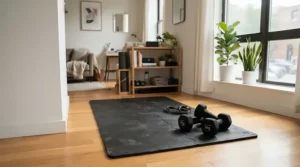
These are a pair of 30-by-24-by-6-inch pads at roughly 22 pounds each. They have a vinyl cover, dense foam inside, carry handles, and a listed 300-pound weight capacity.
They aren’t a floor. They’re a landing zone. Lay tiles across the room and put these where weight actually comes down, because the loudest sound in any apartment workout is the set-down. Garage Gym Reviews’ trainers also use similar pads for jumps and step-ups, with one warning: your feet will sink a little.
Reviewers on Amazon have complained about the cover stitching coming apart after limited use. Titan offers a one-year warranty when you buy direct.
Pros:
- ✅ Targets the loudest impact point
- ✅ Handles make storage and moving easy
- ✅ Doubles as a step-up platform
Cons:
- ❌ Some reports of stitching failing early
- ❌ Soft footing that isn’t rigid underfoot
Price check: around the $150-$175 range at the time of research. It’s expensive, but it fits lifters who need the noise control.
7. Bells of Steel Deadlift Pads — 6-inch foam pair with Velcro edges
Also sold as a pair, these are 30-by-23-by-6-inch pads at about 20 pounds each. A 600-denier polyester cover wraps the noise-reducing foam, with Velcro edges to link pads and handles for carrying. They come from a brand operating since 2010.
They excel at one job: absorbing a barbell’s final descent. Bells of Steel warns against leaving a loaded bar resting on them, since that wears the pads faster. In an apartment, put them just ahead of the bar and lower with control.
Some buyers reported stitching separating, and testers called them pricey but well-made. A one-year warranty applies. Deadlifting in an upper-floor unit may also raise lease and neighbor questions that no pad can answer.
Pros:
- ✅ Thick foam softens the barbell’s final impact
- ✅ Velcro edges link pads together
- ✅ Durable cover built for repeated use
Cons:
- ❌ Premium price for two pads
- ❌ Some stitching failures reported
Price check: around the $170-$200 range at the time of research. It’s worthwhile for serious lifters only.
Side-by-Side Spec Comparison
| Product | Thickness | Coverage/Size | Surface | Review Sentiment | Best For |
|---|---|---|---|---|---|
| ProsourceFit Extra Thick Puzzle Exercise Mat (1-Inch) | 1 in | 24 sq ft set | Textured foam | Soft, budget-friendly; edges can separate | Low-impact routines |
| ProsourceFit Rubber Top Exercise Puzzle Mat | ½ or ¾ in | 24 or 48 sq ft | Rubber top | Limited independent data | Light lifting |
| SUPERJARE 0.79-Inch Rubber Top Tiles | 0.79 in | 24-72 sq ft | Rubber top | Grippy, comfortable | Shared walls, HIIT |
| AIRHOP 0.79-Inch Rubber Top Tiles | 0.79 in | 24-48 sq ft | Rubber top | Praised in roundups | Thick full-room floors |
| Gorilla Mats Premium Large Exercise Mat | 6 mm | 6 x 4 ft | ProFoam | Roomy; can slip on carpet | Plyometrics |
| Titan Fitness Silencer Drop Pads | 6 in | 30 x 24 in each | Vinyl cover | Effective; stitching complaints | Drop zones |
| Bells of Steel Deadlift Pads | 6 in | 30 x 23 in each | Polyester cover | Quality materials; stitching complaints | Deadlift set-downs |
The pattern is clear. Thickness and material set the noise ceiling, and coverage decides how much floor you protect. The SUPERJARE and AIRHOP hybrids give the best balance for whole-room use. The Titan Fitness Silencer Drop Pads and Bells of Steel Deadlift Pads only matter if something heavy actually lands.
Apartment Fitness Setup: A Practical 30-Minute Guide
Amazon listings rarely tell you how to actually lay a mat down so it works. This routine gets a solid apartment fitness setup running in about half an hour.
Step-by-step setup
- Measure first. Sketch your workout footprint (a 6-by-4-foot rectangle covers most bodyweight work) and mark a landing zone for weights.
- Clear and clean the floor. Grit trapped under a mat can scuff finishes, so sweep and dry the area.
- Lay tiles staggered. Interlock hybrid tiles like the SUPERJARE 0.79-Inch Rubber Top Tiles in a brick pattern, then add border pieces along walls.
- Place your drop zone. Put Titan Fitness Silencer Drop Pads or Bells of Steel Deadlift Pads where the bar or weight lands.
- Test the seams. Do a few jumps and lunges to make sure nothing slides.
Maintenance schedule
Sweep weekly. Wipe or mop monthly with warm water and a small amount of dish soap, then dry thoroughly to avoid mold. Rotate tiles in high-traffic spots every six months to even out wear.
Common first-30-day mistakes
New owners often skip the seam check, drag heavy gear across foam, or lay rubber over thick carpet where it feels spongy. Give the setup a week before judging it.

Real-World Scenarios: Which Mat Fits Your Apartment Life?
Profiles beat generic advice. These three show how budget, environment, and workout frequency point to different winners.
Scenario 1: The third-floor yoga-and-HIIT beginner. She works out four mornings a week in a wood-frame building with neighbors below and a $100 budget. The ProsourceFit Extra Thick Puzzle Exercise Mat (1-Inch) covers her needs, or the Gorilla Mats Premium Large Exercise Mat if she wants seamless jumping room. Tip: schedule louder circuits after 8 a.m.
Scenario 2: The second-floor kettlebell regular. He trains three evenings a week with kettlebells and adjustable dumbbells. A 48-square-foot SUPERJARE 0.79-Inch Rubber Top Tiles or AIRHOP 0.79-Inch Rubber Top Tiles set gives grip and cushion. A Titan Fitness Silencer Drop Pads pair covers the set-down spot for later-evening work.
Scenario 3: The apartment barbell lifter. She rents a ground-floor unit and deadlifts twice weekly. She’d layer hybrid tiles with Bells of Steel Deadlift Pads at the bar. She should still check her lease, since heavy lifting can raise rules or neighbor concerns.
Downstairs Neighbor Noise: 5 Problems and Practical Fixes
Complaints about downstairs neighbor noise almost always come from specific moments, not the whole workout. Building codes only require modest impact isolation. A ScienceDirect overview notes that at the 50 IIC code minimum, footsteps from above can still be clearly audible. Your mat has real work to do.
Problem 1: Jump thumps. Swap high-impact jumps for step-ups or split squats, and use a thick hybrid such as AIRHOP 0.79-Inch Rubber Top Tiles under whatever jumping remains.
Problem 2: Dumbbell set-downs. Lower weights with control rather than releasing them. A rubber-top tile from ProsourceFit Rubber Top Exercise Puzzle Mat helps with the click of metal on floor.
Problem 3: Early or late timing. Put the loud circuit in the middle of the day.
Problem 4: Rattling seams. Gaps let tiles chatter and slide. Interlock them fully and use double-sided tape where the listing recommends it.
Problem 5: Talking to the neighbor. Sometimes the cheapest fix is a friendly heads-up about your workout schedule.
How to Choose a Floor Mat for Quiet Home Workouts in Apartment Spaces
Here are six numbered steps, each grounded in how impact sound actually behaves.
- Match thickness to your loudest move. Bodyweight work needs roughly ½ inch, while dumbbell and kettlebell circuits are better with ¾ inch or more.
- Choose the surface for grip. Rubber tops give better traction than plain foam during sweaty sessions.
- Decide between tiles and one piece. Tiles expand and rearrange, but one-piece mats like the Gorilla Mats Premium Large Exercise Mat avoid seam separation.
- Add a drop zone if weights land. Titan Fitness Silencer Drop Pads or Bells of Steel Deadlift Pads target the loudest impact.
- Consider your subfloor. Thick carpet can make heavy rubber feel spongy, so foam or one-piece mats often work better there.
- Check storage and moving. Lightweight tiles like SUPERJARE 0.79-Inch Rubber Top Tiles stash easily and move with you.
Quiet Home Gym Flooring Options: Foam, Rubber, and Hybrid Compared
The market for quiet home gym flooring options splits into three families, and each behaves differently underfoot.
| Flooring Type | Noise Control | Durability | Best For |
|---|---|---|---|
| Bare floor or thin yoga mat | Minimal | Low | Stretching only |
| EVA foam puzzle tiles | Good for light impact | Medium | Yoga, bodyweight with ProsourceFit Extra Thick Puzzle Exercise Mat (1-Inch) |
| Rubber-top hybrid tiles | Good, more durable | High | Mixed training with SUPERJARE 0.79-Inch Rubber Top Tiles |
| Thick foam drop pads | Strongest at impact point | Medium | Barbell set-downs with Bells of Steel Deadlift Pads |
Dense rubber is generally regarded as the strongest floor for cutting impact noise, but it’s heavy and costly. Hybrids like the AIRHOP 0.79-Inch Rubber Top Tiles bring much of the benefit at renter-friendly weight. Pure foam is cheapest but wears faster under gear. Drop pads solve one specific problem better than any full floor can.
Noise Reducing Exercise Mat Features That Actually Matter (And Those That Don’t)
A noise reducing exercise mat is only as good as its weak link. These features earn attention.
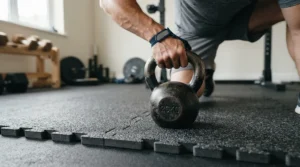
Matters: thickness, density, and whether the top layer resists dents. A soft mat that bottoms out under a dumbbell isn’t cushioning anything. Interlock quality matters too, since edges that separate during explosive movements defeat the purpose.
Matters a bit: grip texture, because sliding feet are an injury risk and a source of scuffing noise.
Doesn’t matter as much: color, marketing words like “ultra” or “pro,” and border pieces beyond a tidy look. A “noise-reducing design” claim on a listing is a description of intent, not a measured result. Ask what the mat is made of and how thick it is.
What to Expect: Impact Absorption Mat Performance in the Real World
An impact absorption mat turns spec numbers into everyday behavior. A thicker mat lets your foot decelerate over a longer distance, which lowers the peak force sent into the floor. Foam compresses easily for light loads but bottoms out under heavy ones. Rubber resists compression, which is why rubber tops keep their shape under dumbbells.
In practice, expect a softer thud, not silence. Dropped weights still transmit some vibration, particularly in wood-frame buildings. The Bells of Steel Deadlift Pads and Titan Fitness Silencer Drop Pads show the ceiling of what soft materials can do at 6 inches thick. Even they reduce noise rather than eliminate it. If you can still hear a bar hit, don’t blame the mat. It’s the physics of buildings.
Long-Term Cost & Maintenance: What Your Mat Really Costs
Cheap mats can cost more over time if they compress or split. Consider cost per year of use, not just checkout price.
| Product | Price Range | Durability Outlook | Value Verdict |
|---|---|---|---|
| ProsourceFit Extra Thick Puzzle Exercise Mat (1-Inch) | Budget tier | Foam compresses over time | Good starter |
| SUPERJARE 0.79-Inch Rubber Top Tiles | Mid tier | Rubber top resists wear | Best all-round value |
| Gorilla Mats Premium Large Exercise Mat | $120-$160 | Lifetime warranty | Strong for bodyweight |
| Bells of Steel Deadlift Pads | $170-$200 | One-year warranty | Niche but useful |
The Gorilla Mats Premium Large Exercise Mat is pricier upfront but offers a lifetime warranty. The SUPERJARE 0.79-Inch Rubber Top Tiles spread cost across a large area with a durable top layer. Drop pads carry a warranty measured in a single year, so buy them only if you’ll use them constantly.
Safety, Leases, and Noise Rules for Apartment Workouts
Noise isn’t just an annoyance. The EPA describes noise as unwanted or disturbing sound that can interfere with sleep and diminish quality of life, which is exactly what a 6 a.m. thud does to a neighbor.
Enforcement usually lives at the state and local level. Read your lease for quiet hours and flooring rules, since some require carpet coverage. Mats generally install without adhesive, which is friendlier for security deposits. Also keep safety in mind. Soft, thick surfaces can be unstable for heavy lifts, so keep barbell work on firmer surfaces and use pads only as directed.
✨ Don’t Miss These Carefully Selected Picks!
🔍 Take your apartment workouts to the next level with these products. Click on any highlighted item to check current pricing and availability. These tools will help you create a quieter routine your neighbors will notice for all the right reasons!
Frequently Asked Questions
❓ Can I jump rope on foam tiles in an apartment?
❓ Is a rubber-top mat better than plain foam for apartments?
❓ How much floor space do I need for a workout corner?
❓ Will interlocking mats damage hardwood floors or my deposit?
❓ Do drop pads replace a full workout floor?
Conclusion
Picking a floor mat for quiet home workouts in apartment living isn’t about finding a magic silencer. It’s about matching thickness, material, and layout to what you actually do. Bodyweight and yoga fans can start with the ProsourceFit Extra Thick Puzzle Exercise Mat (1-Inch). Anyone adding dumbbells or kettlebells will likely prefer the SUPERJARE 0.79-Inch Rubber Top Tiles or AIRHOP 0.79-Inch Rubber Top Tiles. The ProsourceFit Rubber Top Exercise Puzzle Mat sits between them for budget buyers who want more grip. Plyometrics fans should look at the seamless Gorilla Mats Premium Large Exercise Mat.
If a barbell or heavy weights are involved, add Titan Fitness Silencer Drop Pads or Bells of Steel Deadlift Pads where the weight lands. Then treat noise as a habit problem too: control your set-downs, time your louder circuits, and talk to the person below. Combine a smart mat with smart routines, and your apartment gym can stay in the good graces of everyone in the building.
Recommended for You
- Foam Floor Mat For Home Gym On A Budget: 7 Picks For 2026
- Carpet Protector For Exercise Bike On Carpet: 7 Proven Picks (2026)
- 7 Best Hardwood Floor Protection Mats For Elliptical Machines (2026)
Disclaimer: This article contains affiliate links. As an Amazon Associate, I earn from qualifying purchases. If you purchase products through these links, we may earn a small commission at no additional cost to you.
✨ Found this helpful? Share it with your friends! 💬🤗
