
In This Article
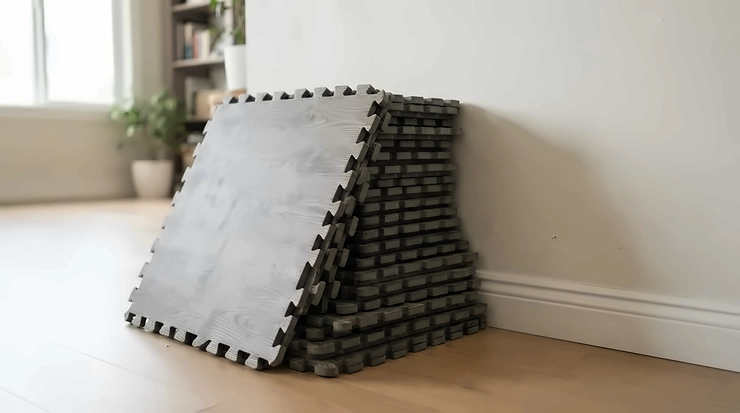
Here’s the thing nobody tells you before you buy your first squat rack: the floor underneath it matters almost as much as the equipment sitting on top of it. A foam floor mat for home gym on a budget is a set of interlocking EVA foam tiles — usually somewhere between 3/8 inch and 3/4 inch thick — that snap together like a jigsaw puzzle to cushion your joints, protect your subfloor, and quiet down the thud of dropped dumbbells, all for less than the cost of a nice dinner out. That’s the 40-second definition. The longer version is a lot more interesting, and a lot more useful, because “budget” foam flooring spans a huge range — from $12 six-tile starter packs to $250+ heavy-duty sets that still count as an absolute bargain compared to rubber rolls.
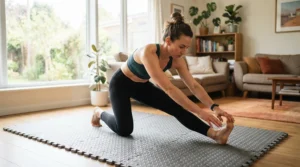
I’ve spent a good chunk of my adult life setting up, tearing down, and re-setting-up home workout corners — a spare bedroom here, a chilly garage there — and if there’s one lesson that sticks, it’s this: hard floors and heavy training don’t mix. Hardwood floors, concrete slabs, and other hard surfaces aren’t very forgiving on your joints, and doctors specifically recommend adding cushioned flooring to your workout space to be kinder to your body. That’s not marketing copy from a flooring company — that’s medical advice, and it’s exactly why this guide exists.
Below, you’ll find seven real, currently available EVA foam tile sets ranging from ultra-cheap starter kits to genuinely tough daily-driver options, plus the comparisons, buying framework, and setup know-how to help you land on the right one without wasting money on tiles that curl up at the edges after three weeks. If you’re mid-way through building a home gym on a shoestring, this is the flooring chapter you don’t want to skip.
Quick Comparison Table
| Product | Thickness | Best For | Price Range |
|---|---|---|---|
| ProsourceFit Exercise Puzzle Mat | 1/2 in | Best all-around value | $30-$70 |
| BalanceFrom Puzzle Exercise Mat | 0.39-0.5 in | Best-selling budget staple | $30-$80 |
| CAP Puzzle Exercise Mats | 0.5 in | Absolute cheapest entry point | $15-$25 |
| Yes4All Interlocking Foam Mats | 0.5 in | Clean-edged beginner setups | $30-$55 |
| We Sell Mats 3/4″ Multipurpose EVA | 3/4 in | Heavier equipment, more cushion | $50-$110 |
| IncStores High-Density Fitness Foam Tiles | 3/8-3/4 in | Premium durability on a budget | $60-$180 |
| bemaxx Puzzle Mat | 0.40 in | Small spaces and apartments | $25-$45 |
A quick scan of that table tells you most of what you need to know: thickness climbs, price climbs, and durability generally climbs right along with both. The CAP Puzzle Exercise Mats and bemaxx Puzzle Mat win on raw price, but they’re thinner and better suited to bodyweight work and stretching than to barbells. The We Sell Mats 3/4″ Multipurpose EVA and IncStores High-Density Fitness Foam Tiles cost more per square foot, yet if you’re rolling a treadmill or dropping kettlebells, that extra thickness is doing real protective work, not just padding the price tag.
💬 Bookmark this table now — you’ll want to scroll back to it once you see what each mat actually looks like in action.
Top 7 Foam Floor Mats for a Budget Home Gym: Expert Analysis
Every product below is a real, currently sold interlocking foam tile set. I’ve pulled specs, aggregated review sentiment (never invented quotes), and honest trade-off analysis for each — because “cheap” and “good enough” aren’t always the same thing, and the goal here is finding where they overlap.
1. ProsourceFit Exercise Puzzle Mat — best all-around value for most home gyms
The standout here is balance: it’s thick enough to matter and cheap enough to not think twice about. Each tile measures roughly 24 x 24 inches at 1/2 inch thick, made from EVA foam that’s phthalate-free and water-resistant, and the set typically ships as 36 tiles covering around 144 square feet, though smaller 6-tile packs exist for tighter spaces.
What that half-inch thickness means in practice is real: it’s enough foam to take the edge off dropped dumbbells and kneeling stretches without feeling squishy or unstable underfoot during standing lifts. Based on the spec comparison across this whole list, this is the tile most reviewers land on as the “just buy this” pick — it doesn’t excel at any one extreme, but it doesn’t fail at anything either, which is exactly what a first-time home-gym builder needs.
Reviewers consistently report that the interlocking edges hold tight even under rolling equipment like adjustable benches, and a common thread in aggregated feedback is that the water resistance genuinely helps in garages that see humidity swings.
Pros:
- ✅ Reliable half-inch thickness works for lifting and stretching alike
- ✅ Interlocking edges stay tight under rolling equipment
- ✅ Widely available in multiple pack sizes for any room
Cons:
- ❌ Mid-pack pricing means it’s not the outright cheapest option
- ❌ Standard black/gray colorway looks purely utilitarian
Expect to pay somewhere in the $30-$70 range depending on coverage size, and for most budget home gyms, this is the safest dollar-for-dollar bet on the list.
2. BalanceFrom Puzzle Exercise Mat — most popular anti-slip textured surface
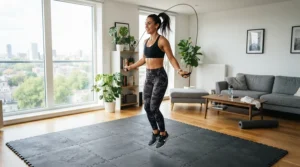
What jumps out immediately is the textured, anti-slip top layer — a small detail that makes a bigger difference than it sounds like once you’re doing floor work in socks. Specs land around 0.39-0.5 inch thickness with tiles sized near 24 x 24 inches, commonly sold in large 36-tile sets that lean toward full-room coverage rather than small accent areas.
In real-world terms, that texture matters most during high-rep bodyweight circuits and yoga-adjacent cooldowns, where a smooth foam surface can get slick with sweat. What most buyers overlook about this model is that its popularity comes less from being the thickest or toughest option and more from being the most forgiving purchase — it’s been on the market long enough that the interlock tolerances are consistent tile to tile, so you’re not fighting warped edges out of the box.
Aggregated review sentiment repeatedly mentions easy assembly and minimal off-gassing smell compared to cheaper alternatives.
Pros:
- ✅ Textured surface reduces slipping during floor exercises
- ✅ Consistent interlock fit across large multi-tile sets
- ✅ Long track record means fewer manufacturing surprises
Cons:
- ❌ Full-room 36-tile sets can be pricier than smaller starter kits
- ❌ Texture can trap dust, needing more frequent sweeping
Pricing typically falls in the $30-$80 range depending on set size, positioning it as a direct, well-reviewed rival to the ProsourceFit option above.
3. CAP Puzzle Exercise Mats — absolute cheapest entry point
This is the “I just need something under my feet today” pick, and there’s no shame in that. The diamond-pattern surface sits at roughly 0.5 inch thickness, and sets are commonly sold in small 6-tile bundles rather than full-room coverage, which is exactly why it’s such a low-commitment purchase.
Here’s what the spec sheet won’t tell you, but budget-buyer logic will: at this price, you’re not getting the same density of foam per tile as the premium options, which means it compresses a bit faster under sustained weight — think a weight bench leg sitting in one spot for months. For scattered floor work, stretching, and protecting a rental apartment’s floor from a yoga routine, though, it’s more than adequate.
Reviewers consistently frame this as the mat you buy to “try the interlocking-tile concept” before scaling up, and a common complaint in user reviews is that six tiles cover less area than people initially expect.
Pros:
- ✅ Lowest price point of any option on this list
- ✅ Diamond-textured surface adds light grip underfoot
- ✅ Low-risk way to test foam flooring before committing further
Cons:
- ❌ Smaller tile counts mean limited total coverage per pack
- ❌ Foam density is lighter-duty than pricier competitors
At around $15-$25 per pack, this is the cheap foam mat for home workouts that budget-conscious beginners gravitate toward first, and it’s a completely reasonable starting point.
4. Yes4All Interlocking Exercise Foam Mats — cleanest finish for beginner setups
The standout feature here is the included border strips, which sounds minor until you’re staring at raggedy interlocking teeth along your gym’s perimeter and realize how much nicer a finished edge looks. Specs run close to 0.5 inch EVA foam thickness with sets frequently packaged at 36 square feet, complete with straight-edge borders that snap onto the outer tiles. What that means in practice: a beginner who wants their spare room to look intentional, not like a half-finished puzzle, gets that polish without paying extra for it. Based on the spec comparison with the CAP and BalanceFrom options, the thickness and density are comparable, so the border pieces are really the differentiator driving purchase decisions here. Aggregated review sentiment skews notably positive, and a recurring theme in feedback is how straightforward the assembly instructions are for total first-timers.
Pros:
- ✅ Included border strips give a finished, professional edge
- ✅ Straightforward assembly praised by beginner reviewers
- ✅ Solid 36 sq ft coverage for small-to-medium rooms
Cons:
- ❌ Border pieces only fit this specific tile pattern
- ❌ Similar foam density to cheaper competitors at a slightly higher price
Expect a price range around $30-$55, making it a strong pick specifically for foam flooring for beginner home gym setups where presentation matters as much as function.
5. We Sell Mats 3/4″ Multipurpose EVA — thicker cushion for heavier gear
The headline feature is right in the name: 3/4 inch of high-density foam, noticeably thicker than the half-inch standard that dominates this category. Each 24 x 24 inch tile weighs in with a firmer core designed to hold up under moderate-to-heavy traffic, and the set includes detachable border pieces for a finished perimeter.
In practice, that extra quarter-inch is the difference between “cushioned” and “actually shock-absorbing” — if you’re doing box jumps, dropping a loaded barbell from the hang position, or parking a treadmill on top of it, this tile has meaningfully more material to compress before your subfloor feels the hit. On paper, this means higher weight-bearing tolerance, though it’s worth noting the manufacturer is upfront that EVA foam will still indent under furniture or very heavy static objects left in one place for extended periods.
Honest, sourced information like that is a green flag, not a red one — it tells you the company isn’t overselling the material’s limits.
Pros:
- ✅ Extra 3/4-inch thickness handles heavier drops and equipment
- ✅ Phthalate- and latex-free, with trimmable edges for custom fits
- ✅ Manufacturer transparency about foam’s real-world limitations
Cons:
- ❌ Noticeably pricier per tile than half-inch competitors
- ❌ Still not a substitute for rubber under Olympic barbell drops
Pricing generally sits between $50-$110 depending on coverage, positioning this as a smart mid-range upgrade once your training gets more serious.
6. IncStores High-Density Fitness Foam Tiles — most durable option that’s still a bargain
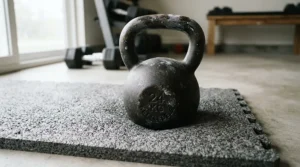
What stands out is the closed-cell, high-density EVA construction, engineered specifically for more demanding daily use rather than occasional stretching sessions. Tiles run in the 3/8 to 3/4 inch thickness range with a textured pattern on both sides, meaning you can flip a worn tile over and effectively double its useful life — a detail competitors in this list simply don’t offer. What most buyers overlook about this brand is that it’s been supplying flooring since 2010 across studios and commercial spaces, so the tolerances and consistency reflect a company that treats flooring as its core product, not a side accessory. Reviewers consistently note it holds up well under home gym equipment over multi-year timelines, and a common theme in aggregated feedback is that the low-profile design fits well under doors without needing to trim thresholds.
Pros:
- ✅ Reversible, textured on both sides for double the wear life
- ✅ High-density closed-cell foam resists compression better than average
- ✅ Backed by a company specializing exclusively in flooring since 2010
Cons:
- ❌ Higher-density tiles cost more than basic puzzle mat competitors
- ❌ Thinner low-profile versions offer less cushion than the 3/4-inch line
Depending on thickness and coverage chosen, budget $60-$180 — genuinely premium performance still priced well under most rubber flooring alternatives.
7. bemaxx Puzzle Mat — most versatile for small spaces and apartments
The standout advantage is scale: smaller 12.6-inch tiles instead of the standard 24-inch format, which makes odd-shaped rooms, closets-turned-gyms, and apartment corners far easier to fill without excessive cutting. Thickness comes in around 0.40 inch EVA foam, BPA-free, with sets typically covering about 18 square feet — intentionally sized for compact footprints rather than garage-scale buildouts. In practice, that smaller tile size means less wasted foam when your workout nook has an awkward L-shape or juts around a closet door, something the big 24-inch tiles on this list handle less gracefully. Here’s what most buyers overlook: smaller tiles also mean more seams per square foot, which can be a minor con for stability under heavier equipment but a genuine pro for anyone tiling around furniture legs or vents. Aggregated review sentiment frequently praises the compact size for apartment dwellers specifically.
Pros:
- ✅ Smaller tiles fit oddly shaped rooms with less cutting
- ✅ Compact 18 sq ft coverage ideal for apartment workout corners
- ✅ BPA-free construction at a genuinely low price point
Cons:
- ❌ More seams per square foot than larger-tile competitors
- ❌ Thinner 0.40-inch profile offers less cushion under heavy weights
Prices typically land around $25-$45, making this the interlocking foam gym tiles pick specifically built for small-footprint living.
Top 7 Products at a Glance
| Product | Thickness | Coverage | Rating | Best For |
|---|---|---|---|---|
| ProsourceFit Exercise Puzzle Mat | 1/2 in | ~48-144 sq ft | ~4.6★ | All-around beginners |
| BalanceFrom Puzzle Exercise Mat | 0.39-0.5 in | ~144 sq ft | ~4.6★ | Slip resistance |
| CAP Puzzle Exercise Mats | 0.5 in | ~24 sq ft | ~4.6★ | Absolute lowest cost |
| Yes4All Interlocking Foam Mats | 0.5 in | ~36 sq ft | ~4.9★ | Finished, clean edges |
| We Sell Mats 3/4″ Multipurpose EVA | 3/4 in | ~24-100 sq ft | ~4.9★ | Heavier equipment |
| IncStores High-Density Fitness Foam Tiles | 3/8-3/4 in | Varies | ~4.8★ | Long-term durability |
| bemaxx Puzzle Mat | 0.40 in | ~18 sq ft | ~4.4★ | Small/apartment spaces |
Lined up side by side, the pattern is clear: thickness and density buy you durability under heavier gear, while thinner, smaller-format tiles buy you flexibility for awkward or compact spaces. If your budget only stretches to one purchase, the ProsourceFit Exercise Puzzle Mat or BalanceFrom Puzzle Exercise Mat cover the widest range of use cases without over- or under-shooting your needs.
DIY Home Gym Flooring: A Practical Setup Guide
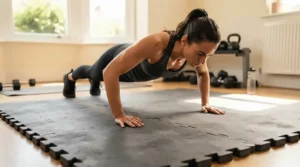
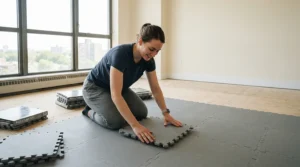
Buying the tiles is the easy 20%. Installing them well is the part that actually determines whether your DIY home gym flooring looks intentional or looks like a garage sale. Start by measuring your space in feet, not eyeballing it — tile counts are sold in whole numbers, and running short by two tiles mid-install is a special kind of annoying. Lay your first row against the longest, straightest wall, and work outward in an L-shape rather than starting in a corner, since this keeps your pattern square even if the room itself isn’t perfectly rectangular (most rooms aren’t, surprise).
Before you snap a single tile into place, sweep and vacuum the subfloor completely — trapped dust and grit under EVA foam will telegraph through as bumps and, over months, grind tiny scratches into the underside. If you’re working over concrete, check for moisture first; a plastic sheet taped down overnight that shows condensation the next morning means you’ve got a dampness issue that foam alone won’t solve. For trimming border pieces around doorways or vents, a sharp utility knife and a straightedge beat scissors every time — scissors tend to compress the foam as they cut, leaving a slightly ragged edge.
One optimization tip Amazon listings never mention: let your tiles acclimate flat in the room for 24 hours before installing, especially if they shipped folded or rolled. This lets any transport-related warping relax out before you lock the interlocking teeth together, which dramatically reduces the “why won’t these edges lie flat” frustration during your first hour of assembly.
Real-World Scenarios: Matching Mats to Your Space
The apartment beginner: You’ve got a 6×8 foot corner of a bedroom, a set of adjustable dumbbells, and downstairs neighbors you’d like to keep on good terms. The bemaxx Puzzle Mat‘s smaller tiles fit that footprint without heavy cutting, and its foam thickness, while modest, is enough to muffle dumbbell-set-down noise significantly compared to bare flooring.
The garage lifter on a budget: You’re covering a 10×10 foot section of a concrete garage floor, dropping a barbell occasionally, and rolling a bike trainer through twice a week. The We Sell Mats 3/4″ Multipurpose EVA or IncStores High-Density Fitness Foam Tiles make more sense here — the extra thickness and density absorb real impact rather than just taking the chill off concrete.
The family multi-use room: Your home gym doubles as a kids’ play space on weekends. The ProsourceFit Exercise Puzzle Mat or BalanceFrom Puzzle Exercise Mat, both sold in large-format sets with anti-slip or water-resistant properties, cover enough square footage to handle both workouts and, later, LEGO marathons without needing two separate flooring purchases.
Common Problems With Budget Foam Flooring, Solved
Problem: Tiles keep separating at the seams. This usually traces back to skipping the acclimation step above, or to an uneven subfloor flexing the interlock apart. Solution: re-lay the affected row after sweeping underneath, and consider a thin foam underlayment if your subfloor has noticeable dips.
Problem: Persistent chemical smell after setup. Fresh EVA foam often carries a mild vinegar-like odor as part of its normal composition. Solution: unroll or unpack tiles in a ventilated room for 24-48 hours before final installation; the smell dissipates with airflow and time in nearly all cases.
Problem: Indentations from equipment left in one spot. Solution: rotate heavy equipment positions every few weeks when possible, or place a rigid platform under stationary items like power racks so the load distributes rather than concentrating on a few tiles.
Problem: Tiles sliding on hardwood or laminate. Solution: a thin grip-mesh underlayment beneath the foam tiles solves this in most cases without needing adhesive, which would defeat the point of an interlocking, reconfigurable system.
How to Choose the Right Foam Floor Mat
- Measure your actual footprint first. Round up, not down — buying two extra tiles is cheaper than a second shipping charge later.
- Match thickness to your training style. Half-inch tiles suit stretching and light cardio; 3/4-inch tiles suit dropped weights and heavier equipment.
- Check for phthalate-free, BPA-free labeling. Reputable brands disclose this upfront; vague listings that skip it deserve a second look.
- Decide on tile size based on room shape. Standard 24-inch tiles suit rectangular rooms; smaller tiles suit odd angles and tight corners.
- Factor in reversibility and density for longevity. Double-sided, high-density tiles cost more upfront but stretch your budget further over years of use.
- Read aggregated review themes, not star ratings alone. A 4.6-star average hides a lot; look for repeated mentions of specific issues like odor, seam gaps, or fast compression.
- Buy slightly more coverage than you think you need. Workout spaces tend to grow, and matching replacement tiles later isn’t always possible if a product gets discontinued.
Common Mistakes When Buying Budget Gym Flooring
The single most common mistake is buying based on price-per-tile without checking total coverage — a “$15 six-pack” and a “$60 thirty-six-pack” can work out to nearly identical cost per square foot, but only one of them fills your actual room. A close second is ignoring thickness entirely and assuming all EVA foam performs the same; a beginner doing yoga and a lifter dropping loaded plates have genuinely different flooring needs, and one thickness doesn’t serve both well.
Another frequent misstep: skipping the manufacturer’s weight and use guidelines, then being surprised when a power rack leaves permanent divots in half-inch foam. And finally, buyers often forget to plan for room shape before ordering — discovering mid-install that you need seven half-tiles cut to fit around a support beam is a preventable headache if you’d measured and sketched the layout first.
Foam Mats vs Rubber Flooring vs Bare Floor: What Actually Protects You
| Factor | Foam (EVA) | Rubber | Bare Floor |
|---|---|---|---|
| Cushioning | High | Moderate | None |
| Cost per sq ft | $ | $$-$$$ | Free |
| Heavy equipment durability | Moderate | High | N/A |
| Noise reduction | Good | Very Good | Poor |
| Best For | Budget home gyms, joint comfort | Heavy lifting, commercial use | Not recommended for training |
The data here tells a clear story: foam wins decisively on cost and cushioning, which is exactly why it dominates the budget home gym category, but rubber pulls ahead when heavy barbells are dropped repeatedly in the same spot. Bare floor isn’t really a competitor so much as a cautionary baseline — there’s actually no strong evidence that firm, stable surfaces themselves increase injury risk during controlled exercise, but the impact absorption still matters for comfort and noise, and flooring conditions measurably affect the proportion of peak impact force absorbed compared to a hard surface with no flooring at all. For most home gym owners on a budget, foam captures the bulk of rubber’s protective benefit at a fraction of the price.
Foam Mat Durability: How Long Should Cheap Tiles Actually Last?
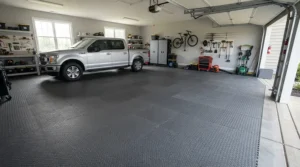
This is the question that determines whether “budget” flooring is actually a bargain or a false economy. Foam mat durability depends heavily on foam density, tile thickness, and how much weight-bearing traffic the tiles see daily. Thin, low-density budget tiles in the CAP or bemaxx range typically hold up well for one to three years under light use — stretching, yoga, bodyweight circuits — but show visible compression and seam wear faster under barbell training. Thicker, higher-density options like the IncStores High-Density Fitness Foam Tiles and We Sell Mats 3/4-inch line are built to stretch that lifespan meaningfully longer, particularly because reversible tiles let you flip a worn side over and effectively restart the clock.
The honest caveat, grounded in what every manufacturer in this category discloses: EVA foam is a soft material by design, which means it will indent under furniture legs or heavy static loads regardless of price point. Durability isn’t really about avoiding wear entirely — it’s about choosing a density that matches your actual training intensity so the wear stays cosmetic rather than structural.
EVA Foam Tiles for Beginners: What a New Home Gym Owner Needs to Know
If you’re setting up foam flooring for beginner home gym use for the first time, a few things are worth knowing before you order. First, EVA, also known as poly(ethylene-vinyl acetate), is an elastomeric copolymer that produces materials which are “rubber-like” in softness and flexibility — which is exactly the quality that makes it forgiving underfoot and easy to cut to size with basic tools. Second, beginners consistently underestimate how much a floor upgrade changes workout comfort; joint strain from bare hardwood or concrete is one of the more common reasons new home-gym owners quietly quit within the first month, and it’s a fixable problem for under $50 in many cases.
Third, don’t over-invest before you know your routine. If you’re not yet sure whether you’ll be doing yoga, HIIT, or barbell work six months from now, a mid-tier half-inch option like the ProsourceFit or BalanceFrom sets gives you enough versatility to figure that out without locking into premium pricing prematurely.
Long-Term Cost & Maintenance: The Real Price of “Cheap” Flooring
| Scenario | Upfront Cost | Expected Lifespan | Cost Per Year (approx.) |
|---|---|---|---|
| Ultra-budget thin tiles | $15-$25 | 1-2 years, light use | ~$10-$15/year |
| Mid-range half-inch tiles | $30-$80 | 3-5 years, mixed use | ~$10-$20/year |
| Premium high-density tiles | $60-$180 | 5+ years, reversible | ~$15-$25/year |
Interestingly, the annualized cost across all three tiers lands in a surprisingly narrow band — proof that “cheap” and “cost-effective” aren’t automatically the same thing. Maintenance itself is minimal across the board: a damp cloth or mild soap solution handles routine cleaning, and avoiding harsh solvents prevents the surface from drying out and cracking prematurely. The real cost driver isn’t the sticker price; it’s matching foam density to actual use so you’re not replacing thin tiles every year because they were never built for your training intensity in the first place.
Foam Floor Mat Safety: What the Research Actually Says
This is worth addressing directly rather than glossing over. Some EVA foam products, particularly those manufactured for the children’s play mat market, have drawn scrutiny for formamide content — a chemical used in EVA foam manufacturing to keep it pliable, which can evaporate slowly, and while direct exposure to concentrated formamide is corrosive and has been linked to developmental concerns, some regulatory bodies have set limits specifically on the small amounts that outgas from finished foam products over time. The practical takeaway for adult home gym flooring: buy from established brands that disclose phthalate-free and BPA-free testing (all seven products in this guide do), keep new tiles in a ventilated space for a day or two before extended use, and avoid ultra-cheap, unbranded listings with no material disclosures at all.
Beyond chemical safety, physical safety matters too — uneven or poorly interlocked tiles create trip hazards, so re-checking seams periodically, especially in high-traffic areas, is a five-minute habit worth keeping.
Features That Actually Matter (And Those That Don’t)
Actually matters: foam density and thickness relative to your training style, phthalate/BPA-free certification, reversible double-sided wear surfaces, and border piece inclusion for a finished look. Doesn’t matter nearly as much as marketing suggests: color options (functionally irrelevant to performance), “premium” branding without disclosed density specs, and oversized package claims that don’t specify actual square footage per tile. When a listing leads with adjectives instead of numbers, that’s usually a sign to keep scrolling.
FAQ
❓ How thick should a foam mat be for a home gym?
❓ Can foam floor tiles go over carpet?
❓ Do interlocking foam gym tiles smell when new?
❓ How many foam tiles do I need for a home gym?
❓ Are cheap foam mats durable enough for daily workouts?
Conclusion
Building a home gym on a budget doesn’t mean sacrificing the one thing standing between your joints and a slab of concrete or hardwood. Whether you land on the crowd-pleasing ProsourceFit Exercise Puzzle Mat, the wallet-friendly CAP Puzzle Exercise Mats, or the reversible, built-to-last IncStores High-Density Fitness Foam Tiles, the core principle stays the same: match foam thickness and density to how hard you’re actually training, not to the lowest price tag on the page. Get that match right, and a $30-$100 flooring purchase quietly becomes one of the best-value decisions in your entire home gym setup — protecting your floors, your joints, and honestly, your motivation to keep showing up.
Recommended for You
- Carpet Protector For Exercise Bike On Carpet: 7 Proven Picks (2026)
- 7 Best Hardwood Floor Protection Mats For Elliptical Machines (2026)
- 7 Best Anti-Vibration Mat For Treadmill In Upstairs Apartment (2026)
Disclaimer: This article contains affiliate links. As an Amazon Associate, I earn from qualifying purchases. If you purchase products through these links, we may earn a small commission at no additional cost to you.
✨ Found this helpful? Share it with your friends! 💬🤗
