
In This Article
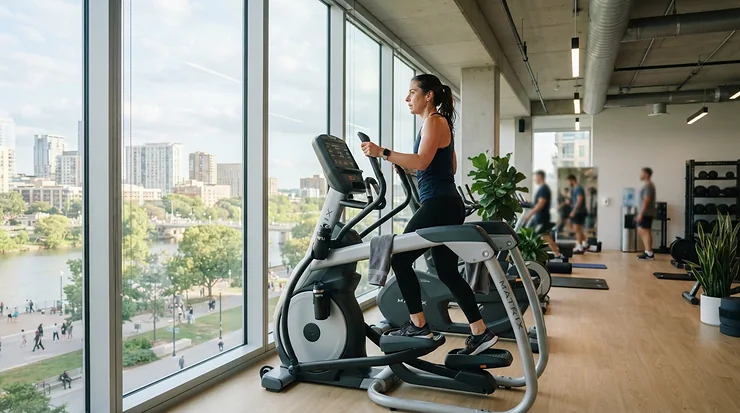
Somewhere between the third Zoom call and the fourth cold-brew refill, most office workers hit a wall. Their back is stiff, their focus is shot, and the only cardio they’ve gotten all week is the sprint to catch the elevator. That’s exactly the gap a good elliptical for corporate wellness room use is supposed to close — a low-impact, low-noise, high-availability machine employees can hop on for fifteen minutes between meetings without needing to change clothes or drive to a gym.
Picking one, though, is trickier than it sounds. Home-gym ellipticals buckle under all-day, multi-user traffic. True commercial machines from big-box gyms can blow through a facilities budget before you’ve bought a single mat. Somewhere in between sits a sweet spot of light-commercial durability, sensible pricing, and features that actually get used rather than ignored. Below, we’ve researched seven real machines — budget, mid-range, and premium — that fit that sweet spot, along with the setup logistics, ROI math, and planning framework HR and facilities teams actually need. Let’s get into it.
What Is an Elliptical for a Corporate Wellness Room?
An elliptical for corporate wellness room use is a light-commercial cardio machine engineered for daily, multi-user traffic in an office setting rather than a single household. It typically features a reinforced frame, sealed or heavy-duty bearings, a simple console that doesn’t require app logins, and a weight capacity and warranty structure built to survive dozens of different employees a day instead of one or two people at home.
Quick Comparison Table
| Machine | Best For | Price Range | Weight Capacity |
|---|---|---|---|
| Horizon EX-59 | Tightest budgets | Under $700 | 300 lbs |
| Sole E25 | Best all-around value | $900–$1,300 | 350 lbs |
| Schwinn 430 | Simple, no-fuss reliability | Around $1,000 | 300 lbs |
| NordicTrack Commercial 14.9 | Engagement & variety | $1,700–$2,000 | 350 lbs |
| Octane Q37 | Smooth, quiet biomechanics | $2,000–$2,700 | 300 lbs |
| Life Fitness E5 | Mixed-height teams | $4,000–$5,000 | 400 lbs |
| Precor 500 Series (EFX) | True commercial durability | $4,500–$7,000 | 300+ lbs |
Looking at the spread above, the real story isn’t “cheap versus expensive” — it’s usage volume. A 40-person office running one elliptical a handful of times a day can get years out of the Sole E25 or Schwinn 430. A 300-person campus with a wellness room in near-constant rotation needs the sealed bearings and heavier-duty frame of something like the Precor 500 Series or Life Fitness E5, because a residential-grade machine simply wasn’t engineered for that duty cycle. Budget should follow expected daily usage hours, not headcount alone.
💬 Just one click — help others make better buying decisions too!😊
Top 7 Elliptical Machines for Corporate Wellness Rooms: Expert Analysis
1. Horizon EX-59 — most affordable entry point
The standout here is simple: you get a genuinely usable elliptical for less than most companies spend on a single ergonomic chair. The Horizon EX-59 runs on an 18-inch stride and a roughly 14-pound flywheel, numbers that put it firmly in the “light use” category rather than the all-day commercial tier.
What that means in practice is a machine that feels smooth enough for a 15–20 minute session but starts to show its limits under back-to-back use by multiple people in a single afternoon. The SixStar-certified frame design minimizes the distance between pedals, which reduces hip and lower-back strain — a detail that matters more than most buyers realize when a machine will be shared by people of very different heights.
Based on the spec comparison with pricier options on this list, the Horizon EX-59 makes the most sense for small offices or satellite locations testing whether a wellness room gets used at all before committing bigger budget. Reviewers consistently report that assembly is straightforward and the 4.5-inch LCD display, while basic, covers the essentials — time, speed, distance, and calories.
Pros:
- ✅ Lowest price point of any option on this list
- ✅ Lifetime frame warranty included standard
- ✅ Compact footprint fits small or converted rooms
Cons:
- ❌ Lighter flywheel feels less smooth under heavy daily use
- ❌ Fixed, non-adjustable stride limits taller employees
Check current price directly through Horizon or major retailers — pricing fluctuates, but this machine consistently lands under $700, making it the most budget-friendly entry on this list and a reasonable value verdict for low-traffic rooms.
2. Sole E25 — most balanced value for daily office use
What most buyers overlook about the Sole E25 is that it punches noticeably above its price class on flywheel weight and stride length, two of the specs that most directly affect how a machine holds up to repeat daily use. A 20-pound flywheel and full 20-inch stride put it closer to mid-range machines than its price tag suggests.
The 20 levels each of resistance and incline give employees enough variety to avoid workout boredom, and the unique 2-degree inward foot-pedal slope — designed in collaboration with a physical therapist — is a small engineering choice that reduces ankle and knee stress over repeated sessions. That’s a real differentiator most competitors in this price range simply don’t offer.
Reviewers consistently note that assembly instructions could be clearer, but once set up, the machine feels stable with minimal side-to-side wobble, thanks to a four-wheel rail system. A 350-pound weight capacity also means the Sole E25 accommodates a wider range of employees than most machines near its price point.
Pros:
- ✅ Lifetime warranty on frame and flywheel
- ✅ 20-inch stride comfortably fits most adult heights
- ✅ Tablet holder and Bluetooth speakers for content
Cons:
- ❌ Assembly instructions are reportedly hard to follow
- ❌ No touchscreen or app-guided workout programming
Price ranges for the Sole E25 typically fall between $900 and $1,300 depending on retailer and promotions, and given the specs, that places it as one of the strongest value verdicts in this entire roundup.
3. Schwinn 430 — simplest console for zero-training onboarding
The Schwinn 430‘s standout feature is how little explanation it needs. There’s no touchscreen, no app pairing, no login screen — just a 6.5-inch LCD display with six preset programs and two heart-rate-targeted routines, which matters enormously in a shared office space where you can’t count on IT support or a training session for every new user.
Twenty resistance levels give the machine real range for both beginners easing into cardio and more seasoned users looking for a harder interval session. The included tablet holder and Bluetooth speakers mean employees can still stream a meeting recap or a podcast mid-workout, even without a fancy built-in entertainment system.
Here’s what to weigh: setup has been flagged by testers as more involved than average, so professional assembly is worth the extra line item in a facilities budget. Once running, though, the Schwinn 430 delivers a dependable, low-drama experience — exactly what you want from a shared-use machine nobody has to babysit.
Pros:
- ✅ Extremely simple, no-login console interface
- ✅ 20 resistance levels cover beginner to advanced
- ✅ Bluetooth speakers built in for hands-free audio
Cons:
- ❌ Setup is more complex than competitors at this price
- ❌ No touchscreen limits guided-workout options
At around $1,000, the Schwinn 430 slots into the same price tier as the Sole E25 but trades a bit of stride comfort for console simplicity — a fair trade for offices worried about a learning curve.
4. NordicTrack Commercial 14.9 — best for keeping engagement high
If your corporate wellness initiatives goal is participation, not just equipment ownership, the NordicTrack Commercial 14.9 earns its spot through sheer engagement power. Its 14-inch touchscreen and iFit-guided workout library give employees a reason to keep coming back instead of trying the machine once and forgetting it exists.
A 32-pound flywheel — one of the heavier options in this entire list — combined with Silent Magnetic Resistance produces a notably smooth stride, and a 20% incline range adds genuine intensity variation that flatter machines can’t match. What the spec sheet won’t tell you, but user reports suggest, is that the touchscreen and interactive coaching are the actual reason adoption stays high after the initial-novelty period wears off elsewhere.
Based on the spec comparison, this machine sits in an interesting middle zone: not fully commercial-grade at roughly 195 pounds assembled, but noticeably sturdier than budget models. For offices running structured wellness challenges or step competitions, the trackable stats and guided classes add real transformation value beyond raw hardware.
Pros:
- ✅ 14-inch HD touchscreen with guided iFit workouts
- ✅ Heavy 32-lb flywheel for smooth, stable motion
- ✅ 20% incline range adds workout variety
Cons:
- ❌ Full feature set requires an ongoing iFit subscription
- ❌ Not true commercial-grade frame weight
Expect a price in the $1,700–$2,000 range, which is a reasonable value verdict if sustained engagement — not just equipment presence — is the metric your HR team is tracking.
5. Octane Q37 — smoothest, quietest biomechanics
The Octane Q37‘s standout feature is its close 1.8-inch pedal spacing, a detail borrowed directly from Octane’s biomechanics research that keeps the body properly aligned and reduces lower-back pressure during longer sessions. That single design choice is a big part of why this machine has picked up multiple industry awards over the years.
Converging Path and MultiGrip handlebars let users shift which muscle groups they’re targeting just by changing hand position, and a low step-up height with rear access makes mounting and dismounting easier and safer — a genuinely underrated feature in a shared space where people are moving on and off the machine all day in work clothes. Reviewers consistently describe the stride as one of the smoothest available outside true full commercial equipment.
Based on real spec comparisons, the trade-off is space efficiency over raw footprint size: the Octane Q37 is shorter than most premium ellipticals, which is a plus for tight wellness rooms but does mean a slightly more compact overall stride range than something like the Life Fitness or Precor options further down this list.
Pros:
- ✅ Close pedal spacing improves alignment and comfort
- ✅ Compact footprint fits smaller wellness rooms
- ✅ 5-year parts warranty, 1-year labor included
Cons:
- ❌ Premium price relative to its footprint
- ❌ Console tech feels dated next to touchscreen rivals
Price ranges for the Octane Q37 generally run $2,000–$2,700 depending on console configuration, positioning it as a strong pick for offices prioritizing comfort and quiet operation over flashy screens.
6. Life Fitness E5 — best for mixed-height, mixed-fitness-level teams
What sets the Life Fitness E5 apart on this list is its electronically adjustable stride, ranging from 18 to 24 inches at the push of a button. In an office with employees ranging from 5’2″ to 6’4″, that single feature solves a problem no budget or mid-range machine on this list can — everyone gets a stride that actually fits their body.
WhisperStride technology and maintenance-free ball bearings keep operating noise low enough for a shared space near actual workstations, and the 400-pound weight capacity is the highest of any machine here, meaningfully widening who can comfortably and safely use it. Twenty resistance levels controlled directly from the moving handlebars let users adjust intensity mid-stride without breaking form.
Here’s what to weigh: this is a genuine investment, not an impulse purchase, and it’s built more like club equipment than a home unit — which is exactly the point for a wellness room seeing consistent daily traffic from a large or varied workforce.
Pros:
- ✅ Adjustable 18–24 inch stride fits nearly any height
- ✅ Highest weight capacity on this list at 400 lbs
- ✅ Whisper-quiet operation near workstations
Cons:
- ❌ Highest price point among mid-tier options
- ❌ No wheels, making repositioning more difficult
Check current price directly with Life Fitness or an authorized dealer; expect a $4,000–$5,000 range, which places this firmly as a premium pick for larger or higher-traffic wellness rooms.
7. Precor 500 Series (EFX) — most durable, true commercial-grade build
The Precor 500 Series earns its premium spot for one reason above all: it’s actually engineered for the duty cycle a busy corporate wellness room demands. Precor rates its commercial units for 10-plus hours of daily use, with sealed bearings and covered ramps that keep dust, dirt, and sweat out of the internal components — the exact conditions a high-traffic office gym creates.
The Active Status Light is a small but genuinely useful feature for facilities teams: a green light means the machine is ready to go, while yellow or red flags a maintenance issue before it becomes a full breakdown and an angry email thread. Precor’s patented CrossRamp technology, found across its higher EFX tiers, guides the feet toward the body’s midline in a way that more closely mimics natural running gait, translating to reduced joint strain during longer sessions.
Based on the spec comparison with every other machine on this list, the Precor 500 Series is the only one built to genuinely commercial specifications rather than “commercial-adjacent” residential engineering. For any office treating its wellness room as permanent, heavily used infrastructure rather than a nice-to-have amenity, this is the category leader.
Pros:
- ✅ Rated for 10+ hours of daily commercial use
- ✅ Sealed bearings resist dust, sweat, and grime
- ✅ Active Status Light flags maintenance proactively
Cons:
- ❌ Highest price point on this entire list
- ❌ Overkill for very low-traffic wellness rooms
Prices vary widely by console and financing terms — check current price with a Precor dealer — but new commercial units in this tier commonly run $4,500–$7,000, a price that reflects genuine engineering, not marketing.
Employee Wellness Room Setup Guide: From Delivery to First Workout
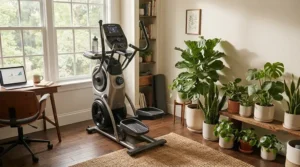
Buying the machine is the easy part. A solid employee wellness room setup guide starts well before delivery day. Measure your space first — most commercial ellipticals need a footprint between 70 and 85 inches long, plus at least 24 inches of clearance on each side for safe entry and exit, and enough ceiling height to clear the tallest likely user during a full stride.
Flooring matters more than most facilities teams expect. A rubber gym mat under each machine protects both the flooring and the equipment’s leveling feet, and it meaningfully cuts vibration noise if the wellness room sits near open-plan desks. Budget for professional assembly on anything above entry-level pricing; several of the machines above were flagged by testers for tricky setup instructions, and a botched DIY assembly can void warranty coverage on some models.
Before opening day, post simple laminated instructions at each station — how to adjust resistance, where the heart rate sensors are, and who to contact for maintenance issues. In the first 30 days, the most common mistake is skipping a maintenance schedule entirely; a quick weekly wipe-down and monthly bolt-check catches small issues before they become costly repairs. Finally, loop your equipment vendor’s warranty terms into your facilities calendar so parts coverage windows don’t quietly expire unused.
Real-World Scenarios: Which Elliptical Fits Which Workforce
Picture a 35-person marketing agency in a converted loft space with one modest wellness corner. Budget is tight, usage will likely be a handful of employees a few times a week, and the room doubles as storage on busy weeks. This is exactly the profile that fits the Sole E25 or Horizon EX-59 — solid build quality without paying for commercial-grade durability nobody will stress-test.
Now picture a 250-person logistics company headquarters with a dedicated wellness room open from 6 a.m. to 8 p.m., seeing steady rotation across three shifts. That kind of continuous, multi-shift traffic is precisely the scenario the Precor 500 Series or Life Fitness E5 was engineered for — sealed components and heavier frames simply survive that duty cycle longer, and the higher weight capacities accommodate a broader employee population.
A mid-size tech company running quarterly step-count challenges and wanting employees genuinely excited to log in sits in a different lane entirely: engagement matters as much as durability, which points toward the NordicTrack Commercial 14.9 and its guided-workout library. Matching the machine to the actual usage pattern — not just the budget line — is what separates a wellness room people use from one that becomes an expensive coat rack.
Problem → Solution: Fixing Common Corporate Wellness Room Equipment Headaches
Problem: Low employee participation. Machines that sit unused usually aren’t a hardware problem — they’re a visibility and variety problem. Solution: rotate simple challenges, post the machine’s warm-up program on a laminated card, and consider a touchscreen-enabled option like the NordicTrack Commercial 14.9 if engagement is the core issue.
Problem: Noise complaints from nearby desks. Solution: prioritize magnetic-resistance machines with sealed, near-silent bearings, such as the Life Fitness E5 or Octane Q37, and add a rubber mat underneath to absorb vibration transfer through the floor.
Problem: Frequent breakdowns under heavy use. Solution: this is almost always a mismatch between machine tier and actual usage volume. If a budget or mid-range machine is failing every few months under heavy daily traffic, the fix isn’t more repairs — it’s upgrading to genuinely commercial-rated equipment like the Precor 500 Series.
Problem: One machine doesn’t fit everyone comfortably. Solution: an adjustable-stride model like the Life Fitness E5 solves this directly; for fixed-stride budget machines, pair the purchase with a second unit at a different stride length rather than assuming one size fits all.
Problem: Nobody knows how to use the console. Solution: choose a simpler interface like the Schwinn 430‘s no-login LCD display, and back it up with a one-page laminated quick-start guide at the station itself.
How to Choose an Elliptical for a Corporate Wellness Room
- Estimate realistic daily usage hours, not just headcount — a machine used two hours a day needs far less durability than one running ten.
- Match weight capacity to your actual employee population, erring toward higher capacity when in doubt, since it costs little extra and widens who can safely use the machine.
- Prioritize stride length and adjustability if your workforce spans a wide height range, since a mismatched stride is the top reason employees quietly stop using shared equipment.
- Weigh noise output against room location — a wellness room next to open desks needs quieter magnetic resistance over friction-based budget models.
- Check the warranty structure closely, especially parts and labor terms, since light-commercial machines see far more wear-and-tear claims than home units.
- Consider console complexity against onboarding capacity — if there’s no dedicated facilities staff to train employees, simpler consoles win.
- Budget for delivery, assembly, and flooring, not just the sticker price, since these add-ons commonly run several hundred dollars per machine.
Best Cardio Machines for Office Wellness Room: Elliptical vs Treadmill vs Bike
Ellipticals aren’t the only cardio option facilities teams weigh, and for good reason — treadmills and stationary bikes both have real advantages in specific office scenarios. Understanding where each format wins helps you build a smarter, more balanced corporate wellness program equipment list rather than defaulting to whatever’s trendy.
| Format | Impact Level | Noise | Space Needed | Best For |
|---|---|---|---|---|
| Elliptical | Low | Low–Moderate | Large footprint | Joint-friendly, full-body cardio |
| Treadmill | Moderate–High | Higher | Large footprint | Familiar, high-calorie-burn cardio |
| Stationary Bike | Very Low | Low | Compact footprint | Small rooms, rehab-friendly use |
The table above reflects a common industry starting ratio for a well-rounded office cardio lineup: roughly 50-60% treadmills, 25-30% bikes, and the remainder split between ellipticals and other formats for an eight-station setup. Ellipticals earn their place specifically because they combine upper- and lower-body engagement with near-zero joint impact — a meaningful advantage for employees managing existing knee, hip, or back issues who might otherwise skip cardio equipment entirely. If your wellness room can only fit two or three machines total, an elliptical paired with a bike typically covers the widest range of fitness levels and physical limitations without the higher injury risk profile treadmills carry in unsupervised, low-training environments.
Corporate Wellness Program Equipment List: Where the Elliptical Fits
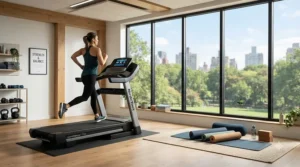
A well-planned corporate wellness program equipment list rarely starts and ends with cardio. Most effective wellness rooms combine one or two cardio stations — often an elliptical plus a treadmill or bike — with light strength equipment such as adjustable dumbbells, a cable functional trainer, and a stretching or recovery zone with mats and foam rollers.
Within that mix, the elliptical typically serves as the “safe default” machine — the one HR can recommend to nearly any employee regardless of fitness background or injury history, precisely because of its low-impact profile. Facilities teams building out a room from scratch often underweight this category, assuming treadmills alone cover cardio needs, only to discover later that employees with joint sensitivities simply avoid the room altogether. Slotting in even one elliptical from this list — sized appropriately to your traffic volume — closes that accessibility gap without requiring a full room redesign or a second capital request cycle.
Common Mistakes When Buying Elliptical Machines for a Corporate Wellness Room
The single biggest mistake facilities teams make is buying based on sticker price alone, without mapping it against expected usage hours — a $700 machine asked to survive ten hours of daily multi-user traffic will fail fast, regardless of how solid the reviews looked. A close second is skipping delivery and assembly costs in the budget, which routinely adds several hundred dollars per unit and gets discovered only after the purchase order is already approved.
Another common pitfall is ignoring stride length entirely and assuming “an elliptical is an elliptical.” Reviewers consistently note that a mismatched stride is one of the top reasons employees try a machine once and never return. Finally, many teams underestimate maintenance planning — treating warranty coverage as a one-time checkbox instead of an ongoing calendar item — which means avoidable repairs slip through simply because nobody was tracking coverage windows.
Corporate Wellness Initiatives and the Real Workplace Wellness ROI
Corporate wellness initiatives live or die on a simple question executives eventually ask: does this actually pay for itself? The honest answer, backed by research, is “it depends on design and participation” rather than a guaranteed number. A Harvard Medical School analysis of workplace wellness programs notes that while early studies suggested returns as high as $3 for every dollar invested, more recent research has found mixed results on cost savings specifically — a useful reality check against overly rosy marketing claims from wellness vendors.
That nuance matters for how facilities and HR teams should frame an equipment purchase. Rather than promising guaranteed healthcare-cost reductions, the stronger case for workplace wellness ROI centers on participation-driven benefits: reduced absenteeism, improved self-reported energy and focus, and demonstrable organizational investment in employee wellbeing, which independently supports retention and culture metrics regardless of direct medical claim impact. A broader systematic review of physical activity-led workplace interventions found that over 60% of studies reported meaningfully increased physical activity levels and reduced psychological stress among participating employees — outcomes that don’t require a perfect ROI spreadsheet to justify.
Practically, that means budgeting for equipment that gets used, not just equipment that looks impressive in a benefits deck. A mid-range machine with high adoption beats a premium machine gathering dust every time. Track simple usage metrics — swipe-ins, booking-app logins, or informal headcounts — for the first 90 days, and treat that data as your real ROI signal rather than waiting on annual healthcare claims data that takes years to move meaningfully.
Office Amenity Planning: Space, Flooring, and Layout for Your Elliptical
Good office amenity planning starts with traffic flow, not just square footage. Position ellipticals with clear sightlines to the room entrance so passersby can see the space is active — visibility alone measurably boosts adoption in shared amenity spaces, since unused equipment behind closed doors quietly signals “this isn’t really for you” to hesitant employees.
Leave generous side and rear clearance around each machine — most manufacturers recommend at least 24 inches on each side and additional rear clearance for safe mounting and dismounting, especially on step-up models. Rubberized flooring isn’t optional in most multi-tenant office buildings; beyond protecting the subfloor, it significantly reduces the vibration and low-frequency noise that travels through shared walls and floors into nearby workstations or conference rooms.
Finally, plan for growth from day one. A room sized for three machines today but budgeted with only one power outlet and no spare floor space becomes a costly retrofit project the moment usage climbs. The CDC’s Workplace Health Resource Center offers free planning tools that many facilities teams overlook, useful for benchmarking your room’s size and equipment mix against comparable organizations before finalizing a layout.
✨ Don’t Miss These Exclusive Deals!
🔍 Take your corporate wellness room to the next level with these carefully selected machines.Click on any highlighted product to check current pricing and availability. These picks will help you build a wellness space your whole team will actually use!
FAQ
❓ What size elliptical fits a small corporate wellness room?
❓ How many ellipticals does an office wellness room need?
❓ Are commercial ellipticals worth the extra cost for offices?
❓ How much does it cost to equip a corporate wellness room with an elliptical?
❓ Do ellipticals help with workplace wellness ROI?
Conclusion
Choosing the right elliptical for corporate wellness room use really comes down to being honest about how the room will actually get used — not how impressive the equipment looks in a proposal deck. A small office with light, occasional use is well served by the Sole E25 or Horizon EX-59, while a high-traffic, multi-shift facility genuinely needs the sealed-bearing durability of something like the Precor 500 Series or Life Fitness E5 to avoid a revolving door of repair tickets.
Whatever tier you land on, the equipment itself is only half the equation. Setup logistics, flooring, layout, and a simple maintenance calendar determine whether that machine gets used for years or quietly becomes a very expensive clothes rack by month three. Pair the right hardware with thoughtful office amenity planning and realistic expectations around workplace wellness ROI, and a corporate wellness room stops being a line item nobody notices and starts being a benefit employees genuinely value.
Recommended for You
- 7 Best Elliptical for Hotel Fitness Center Options in 2026
- Gym Quality Elliptical for Home Use: 7 Best Picks (2026)
- Commercial Grade Elliptical: 7 Real Picks for Small Gyms (2026)
Disclaimer: This article contains affiliate links. As an Amazon Associate, I earn from qualifying purchases. If you purchase products through these links, we may earn a small commission at no additional cost to you.
✨ Found this helpful? Share it with your friends! 💬🤗
