
In This Article
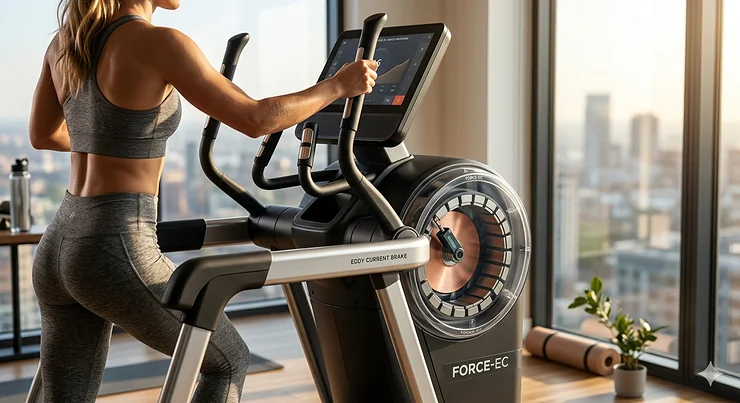
If you’ve ever used a commercial gym elliptical and wondered why it feels impossibly smooth compared to your home machine, here’s your answer: eddy current brake technology. Unlike the friction-based resistance systems that wear out and create that annoying grinding noise after six months, eddy current brake elliptical machines use electromagnetic physics to create resistance without any parts touching each other. What most buyers overlook about this technology is that you’re essentially getting the same braking system used in high-speed bullet trains and industrial machinery—except it’s making your workout smoother instead of stopping a train.
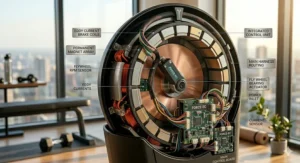
The real game-changer here isn’t just the silky-smooth motion. It’s the fact that these systems require absolutely zero maintenance over their lifetime because there’s no physical contact between components. No brake pads to replace, no tension cables to snap, and no weird clicking sounds that mysteriously appear after your warranty expires. When you’re comparing a standard magnetic resistance elliptical in the $800-$1,200 range to an eddy current model around $1,500-$2,800, you’re not just paying extra for a fancier name—you’re investing in technology that professional rehabilitation centers and Olympic training facilities choose for a reason.
What the spec sheets won’t tell you is how this affects your actual workout experience. Traditional magnetic systems use a physical magnet that moves closer or farther from the flywheel. That mechanical movement means there’s always a slight delay when you adjust resistance, and the transitions feel abrupt. Eddy current resistance elliptical technology adjusts the electrical field strength instantaneously, which means when you’re doing interval training and jumping from level 5 to level 18, the change happens the moment you press the button—not three seconds later when your legs have already adjusted to the old setting.
Quick Comparison: Top 7 Eddy Current Brake Ellipticals
| Model | Price Range | Stride Length | Weight Capacity | Resistance Levels | Best For |
|---|---|---|---|---|---|
| Precor EFX 835 | $4,500-$6,800 | 21″-25″ adjustable | 350 lbs | 20 | Commercial facilities & serious home gyms |
| Sole E35 | $1,600-$2,100 | 20″ fixed | 350 lbs | 20 | Best value home use |
| Life Fitness X5i | $3,200-$4,800 | 18″-24″ adjustable | 400 lbs | 20 | Heavy users & rehabilitation |
| Precor EFX 546 | $3,800-$5,200 | 21″-25″ adjustable | 350 lbs | 20 | CrossRamp enthusiasts |
| Sole E55 | $2,400-$3,200 | 20″ fixed | 400 lbs | 20 | Compact commercial-grade |
| Sole E25 | $1,100-$1,600 | 20″ fixed | 350 lbs | 20 | Budget-conscious buyers |
| Precor EFX 221 | $1,800-$2,600 | 18″-21″ manual | 300 lbs | 16 | Entry-level commercial |
Looking at this comparison, the Sole E35 delivers exceptional value in the $1,600-$2,100 range with the same 20-level eddy current system found in machines costing twice as much. However, if adjustable stride length is your priority, the Life Fitness X5i justifies its premium price with superior biomechanics for users between 5’2″ and 6’7″. Budget buyers should note that the Sole E25 sacrifices only flywheel weight compared to the E35, not resistance technology—making it the smartest entry point into contactless resistance systems.
💬 Just one click — help others make better buying decisions too! 😊
Top 7 Eddy Current Brake Ellipticals: Expert Analysis
1. Precor EFX 835 Commercial Series – The Gold Standard
The Precor EFX 835 isn’t just a commercial-grade elliptical—it’s the machine that defined what commercial-grade means. With self-powered eddy current resistance and the patented CrossRamp technology that adjusts from 10° to 40° incline, this beast handles everything from gentle rehabilitation sessions to Olympic athlete training without breaking a sweat.
Real-World Performance: The 20-level eddy current brake system delivers resistance ranging from “barely there” to “climbing a mountain with a backpack.” What separates it from cheaper models is the consistency—level 10 today feels exactly like level 10 six years from now because there’s zero mechanical wear on the resistance system. The self-powered generator means you don’t need a wall outlet, which gym owners love because it eliminates cord-management nightmares.
Who This Is For: This machine makes sense for home gym owners who plan to use it 5-7 days per week for the next decade, or anyone who’s tired of replacing $800 ellipticals every 18 months. At 340 pounds and 350-pound weight capacity, it’s built like a tank and doesn’t wobble even during aggressive HIIT workouts.
Customer Insights: Users consistently praise the whisper-quiet operation and the natural stride feel that mimics actual running biomechanics. The common complaint? It requires a 110V outlet despite being “self-powered”—the generator handles the console and resistance, but the incline motor needs external power.
✅ Pros:
- Self-powered eddy current system eliminates cord dependency for basic functions
- Adjustable 21″-25″ stride accommodates users from 5’4″ to 6’8″
- Lifetime frame warranty with 5-year parts coverage
❌ Cons:
- Heavy at 340 lbs—plan for professional delivery
- Price point around $5,500-$6,800 requires serious commitment
Price Range: Check current availability in the $4,500-$6,800 range depending on console upgrades.
2. Sole E35 Elliptical – Best Value Champion
The Sole E35 is what happens when a manufacturer decides to put commercial-grade technology into a home-friendly package without the commercial price tag. The 25-pound flywheel paired with eddy current resistance creates that smooth, natural motion you normally only find in $4,000+ machines.
Real-World Performance: The 20 resistance levels span from recovery-day-easy to “why-did-I-choose-this-hard.” What most buyers don’t realize until they own it is that the adjustable foot pedals with 2-degree inward slope eliminate the numb-toe problem that plagues 90% of ellipticals. You can actually fine-tune the pedal angle with a simple dial on each pedal—a feature usually reserved for $3,000+ models.
Who This Is For: Perfect for fitness enthusiasts who want commercial gym quality at home without the commercial gym price. The 20-inch stride works beautifully for users 5’5″ to 6’2″, though taller users might feel slightly cramped during high-incline work.
Customer Insights: Reviewers consistently mention how quiet it runs—quiet enough for apartment use without disturbing neighbors. The power incline system (20 levels) adds significant workout variety that budget ellipticals simply can’t match.
✅ Pros:
- Eddy current resistance at mid-range pricing
- Adjustable pedal angles solve the numb-toe issue
- 350-pound weight capacity handles heavy users
❌ Cons:
- 231-pound machine requires two people to assemble
- Fixed 20″ stride doesn’t adjust like premium models
Price Range: Typically around $1,600-$2,100, making it the sweet spot for value-conscious buyers.
3. Life Fitness X5i – The Rehabilitation Specialist
The Life Fitness X5i earned its reputation in physical therapy clinics before migrating to home gyms. The eddy current brake system offers unprecedented precision in the lower resistance ranges—crucial for post-surgery rehabilitation or elderly users who need gentle, controlled movement.
Real-World Performance: The adjustable stride (18″-24″) isn’t just a spec sheet bragging point. In practice, it means a 5’2″ user and a 6’5″ user can both achieve optimal biomechanics on the same machine. The eddy current system maintains smooth resistance even at level 1, whereas cheaper magnetic systems feel jerky at low settings.
Who This Is For: This machine justifies its $3,200-$4,800 price tag for multi-user households, rehabilitation patients, or anyone over 6’3″ who’s tired of ellipticals that feel like they were designed for average-height people. The 400-pound weight capacity provides extra headroom for bariatric rehabilitation.
Customer Insights: Physical therapists praise the ultra-smooth low-end resistance that doesn’t stress healing joints. Home users appreciate the durability—many report 10+ years of daily use with zero maintenance beyond occasional cleaning.
✅ Pros:
- Adjustable stride accommodates extreme height ranges
- Precision resistance control for rehabilitation
- 400-pound capacity exceeds most home models
❌ Cons:
- Requires dedicated power outlet
- Premium pricing requires long-term commitment
Price Range: Expect to invest in the $3,200-$4,800 range for this professional-grade equipment.
4. Precor EFX 546 – CrossRamp Technology Showcase
The Precor EFX 546 brings the famous CrossRamp technology to a slightly more accessible price point than the 835 series. The 20-level motorized incline adjustment (10° to 40°) transforms how you target different muscle groups—something static-path ellipticals simply can’t replicate.
Real-World Performance: The advanced eddy current brake design ensures resistance calibration stays consistent between all 20 levels even after years of use. What the marketing materials don’t emphasize is how the CrossRamp indicator console shows you exactly which muscles you’re targeting at each angle—glutes at 40°, quads at 25°, calves at 10°. This visual feedback helps users actually vary their workouts instead of defaulting to the same routine.
Who This Is For: Serious athletes who understand the value of muscle-group targeting and want to replicate the programming capabilities of a commercial gym. Also perfect for trainers who work with multiple clients—each person can save their preferred CrossRamp angle.
Customer Insights: Users who switched from standard ellipticals report feeling muscles they didn’t know existed. The downside? The abundance of options can be overwhelming for beginners who just want to hop on and go.
✅ Pros:
- Motorized CrossRamp technology (not manual like cheaper models)
- Eddy current consistency across all resistance levels
- HR monitoring with included chest strap
❌ Cons:
- Learning curve for maximizing CrossRamp benefits
- Requires electrical outlet for full functionality
Price Range: Around $3,800-$5,200 depending on console configuration and delivery options.
5. Sole E55 Elliptical – Compact Commercial Power
The Sole E55 solves a problem most manufacturers ignore: people who want commercial-grade construction in a slightly smaller footprint. At 71″ long instead of the typical 80″+ for gym-grade machines, it fits home gyms where space is premium but quality isn’t negotiable.
Real-World Performance: The 27-pound flywheel combined with eddy current resistance creates momentum that feels more like a commercial machine than other home units. The 20 resistance levels offer serious challenge at the top end—level 20 will humble even experienced athletes. What’s clever is the power incline system that adjusts automatically during programmed workouts, so interval training doesn’t require constant manual adjustment.
Who This Is For: Home gym owners who can’t sacrifice the full footprint for an 835 but refuse to settle for consumer-grade build quality. The 400-pound weight capacity makes it suitable for heavier users who’ve had bad experiences with flimsy home ellipticals.
Customer Insights: Former gym members report this machine replicates the “gym feel” better than competitors at this price point. The lack of Bluetooth connectivity disappoints tech-focused users, though the 10 pre-programmed workouts cover standard training needs.
✅ Pros:
- Commercial-grade eddy current system in smaller package
- 27-pound flywheel exceeds most home models
- Power incline automation enhances interval training
❌ Cons:
- No Bluetooth or app connectivity
- Still requires 71″ of floor space
Price Range: Positioned around $2,400-$3,200 for commercial quality in a semi-compact design.
6. Sole E25 Elliptical – Budget Entry Point
The Sole E25 proves you don’t need to spend $3,000 to access eddy current resistance technology. While it makes strategic compromises on flywheel weight (19 pounds vs. 25-27 on premium models), it retains the smooth eddy current resistance elliptical system that delivers the silent, maintenance-free performance.
Real-World Performance: The 20 resistance levels provide the same contactless adjustment as models costing twice as much. The power incline (20 levels) is a standout feature at this price—most budget ellipticals force you to manually adjust a knob, but the E25 handles it electronically. What you sacrifice compared to the E35 is smoothness during intense sprints—the lighter flywheel creates slightly more momentum fluctuation.
Who This Is For: First-time elliptical buyers who understand the value of upgrading from friction-based resistance but can’t justify premium pricing. Also great for guest rooms or secondary workout spaces where it won’t see daily heavy use.
Customer Insights: Users upgrading from $500 retail-store ellipticals report being shocked by how smooth eddy current feels. The common regret? Wishing they’d spent $400 more for the E35’s heavier flywheel after experiencing the difference at a gym.
✅ Pros:
- Genuine eddy current resistance at entry-level pricing
- Power incline unusual for this price range
- 350-pound capacity matches premium models
❌ Cons:
- 19-pound flywheel feels lighter during high-intensity work
- No app connectivity or advanced tracking
Price Range: Around $1,100-$1,600, making it the most affordable true eddy current option.
7. Precor EFX 221 Energy Series – Manual CrossRamp Entry
The Precor EFX 221 represents Precor’s answer to “what if we make commercial quality accessible?” The manual CrossRamp adjustment (three ramp angles) sacrifices the motorized convenience of premium models but retains the biomechanical benefits that made CrossRamp technology famous.
Real-World Performance: The 16 resistance levels (four fewer than premium models) still cover beginner through advanced training. The eddy current system ensures level 12 on this machine feels identical to level 12 on the $6,000 EFX 835—the difference is you’re manually adjusting the ramp angle instead of pressing a button. For focused workouts where you set one angle and maintain it, this isn’t a limitation.
Who This Is For: Budget-conscious buyers who want Precor’s legendary build quality and understand they’re trading convenience features for durability. Perfect for physical therapy clinics or senior centers where users appreciate simplicity over endless options.
Customer Insights: Rehabilitation professionals praise the ultra-smooth low-resistance levels for post-surgical patients. Home users report the manual ramp adjustment isn’t as annoying as expected—most people find their preferred angle and rarely change it mid-workout anyway.
✅ Pros:
- Precor commercial-grade construction at accessible pricing
- Eddy current reliability without premium price
- Stationary handlebars great for lower-body focus
❌ Cons:
- Manual ramp adjustment requires stopping to change
- 16 resistance levels vs. 20 on premium models
Price Range: Around $1,800-$2,600, bridging the gap between consumer and commercial pricing.
Understanding Eddy Current Technology: The Science Behind the Smoothness
Most elliptical marketing focuses on stride length and weight capacity while glossing over what actually makes the machine work: the resistance system. Here’s what happens inside an eddy current brake that separates it from cheaper alternatives.
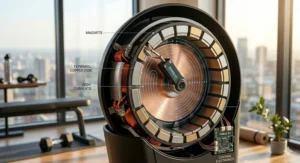
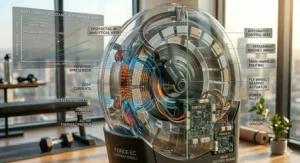
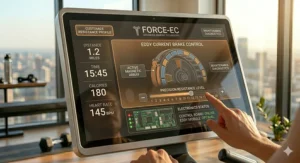
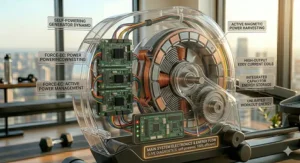
According to Faraday’s law of electromagnetic induction, when a conductor (usually an aluminum disc) moves through a magnetic field, circular electric currents called eddy currents form within the conductor. By Lenz’s law, these currents create their own magnetic field that opposes the original field—and that opposition is what creates resistance you feel in your legs.
The brilliance of this system is zero physical contact. Traditional magnetic systems move a physical magnet closer to or farther from the flywheel using a motor and cable assembly. That cable will eventually stretch or snap—it’s not a question of if, but when. The motor can fail. The physical magnet mount can wear. Eddy current systems simply vary the strength of the electromagnetic field by adjusting current flow. No moving parts means nothing to break.
This contactless resistance technology is the same principle used in high-speed trains and industrial machinery where friction-based brakes would wear out catastrophically. When you’re doing interval training and slamming between resistance levels, you’re relying on the same technology that safely stops a 500-ton train—except scaled down to make your quads burn.
Manual vs. Motorized vs. Eddy Current: What Each Feels Like
Manual Magnetic Resistance (found on $300-$600 ellipticals): You turn a knob that pulls a cable that moves a magnet. Resistance changes feel steppy, there’s a 2-3 second lag between adjustment and effect, and the cable will eventually snap, leaving you stuck on whatever resistance it was last set to. When it works, level 8 feels different every six months as components wear.
Motorized Magnetic Resistance (found on $600-$1,500 ellipticals): Press a button, a small motor moves the magnet. Better than manual, but the motor can fail (and will after 3-5 years of heavy use), and you still have physical parts moving against each other. Resistance feels smoother than manual but still has slight lag and inconsistency as components age.
Eddy Current Resistance (found on $1,500+ professional equipment): Instantaneous adjustment by changing electrical field strength. No lag, no mechanical parts to fail, perfectly consistent resistance for the machine’s entire lifespan. The difference is most noticeable during interval training—when you jump from level 5 to level 18, your legs know immediately, not three strides later.
How to Choose Your Eddy Current Brake Elliptical
Step 1: Determine Your Usage Pattern
Calculate your expected weekly hours: 3-5 hours per week for general fitness, 7-10 hours for serious training, or 15+ hours for multiple household users. Light users (3-5 hours weekly) can consider the Sole E25 or Precor EFX 221 without overspending on features they won’t use. Moderate users (7-10 hours) should target the Sole E35 or E55 for the better flywheel weight. Heavy users or multi-person households need the Life Fitness X5i or Precor EFX 835 built for commercial punishment.
Step 2: Measure Your Available Space (Including Ceiling)
Don’t just measure floor space—measure vertical clearance. When using a power incline at level 20, taller users can come within inches of an 8-foot ceiling. Add your height plus 18 inches for safety. The Sole E55 at 71″ length fits tighter spaces better than the 80″+ commercial units, but you’re still looking at a 27″ width footprint that doesn’t fold.
Step 3: Calculate Cost Per Use
A $5,500 Precor EFX 835 used 300 hours per year for 10 years = $1.83 per hour. A $1,100 Sole E25 replaced after 4 years (1,200 total hours) = $0.92 per hour. But factor in the $150 repair for the inevitable cable replacement on the E25 and suddenly you’re at $1.04 per hour—and that’s assuming only one repair. Premium eddy current machines cost more upfront but deliver lower lifetime cost per use.
Step 4: Prioritize Your Non-Negotiables
If you’re over 6’2″, adjustable stride length isn’t optional—it’s mandatory. The Life Fitness X5i and Precor EFX 546 offer 18″-24″ range. If you live in an apartment, whisper-quiet operation moves from “nice to have” to “won’t get evicted.” All eddy current models excel here, but the Sole E35 particularly shines in user reviews for silence. If you need multiple user profiles for family members, prioritize models with dedicated user memory.
Step 5: Test Resistance Smoothness at Both Extremes
If buying in-store (or trying at a gym), don’t just test mid-level resistance. Test level 1—it should feel controlled and smooth, not jerky. Test maximum resistance—it should engage immediately when you press the button, not gradually ramp up over five seconds. The difference between eddy current and cheaper systems is most obvious at these extremes.
Step 6: Verify Power Requirements
Self-powered models like the Precor EFX 835 still need electricity for certain features. Check whether “self-powered” means truly cordless or just powers the console. Most eddy current systems require a standard 110V outlet, but verify your gym space has convenient access before delivery day.
Step 7: Factor in Warranty Coverage
Lifetime frame warranties are standard on quality machines, but examine parts and labor coverage. The Sole series offers 5-year parts, 2-year labor. Precor commercial models often include 5-year parts with optional labor extensions. Budget extra for extended warranties on models approaching $4,000+—the peace of mind justifies the cost when you’re this deep into an investment.
Common Mistakes When Buying Commercial Eddy Current Ellipticals
Mistake #1: Ignoring Delivery and Assembly Costs
That $4,500 Precor EFX 835 listing doesn’t include the $300-$500 freight delivery charge or the $200 professional assembly fee. Budget an extra $500-$700 on top of the machine cost. Attempting to DIY a 340-pound commercial elliptical up basement stairs rarely ends well and voids most warranties.
Mistake #2: Assuming All “20 Levels” Are Equal
Level 20 on a $1,100 Sole E25 and level 20 on a $5,500 Precor EFX 835 both exist, but the resistance curve and maximum resistance output differ significantly. Commercial units typically calibrate their top levels for Olympic-level athletes. Read user reviews from experienced athletes to gauge whether “level 20” actually challenges advanced users.
Mistake #3: Skipping the Stride Length Test
You can’t accurately assess stride length from specs alone. A 20″ fixed stride works beautifully for a 5’8″ user but feels cramped for anyone 6’3″+. If you’re on the height extremes (under 5’4″ or over 6’2″), prioritize adjustable stride models like the Life Fitness X5i or test the exact model in person before committing.
Mistake #4: Overlooking Footprint vs. Stride Length Math
Beginners assume longer stride automatically means better machine. But a 25″ stride requires a longer machine base. If you have 75″ of available floor space, a machine with 24″ stride won’t fit regardless of how perfect the specs look. The Sole E55 compromises to 20″ stride partly to achieve a more compact 71″ footprint.
Mistake #5: Buying Based on One Great Review
Eddy current ellipticals represent significant investments. One glowing review might be an outlier or an incentivized testimonial. Look for patterns across 50+ reviews—specifically reviews from buyers at 12+ months of ownership when the honeymoon phase has worn off. Early reviews love everything; one-year reviews tell you what breaks.
Setting Up Your Eddy Current Elliptical for Peak Performance
Most buyers assume once it’s assembled, it’s ready to go. These machines require specific optimization that retail-store staff rarely explains and manufacturers bury in owner’s manuals nobody reads.
Break-In Period (First 30 Days)
Eddy current systems don’t technically require break-in since there’s no friction to wear in, but the drive belt does. For the first 30 days, keep resistance below level 15 even if you’re capable of more. This allows the poly-v belt to settle into optimal contact with the flywheel pulley. Jumping straight to max resistance can cause premature belt slip.
Leveling the Machine (Critical Step Most Skip)
Use a bubble level on the frame rails, not the console or pedals. An unlevel elliptical puts uneven stress on the drive system and causes that mysterious “clicking” sound that haunts online forums. Adjust the stabilizing feet until the bubble centers perfectly on both length and width axes. Expect to spend 15-20 minutes getting this right—it matters.
Calibrating Resistance (Advanced Users Only)
Most eddy current ellipticals include a calibration mode accessed through specific button combinations during power-up. The manual explains this (page 40+), but essentially it re-teaches the system where “level 1” and “level 20” should be. Run calibration every 6 months if you notice resistance feeling inconsistent. This isn’t fixing a broken machine—it’s maintaining precision.
Optimal Placement for Temperature
Eddy current systems convert kinetic energy into heat (that’s literally how the physics works). Place the machine where ambient temperature stays between 50-80°F. Extremely cold basements or hot garages will affect performance. Not catastrophically, but noticeably enough that your “usual” resistance feels different.
Maintenance-Free Doesn’t Mean Maintenance-Never
The marketing promise of “maintenance-free resistance” is technically accurate—the eddy current brake itself requires zero maintenance. But the machine has other components that do need attention.
Every Week: Wipe down the console, handlebars, and pedals with a damp (not wet) cloth. Sweat is corrosive and will eventually damage electronics if left to accumulate.
Every Month: Vacuum around the drive assembly to remove dust accumulation. Inspect the drive belt through the side cover for signs of fraying or glazing.
Every 6 Months: Check all bolts and screws for tightness. The vibration from daily use gradually loosens fasteners. A loose pedal arm bolt can damage the crank assembly.
Annually: Inspect power cord for damage, especially where it enters the machine. Replace immediately if the outer insulation shows any cracking.
What You’ll NEVER Need to Do: Replace the resistance brake system, adjust resistance calibration (unless you’ve moved the machine), or lubricate the magnetic components. This is where eddy current technology saves you hundreds in maintenance costs over a decade compared to friction-based systems.
Eddy Current vs. Magnetic Resistance: The Real-World Difference
The technical differences are fascinating, but here’s what actually matters during your workout:
Adjustment Speed: Eddy current systems adjust resistance within 0.2 seconds of pressing the button. Traditional motorized magnetic takes 2-3 seconds as the physical magnet moves. During interval training, those seconds compound—you’re either fighting resistance that’s too high for three strides or too low for three strides on every transition.
Consistency Over Time: A magnetic resistance elliptical’s level 10 feels different after 1,000 hours of use because the magnet mount has worn slightly, the cable has stretched, and the motor has weakened. An eddy current system’s level 10 will feel identical in year 5 as it did in week 1 because nothing has physically degraded.
Noise Profile: Magnetic systems emit a faint humming from the motor and occasional clicking from the cable guide. Eddy current resistance is electronically controlled and genuinely silent—you’ll hear the drive belt and bearings, but zero noise from resistance adjustment.
Repair Costs: When a magnetic resistance motor fails (they all eventually do), expect $200-$400 in parts and labor if you’re handy, $500-$800 if you hire service. Eddy current systems rarely fail, but when they do, the control board replacement runs $300-$600. The difference is frequency—you’ll replace a magnetic motor 2-3 times over the machine’s life versus one eddy current board if you’re unlucky.
Energy Efficiency: Eddy current systems require constant electrical draw to maintain the electromagnetic field. Typical consumption runs 50-120 watts during use. Magnetic systems only power the motor during resistance changes, so they’re technically more energy efficient. Over a year of daily use, the difference is about $15-$30 in electricity costs.
❓ Frequently Asked Questions
❓ What is the difference between eddy current brake elliptical and magnetic resistance?
❓ Do eddy current brake ellipticals need to be plugged in?
❓ How long do eddy current resistance systems last?
❓ Are commercial eddy current ellipticals worth it for home use?
❓ Can you adjust resistance during a workout on eddy current ellipticals?
Why Smooth Eddy Current Resistance Matters More Than You Think
The difference between choppy resistance and smooth resistance isn’t just about comfort—it directly impacts your workout effectiveness and injury risk. When resistance transitions feel abrupt or jerky, your body compensates by tensing stabilizer muscles unnecessarily. Over hundreds of workouts, this creates chronic tension in your lower back and hips that manifests as the “mystery pain” people blame on age.
Smooth eddy current resistance allows your body to maintain natural biomechanics throughout the entire stride. Your hip flexors don’t suddenly engage harder because the resistance jumped unexpectedly. Your knee tracking stays consistent because there’s no micro-adjustment needed when the machine “catches” on a sticky spot in the resistance mechanism.
Physical therapists choose eddy current systems for rehabilitation specifically because the smooth resistance profile doesn’t stress healing joints. If you’re recovering from knee surgery or managing arthritis, the difference between a $1,600 Sole E35 with eddy current and a $900 magnetic resistance model isn’t luxury—it’s medical practicality.
Conclusion: Choosing Your Lifetime Elliptical Investment
The eddy current brake elliptical market has matured to where you’re no longer paying exclusively for premium brand names. The technology itself has become accessible enough that the Sole E25 delivers genuine maintenance-free resistance elliptical performance in the $1,100-$1,600 range—a price point that was impossible five years ago.
For most buyers, the sweet spot remains the Sole E35 around $1,600-$2,100. It captures 90% of what makes commercial ellipticals exceptional while fitting home gym budgets and footprints. You’re getting the same contactless resistance technology found in $5,000 machines, just with a smaller flywheel and fewer connectivity features.
Athletes and serious fitness enthusiasts should bypass the mid-range entirely and commit to the Precor EFX 835 or Life Fitness X5i in the $4,000-$6,000 range. The adjustable stride length, heavier flywheel, and commercial-grade construction justify the premium when you’re logging 10+ hours weekly. These machines will outlive cheaper alternatives by a decade or more.
Budget-conscious buyers who understand the value of professional eddy current elliptical technology should start with the Sole E25 or Precor EFX 221. You’re sacrificing some smoothness and features, but you’re still getting the core benefit—contactless resistance that never degrades and requires zero maintenance.
Whatever you choose, you’re investing in technology that fundamentally changed how ellipticals work. The smoothness, the silence, the consistency, the reliability—these aren’t marketing buzzwords. They’re the engineering advantages that explain why rehabilitation centers, Olympic training facilities, and serious home gyms all converge on the same solution: eddy current resistance systems that simply work better.
Recommended for You
- 7 Best ECB Resistance Ellipticals Tested & Ranked 2026
- 7 Best Ultra Quiet Magnetic Resistance Ellipticals 2026
- 7 Best Electronic Resistance Ellipticals Transform Workouts 2026
Disclaimer: This article contains affiliate links. As an Amazon Associate, I earn from qualifying purchases. If you purchase products through these links, we may earn a small commission at no additional cost to you.
✨ Found this helpful? Share it with your friends! 💬🤗
