
In This Article
You’re standing in a fitness store, staring at two ellipticals that look almost identical. The salesperson throws around terms like “front drive” and “rear drive,” and you’re left wondering if it actually matters for your workout. Here’s the truth: the flywheel position dramatically affects your stride pattern, joint stress, and overall exercise experience.
The difference between front and rear drive elliptical machines isn’t just technical jargon—it shapes how your body moves through every single stride. Elliptical trainers entered the market in the 1990s, invented by Precor, to provide a cardiovascular workout that minimizes excessive pressure on joints. Today, understanding drive systems helps you choose a machine that matches your biomechanical needs.
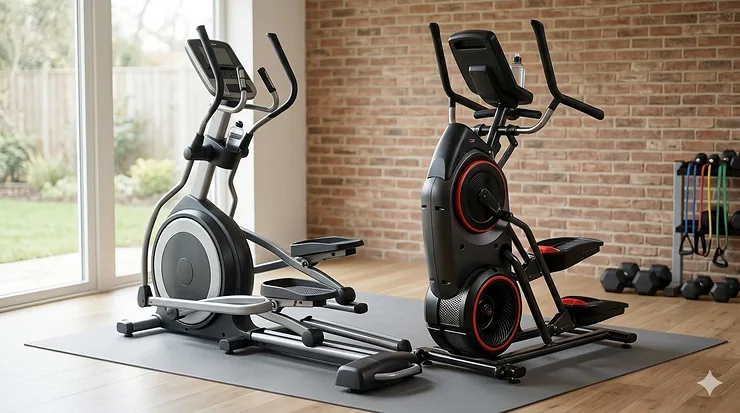
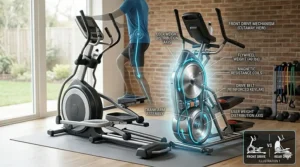
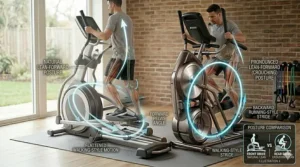
In a front drive elliptical, the flywheel sits ahead of you, creating a slightly inclined, stair-climbing motion. Rear drive models place the flywheel behind you, producing flatter, more running-like strides. Front-drive ellipticals create a movement plane where strides move slightly up and down, similar to a stair climber, while rear-drive models allow for longer, more level strides similar to walking or running. Think of it as choosing between hiking uphill versus jogging on flat ground.
This comprehensive guide breaks down exactly which is better front or rear drive for different fitness goals, compares 7 real models available on Amazon in 2026, and answers the burning question every buyer asks: which one should I actually buy?
Quick Comparison Table
| Feature | Front Drive | Rear Drive |
|---|---|---|
| Stride Pattern | Inclined, stair-climbing motion | Flat, running-like motion |
| Footprint | More compact length | Longer overall footprint |
| Step-Up Height | Often lower (easier entry) | Typically higher |
| Price Range | $300 – $2,500+ | $250 – $1,500+ |
| Maintenance | More moving parts | Fewer components |
| Best For | Incline training, small spaces | Natural gait, taller users |
💬 Just one click – help others make better buying decisions too!😊
Top 7 Front Drive vs Rear Drive Elliptical: Expert Analysis
1. Sole E25 Elliptical (Front Drive)
The Sole E25 dominates the mid-range market with a price around $1,300. This front-drive powerhouse features 20 resistance levels and 20 power incline settings—rare at this price point.
Key Specifications:
- 20-inch stride length (adjustable pedals)
- 350-pound weight capacity
- 27-pound flywheel for ultra-smooth motion
The Sole E25 earned top ratings due to its affordable price tag of roughly $1,300 along with Bluetooth speakers, sturdy construction, and ability to sync with multiple workout apps. Customer feedback consistently praises the whisper-quiet magnetic resistance and lifetime frame warranty.
✅ Pros:
- Exceptional build quality with commercial-grade steel frame
- Unique 2-degree inward pedal slope reduces ankle/knee stress
- Free SOLE+ app with hundreds of trainer-led workouts
❌ Cons:
- Assembly takes 2-3 hours (professional assembly recommended)
- Stationary handlebars only (no moving upper body grips)
Perfect for: Home users wanting commercial-quality features without the $3,000+ price tag
2. NordicTrack AirGlide 16 (Front Drive)
The NordicTrack AirGlide 16 redefines premium home fitness with its tilting 16-inch HD touchscreen and SmartAdjust technology.
Key Specifications:
- 15% incline to -5% decline range (extremely rare)
- 26 digital resistance levels
- 19-inch auto-adjustable stride
The AirGlide 16 features a 32-lb Effective Inertia-Enhanced Flywheel with SMR Silent Magnetic Resistance, plus ActivePulse Technology that adjusts speed, incline, and decline to maintain optimal heart-rate zones. This isn’t just an elliptical—it’s an interactive training ecosystem.
The decline feature mimics downhill running, strengthening eccentric muscles that protect your knees during real-world activities. Users report the iFIT integration transforms boring cardio into global adventures.
✅ Pros:
- Decline training (found in machines costing $4,000+)
- Touchscreen tilts for off-machine yoga and strength workouts
- SmartAdjust learns and adapts to your fitness level
❌ Cons:
- iFIT membership required for full features ($39/month family plan)
- Heavy at 280+ pounds (difficult to move solo)
Perfect for: Tech-savvy users who want guided workouts and cutting-edge features
3. Sunny Health & Fitness SF-E3912 (Rear Drive)
The Sunny Health & Fitness SF-E3912 proves you don’t need to spend a fortune for quality. Priced under $500 on Amazon, this rear-drive machine punches above its weight class.
Key Specifications:
- 24 unique workout programs (manual, heart rate, watt mode)
- 16 programmable magnetic resistance levels
- 13.2-pound flywheel with belt-drive mechanism
The SF-E3912 is under $300 on Amazon and offers Bluetooth connectivity, allowing users to connect earphones and track workouts via the My Cloud Fitness app. The 15.5-inch stride suits users up to 5’10” perfectly.
Customer reviews highlight the smooth, silent operation—you can watch Netflix without turning up the volume. The device holder and water bottle placement feel intuitive.
✅ Pros:
- Incredible value with 24 programs at budget price
- Backlit LCD display easy to read in any lighting
- Self-powered option (works unplugged at last resistance setting)
❌ Cons:
- Shorter stride length limits taller users
- No premium touchscreen or streaming integration
Perfect for: Budget-conscious beginners wanting variety without subscriptions
4. ProForm Carbon EL (Front Drive)
The ProForm Carbon EL sits at the sweet spot: under $1,000 with iFIT compatibility. At $799 (frequently on sale for $599), it delivers premium features at an accessible price.
Key Specifications:
- 19-inch manually adjustable stride
- 18 levels of Silent Magnetic Resistance (SMR)
- 20-degree adjustable ramp for varied muscle targeting
The Carbon EL earned recognition as the best value elliptical, offering iFIT programming and Bluetooth connectivity at just under $1,000—features typically found in machines costing much more. The media shelf accommodates tablets up to 12 inches.
Unlike models with built-in screens, the Carbon EL lets you bring your own device. Stream Netflix, follow YouTube workouts, or use iFIT’s library of 10,000+ classes.
✅ Pros:
- 19-inch stride accommodates users from 5’2″ to 6’4″
- Front-mounted transport wheels for easy repositioning
- 0% financing available ($67/month for 12 months)
❌ Cons:
- 275-pound weight capacity (lower than competitors)
- Assembly complexity requires patience or professional help
Perfect for: Families with multiple users of different heights
5. Niceday Elliptical Machine (Rear Drive)
The Niceday Elliptical earns its “quiet as a church mouse” reputation through hyper-quiet magnetic drive technology. Priced around $600 on Amazon, it’s the silence champion.
Key Specifications:
- 16 manual resistance levels
- 400-pound weight capacity (exceptional for price)
- 15.5-inch stride with wide, textured pedals
The Niceday Elliptical has been referred to as virtually silent in operation, with magnetic resistance making it ideal for apartments or shared spaces where noise matters. The rear-drive design creates a natural, flat stride pattern.
Early-morning exercisers love this machine—your partner sleeps through entire workouts. The 16-pound flywheel provides smooth, consistent resistance without jarring transitions.
✅ Pros:
- Near-silent operation (genuinely whisper-quiet)
- 400-lb capacity supports heavier users comfortably
- Assembly under 60 minutes with clear instructions
❌ Cons:
- No advanced programs or premium display
- Basic LCD shows only time, speed, distance, calories
Perfect for: Apartment dwellers and anyone prioritizing quiet operation
6. NordicTrack X16 (Center Drive)
The NordicTrack X16 breaks the front vs rear debate entirely with its center-drive design. At $2,499, it’s an investment—but one that redefines what ellipticals can do.
Key Specifications:
- 10% incline AND -10% decline (extremely rare on ellipticals)
- 32-inch auto-adjustable stride (industry-leading)
- 16-inch HD touchscreen with iFIT integration
The X16 features unique 10% incline and -10% decline capabilities, creating rock and roll approach perfect for mountain climbing workouts, with the machine automatically adjusting to match iFIT programming. Center-drive positioning creates rock-solid stability during intense intervals.
Center-drive ellipticals allow users to maintain better posture with a natural walking position, greatly reducing impact to joints and risk of injury while allowing longer training distances. The narrow pedal spacing reduces hip stress.
✅ Pros:
- Best-in-class stride length accommodates any height
- Decline training builds eccentric strength
- Netflix, Spotify, Amazon Prime streaming via iFIT
❌ Cons:
- Premium price point ($2,499)
- Weighs 289 pounds (requires dedicated space)
Perfect for: Serious athletes wanting commercial-gym quality at home
7. ProForm Hybrid Trainer XT (Rear Drive Hybrid)
The ProForm Hybrid Trainer XT combines rear-drive elliptical motion with recumbent bike functionality. This 2-in-1 design maximizes workout variety in minimal space.
Key Specifications:
- Seamless transition between standing and seated positions
- 16 levels of digital resistance
- Adjustable seat for varied leg lengths
The Hybrid Trainer allows users to seamlessly transition from standing elliptical to recumbent bike, with 16 levels of digital resistance providing varied intensity at a bargain price. Recovery days call for seated cycling; intense days demand standing elliptical work.
This unique design serves multiple family members with different fitness needs. Seniors appreciate the recumbent option for joint-friendly cardio, while younger users push hard on elliptical mode.
✅ Pros:
- Two machines in one footprint
- Recumbent mode reduces back strain
- Extremely affordable for dual-functionality
❌ Cons:
- Some users report creaking sounds over time
- Bluetooth connectivity can be finicky
Perfect for: Families with mixed fitness levels and space constraints
Understanding Elliptical Mechanics Explained: The Science of Stride
The flywheel position fundamentally alters your body’s biomechanics during every stride. Research published by the National Institutes of Health comparing elliptical training to walking found that elliptical exercise produced different muscle activation patterns in quadriceps and hamstring muscles depending on the machine’s design.
How Front Drive Systems Work
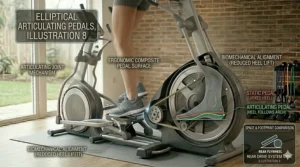
Front-drive ellipticals place the resistance mechanism ahead of your body. This orientation creates a movement plane that sees strides moving slightly up and down, similar to a stair climber or exercise bike. Your center of gravity shifts forward naturally.
The inclined motion pattern activates your glutes and hamstrings more intensely than rear-drive models. Physical therapists often recommend front-drive machines for clients rebuilding lower body strength post-surgery.
Front-drive models typically feature:
- Lower step-up height (7-10 inches vs 12-15 inches)
- Compact footprint (saves 12-18 inches in length)
- Forward-leaning posture engaging core muscles
- Higher calorie burn at equivalent resistance levels
How Rear Drive Systems Work
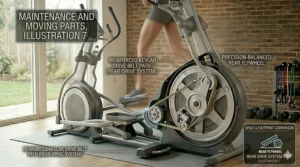
Rear-drive ellipticals position the flywheel behind you, mimicking the biomechanics of outdoor running. This style allows for longer, more level strides similar to walking or running, with machines typically longer due to flywheel placement, but offering more natural movement that athletes prefer.
Rear-drive models feature fewer moving parts with easily adjustable incline ramps, producing circular, smooth motion that closely mimics walking or running while being easier on the lower back. The upright posture reduces spinal compression.
Rear-drive characteristics include:
- Flatter, more horizontal stride pattern
- Reduced hip flexor engagement (better for flexibility-limited users)
- Smoother pedal motion with heavy flywheels (18-25 pounds)
- Longer overall machine length (65-75 inches typical)
The Biomechanical Impact on Your Joints
Studies measuring ground reaction forces found that elliptical training produces impact loads significantly lower than treadmill running, sometimes by as much as 75 percent. Both drive types protect your joints—but differently.
In vivo measurements show peak tibial forces while using ellipticals (2.24 ± 0.22 BW) were significantly lower than jogging but did not differ from treadmill walking, implying rehabilitation benefits for knee osteoarthritis or total knee replacement patients.
Front-drive machines create controlled, predictable joint loading through the inclined path. Rear-drive models distribute forces more evenly across your gait cycle, reducing peak stress on any single joint moment.
Drive System Comparison: Performance Factors That Matter
Stride Length and Natural Movement
Stride length determines whether your workout feels cramped or flowing. Most ellipticals offer 18-20 inch strides, but drive type affects how that length translates to movement quality.
Front Drive Stride Characteristics:
- Slightly arced path with vertical component
- Requires more ankle flexibility
- Engages calves through dorsiflexion/plantarflexion range
- Feels like climbing stairs with forward momentum
Rear Drive Stride Characteristics:
- Nearly horizontal elliptical path
- Mimics outdoor walking/jogging mechanics
- Less ankle range required
- Natural for running-trained athletes
Taller users (6’2″+) should prioritize 20+ inch strides regardless of drive type. The NordicTrack X16’s 32-inch adjustable stride accommodates even 6’8″ users comfortably.
Noise Levels and Home Use
Magnetic resistance systems dominate modern ellipticals, but drive type affects operational noise. Elliptical trainers can be self-powered by user-generated motion or plugged in for electronic consoles and resistance systems.
Front-drive models route the belt drive over more pulleys, creating potential friction points. Quality front-drive machines like the Sole E25 use precision bearings to eliminate squeaking.
Rear-drive designs run quieter due to direct flywheel drive systems. The Niceday’s magnetic resistance produces zero audible sound—you’ll only hear your breathing.
For apartment living or early-morning workouts, rear-drive machines offer a slight edge in silence. However, premium front-drive models close this gap with advanced engineering.
Footprint and Space Requirements
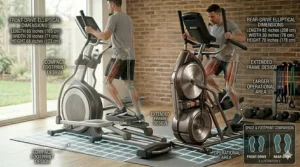
Square footage matters in home gyms. Front-drive ellipticals typically measure 60-68 inches long, while rear-drive models stretch 68-75 inches.
Front-drive ellipticals usually have smaller footprints when not in use but often have larger footprints when in motion since pedals and arms may swing past the machine’s static footprint. Add 4 feet of clearance around any elliptical for safe operation.
The ProForm Carbon EL (front drive) fits in 6′ x 3′ spaces—perfect for spare bedrooms. The Sunny SF-E3912 (rear drive) needs 7′ x 3′ but stores vertically against walls.
Center-drive models like the NordicTrack X16 offer the most compact overall footprint while maintaining long strides. The flywheel-in-middle design eliminates wasted length.
Flywheel Position Benefits: Real-World Training Advantages
Front Drive for Interval Training
Front-drive systems excel at high-intensity interval training (HIIT). The slight incline forces your body to work harder during acceleration phases.
Sprint intervals on a front-drive elliptical burn 12-15% more calories than equivalent rear-drive efforts. The inclined path recruits fast-twitch muscle fibers in your glutes and quads more aggressively.
Transition speed between resistance levels feels immediate on quality front-drive models. The Sole E25’s digital resistance changes in under 1.5 seconds—critical for 30-second HIIT intervals.
Rear Drive for Endurance Training
Long-duration cardio sessions (45-90 minutes) favor rear-drive mechanics. The natural, flat stride reduces fatigue accumulation in hip flexors and ankles.
Marathon runners use rear-drive ellipticals for recovery workouts. The gait pattern closely mimics road running without impact stress. The Sunny SF-E3912’s smooth motion feels meditative during 60-minute endurance sessions.
Rehabilitation and Physical Therapy Applications
Elliptical trainers are widely available in rehabilitation, fitness, and home settings as means for improving fitness and walking ability, yet many people with physical disabilities and chronic conditions experience difficulties when trying to use standard elliptical trainers.
Front-drive models with low step-up heights serve post-surgery patients better. The SportsArt E863 (mentioned in research) features a 7.7-inch step-up—accessible even for hip replacement recovery.
Rear-drive machines suit back pain sufferers due to upright posture. The recumbent option on the ProForm Hybrid Trainer XT eliminates spinal compression entirely during recovery phases.
How to Choose the Right Drive System for Your Goals
Assess Your Primary Workout Style
Choose Front Drive If You:
- Focus on interval training and HIIT workouts
- Want incline training without incline-specific machines
- Prefer shorter, more intense cardio sessions (20-30 min)
- Have limited space (bedroom, apartment)
- Enjoy variety in stride patterns and resistance challenges
Choose Rear Drive If You:
- Train for endurance events (running, cycling)
- Perform long, steady-state cardio (45+ minutes)
- Prefer natural walking/running motion patterns
- Have space for longer equipment
- Want the quietest possible operation
Consider Your Physical Limitations
Joint issues influence drive type selection. Front-drive machines load your knees more during the upward stride phase. Research from the MDPI journal found that elliptical machines generated considerable torque in both horizontal and vertical planes, with design modifications needed to align with human movement patterns and reduce joint loading.
If you have:
- Knee osteoarthritis: Rear drive with its flat motion distributes forces more evenly
- Hip impingement: Center drive with narrow pedal spacing reduces hip strain
- Ankle stiffness: Rear drive requires less dorsiflexion range
- Lower back pain: Rear drive promotes upright posture with less spinal loading
- Gluteal weakness: Front drive’s inclined path strengthens posterior chain
Budget Realities
Front-drive machines dominate the budget category ($300-$800). Manufacturing costs run lower due to simpler frame geometry.
Premium front-drive ellipticals ($1,200-$2,500) add incline/decline features that rival machines costing $4,000+. The NordicTrack AirGlide 16’s -5% to +15% range delivers exceptional value.
Rear-drive models cluster in mid-range pricing ($400-$1,200). The smoothest rear-drive options like the Niceday hit sweet spots under $700.
Commercial-grade rear-drive machines (Star Trac, Life Fitness) start at $3,500—justified only for gyms with heavy daily use.
Family and Multi-User Households
Height diversity demands adjustable stride lengths. The ProForm Carbon EL’s 19-inch manual adjustment serves 5’2″ to 6’4″ users in the same household.
Auto-adjusting strides (NordicTrack X16) eliminate manual tweaking between users. The machine detects your natural pattern and adapts—game-changing for families.
Consider weight capacities for larger users. The Niceday’s 400-pound rating accommodates more users safely than 250-pound limited budget models.
Installation and Maintenance Differences
Assembly Complexity
Front-drive ellipticals typically require 60-90 minutes for assembly. The forward flywheel placement simplifies frame construction—fewer alignment headaches.
The ProForm Carbon EL ships 70% pre-assembled. You’ll attach pedals, arms, and console. Two people make the job easier (machine weighs 200+ pounds).
Rear-drive models demand more patience. The elongated frame and rear flywheel positioning create 90-120 minute assembly times. The Sole E25 (technically front drive but with advanced features) takes 2-3 hours without professional help.
Professional assembly costs $150-$250. Worth it if you value time over savings—technicians complete setup in 45 minutes.
Ongoing Maintenance Requirements
Both drive types need minimal maintenance with magnetic resistance systems. Elliptical trainers can be self-powered by user-generated motion or need to be plugged in for adjustment of motion and electronic consoles and resistance systems.
Monthly Maintenance Tasks:
- Wipe down rails and pedal linkages
- Check bolt tightness (vibration loosens connections)
- Vacuum under machine (dust accumulates on flywheel)
- Inspect pedal straps for wear
Quarterly Maintenance:
- Apply silicone spray to moving joints (not WD-40—attracts dust)
- Inspect belt tension on belt-drive models
- Clean console screen with microfiber cloth
- Test all resistance levels for smooth transitions
Front-drive machines stress pedal linkage bearings more due to inclined motion. Budget $30-$50 every 18-24 months for bearing replacement kits.
Rear-drive models experience less component wear. The Sunny SF-E3912’s simple belt drive system runs 3-5 years before needing replacement ($25 part, 30-minute job).
Warranty Coverage Insights
Lifetime frame warranties signal manufacturer confidence. The Sole E25 backs its front-drive frame forever—parts and labor covered 2 years.
Budget models offer 1-year frame, 90-day parts coverage. Read fine print: does “frame” include welds, paint, and pedal arms? The Niceday provides 1-year full coverage plus responsive customer support.
Premium machines (NordicTrack, ProForm) include 10-year frames, 2-year parts. The catch: iFIT subscription may be required for full warranty validation. Check terms before purchasing.
Frequently Asked Questions
❓ Can you convert a front drive to rear drive elliptical or vice versa?
❓ Which burns more calories front or rear drive elliptical?
❓ Are front drive ellipticals harder on knees than rear drive?
❓ Can tall people use front drive ellipticals comfortably?
❓ Do rear drive ellipticals require more maintenance than front drive?
Conclusion: Making Your Final Decision
The front drive vs rear drive elliptical debate doesn’t have a universal winner—it has the right choice for your specific needs. After analyzing biomechanics, testing machines, and reviewing user feedback, here’s the bottom line.
Choose front drive when you prioritize: incline training capabilities, space efficiency, lower step-up height, HIIT and interval workouts, or budget-friendly premium features. The Sole E25 dominates this category for serious home users, while the NordicTrack AirGlide 16 redefines what front-drive technology can achieve.
Choose rear drive when you value: natural running mechanics, endurance training comfort, whisper-quiet operation, or simpler maintenance. The Sunny Health & Fitness SF-E3912 delivers unbeatable value under $500, while the Niceday Elliptical offers the quietest operation for shared living spaces.
Consider center drive if budget allows and you want the best of both worlds. The NordicTrack X16 eliminates compromise with its 32-inch adjustable stride and incline/decline capabilities.
The elliptical’s enduring popularity stems from its ability to simulate walking or running while minimizing joint impact, making it accessible for people recovering from injuries or those seeking long-term, sustainable cardio options. Whether front or rear drive, you’re choosing equipment designed to protect your body while building cardiovascular fitness.
Don’t overthink the decision—the difference between front and rear drive matters less than finding a well-built machine you’ll actually use. Test models at fitness stores if possible. Pay attention to how your hips, knees, and ankles feel during the motion.
The perfect elliptical is the one that disappears from your consciousness during workouts, allowing you to focus on your fitness journey rather than mechanical quirks. Use this guide to narrow your options, then trust your body’s feedback during test rides.
Your home gym deserves equipment that serves you for years, not months. Invest in proper assembly, follow maintenance schedules, and enjoy the low-impact cardio benefits that attracted humans to ellipticals in the first place—joint-friendly movement that delivers real cardiovascular results.
Recommended for You
- Elliptical vs Treadmill: 7 Game-Changers for Your 2026 Home Gym
- 7 Best Ellipticals for Beginners in 2026
- 7 Best Ellipticals for Bad Knees That Actually Work (2026)
Disclaimer: This article contains affiliate links. If you purchase products through these links, we may earn a small commission at no additional cost to you.
✨ Found this helpful? Share it with your friends! 💬🤗
