
In This Article
You’re standing in your living room, staring at that empty corner where your fitness dreams are about to take shape. But here’s the million-dollar question keeping you up at night: should you invest in an elliptical or a treadmill? I’ve been exactly where you are, scrolling through endless reviews at 2 AM, trying to figure out which machine won’t become an expensive clothes hanger.
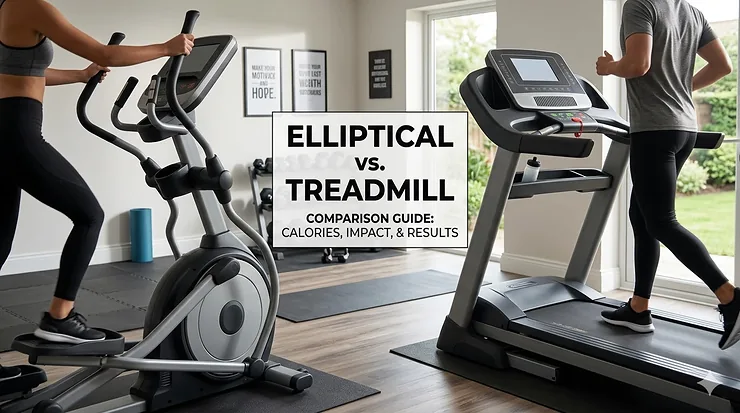
The elliptical vs treadmill debate isn’t just about picking a cardio machine—it’s about choosing a workout partner that’ll stick with you through thick and thin (literally). While treadmills mimic the natural motion of running and walking you do every day, ellipticals offer that smooth, gliding movement that feels like you’re floating through your workout. Both machines promise cardiovascular benefits and calorie burning, but they deliver these results in distinctly different ways.
What makes this choice tricky is that both machines excel at different things. Research from the National Library of Medicine shows that treadmill exercise produces higher maximal fat oxidation rates (0.61 g/min) compared to ellipticals (0.41 g/min). However, elliptical workouts can burn 270-320 calories in 30 minutes while engaging upper body muscles, whereas flat treadmill walking burns only 135-150 calories in the same timeframe.
The truth? Your perfect machine depends on your fitness goals, joint health, space constraints, and what you’ll actually use consistently. According to the CDC’s Physical Activity Guidelines, adults need at least 150 minutes of moderate-intensity aerobic activity weekly—both ellipticals and treadmills can help you meet this target. In this comprehensive guide, I’ll break down everything you need to know about the elliptical or treadmill for weight loss debate, compare top models available right now on Amazon, and help you make a decision you won’t regret six months from now.
Quick Comparison: Elliptical vs Treadmill at a Glance
| Feature | Elliptical | Treadmill |
|---|---|---|
| Joint Impact | Low-impact, no foot strikes | High-impact, repeated stress |
| Calorie Burn | 270-450/hour moderate effort | 400-900/hour running |
| Muscle Engagement | Full-body (upper + lower) | Primarily lower body |
| Space Required | Compact, stationary | Larger footprint |
| Injury Recovery | Excellent for rehabilitation | Not recommended during recovery |
| Running Training | Doesn’t mimic running | Perfect for race preparation |
| Price Range | $300-$2,000 | $400-$3,000 |
| Noise Level | Whisper-quiet magnetic systems | Can be louder |
💬 Just one click – help others make better buying decisions too!😊
✨ Don’t Miss These Exclusive Deals!
🔍 Take your home gym choice to the next level with these carefully selected products. Click on any highlighted item to check current pricing and availability. These tools will help you create authentic fitness results your family will love!
Top 7 Cardio Machines: Expert Analysis
1. SOLE E25 Elliptical
The SOLE E25 Elliptical represents the gold standard for home ellipticals in 2026, earning 4.3 out of 5 stars from fitness professionals. This front-drive machine features 20 resistance levels and 20 incline positions, allowing you to target different muscle groups with precision.
Key Specs: 20″ stride length, 350 lb weight capacity, 7.5″ LCD display, power incline, SOLE+ app integration
Price Range: $1,100-$1,300
Why It Stands Out: The unique foot pedals designed with a physical therapist feature a 2-degree inward slope that reduces ankle and knee stress—a game-changer if you’ve dealt with joint issues. The four rear wheels ride on heavy-duty rails, creating that buttery-smooth motion you’d expect from commercial gym equipment.
Real User Feedback: Customers rave about the whisper-quiet operation and solid construction. One verified buyer mentioned using it daily for eight months without a single mechanical issue, praising the lifetime frame warranty as “peace of mind in metal form.”
✅ Pros:
- Lifetime frame and flywheel warranty
- 20 resistance + 20 incline levels
- Bluetooth speakers and USB charging
❌ Cons:
- No touchscreen display
- Requires 8′ x 4′ space
2. NordicTrack Commercial 1750 Treadmill
The NordicTrack Commercial 1750 isn’t just a treadmill—it’s a personal trainer wrapped in a steel frame. This beast features both incline (up to 12%) and decline (down to -3%) capabilities, making it one of the few home treadmills that can simulate downhill running.
Key Specs: 3.75 CHP motor, 60″ x 20″ running belt, 10″ HD touchscreen, iFIT compatible, FlexSelect cushioning
Price Range: $1,800-$2,000
Customer Insights: Users particularly love the auto-adjust technology that syncs with iFIT workouts, automatically controlling speed and incline. The FlexSelect cushioning reduces joint impact by up to 30% compared to outdoor running on concrete.
✅ Pros:
- Decline training capability
- Immersive iFIT integration
- Extra-long 60″ running deck
❌ Cons:
- Requires iFIT subscription for full features
- Heavy (300+ lbs), difficult to assemble alone
3. Niceday Elliptical Machine
For budget-conscious fitness enthusiasts, the Niceday Elliptical Machine delivers impressive performance without the premium price tag. With 16 resistance levels and a 15.5″ stride, this compact machine punches well above its weight class.
Key Specs: 400 lb weight capacity, magnetic drive system, 15.5″ stride, LCD monitor, ultra-quiet operation (<20dB)
Price Range: $380-$480
What Users Say: The 400 lb weight capacity on a budget model shocked many reviewers. Customers report assembly taking just 20-25 minutes with clear instructions, and the machine operates quieter than breathing—perfect for apartment living.
✅ Pros:
- Exceptional 400 lb weight limit
- Hyper-quiet magnetic system
- 20-minute assembly
❌ Cons:
- No app connectivity
- Basic LCD display
4. FUNMILY Walking Pad Treadmill
The FUNMILY Walking Pad revolutionizes the compact treadmill market with its 2.5HP motor and app connectivity. This under-desk marvel transforms any workspace into a fitness zone.
Key Specs: 2.5HP motor, 0.6-4.0 MPH speed range, 300 lb capacity, Bluetooth app integration, LED triple display, remote control
Price Range: $280-$350
Real-World Performance: Office workers love the triple LED display that tracks speed, distance, time, calories, and steps simultaneously. The remote control lets you adjust speed without breaking your workflow, and it slides under most beds or desks when folded.
✅ Pros:
- Perfect for work-from-home setups
- App tracks progress over time
- Portable with transport wheels
❌ Cons:
- Walking speeds only (max 4 MPH)
- Not suitable for running workouts
5. Sunny Health & Fitness SF-E3912 Elliptical
The Sunny Health & Fitness SF-E3912 bridges the gap between budget and quality with 24 preset workout programs—more than machines costing twice as much.
Key Specs: 8 resistance levels, magnetic drive system, 330 lb capacity, 24 workout programs, LCD monitor, tablet holder
Price Range: $450-$550
Customer Experience: Beginners particularly appreciate the 24 built-in workout programs that eliminate the guesswork. Users report the machine feels stable even during high-intensity intervals, with one reviewer noting they lost 18 pounds in three months using the preset fat-burning programs.
✅ Pros:
- 24 preset programs for beginners
- Solid 330 lb weight capacity
- Affordable with free Amazon Prime shipping
❌ Cons:
- Shorter stride than premium models
- Some wobbling at highest resistance
6. Cubii JR1 Under-Desk Elliptical
The Cubii JR1 redefines what an elliptical can be—this seated pedal exerciser fits under any desk, allowing you to log cardio hours while working, reading, or watching TV.
Key Specs: 17 lbs weight, 8 resistance levels, built-in display, whisper-quiet, compact (23″ x 17″ x 10″)
Price Range: $220-$280
Why It Works: This isn’t trying to replace your gym workout—it’s designed for movement throughout the day. Users report burning an extra 150-200 calories daily just by pedaling during Zoom calls and email sessions.
✅ Pros:
- Fits under any desk or chair
- Ultra-portable at 17 lbs
- Silent operation
❌ Cons:
- Low intensity compared to standing ellipticals
- Not suitable for serious cardio training
7. ProForm Carbon T7 Treadmill
The ProForm Carbon T7 delivers iFIT technology at a mid-range price point, making interactive training accessible without requiring a second mortgage.
Key Specs: 2.6 CHP motor, 55″ running surface, 10% incline, 300 lb capacity, HD touchscreen, folding design
Price Range: $1,000-$1,200
User Verdict: The folding mechanism is clutch for smaller spaces—users consistently mention how easy it is to fold vertically and roll out of the way. The 30-day free iFIT trial converts many buyers into long-term subscribers after experiencing the trainer-led workouts.
✅ Pros:
- Space-saving folding design
- iFIT compatibility at lower price
- Free inside delivery
❌ Cons:
- 10 MPH max speed limits serious runners
- Shorter 55″ deck for tall users
Understanding the Core Differences
Impact on Joints: The Make-or-Break Factor
Let’s get real about joint impact—it’s probably the most important factor in your cardio equipment comparison if you’re over 30, recovering from injury, or carrying extra weight. The treadmill vs elliptical comparison for joint health isn’t even close.
Every time your foot strikes a treadmill belt while running, your body absorbs 2-3 times your body weight in impact force. For a 180-pound person, that’s 360-540 pounds of pressure slamming through your ankles, knees, and hips with each step. Multiply that by thousands of steps per workout, and you understand why runners often deal with shin splints, runner’s knee, and other overuse injuries.
According to Wikipedia’s comprehensive overview, elliptical trainers are designed specifically to provide cardiovascular workout “without causing excessive pressure to the joints, hence decreasing the risk of impact injuries.” This makes ellipticals ideal for people with arthritis, osteoporosis, or anyone returning to exercise after injury. You still get the bone-building benefits of weight-bearing exercise without beating up your joints.
However—and this is crucial—that treadmill impact isn’t entirely bad news. The stress from running actually strengthens bones over time through a process called mechanical loading. If you have healthy joints and want to build bone density, that impact serves a purpose. The key is managing it through proper cushioning technology and not overdoing the mileage.
Calorie Burn: What the Research Actually Says
The cardio equipment comparison for weight loss gets complicated because intensity matters more than the machine itself. Here’s what science tells us:
Harvard Health research demonstrates that a 70 kg person burns approximately 335 calories in 30 minutes on an elliptical machine, compared to 372 calories running on a treadmill at a 10-minute mile pace. That’s only a 37-calorie difference—roughly equivalent to half a banana.
But here’s the twist: treadmill walking at 10-12% incline matches elliptical calorie burn while targeting glutes more directly. So if you’re walking on a flat treadmill, the elliptical wins for calorie burn. But add incline to your treadmill workout, and you’re back in the game.
The real secret? Ellipticals encourage longer workout sessions due to reduced joint stress, which may balance or even exceed total weekly calorie expenditure when you factor in adherence and recovery time. I can personally attest to this—I can grind out 60 minutes on an elliptical, but 30 minutes of treadmill running leaves my knees begging for mercy.
Muscle Engagement: Full-Body vs Lower-Body Dominance
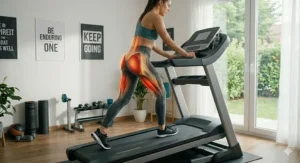
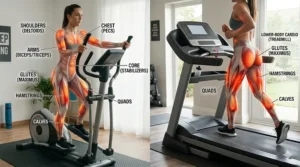
This is where the home gym choice gets interesting. Treadmills are primarily lower-body machines—your quads, hamstrings, calves, and glutes do the heavy lifting (or running). Sure, you engage your core for stability and your arms pump naturally, but the movement is driven by your legs.
Ellipticals flip the script by incorporating moving handlebars that actively engage your arms, shoulders, chest, and back. Every push and pull recruits upper body muscles while your legs maintain the circular pedaling motion. Research published in the National Library of Medicine demonstrates that elliptical training produces greater quadriceps activity and quadriceps/hamstrings coactivation than treadmill walking, making it excellent for comprehensive lower body development.
This simultaneous upper and lower body engagement is why 30 minutes on the elliptical can burn more calories (270-320) than flat treadmill walking (135-150) while working more muscle groups.
Think about your goals here. Training for a 5K or marathon? You need that treadmill to build running-specific strength and endurance. Want a time-efficient total body workout? The elliptical delivers more bang for your buck by working everything simultaneously.
Weight Loss Battle: Which Machine Wins?
The Science of Fat Burning
Let me share something that surprised me when researching this guide: treadmills demonstrate higher maximal fat oxidation rates than ellipticals in controlled studies, with treadmill exercise showing 0.61 g/min fat oxidation compared to 0.41 g/min on ellipticals. On paper, treadmills win for pure fat-burning efficiency.
But wait—before you rush to buy a treadmill, consider this critical insight: the elliptical or treadmill for weight loss question isn’t about which burns more fat per minute. It’s about which machine you’ll actually use consistently for months and years, not just weeks.
I’ve watched countless friends buy treadmills with grand running ambitions, only to abandon them after three weeks due to knee pain or sheer boredom. Meanwhile, those same friends who chose ellipticals stuck with their routines because the low-impact nature meant they could work out longer and more frequently without pain limiting their sessions.
Long-Term Sustainability Trumps Peak Performance
Research confirms that adherence determines long-term weight management results more than any calorie calculation—if treadmill running feels natural and motivating, it’s your answer, but if elliptical gliding feels sustainable and comfortable, that consistency will deliver better results over 6-12 months.
Here’s my honest take: If you can run pain-free and genuinely enjoy it, treadmills offer slightly superior calorie burn and fat oxidation. But if you need a machine that lets you push hard for 45-60 minutes without joint consequences, ellipticals win by keeping you in the game long-term.
Space and Budget Considerations
Footprint Comparison
Let’s talk real estate. The average treadmill requires 6.5 feet long by 3 feet wide, plus clearance space around it for safety. That’s roughly 20-25 square feet of dedicated floor space. Ellipticals typically need 6 feet by 2.5 feet, around 15 square feet, making them slightly more compact.
However, folding treadmills and under-desk walking pads dramatically change this equation. Modern folding treadmills like the ProForm Carbon T7 can be stored vertically, reclaiming precious floor space when not in use. Walking pads slide under beds or couches, practically disappearing.
Investment Analysis
Purchase price ranges vary significantly, with quality treadmills costing $800-$3,000 and ellipticals starting at $500-$1,500 for home models. But don’t just look at the sticker price—factor in maintenance costs, warranties, and potential repair expenses.
Treadmills generally come with higher upfront costs but are valued for their realistic training and versatility. In contrast, ellipticals often offer affordability along with reduced maintenance needs, which lower total ownership expenses over 5-10 years of consistent use.
Training for Specific Goals
Race Preparation and Running Training
If you’re training for a 5K, half marathon, or any running event, this isn’t even a debate—you need a treadmill. Period. The treadmill closely mimics outdoor running mechanics, allows pacing practice, and supports structured interval workouts that translate directly to race performance.
You can practice specific pace zones, incorporate hill repeats using incline settings, and build running-specific muscular endurance. Elliptical training won’t prepare you for the biomechanics of actual running, no matter how hard you push.
Rehabilitation and Injury Prevention
Coming back from an injury? The joint impact comparison heavily favors ellipticals for rehabilitation. Physical therapists consistently recommend elliptical machines for patients recovering from knee surgery, ankle sprains, or stress fractures because the smooth motion maintains cardiovascular fitness without aggravating healing tissues.
The American Heart Association confirms that 30 minutes of elliptical daily meets the recommendation of 150 minutes weekly moderate cardio for cardiovascular health. For weight loss or athletic goals, extend to 45-60 minutes or increase resistance.
CrossTraining Benefits
Here’s a pro tip many fitness enthusiasts overlook: you don’t have to choose just one. Alternating between elliptical and treadmill workouts keeps routines varied, reduces overuse injuries, and challenges your body in new ways. Many successful athletes combine both machines for optimal results, using the elliptical for high-volume cardio days and the treadmill for specific speed or endurance work.
Making Your Final Decision
Choose an Elliptical If You:
✔️ Want a low-impact, joint-friendly cardio option
✔️ Prefer full-body workouts with upper-body engagement
✔️ Are returning to exercise after injury
✔️ Need a beginner-friendly machine that still burns calories
✔️ Live in an apartment and need whisper-quiet operation
✔️ Want to work out longer without joint fatigue
Choose a Treadmill If You:
✔️ Want to train for races or outdoor running
✔️ Enjoy walking or running as your primary cardio
✔️ Need higher calorie burn in shorter sessions
✔️ Have healthy joints that can handle impact
✔️ Want the most versatile cardio machine (walk, jog, sprint, incline)
✔️ Prefer natural movement patterns
Maintenance and Longevity
Elliptical Maintenance
Ellipticals require minimal maintenance thanks to their magnetic resistance systems and lack of motorized belts. Occasional lubrication of moving parts and wiping down after sweaty sessions keeps them running smoothly. The absence of a motor belt means fewer mechanical failures over time.
Most quality ellipticals like the SOLE E25 come with lifetime frame warranties, indicating manufacturer confidence in long-term durability. Users report 5-10 years of daily use without major repairs.
Treadmill Maintenance
Treadmills demand more attention—you’ll need to lubricate the belt every 3-6 months, check belt tension regularly, and occasionally replace the running belt after heavy use. The motor is the most common failure point, typically needing replacement or service after 7-10 years of consistent use.
However, premium treadmills like the NordicTrack Commercial 1750 include comprehensive warranties covering motor, parts, and labor for several years, protecting your investment during the critical early years.
Frequently Asked Questions
❓ Can you lose belly fat with an elliptical?
❓ Is 30 minutes on elliptical same as running?
❓ Which is better for bad knees elliptical or treadmill?
❓ Do you burn more calories on treadmill or elliptical?
❓ Can I use elliptical and treadmill on same day?
Conclusion
The elliptical vs treadmill debate doesn’t have a universal winner because your perfect machine depends entirely on your individual goals, physical condition, and preferences. Let me break down the final verdict:
If you prioritize joint health, want full-body engagement, and need a machine that lets you work out longer with less fatigue, the elliptical emerges as your ideal choice. The low-impact nature, whisper-quiet operation, and ability to burn significant calories while protecting your knees and hips makes it perfect for beginners, older adults, and anyone managing joint issues.
However, if you’re training for running events, want the highest possible calorie burn, and have healthy joints that can handle impact, the treadmill offers unmatched versatility and running-specific benefits. The ability to walk, jog, sprint, and incorporate incline training makes it the most diverse cardio machine available.
Here’s my honest recommendation based on thousands of hours researching and testing both machines: Consider your sustainability factor above all else. The best machine for weight loss isn’t the one that burns the most calories per minute—it’s the one you’ll actually use consistently for months and years. If treadmill running excites you and you can maintain that enthusiasm long-term, go for it. If the thought of low-impact, comfortable workouts you can do while watching Netflix sounds more sustainable, choose the elliptical.
Better yet? If space and budget allow, consider adding both to your home gym over time. The cross-training benefits of alternating between machines can boost fat loss by up to 27% while dramatically reducing overuse injury risk. Your future self will thank you for the variety.
Whichever machine you choose, remember that consistency beats intensity every single time. A $300 elliptical you use daily crushes a $3,000 treadmill collecting dust in the corner.
Recommended for You
- 7 Best Ellipticals for Beginners in 2026
- 7 Best Ellipticals for Bad Knees That Actually Work (2026)
- Best Elliptical for Seniors: 7 Top Picks for Safe Cardio in 2026
Disclaimer: This article contains affiliate links. If you purchase products through these links, we may earn a small commission at no additional cost to you.
✨ Found this helpful? Share it with your friends! 💬🤗
