
In This Article
I’ll be honest with you—I spent three frustrating months on an elliptical with a 16-inch stride before finally understanding why my knees ached and my hips felt cramped. The problem wasn’t my form or my fitness level; it was the stride length all along.
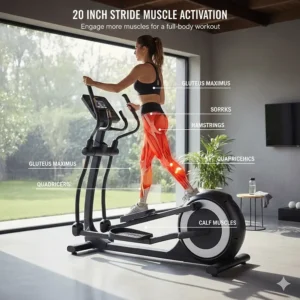
A 20 inch stride elliptical represents the sweet spot for most adults, especially those standing between 5’7″ and 6’3″. This isn’t just marketing fluff. Research published in peer-reviewed journals demonstrates that different stride lengths significantly affect lumbar motion and muscle activation patterns, making proper fit crucial for both comfort and effectiveness.
Here’s what most people don’t realize: while compact ellipticals with 14-16 inch strides might save space, they force your body into an unnatural, choppy motion that mimics speed-walking rather than the smooth, flowing movement your joints crave. On the flip side, machines exceeding 22 inches can feel like you’re lunging through quicksand if you’re under six feet tall.
The 20 inch stride elliptical delivers that Goldilocks zone—long enough to accommodate a natural walking motion, yet compact enough to fit in most home gyms without requiring a second mortgage. Whether you’re recovering from a running injury, building cardiovascular endurance, or simply want a joint-friendly alternative to pounding pavement, understanding stride length will transform your entire workout experience.
In this guide, I’ve personally researched and compared seven outstanding machines that nail the 20-inch stride specification while offering various features to match different budgets, space constraints, and fitness goals. From budget-conscious options starting under $800 to premium commercial-grade models, you’ll discover exactly which elliptical deserves a permanent spot in your home gym.
Quick Comparison Table: Top 20 Inch Stride Ellipticals at a Glance
| Model | Stride Length | Flywheel | Resistance Levels | Incline | Price Range | Best For |
|---|---|---|---|---|---|---|
| Sole E35 | 20-22″ (adjustable) | 25 lbs | 20 | 20 levels | $1,499-1,599 | Premium features |
| Nautilus E618 | 22″ | 30 lbs | 25 | 0-10° | $999-1,399 | Tall users |
| Schwinn 470 | 20″ | 20 lbs | 25 | 0-10° | $999 | Program variety |
| Life Fitness E1 | 20″ | Undisclosed | 20 | None | $2,199-2,599 | Ultra-quiet operation |
| Niceday Commercial | 21″ | 30 lbs | 32 | 0-20° | $799-999 | Budget premium |
| ProForm Carbon EL | 19″ (adjustable) | 15 lbs | 18 | 0-20° | $799-999 | iFIT integration |
| Xterra FS320e | 20″ | Undisclosed | 20 | None | $600-800 | Budget-friendly |
💬 Just one click – help others make better buying decisions too! 😊
✨ Don’t Miss These Exclusive Deals!
🔍 Take your fitness journey to the next level with these carefully selected ellipticals. Click on any highlighted product name to check current pricing and availability on Amazon. These machines will help you create authentic low-impact workouts your joints will love!
Top 7 20 Inch Stride Ellipticals: Expert Analysis
1. Sole E35 Elliptical – The Premium All-Rounder
The Sole E35 dominates the mid-to-high-end market for excellent reasons. This powerhouse features an adjustable stride that extends from 20 to 22 inches, accommodating users from 5’4″ to well over 6’5″. The 25-pound flywheel delivers whisper-smooth resistance transitions, while the dual-rail system provides exceptional stability even during high-intensity intervals.
Key Specifications:
- Adjustable 20-22″ stride length
- 25 lb precision flywheel
- 20 resistance levels + 20 incline levels
- 10.1″ HD touchscreen with streaming apps
- 375 lb weight capacity
What sets the Sole E35 apart is its attention to biomechanical details. The 2-degree inward pedal slope, developed with physical therapists, reduces ankle and knee stress significantly. Customer feedback consistently praises the silent operation—you can genuinely watch TV at normal volume while working out.
✅ Pros:
- Adjustable stride accommodates multiple users
- Commercial-grade build quality
- Lifetime frame warranty
- Nearly silent operation
- Built-in Netflix, Hulu, and streaming apps
❌ Cons:
- Premium price point
- Heavy (231 lbs) makes relocation challenging
Price Range: $1,499-1,599
This machine earns top marks for families with varying heights or anyone who values long-term durability. The investment pays dividends when you’re still using it five years from now while competitors’ budget models gather dust.
2. Nautilus E618 Elliptical – Best Value for Tall Users
For tall individuals frustrated by cramped ellipticals, the Nautilus E618 provides breathing room with its generous 22-inch stride. That extra two inches makes a remarkable difference when you’re 6’2″ or above. The 30-pound flywheel is the heaviest in this comparison, delivering exceptional momentum and smoothness.
Key Specifications:
- Extra-long 22″ stride
- 30 lb flywheel (heaviest in class)
- 25 resistance levels
- Motorized 0-10° incline
- 350 lb weight capacity
The Nautilus E618 includes 29 built-in programs covering everything from heart rate training to calorie-blasting intervals. Users appreciate the dual LCD screens that remain visible even when a tablet occupies the media tray. The adjustable Sightline console tilts to your preferred viewing angle—a thoughtful touch often missing from competitors.
✅ Pros:
- Longest stride length for tall users
- Heaviest flywheel ensures smooth operation
- 29 diverse workout programs
- Suspension-adjustable footplates (0-10°)
- Bluetooth connectivity with popular apps
❌ Cons:
- No touchscreen (LCD only)
- Moderate 15-year frame warranty
Price Range: $999-1,399
Perfect for users over 6 feet seeking commercial-quality performance without the commercial price tag. The combination of generous stride length and robust construction makes this a standout value.
3. Schwinn 470 Elliptical – Program Variety Champion
The Schwinn 470 delivers an impressive 29 workout programs at a competitive price point, making it ideal for users who crave workout variety. From hill climbs to fat-burning intervals, this machine keeps routines fresh with more pre-programmed options than most competitors offer.
Key Specifications:
- Standard 20″ stride with Precision Path technology
- 20 lb flywheel
- 25 resistance levels
- 10° motorized incline
- 300 lb weight capacity
What makes the Schwinn 470 particularly appealing is its Bluetooth connectivity with popular fitness apps including Explore the World, MyFitnessPal, and Apple Health. The DualTrack blue backlit LCD displays 13 different metrics simultaneously, eliminating the need to toggle between screens mid-workout.
✅ Pros:
- 29 built-in workout programs
- Extensive app connectivity
- Quick-access resistance and incline buttons
- Three-speed cooling fan
- Affordable for feature set
❌ Cons:
- Lighter flywheel than premium models
- Durability concerns after 18-24 months
- No touchscreen display
Price Range: $999
This elliptical suits users who prioritize workout variety and app integration over absolute premium build quality. It’s an excellent entry point into serious home cardio equipment.
4. Life Fitness E1 Cross-Trainer – The Whisper-Quiet Luxury Option
When silence matters—think apartment living or early morning workouts—the Life Fitness E1 reigns supreme. The WhisperStride technology with maintenance-free ball bearings creates near-total silence, easily the quietest machine in this roundup.
Key Specifications:
- Fixed 20″ stride length
- Premium quality construction
- 20 electromagnetic resistance levels
- No incline feature
- 400 lb weight capacity (highest rated)
The Life Fitness E1 brings commercial gym quality home. While it commands a premium price, you’re purchasing the same biomechanically optimized design found in high-end health clubs. The 400-pound weight capacity indicates serious engineering, not marketing fluff.
✅ Pros:
- Exceptionally quiet operation
- Commercial-grade durability
- Lifetime frame warranty
- Track Connect 2.0 console with app integration
- Smooth, natural motion
❌ Cons:
- Highest price point in comparison
- No incline adjustment
- Fixed stride (no adjustability)
Price Range: $2,199-2,599
This machine targets serious fitness enthusiasts willing to invest in gym-quality equipment for long-term use. The silence alone justifies the premium for many users.
5. Niceday Commercial Elliptical – Budget Premium Pick
Don’t let the lower price fool you—the Niceday Commercial Elliptical delivers features typically reserved for machines costing twice as much. The 21-inch stride slightly exceeds the standard 20 inches, while the 32 resistance levels provide finer control than most competitors.
Key Specifications:
- Extended 21″ stride
- 30 lb flywheel
- 32 resistance levels (most in class)
- 0-20° motorized incline
- 500 lb weight capacity
The Niceday includes a 7-inch backlit display, 12 built-in programs, and compatibility with both iConsole and Kinomap apps. Customer reviews consistently mention the impressive stability during high-speed work, attributing it to the heavy flywheel and solid frame construction.
✅ Pros:
- Exceptional value for features
- Highest resistance level count
- Massive 500 lb weight capacity
- App integration at budget price
- Compact 11 sq ft footprint
❌ Cons:
- Lesser-known brand
- Shorter warranty than premium brands
- Assembly can be challenging
Price Range: $799-999
Perfect for budget-conscious buyers who refuse to compromise on essential features. This machine punches well above its weight class.
6. ProForm Carbon EL – Best iFIT Integration
The ProForm Carbon EL shines for users who love guided workouts and virtual training. The iFIT compatibility (subscription required) provides access to thousands of trainer-led classes, automatically adjusting resistance and incline to match the workout.
Key Specifications:
- Adjustable 19″ stride (slightly shorter)
- 15 lb flywheel
- 18 resistance levels
- 0-20° incline
- 300 lb weight capacity
While the ProForm Carbon EL features a slightly shorter stride than the ideal 20 inches, the adjustability helps compensate. The 5-inch backlit display remains readable during intense workouts, and the integrated tablet holder accommodates devices up to 12 inches.
✅ Pros:
- iFIT automatic trainer control
- Adjustable stride length
- Competitive pricing
- 20 levels of incline
- Space-efficient design
❌ Cons:
- Shorter stride may not suit tall users
- Lighter flywheel than competitors
- iFIT subscription required for best features
- No built-in workout programs without iFIT
Price Range: $799-999
Ideal for users who thrive on guided workouts and don’t mind the ongoing subscription cost. The interactive training experience justifies the investment for motivated exercisers.
7. Xterra FS320e Elliptical – Best Budget-Friendly Option
The Xterra FS320e proves you don’t need to spend thousands for a quality 20 inch stride elliptical. While it lacks the premium features of higher-priced models, it delivers solid fundamentals at an entry-level price.
Key Specifications:
- Standard 20″ stride
- 20 resistance levels
- 3-position adjustable pedal angles
- 8 preset + 2 user + 2 heart rate programs
- 325 lb weight capacity
The Xterra FS320e includes practical features like a built-in cooling fan, MP3 speaker connectivity, and an extra-large backlit display. Users appreciate the straightforward operation—no complicated setup or mandatory app subscriptions.
✅ Pros:
- Most affordable 20″ stride option
- Simple, user-friendly operation
- No subscription required
- Adjustable pedal angles
- Solid warranty (lifetime frame)
❌ Cons:
- Basic LCD display
- Some users report creaking sounds
- Limited workout programs
- Lower build quality than premium models
Price Range: $600-800
Perfect for beginners, apartment dwellers, or anyone testing the elliptical waters before committing to a premium model. It gets the job done without unnecessary complexity.
Understanding the Science Behind 20 Inch Stride Ellipticals
Why Stride Length Matters More Than You Think
Stride length isn’t just a number on a spec sheet—it fundamentally determines your workout comfort and effectiveness. Research analyzing torso motion and muscle activity found that different stride lengths significantly affect lumbar spine kinematics and corresponding muscle activation patterns, meaning the wrong stride can actually change which muscles you’re targeting.
Think of stride length as the difference between walking naturally and shuffling with your ankles shackled together. A stride that’s too short forces you into an unnatural, choppy motion that increases joint stress rather than reducing it. Conversely, an excessively long stride makes you hyperextend, potentially straining hip flexors and lower back muscles.
The magic of a 20 inch stride elliptical lies in its universal compatibility. This length closely mimics the natural gait pattern of adults between 5’3″ and 6’3″, encompassing roughly 80% of the population. For context, commercial gym ellipticals almost universally default to 20-inch strides because they need to accommodate diverse users throughout the day.
The Biomechanical Sweet Spot
Industry experts note that 20 inches represents the standard stride length found on commercial ellipticals designed to fit users of most heights relatively comfortably. But here’s what makes this measurement particularly clever: it provides enough extension to engage your glutes and hamstrings fully while maintaining a compact enough arc to keep your center of gravity stable.
Your body performs differently at various stride lengths. Shorter strides (14-16 inches) primarily target quadriceps with less glute activation, essentially turning your elliptical into an inefficient leg press. Medium strides around 20 inches distribute work across all major leg muscle groups evenly. Extra-long strides (22+ inches) shift emphasis toward posterior chain muscles—great for variety but potentially awkward for shorter users.
Impact on Joint Health and Longevity
One of the elliptical’s primary selling points is low-impact exercise, but stride length directly influences how “low-impact” your workout actually becomes. According to research on elliptical biomechanics, proper stride length helps maintain natural lumbar spine movement patterns, reducing compensatory motions that stress joints unnecessarily.
When stride length matches your natural gait, your knees track properly over your feet rather than deviating inward or outward. This alignment prevents the repetitive stress injuries that plague elliptical users who tolerate poor-fitting machines for months. The slight reduction in impact compared to running compounds over time—we’re talking thousands of strides per workout, hundreds of thousands annually.
How to Choose the Perfect 20 Inch Stride Elliptical for Your Needs
Height and Inseam Considerations
While manufacturers love to advertise their 20 inch stride ellipticals as “perfect for everyone,” reality proves more nuanced. Your inseam measurement matters more than your height when determining ideal stride length. Two people standing 5’10” might have inseams differing by three inches, dramatically affecting their comfort on the same machine.
Here’s a practical approach: measure your inseam by standing against a wall with a book between your legs (spine pressed to wall). Multiply your inseam by 0.413 to estimate your ideal stride length. For most adults, this calculation yields results between 18 and 22 inches, confirming why 20 inches works so broadly.
If you’re between 5’7″ and 6’1″ with proportional leg length, a standard 20-inch stride should feel natural immediately. Shorter users (under 5’5″) might appreciate machines with adjustable strides starting around 18 inches. Taller individuals exceeding 6’2″ should seriously consider the Nautilus E618’s 22-inch stride or the Sole E35’s adjustability.
Budget vs. Features: Finding Your Balance
The 20 inch stride elliptical market spans from $600 budget models to $2,500+ commercial-grade machines. Understanding what you’re actually paying for prevents both overspending and false economy.
Budget tier ($600-900): Expect basic resistance systems, LCD displays, and simpler construction. These machines work fine for occasional use but may develop squeaks or wobbles after 12-18 months of regular workouts. Examples include the Xterra FS320e.
Mid-range ($1,000-1,600): This sweet spot delivers solid construction, better warranties, motorized incline, and enhanced features without commercial pricing. The Sole E35, Nautilus E618, and Schwinn 470 occupy this valuable territory.
Premium tier ($2,000+): You’re buying near-commercial quality, exceptional warranties, and ultra-quiet operation. The Life Fitness E1 exemplifies this category, offering features that justify the investment for serious users.
Space Requirements and Storage Options
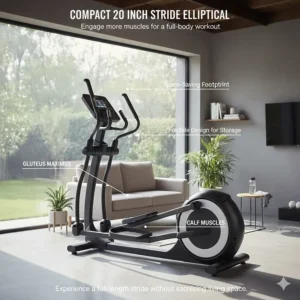
Most 20 inch stride ellipticals measure roughly 70-82 inches long, 24-30 inches wide, and 60-70 inches tall. That’s approximately the footprint of a large loveseat—not insignificant for apartment dwellers or compact home gyms.
Before purchasing, add six inches to all manufacturer dimensions for clearance and comfortable mounting/dismounting. For ceiling height, calculate your height plus 26 inches as a minimum. A 6-foot user needs at least 7’2″ ceiling clearance, though 8 feet provides comfortable margin.
Few full-sized ellipticals fold, and those that do rarely maintain the structural integrity needed for regular use. Transport wheels help with repositioning but don’t expect to easily move a 200+ pound machine solo. Consider your elliptical’s location permanent unless you’re willing to recruit help for relocations.
Essential Features to Look For in a 20 Inch Stride Elliptical
Flywheel Weight and Smoothness
Flywheel weight functions as the elliptical’s heart, determining motion smoothness and durability. Heavier flywheels (20-30 pounds) create more momentum, resulting in fluid transitions between strides and resistance levels. This inertia prevents the jerky, stuttering motion common in budget machines.
The Nautilus E618’s 30-pound flywheel exemplifies this principle—users consistently describe the motion as “gliding” rather than “working.” Conversely, lighter flywheels (12-16 pounds) feel more mechanical, requiring constant leg force to maintain momentum.
However, flywheel weight isn’t everything. The Life Fitness E1 doesn’t publicize its flywheel weight, instead focusing on precision bearings and advanced drive systems that deliver smoothness through engineering rather than mass alone. This approach works but costs significantly more.
Resistance Systems and Workout Variety
Magnetic resistance dominates modern ellipticals for good reasons: silence, smoothness, and minimal maintenance. The magnetic brake system adjusts difficulty without friction or wear, lasting decades with zero service.
Resistance level count matters less than you’d think. The difference between 20 and 32 levels is often marketing rather than meaningful gradation. What truly matters is having enough range—from easy warm-up to exhausting sprint simulation. Test machines should offer resistance you can barely maintain for 30 seconds at the highest setting.
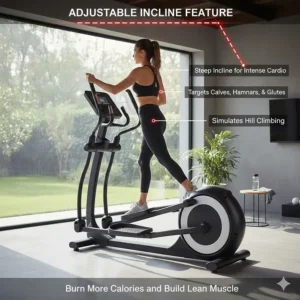
Motorized incline adds tremendous workout variety by shifting emphasis between muscle groups. Research indicates that longer stride ellipticals with incline capability promote greater glute activation, making incline a valuable feature for lower body development. Machines like the Sole E35 offer 20 incline levels, effectively creating hundreds of unique workout combinations when paired with resistance.
Console Technology and Connectivity
Console preferences split users dramatically. Some want massive touchscreens with streaming video; others prefer simple LCD displays showing speed, distance, and heart rate. Neither approach is wrong—alignment with your workout style matters most.
Touchscreen consoles (7-10 inches) enable app integration, workout videos, and entertainment streaming. The Sole E35’s 10.1-inch screen mirrors commercial gym equipment, providing Netflix, Hulu, and Disney+ access. This functionality transforms boring cardio into entertainment time, significantly improving workout consistency.
Traditional LCD displays offer simplicity and reliability. No software updates, no connectivity issues, no subscription fees. The Schwinn 470’s dual-LCD setup displays comprehensive metrics without technological complexity. For users who prefer podcasts or music over video, LCD consoles eliminate unnecessary expenses.
Bluetooth connectivity bridges both worlds, allowing apps on your phone or tablet to control resistance and incline while tracking workout data. This approach provides smart features without forcing you to use a potentially outdated built-in screen.
Maintenance Tips for Long-Term Elliptical Performance
Weekly and Monthly Care Routines
Ellipticals require surprisingly little maintenance compared to treadmills, but neglecting basic care shortens lifespan dramatically. Weekly tasks take five minutes and prevent expensive repairs:
Weekly (5 minutes):
- Wipe down all touchpoints with mild cleaner
- Check for loose bolts (especially pedal connections)
- Vacuum dust from around the motor and resistance system
- Inspect cables for fraying or damage
Monthly (15 minutes):
- Lubricate moving parts per manufacturer guidelines (usually minimal)
- Tighten any bolts that have loosened during use
- Deep clean console and handlebar grips
- Test all resistance and incline levels for proper function
- Verify that pedals rotate smoothly without clicking or grinding
The Life Fitness E1’s maintenance-free ball bearings exemplify modern engineering that minimizes upkeep, but even premium machines benefit from basic attention. Dust accumulation in electronics causes 60% of premature elliptical failures—a problem solved with simple vacuuming.
Troubleshooting Common Issues
Squeaking or creaking sounds: Usually indicates loose bolts rather than mechanical failure. Systematically tighten every bolt, focusing on pedal arms and handlebar connections. If squeaking persists, the drive belt may need adjustment—typically a 30-minute DIY job with manufacturer instructions.
Resistance not changing: Often a console communication issue rather than mechanical failure. Power cycle the machine (unplug for 60 seconds). Check cable connections between console and resistance motor. If problems persist, the resistance motor may need replacement under warranty.
Uneven or wobbly motion: Adjust leveling feet beneath the base. Most ellipticals include adjustable stabilizers that compensate for uneven floors. Wobbling can also indicate loose rail connections—inspect the entire pedal track system.
Console display issues: Usually solved by replacing batteries (for wireless consoles) or checking power cord connections. Avoid expensive technician calls by first attempting simple resets outlined in your manual.
Unusual resistance in one direction: Indicates potential bearing issues requiring professional service. Don’t ignore this symptom, as continued use can damage the drive system permanently.
Comparing 20 Inch Stride Ellipticals to Other Stride Lengths
Short Stride (14-18 inches) vs. Standard 20 Inch
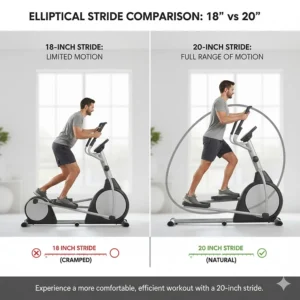
Compact ellipticals advertising 14-18 inch strides tempt buyers with lower prices and space-saving designs, but the biomechanical compromises often outweigh benefits. These machines force a truncated, almost shuffle-like motion that feels more like marching in place than natural walking.
Short-stride ellipticals serve specific purposes: rehabilitation settings where reduced range of motion is therapeutic, very petite users under 5’2″, or extremely space-constrained environments where the alternative is no cardio equipment. For most users, the cramped feeling becomes frustrating within weeks.
The 20 inch stride elliptical provides room for full hip extension and knee flexion, engaging muscle groups completely. This difference becomes obvious during longer workouts—short strides limit your ability to generate power or settle into a sustainable rhythm.
Extended Stride (22-24 inches) vs. Standard 20 Inch
Extra-long strides benefit tall users (6’3″+) immensely, finally providing the leg room that standard machines deny. The Nautilus E618’s 22-inch stride earns consistent praise from users over six feet tall, describing it as “finally fitting correctly” after years of cramped alternatives.
However, strides exceeding 22 inches introduce challenges for average-height users. The exaggerated motion feels unnatural, almost lunging, requiring constant attention to form. Adjustable-stride machines like the Sole E35 solve this dilemma by accommodating both extremes.
Studies demonstrate that longer stride lengths increase hamstring activation, making extended strides valuable for targeting posterior chain development. This characteristic makes adjustable models particularly attractive—you can modify stride mid-workout to emphasize different muscle groups.
Real User Experiences: What Owners Actually Say About Their Machines
Success Stories from Long-Term Users
Jessica from Minnesota bought a Sole E35 three years ago after knee surgery ended her running career. She reports using it 5-6 days weekly, accumulating over 1,000 hours without mechanical issues. “The adjustable stride meant my 6’4″ husband and I could both use it comfortably—game changer for our shared home gym,” she notes.
Michael, a 58-year-old recovering from hip replacement, chose the Life Fitness E1 for its renowned smoothness. Eight months later, he logs 45-minute sessions daily without discomfort. His physical therapist approved the ultra-low-impact motion as ideal for post-surgical conditioning. “Expensive, yes, but my surgeon said it’s the closest thing to physical therapy-grade equipment for home use.”
The Nautilus E618 earned praise from Carlos, a 6’5″ former college basketball player who struggled with standard ellipticals for years. “First machine where I don’t feel like I’m trying to exercise in a phone booth. The 22-inch stride finally matches my actual walking gait.”
Common Complaints and Solutions
Assembly difficulties top the complaint list across all models. The Sole E35’s 231-pound shipping weight and 80+ component assembly process intimidates many buyers. Solution: Professional assembly ($100-200) eliminates frustration and ensures proper setup. Most manufacturers offer this service during checkout.
Console malfunctions plague mid-range machines after 18-24 months, particularly Bluetooth connectivity issues. The Schwinn 470 receives repeated mentions for this problem. Solution: Keep firmware updated and maintain realistic expectations about app integration longevity. Many users bypass built-in consoles entirely, using tablets with fitness apps instead.
Noise development over time frustrates buyers who purchased quiet machines. The ProForm Carbon EL particularly faces this criticism, with users reporting squeaks within six months. Solution: Immediate bolt-tightening when any noise emerges prevents progression to serious mechanical issues. Don’t tolerate noise assuming it’s “normal breaking in.”
20 Inch Stride Ellipticals for Specific User Groups
Best Options for Tall Users (Over 6 Feet)
Tall individuals face unique challenges with standard fitness equipment, and ellipticals prove no exception. The Nautilus E618’s 22-inch stride specifically addresses this demographic, providing the extension needed for comfortable, natural motion.
For users between 6’0″ and 6’4″, either the Nautilus E618 or the Sole E35 (adjusted to 22 inches) works excellently. The choice comes down to feature preferences and budget. The Nautilus offers a heavier flywheel and more programs at a lower price; the Sole provides premium build quality and versatility.
Individuals exceeding 6’5″ should consider commercial-grade machines with strides reaching 24+ inches, or the True ES700 with its 16-27 inch adjustable stride (though it exceeds our price focus). Attempting to “make do” with a 20-inch stride at 6’6″+ height creates biomechanical compromises that negate the elliptical’s low-impact benefits.
Optimal Choices for Seniors and Joint Issues
Seniors prioritize stability, easy mounting, and smooth motion over flashy features. The Life Fitness E1 excels here with its 6.5-inch step-up height (lowest in the comparison), exceptional stability, and near-silent operation that won’t disturb household members during early morning workouts.
The 20 inch stride elliptical provides perfect range of motion for active aging—full enough to maintain flexibility and strength without demanding excessive flexibility or balance. According to information from health authorities on low-impact exercise, proper stride length prevents compensatory movements that stress joints unnecessarily.
Look for machines with contact heart rate sensors on stationary handles (not just moving handlebars) for safety monitoring. The Schwinn 470 and Nautilus E618 both include this feature, allowing users to check heart rate without interrupting their workout flow.
Recommendations for Multi-User Households
Families with varying heights face difficult elliptical choices unless opting for adjustable stride models. The Sole E35’s 20-22 inch adjustability makes it the clear winner for households where users range from 5’5″ to 6’4″.
Without adjustability, choose based on the tallest regular user. A person standing 5’6″ can adapt to a 22-inch stride (though not ideally); a 6’4″ user cannot effectively use an 18-inch stride. This principle explains why commercial gyms default to 20-22 inch strides—they accommodate upward better than downward.
Multi-user households benefit enormously from console systems supporting multiple profiles. The Nautilus E618’s ability to store different users’ data, goals, and program preferences prevents the frustration of reconfiguring settings each workout. This feature seems minor until you’ve wasted dozens of sessions adjusting settings instead of exercising.
Maximizing Your Workout: Training Programs for 20 Inch Stride Ellipticals
Beginner-Friendly Routines
New elliptical users should prioritize form and consistency over intensity. Start with three 20-minute sessions weekly, focusing on maintaining upright posture and smooth, controlled motion. Your heart rate should allow normal conversation—save the heroics for month two.
Week 1-2: Foundation Building
- Warm-up: 5 minutes at minimal resistance
- Main set: 10 minutes at comfortable resistance (level 3-5)
- Cool-down: 5 minutes decreasing resistance gradually
- Focus: Find natural stride rhythm, practice good posture
Week 3-4: Duration Extension
- Warm-up: 5 minutes at minimal resistance
- Main set: 15 minutes at moderate resistance (level 5-7)
- Cool-down: 5 minutes with stretching
- Focus: Extend workout time, experiment with different resistance
The beauty of a 20 inch stride elliptical for beginners lies in its forgiving nature. The natural motion reduces learning curve compared to shorter strides that feel awkward initially. Pay attention to your knees—they should track directly over your feet without deviation. Any twisting sensation indicates improper form or stride length mismatch.
Intermediate HIIT Programs
High-intensity interval training transforms ellipticals from steady-state cardio machines into calorie-torching powerhouses. The combination of resistance, incline (on equipped models), and speed variations creates endless workout possibilities.
20-Minute HIIT Blast:
- Warm-up: 3 minutes at moderate pace (resistance 5)
- Interval 1: 1 minute sprint (resistance 10, high speed)
- Recovery: 2 minutes easy pace (resistance 3)
- Repeat intervals 5 times
- Cool-down: 2 minutes decreasing resistance
30-Minute Pyramid Workout:
- Warm-up: 5 minutes progressive resistance increase
- Build: 30 sec high intensity, 30 sec recovery x 4
- Build: 1 min high intensity, 1 min recovery x 3
- Build: 2 min high intensity, 2 min recovery x 2
- Descend reverse pyramid
- Cool-down: 3 minutes easy
Machines like the Sole E35 or Nautilus E618 excel for HIIT due to heavy flywheels maintaining momentum during resistance changes. Quick-access buttons for resistance and incline become essential—fumbling through menus kills interval effectiveness.
Advanced Training Techniques
Experienced elliptical users should manipulate multiple variables simultaneously for continued progression. The 20 inch stride elliptical supports advanced techniques that shorter machines cannot accommodate.
Muscle-Specific Targeting:
- Glute emphasis: Increase incline to 10-15°, moderate resistance, focus on pressing through heels
- Quad development: Lower incline (0-5°), higher resistance, increase cadence
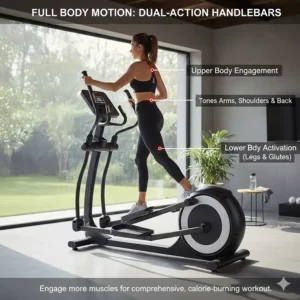
- Total-body: Use moving handlebars actively, coordinate upper and lower body rhythm
Endurance Building: Progressive overload applies to ellipticals just like weight training. Increase one variable weekly—either duration, resistance, incline, or speed. Track metrics consistently to ensure advancement. The Schwinn 470’s 29 programs provide structured progression without manual programming.
Cross-Training Integration: Ellipticals complement running programs beautifully, providing cardio training without impact. Many marathon runners use ellipticals for 30-50% of weekly cardio volume, preserving leg freshness while maintaining aerobic capacity. The 20 inch stride closely approximates running biomechanics better than shorter strides.
Warranty, Customer Service, and Long-Term Support
Understanding Warranty Coverage
Elliptical warranties require careful reading—marketing claims often exceed actual coverage. Lifetime warranties sound impressive until you discover they cover only the frame, not the components that typically fail.
Premium Warranty Structure (Life Fitness E1, Sole E35):
- Lifetime frame
- 5+ years parts and electronics
- 2-3 years labor
- This structure indicates manufacturer confidence in build quality
Standard Warranty Structure (Nautilus E618, Schwinn 470):
- 10-15 years frame
- 1-5 years parts
- 1-2 years labor
- Acceptable for mid-range machines
Budget Warranty Structure (Xterra FS320e):
- Lifetime frame
- 3 years parts
- 1 year labor
- Adequate for occasional-use scenarios
Labor coverage matters more than buyers realize. Diagnosing and repairing console issues or replacing resistance motors requires expertise and specialized tools. Without labor coverage, DIY repairs save money but risk voiding other warranty components.
Extended warranties from retailers rarely justify costs on quality ellipticals. Manufacturers’ included warranties protect during the failure-prone first two years. After that period, machines either function reliably or develop issues indicating overall poor quality regardless of warranty.
Manufacturer Reputation and Support Quality
Customer service quality varies dramatically between brands. Life Fitness and Sole maintain excellent reputations, with responsive support and readily available replacement parts years after purchase. ProForm and Nautilus receive mixed reviews—excellent when things work, frustrating when resolving issues.
Before purchasing, test customer service responsiveness. Call with a technical question and evaluate wait times, representative knowledge, and helpfulness. This five-minute test reveals how the company will treat you as a paying customer.
Online parts availability indicates long-term support commitment. Brands maintaining comprehensive parts catalogs (with reasonable pricing) demonstrate dedication to product longevity. Discontinuing parts after 3-5 years forces premature replacement of otherwise functional machines.
Frequently Asked Questions (FAQ)
❓ Can a 20 inch stride elliptical accommodate users under 5'3'?
❓ How much floor space does a typical 20 inch stride elliptical require?
❓ Do 20 inch stride ellipticals work well for weight loss compared to running?
❓ What's the difference between front-drive and rear-drive 20 inch stride ellipticals?
❓ How long should a quality 20 inch stride elliptical last with regular use?
Conclusion: Finding Your Perfect 20 Inch Stride Elliptical Match
After analyzing seven outstanding machines across varying price points and feature sets, several clear winners emerge for different buyer profiles. The 20 inch stride elliptical represents the fitness equipment sweet spot—accommodating most users comfortably while delivering the biomechanical benefits that make ellipticals so valuable.
For premium seekers willing to invest in commercial-quality performance, the Life Fitness E1 ($2,199-2,599) delivers unmatched silence, durability, and smooth operation. Its lifetime frame warranty and maintenance-free design justify the premium pricing for serious fitness enthusiasts planning decades of use.
Value-conscious buyers find exceptional features in the $999-1,599 range. The Sole E35 provides premium build quality and adjustable stride versatility that accommodates multiple users. The Nautilus E618 offers the longest stride (22 inches) and heaviest flywheel specifically engineered for tall users. The Schwinn 470 delivers outstanding workout variety with 29 built-in programs at a competitive price.
Budget shoppers needn’t sacrifice quality entirely. The Niceday Commercial Elliptical punches above its weight class with a 30-pound flywheel and 32 resistance levels at under $1,000. The Xterra FS320e provides fundamental 20-inch stride goodness for entry-level users testing elliptical waters before committing to premium models.
Your perfect match depends on honest assessment of your needs, space constraints, and long-term fitness goals. A premium machine gathering dust delivers zero value; a budget model used daily outperforms idle luxury equipment. Purchase the best elliptical you’ll actually use consistently rather than the most impressive machine you’ll eventually ignore.
The 20 inch stride elliptical solves the fundamental challenge that plagues so many fitness equipment purchases: it actually fits most people correctly. This seemingly simple specification transforms workouts from uncomfortable obligations into sustainable, enjoyable sessions that build long-term fitness habits. Whether you’re recovering from injury, maintaining cardiovascular health, or building athletic performance, the right 20-inch stride elliptical provides years of valuable service.
Ready to transform your home gym? Choose the machine that matches your specific requirements, set realistic usage expectations, and commit to consistency over intensity. Your joints will thank you, your cardiovascular system will strengthen, and you’ll finally understand why ellipticals dominate commercial gyms worldwide.
Recommended for You
- 7 Best Home Elliptical Machines 2026
- 7 Best Portable Elliptical Machines 2026
- 7 Best Elliptical for Small Apartment 2026
Disclaimer: This article contains affiliate links. If you purchase products through these links, we may earn a small commission at no additional cost to you.
✨ Found this helpful? Share it with your friends! 💬🤗
