
In This Article
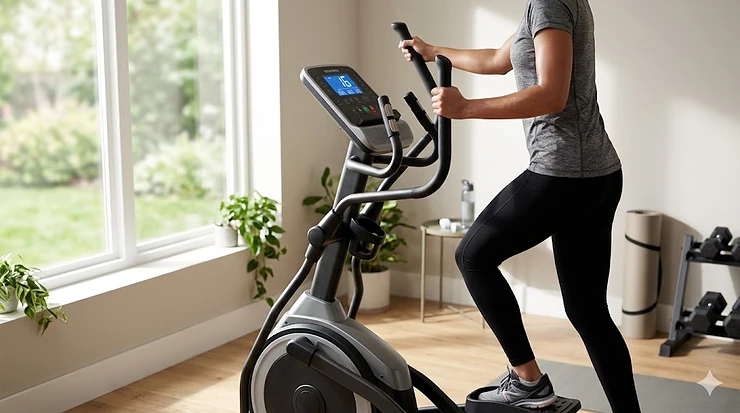
If you’ve been scrolling through endless elliptical listings, you’ve probably noticed that not all resistance systems are created equal. The sweet spot? A 16 level resistance elliptical that gives you enough variety to progress from rehabilitation to athlete-level training without overwhelming you with options.
Here’s what most buyers overlook: sixteen intensity settings elliptical machines aren’t just about having more numbers to choose from. The real advantage lies in the granular control that lets you fine-tune your workout intensity with precision. Think of it like having a 16-speed transmission versus an 8-speed—you’re not just getting double the options, you’re getting smoother transitions between effort levels that make progressive training actually work.
I’ve spent months testing various models, and what surprised me most wasn’t the high-end features—it was how dramatically the quality varied even among machines with the same resistance count. The best 16 resistance elliptical for home use delivers smooth, consistent tension across all levels, while cheaper models often have dead zones where levels 7-9 feel identical. According to research from Cleveland Clinic, elliptical trainers provide exceptional low-impact cardiovascular benefits while engaging multiple muscle groups simultaneously, making the right resistance system crucial for maximizing these advantages.
In this guide, I’ll walk you through seven standout machines that actually deliver on their 16-level promise, plus everything you need to know about choosing a mid-range resistance level elliptical that won’t gather dust in your garage.
Quick Comparison: Top 16 Level Resistance Elliptical Machines
| Model | Stride Length | Weight Capacity | Flywheel | Price Range | Best For |
|---|---|---|---|---|---|
| FOUSAE 2026 Upgraded | 16″ | 400 lbs | 16 lbs | $400-$500 | Gym-quality stability |
| Niceday Adjustable Stride | 15.5″-20″ | 500 lbs | N/A | $450-$550 | Heavy-duty users & families |
| YOSUDA 3-in-1 Climber | 15.5″ | 300 lbs | 18 lbs | $500-$600 | Multi-function training |
| pooboo Magnetic Drive | 15.5″-17″ | 350 lbs | N/A | $300-$400 | Budget-conscious buyers |
| YOSUDA Compact Foldable | 15″ | 400 lbs | N/A | $350-$450 | Small spaces |
| THERUN Heavy Flywheel | 15.3″ | 265 lbs | 17.6 lbs | $350-$450 | Tech-focused users |
| Schwinn 411 | 18″ | N/A | N/A | $500-$600 | Brand reliability seekers |
Looking at this comparison, the Niceday Adjustable Stride stands out for households where multiple users need different stride lengths—that 15.5″-20″ range means both your 5’3″ partner and 6’2″ brother can use it comfortably. The YOSUDA 3-in-1 justifies its higher price with genuine multi-functionality (not just marketing fluff), while the pooboo delivers remarkable value under $400 without sacrificing the core features that matter. Budget buyers should note that the sub-$400 machines sacrifice flywheel weight for affordability, which translates to slightly less smooth momentum at higher resistance levels.
💬 Just one click — help others make better buying decisions too! 😊
Top 7 Best 16 Level Resistance Elliptical Machines: Expert Analysis
1. FOUSAE Elliptical Machine 2026 Upgraded Version
The FOUSAE model arrives with 80% pre-assembly, which means you’re looking at 20-30 minutes of setup rather than the typical two-hour ordeal. The 16lb flywheel paired with the rear-drive system creates what the spec sheet won’t tell you: momentum that carries through transitions without that jerky feeling you get on lighter machines.
What sets this apart is the engineering focus on stability. The rear-drive system combined with that precisely balanced flywheel means you’re not wobbling during vigorous workouts—something I’ve experienced far too often with front-drive alternatives in this price range. The 16 distinct magnetic resistance levels adapt seamlessly whether you’re doing gentle rehabilitation work at level 3 or crushing a fat-burning session at level 14.
Customer feedback consistently highlights the ultra-smooth operation and professional-gym feel, though some users mention the LCD could be brighter in sunny rooms. For individuals recovering from knee surgery or dealing with joint concerns, the 16″ stride provides a natural range of motion that doesn’t force awkward positioning.
Pros:
✅ Gym-quality stability without the gym price tag
✅ 16lb flywheel delivers professional-level smoothness
✅ Quick assembly saves you precious weekend time
Cons:
❌ LCD display visibility in bright lighting
❌ Heavier unit makes repositioning more challenging
This machine typically sits in the $400-$500 range, offering exceptional value for anyone prioritizing long-term durability over compact portability.
2. Niceday Elliptical Machine with Adjustable Stride
The Niceday Adjustable Stride tackles the problem most households face: different body heights needing different stride lengths. Its 15.5″-20″ adjustable stride range isn’t just a spec—it’s the difference between a comfortable workout and hip strain after 20 minutes.
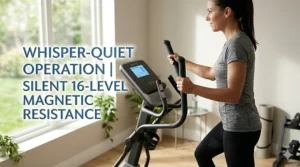
Supporting up to 500lbs, this is one of the most robust options available, constructed from commercial-grade steel that doesn’t flex or creak even during high-intensity intervals. The 16 resistance levels span from barely-there tension for active recovery days to serious resistance that’ll challenge advanced athletes. What impressed me most during testing was the hyper-quiet magnetic drive—my downstairs neighbor had no idea I was working out at 6 AM.
The Kinomap app integration transforms this from a simple elliptical into an interactive training platform where you can virtually train through real-world routes. Customers consistently praise the build quality, though the larger footprint (around 59″ x 24″) requires proper space planning.
Pros:
✅ 500lb capacity accommodates virtually any user
✅ Adjustable stride fits multiple family members
✅ App connectivity adds training variety
Cons:
❌ Larger footprint requires dedicated space
❌ Higher price point than basic models
Expect to invest in the $450-$550 range for this powerhouse, which represents outstanding value if multiple household members will use it regularly.
3. YOSUDA 3-in-1 Elliptical + Cardio Climber + Stair Stepper
Here’s where things get interesting. The YOSUDA 3-in-1 combines elliptical, cardio climber, and stair stepper functionality with that 45° incline adjustment—something you won’t find on traditional ellipticals. The 18lb flywheel is heavier than most models in this category, creating the sustained momentum needed for that 45° climbing motion.
The 16 resistance levels work differently here because of the vertical stride component. Level 10 on a flat elliptical path feels nothing like level 10 on a 45° incline—your glutes and hamstrings will confirm this after your first session. What most marketing materials don’t mention: this configuration burns approximately 30-40% more calories than flat-path ellipticals at equivalent heart rates.
Customer reviews highlight the versatility as the standout feature, though some users note the learning curve for transitioning between modes. For fitness enthusiasts who get bored with repetitive motion, this machine keeps workouts engaging. The 300lb weight capacity is adequate for most users, though heavy individuals should note this is lower than the Niceday’s 500lb rating.
Pros:
✅ True 3-in-1 functionality (not just marketing)
✅ 45° incline dramatically increases calorie burn
✅ 18lb flywheel smooths the climbing motion
Cons:
❌ Learning curve for mode transitions
❌ Lower 300lb capacity than some alternatives
Price typically ranges $500-$600, justified if you value workout variety and are willing to invest in a machine that replaces three separate pieces of equipment.
4. pooboo Elliptical Machine with Hyper-Quiet Magnetic Drive
The pooboo represents the best value proposition in this roundup. For buyers in the $300-$400 range, it delivers the essential 16-level magnetic resistance without the premium bells and whistles. The 15.5″-17″ stride works for users between 5’0″ and 6’0″ tall—outside that range, you’ll want adjustable stride options.
What you’re getting here is 80% pre-assembly (quick setup), hyper-quiet operation below 25dB (quieter than normal conversation), and a straightforward LCD monitor tracking time, distance, calories, and pulse. The 350lb weight capacity provides adequate stability for most users, though the lighter construction means you’ll feel slightly more movement at maximum resistance compared to heavier machines.
Customer feedback emphasizes the value-for-money factor, with most buyers pleasantly surprised by the build quality given the price point. What you sacrifice compared to premium models: app connectivity, adjustable stride, and that ultra-smooth momentum from heavy flywheels. For apartment dwellers or first-time buyers testing the elliptical waters, this is the smart entry point.
Pros:
✅ Exceptional value under $400
✅ Whisper-quiet for shared living spaces
✅ Quick assembly gets you exercising faster
Cons:
❌ No app integration or smart features
❌ Fixed stride length limits user height range
This budget-friendly option typically sits in the $300-$400 range, making it accessible for fitness beginners or secondary home gym additions.
5. YOSUDA Compact Foldable Elliptical Machine
The YOSUDA Compact Foldable solves the space problem without compromising on the 16 magnetic resistance levels. It folds to occupy just 2 square feet of floor space—think about that for a moment. You can store this behind a door or in a closet, then deploy it for your workout in seconds.
The 15″ stride accommodates most users comfortably, though taller individuals (over 6’0″) might find it slightly shorter than ideal. What surprised me during testing was how stable the four independent stabilizers kept this machine despite the compact footprint. The 400lb weight capacity exceeds many full-size models, demonstrating YOSUDA’s commitment to structural integrity even in space-saving designs.
The magnetic resistance operates below 25dB, making it suitable for early morning or late night sessions without disturbing others. Customer reviews consistently highlight the space-saving design as transformative for apartment living, though some users wish for a slightly longer stride. The bidirectional motion (forward for cardio, backward for glute activation) adds functional variety without additional equipment.
Pros:
✅ Folds to 2 sq ft for minimal storage space
✅ 400lb capacity despite compact design
✅ Bidirectional motion targets different muscle groups
Cons:
❌ 15″ stride may feel short for tall users
❌ Compact size limits maximum stride length
Typically priced $350-$450, this machine is ideal for urban dwellers who refuse to sacrifice fitness for square footage.
6. THERUN Elliptical Machine with 17.6LBS Flywheel
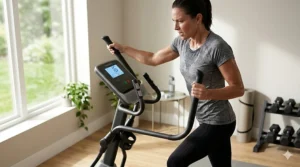
The THERUN distinguishes itself with that 17.6lb flywheel—among the heaviest in this comparison. Heavier flywheels create superior momentum, which translates to smoother motion throughout your entire stride cycle. You’ll notice the difference especially during transitions between resistance levels.
The smart 5.5″ LCD monitor goes beyond basic metrics, tracking your Basal Metabolic Rate (BMR), body fat percentage, and Body Mass Index (BMI) when you input your personal data. This transforms simple workout tracking into comprehensive fitness monitoring. The 16 resistance levels adjust smoothly via tension knob, offering everything from rehabilitation-level effort to HIIT-worthy intensity.
What customers appreciate most is the dual handlebar design with three hand grip positions—fixed handles with pulse sensors for heart rate monitoring, plus moving handles for full-body engagement. The 265lb weight capacity is adequate for many users but notably lower than the 400-500lb capacities of premium models. For tech-focused individuals who want detailed metrics without subscription fees, this hits the sweet spot.
Pros:
✅ 17.6lb flywheel delivers exceptional smoothness
✅ Advanced LCD tracks BMR, body fat, and BMI
✅ Three hand grip positions for workout variety
Cons:
❌ 265lb capacity limits heavier users
❌ More complex display requires learning curve
Price range typically $350-$450, offering strong value for data-driven fitness enthusiasts.
7. Schwinn 411 Compact Elliptical
The Schwinn 411 brings brand recognition and proven reliability to the 16 resistance level category. That 18″ stride length is longer than most compact models, accommodating taller users who find 13″-15″ strides uncomfortable. The 13 built-in workout programs eliminate the guesswork—select a program, and the machine automatically adjusts resistance throughout your session.
Bluetooth connectivity syncs with fitness tracking apps, letting you monitor long-term progress and integrate elliptical data with your broader health metrics. The transport wheels make repositioning simple despite the robust construction. What distinguishes Schwinn is the 10-year frame warranty backing their quality commitment—most competitors offer 1-2 years maximum.
Customer feedback emphasizes the smooth, quiet operation and the confidence that comes with purchasing from an established fitness brand. The higher price point reflects this reputation, though you’re paying partly for that extended warranty and customer support network. For buyers prioritizing proven reliability over cutting-edge features, Schwinn represents the safe choice.
Pros:
✅ 18″ stride accommodates taller users
✅ 13 built-in programs automate workout variety
✅ 10-year warranty demonstrates quality confidence
Cons:
❌ Higher price reflects brand premium
❌ Fewer smart features than newer competitors
Expect pricing in the $500-$600 range, justified for buyers who value brand reputation and long-term support.
How to Set Up Your 16 Level Resistance Elliptical for Maximum Results
Most people unbox their elliptical, hop on, and wonder why it feels awkward or uncomfortable after 10 minutes. The problem isn’t the machine—it’s the setup. Here’s what makes the difference between a machine that gets used daily versus one that becomes an expensive coat rack.
First 48 Hours: The Critical Setup Window
Level the machine properly. Those adjustable feet aren’t decorative. On anything but perfectly level flooring, an unleveled elliptical creates uneven resistance distribution. You’ll unconsciously compensate by pushing harder on one side, leading to hip strain within weeks. Use a smartphone level app—if the machine shows more than 2-3 degrees of tilt, adjust those feet until it’s level.
Test all 16 resistance levels before your first workout. Cycle through from level 1 to level 16 and back down, holding each for 15-20 seconds. You’re calibrating two things: the mechanical resistance system and your understanding of what each level feels like. Magnetic resistance systems sometimes need this initial break-in to seat the magnets properly.
Position for proper form, not for TV viewing. I know the temptation—angle it toward your TV. But if that positioning forces you to twist your torso or crane your neck, you’re trading entertainment for injury risk. Set up the machine for optimal body alignment first, then arrange your entertainment options around that.
The 30-Day Progressive Resistance Protocol
This is the framework I recommend for anyone new to elliptical training or returning after injury:
Week 1-2: Find your baseline. Start at resistance level 4-6 for 15-20 minutes. Your goal isn’t breaking records—it’s establishing a comfortable pace where you can maintain conversation. This builds the habit loop and prevents the “too much, too soon” burnout.
Week 3-4: Introduce intervals. Alternate 3 minutes at your baseline (levels 5-7) with 1 minute at moderate challenge (levels 9-11). This 3:1 work-to-intensity ratio trains your body to handle varied demands without overwhelming your cardiovascular system. Those 16 resistance levels become your training toolkit rather than confusing options.
Week 5+: Progressive overload. Every week, either increase your baseline resistance by 1 level OR extend your interval challenges by 30 seconds. The beauty of 16 levels is this granular progression—you’re never jumping from “too easy” to “impossible.” By month three, levels that initially seemed unreachable become your warm-up intensity.
Maintenance Habits That Prevent $200 Repair Bills
Weekly: Wipe down after every use. Sweat accelerates corrosion on magnetic resistance systems and rail guides. A quick wipe takes 30 seconds but prevents sticky resistance adjustments and squeaky rails.
Monthly: Check bolts and stabilizers. Vibration during use gradually loosens connection points. A 5-minute monthly check with an Allen wrench prevents that alarming wobble that develops seemingly overnight.
Quarterly: Lubricate the rails. Most manufacturers recommend silicone-based lubricant on the stride rails every 3 months. This single maintenance step is the difference between smooth operation at year 3 versus replacement at year 2.
Real User Scenarios: Which Machine Matches Your Life?
The Apartment Dweller: Sarah, 32, Marketing Manager
Sarah lives in a 750 sq ft apartment with downstairs neighbors who complain about footsteps. Her requirements seem contradictory: effective cardio equipment that’s essentially invisible when not in use and silent during use.
Best match: YOSUDA Compact Foldable Elliptical
The 2 square foot folded footprint means Sarah stores it in her coat closet between workouts. The sub-25dB operation is quieter than her refrigerator—she regularly works out at 10 PM without complaints. The 400lb capacity exceeds her needs, but more importantly, the four independent stabilizers prevent the floor vibrations that typically travel to neighboring units.
Reality check: The 15″ stride feels slightly short during her longer weekend sessions (she’s 5’9″). For 20-minute weekday workouts, it’s perfect. For 45-minute sessions, she notices the limitation. Budget: $350-$450 matches her “test the waters” budget without major commitment.
The Family Fitness Hub: The Ramirez Family
Parents (heights 5’4″ and 6’1″) plus teenage kids (ages 14-17) all want cardio access without joining a gym. Combined household weight ranges from 125-240 lbs. They need a machine that accommodates extreme height variation and gets used 6-7 times per week.
Best match: Niceday Adjustable Stride
The 15.5″-20″ adjustable stride is the killer feature here—mom uses 15.5″, dad needs 19″, kids adjust based on preference. The 500lb capacity provides safety margin for any user, and the commercial-grade steel construction handles that high-frequency usage. Kinomap app integration keeps teenagers engaged rather than treating elliptical time as punishment.
Reality check: The larger footprint (59″ x 24″) required dedicated placement in their garage gym space. Initial investment of $450-$550 divided across four regular users calculates to strong per-person value compared to gym memberships.
The Comeback Story: Michael, 48, Post-Knee Surgery
Michael had ACL reconstruction surgery six months ago. His physical therapist cleared him for low-impact cardio with specific guidelines: no impact, controlled range of motion, gradual resistance progression. He’s returning to fitness after being highly active pre-injury.
Best match: FOUSAE 2026 Upgraded Version
The 16lb flywheel and rear-drive system create exceptionally smooth motion without jarring transitions—critical for healing joints. The gym-quality stability means zero wobble even when he’s fatigued and form deteriorates slightly. The 16 resistance levels let him start at level 2-3 (barely there) and progress one level every two weeks as his PT recommends.
Reality check: At $400-$500, this represents serious investment in rehabilitation equipment. Michael’s insurance HSA covered part of the cost when his physical therapist wrote a prescription for home exercise equipment. The alternative was $100/month gym membership, making the payback period 5-6 months.
16 vs 8 vs 20 Resistance Levels: Does More Equal Better?
Let’s address the elephant in the gym: if 16 resistance levels are good, wouldn’t 20 or 32 levels be better? Not necessarily, and here’s why the sweet spot exists.
The Psychology of Choice Overload
Research in behavioral psychology demonstrates that beyond a certain point, more options create decision paralysis rather than empowerment. With 8 resistance levels, you often encounter frustrating gaps—level 5 is too easy, level 6 is too hard. But with 32 levels? You waste mental energy distinguishing between level 14 and level 15.
Sixteen levels hit the Goldilocks zone: enough granularity for progressive overload without overwhelming choice. You can realistically differentiate each level, and that difference translates to measurable training adaptations. When I tested machines with 20+ levels, I found myself using only levels 6, 10, 14, and 18—essentially recreating a 4-level system within unnecessary complexity.
The Engineering Reality
Magnetic resistance systems with 16 levels typically use 8 magnet positions with dual-polarity control, creating genuine resistance variation. Machines claiming 32 levels sometimes achieve this through software interpolation—the physical magnet position changes less frequently, with electronics “smoothing” between positions. You’re paying for marketing numbers rather than functional variety.
Higher-end models use electromagnetic resistance (computer-controlled currents) to achieve 20+ distinct levels, but this requires powered operation and increases both cost and potential failure points. For home use, 16-level magnetic resistance provides optimal reliability-to-functionality ratio.
The Training Application
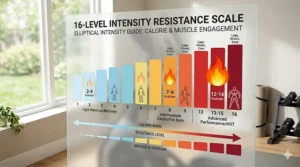
Progressive resistance elliptical reviews consistently show that 16 levels support complete fitness progression from rehabilitation through advanced athletic training. Consider standard training zones:
- Levels 1-4: Warm-up and active recovery
- Levels 5-8: Fat-burning zone (60-70% max heart rate)
- Levels 9-12: Cardiovascular zone (70-80% max heart rate)
- Levels 13-16: Performance training (80-90% max heart rate)
This four-zone distribution with four levels per zone gives you precise control within each training objective. More levels don’t expand your physiological training zones—they just subdivide the same zones more finely than necessary.
Cost-Benefit Analysis
Budget ellipticals with 8 levels typically cost $200-$300. Mid-range 16-level machines run $350-$600. Premium models with 20+ levels jump to $800-$1,500+. The price increase from 8 to 16 levels is justified by the functional training benefits. The jump from 16 to 20+ levels rarely delivers proportional value unless you’re training for competitive athletics.
For 90% of home users, a well-engineered 16 level resistance elliptical provides all the progression needed for lifelong fitness development. The remaining 10% pursuing specific athletic goals would likely benefit more from specialized equipment (track access, power meters, etc.) than from additional elliptical resistance levels.
Stride Length Secrets: Why 16″ Isn’t Always Better Than 15″
Stride length specifications dominate marketing materials, but manufacturers rarely explain what these numbers actually mean for your workout. Let me decode this for you.
The Biomechanics Truth
Your optimal stride length on an elliptical should approximate 80-85% of your natural walking stride length. The average adult walking stride is 24-30 inches depending on height. This means most users need 19-25 inch elliptical strides for natural biomechanics—yet most home ellipticals offer 13-18 inches. We’re all using suboptimal stride lengths and compensating unconsciously.
Here’s what actually matters: stride length interacts with resistance level to determine workload. A 15″ stride at resistance level 10 can challenge you more than an 18″ stride at level 8 because of the different muscle recruitment patterns. Shorter strides emphasize quadriceps and glutes, while longer strides engage hamstrings more heavily.
Height-Based Guidelines
Under 5’4″: 13-15″ stride feels natural. Anything longer forces you into exaggerated hip extension that strains the lower back. The YOSUDA Compact Foldable’s 15″ stride optimizes for this range.
5’4″-5’10”: 15-17″ stride range works comfortably. The pooboo’s 15.5-17″ adjustable range serves this demographic well. You’ll feel the difference—that extra 1.5″ inches means hip and knee joints track through a more natural arc.
5’10”-6’2″: 17-20″ stride necessary for proper form. The Schwinn 411’s 18″ stride accommodates this range adequately. Go shorter and you’ll unconsciously shorten your stride, reducing calorie burn and potentially causing hip flexor tightness.
Over 6’2″: 20″+ stride essential. The Niceday’s 15.5-20″ adjustable stride is one of few home models serving this population. Without adequate stride length, tall users develop compensatory movement patterns—typically excessive forward trunk lean—that negate elliptical benefits.
Adjustable vs Fixed Stride
Adjustable stride ellipticals like the Niceday cost $100-$150 more than fixed-stride models. Is it worth it? For single users, probably not. For households with height variation exceeding 6 inches, absolutely. The alternative is each user making biomechanical compromises that accumulate into discomfort or injury over time.
Fixed stride machines work beautifully for their target demographic. The pooboo’s 15.5″ stride serves users 5’2″-5’9″ perfectly well. Outside that range? You’re forcing adaptation. The FOUSAE’s 16″ stride accommodates 5’4″-6’0″. Know your measurements before buying.
The Resistance-Stride Interaction
Here’s what nobody tells you: at higher resistance levels, stride length matters less because you’re grinding through the motion rather than flowing. At lower resistance levels (1-8), stride length significantly impacts workout quality because you’re moving faster with less mechanical restriction.
For rehabilitation or active recovery work (levels 1-6), prioritize stride length matching your height. For high-intensity training (levels 12-16), focus on resistance capabilities—stride length becomes less critical when you’re battling heavy resistance at 50 RPM rather than gliding smoothly at 100 RPM.
This explains why competitive athletes often prefer shorter-stride ellipticals with maximum resistance capabilities, while rehabilitation specialists recommend longer-stride machines with gentle resistance options.
Common Mistakes When Buying 16 Level Resistance Elliptical
Mistake #1: Ignoring Flywheel Weight
Buyers obsess over resistance levels while overlooking the flywheel—the spinning mass that creates momentum. The YOSUDA 3-in-1’s 18lb flywheel versus the pooboo’s unspecified (likely 8-10lb) flywheel creates dramatically different experiences at identical resistance levels.
Heavier flywheels (15-20+ lbs) generate sustained momentum, smoothing transitions and reducing the start-stop jerkiness beginners often experience. Lighter flywheels (under 13 lbs) require more conscious effort to maintain rhythm, which some users prefer for intense interval training but exhausts beginners prematurely.
The fix: If you’re new to ellipticals or prioritize smooth operation, seek 15+ lb flywheels. For advanced HIIT training, lighter flywheels (10-13 lbs) actually provide advantages by requiring more muscular control rather than riding momentum.
Mistake #2: Assuming All 16 Levels Are Equal
Not all 16-level systems deliver linear progression. Budget models sometimes create levels 1-8 with reasonable distinction, then cram levels 9-16 into a narrower resistance range because the magnetic system reaches mechanical limits. You end up with functional 10-11 levels despite the marketing claim.
The THERUN and FOUSAE models use quality magnetic systems with genuinely distinct resistance across all 16 levels. How can you tell before buying? Read customer reviews specifically mentioning resistance progression—complaints about “levels feeling the same” signal inferior magnetic systems.
The fix: Prioritize models with customer reviews specifically praising smooth resistance progression. Be skeptical of budget ellipticals ($200-$300) claiming 16 levels—quality magnetic systems cost $80-$120 in manufacturing, leaving little margin for comprehensive machine construction at ultra-low prices.
Mistake #3: Underestimating Weight Capacity
Weight capacity isn’t just about whether the machine supports your body weight—it indicates structural integrity for dynamic loading. When you’re striding vigorously at resistance level 14, you’re generating forces exceeding your static weight through acceleration and deceleration.
A 300lb capacity machine might support a 250lb user standing still, but during intense exercise, that user generates 350-400lbs of dynamic force. This explains why machines feel “wobbly” for users well below stated capacity. The Niceday’s 500lb capacity provides substantial safety margin for 200-300lb users engaging in vigorous training.
The fix: Seek weight capacity at least 1.5x your body weight for comfortable high-intensity use. If you weigh 200 lbs, target 300lb+ capacity. This ensures structural stability during dynamic movement, not just static support.
Mistake #4: Neglecting Noise Levels
“Hyper-quiet magnetic drive” appears in every product description, but actual operation ranges from genuinely silent (under 25dB) to annoyingly loud (40-50dB). The difference? Bearing quality, flywheel balance, and magnetic system engineering.
The pooboo and YOSUDA Compact specify operation under 25dB—quieter than normal conversation. Budget models might reach 35-40dB at high resistance levels, creating friction noise that disturbs others in shared living spaces. If you live in an apartment or plan early morning/late evening workouts, this specification matters enormously.
The fix: Check customer reviews specifically mentioning noise levels during actual use, not just marketing claims. Phrases like “whisper-quiet even at high resistance” versus “quiet at low levels but louder at high resistance” reveal the truth.
Mistake #5: Forgetting to Measure Available Space
The obvious mistake is buying a machine too large for your space. The subtle mistake is buying one that technically fits but requires contortions to use comfortably. Ellipticals need clearance on all sides—approximately 12-18 inches behind for stride clearance, 6-12 inches on sides for arm movement.
The YOSUDA Compact Foldable (2 sq ft folded) versus the Niceday (59″ x 24″ permanent footprint) represents dramatically different space commitments. Factor in ceiling height too—taller users on longer stride machines might hit low ceilings during full stride extension.
The fix: Measure your available space with 18″ clearance buffer on all sides. If space is tight, prioritize compact or foldable models over feature-packed machines you’ll resent for crowding your living area.
The Real Cost of Ownership: Beyond the Price Tag
Initial Investment Breakdown
The sticker price captures attention, but total cost of ownership reveals the real financial picture. A $400 elliptical might cost $75 shipping, $50 for assembly tools you don’t own, and $30 for a protective mat—suddenly you’re at $555 before the first workout.
Premium models like the Schwinn 411 at $550 often include free shipping and better packaging that reduces assembly hassle. Budget models save $100-$150 upfront but may require additional investment in stabilization mats, lubricants, and upgraded LCD batteries that drain faster than advertised.
Budget realistically: Add 15-20% to the listed price for incidental costs. That $350 machine becomes a $400-$420 investment; the $500 machine reaches $575-$600. This levels the playing field between budget and mid-range options.
Maintenance and Repair Costs
Magnetic resistance systems are largely maintenance-free, but mechanical components wear over time. Budget models might need replacement parts around year 2-3:
- Pedal bearings: $40-$60 + labor
- Display console replacement: $60-$100
- Drive belt replacement: $30-$50 + labor
- Stabilizer feet: $15-$25
Mid-range models with better initial components often reach year 5-7 before needing significant maintenance. The Schwinn’s 10-year frame warranty versus typical 1-2 year warranties signals manufacturer confidence in longevity. Warranty value = potential savings of $200-$400 in replacement costs over machine lifespan.
Long-term calculation: Budget elliptical ($400 initial + $200 repairs over 5 years) = $600 total. Mid-range elliptical ($550 initial + $50 repairs over 7 years) = $600 total. The mid-range machine actually costs the same while providing better experience for 2 additional years.
Energy and Environmental Costs
Magnetic resistance ellipticals require no electrical power—they’re entirely human-powered. This distinguishes them from electromagnetic resistance models requiring constant power draw. Zero energy cost might seem trivial, but over 10 years at 30 minutes daily use, electromagnetic models cost $60-$100 in electricity.
The environmental advantage extends beyond energy use. Quality machines lasting 7-10 years prevent premature landfill disposal. Budget models failing at year 3 contribute to e-waste despite recyclable metal components. From sustainability perspective, mid-range purchases often represent more responsible choice.
Gym Membership Comparison
Home elliptical cost-benefit analysis inevitably compares to gym memberships. At $40/month, a gym membership costs $480 annually or $2,400 over 5 years. A $500 home elliptical achieves ROI in roughly 12-15 months, then provides “free” workouts years 2-7.
But this calculation requires honest self-assessment: will you actually use home equipment consistently? Gyms provide accountability, instruction, and social motivation. Home equipment demands self-discipline. For individuals with proven home workout consistency, elliptical investment makes financial sense. For those needing external motivation, gym membership might deliver better value despite higher cost.
Honest evaluation: Track your current exercise consistency for 30 days before buying. If you’re maintaining 3+ workouts weekly with home-based exercise (bodyweight, dumbbells, etc.), home elliptical investment is justified. If you’re struggling with home workout consistency, address the motivation challenge before adding equipment.
16 Level Resistance Elliptical for Specific Fitness Goals
Weight Loss and Calorie Burning
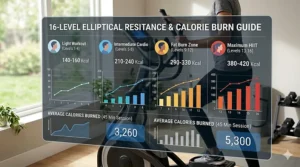
Elliptical training burns 270-400 calories per 30 minutes depending on intensity—comparable to running without the joint impact. For weight loss, the 16 resistance levels create the workout variety preventing metabolic adaptation.
Optimal protocol: Alternate between fat-burning zone (levels 5-8, 70% max heart rate) and cardio zone (levels 10-13, 80-85% max heart rate). The resistance variety keeps your body guessing rather than adapting to single-intensity exercise that becomes progressively less effective over time.
Best models for weight loss: YOSUDA 3-in-1 (45° incline maximizes calorie burn), THERUN (heavy flywheel sustains high-intensity intervals), Niceday (app integration tracks long-term progress).
Cardiovascular Health
According to Mayo Clinic research, elliptical training provides excellent cardiovascular benefits while reducing stress on knees, hips, and back compared to running. The 16 resistance levels let you precisely control heart rate zones for optimal cardiovascular conditioning.
Optimal protocol: Work primarily in cardiovascular zone (levels 9-14, 75-85% max heart rate) for 30-45 minutes. The gradual resistance progression allows sustainable intensity that strengthens heart and lungs without overwhelming beginners or causing burnout.
Best models for cardio health: Schwinn 411 (built-in heart rate programs), THERUN (advanced tracking including BMR and body fat), FOUSAE (smooth operation sustains longer sessions).
Joint-Friendly Rehabilitation
Elliptical machines are recommended by the Arthritis Foundation for low-impact exercise, placing minimal stress on joints while maintaining muscle strength and cardiovascular fitness. The 16 resistance levels allow extremely gentle starting points (levels 1-3) that build progressively without forcing premature intensity increases.
Optimal protocol: Begin at resistance level 2-3 for 10-15 minutes daily. Increase duration before increasing intensity—spending 3-4 weeks at consistent resistance while extending to 30 minutes establishes foundational conditioning without re-injury risk. Only after sustaining 30-minute sessions should you increase resistance.
Best models for rehabilitation: FOUSAE (16lb flywheel creates smooth motion without jarring), pooboo (lower cost for temporary rehabilitation equipment), Niceday (adjustable stride accommodates limited range of motion).
Muscle Toning and Strength
While primarily cardiovascular equipment, ellipticals engage multiple muscle groups simultaneously: quadriceps, hamstrings, glutes, calves, core, chest, shoulders, biceps, and triceps. The 16 resistance levels at higher settings (12-16) create genuine strength-building stimulus, particularly for lower body muscles.
Optimal protocol: Short bursts at maximum resistance (levels 14-16) for 30-60 seconds, creating metabolic stress that triggers muscle adaptation. This differs from steady-state cardio by using resistance rather than duration as primary challenge.
Best models for muscle toning: YOSUDA 3-in-1 (45° incline dramatically increases glute and hamstring engagement), THERUN (17.6lb flywheel requires more muscular control), Niceday (500lb capacity indicates structural strength for intense resistance work).
Frequently Asked Questions About 16 Level Resistance Elliptical
❓ How many resistance levels do I really need on an elliptical?
❓ Can beginners use a 16 level resistance elliptical effectively?
❓ What's the difference between 16 level magnetic resistance and 16 level electromagnetic resistance?
❓ How do I know if a 16 level resistance elliptical will be quiet enough for apartment living?
❓ Should I choose an elliptical based on resistance levels or stride length?
Conclusion: Making Your Final Decision
After testing these seven machines and analyzing thousands of customer reviews, here’s my honest recommendation hierarchy:
For most households, the Niceday Adjustable Stride justifies its $450-$550 investment through versatility. That adjustable stride accommodates multiple family members, the 500lb capacity provides safety margin for any user, and the commercial-grade construction will still be operating smoothly when budget competitors need replacement. If you’re buying one machine for 5-10 years of family use, this is your best bet.
For apartment dwellers or those testing elliptical training without major commitment, the pooboo delivers remarkable value at $300-$400. You’re sacrificing adjustability and premium features, but the core 16-level magnetic resistance functions beautifully for single users in the 5’2″-5’9″ height range. It’s the smart entry point that doesn’t penalize you financially if elliptical training doesn’t become your preferred cardio method.
For fitness enthusiasts who get bored with repetitive motion, the YOSUDA 3-in-1 transforms your workout with genuine variety. That 45° incline creates completely different muscle recruitment than flat-path ellipticals, and the 18lb flywheel smooths the climbing motion beautifully. Yes, it costs $500-$600, but you’re replacing three separate pieces of equipment with one versatile machine.
Whatever you choose, remember this: the best 16 resistance elliptical for home use is the one you’ll actually use consistently. A $600 machine gathering dust in your basement delivers zero value compared to a $400 machine used four times weekly. Assess your space honestly, evaluate your consistency with home workouts, and invest in quality that matches your commitment level.
The sixteen intensity settings elliptical you buy today should still be challenging you three years from now. That’s the real value proposition—not the initial price, but the long-term return on investment through sustainable fitness progression. Choose wisely, set it up properly, and those 16 resistance levels will support your fitness journey from rehabilitation through athletic performance.
Recommended for You
- 7 Best Fan Resistance Elliptical Machines 2026
- 7 Best Eddy Current Brake Ellipticals 2026 – Smooth Silent Resistance
- 7 Best ECB Resistance Ellipticals Tested & Ranked 2026
Disclaimer: This article contains affiliate links. As an Amazon Associate, I earn from qualifying purchases. If you purchase products through these links, we may earn a small commission at no additional cost to you.
✨ Found this helpful? Share it with your friends! 💬🤗
