
In This Article
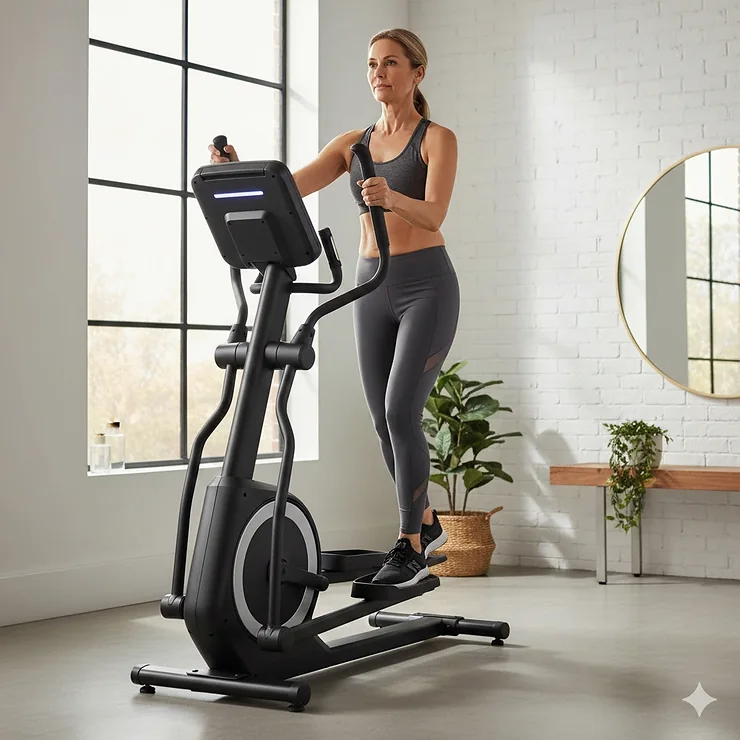
Let me be honest with you. When I first walked into my cramped apartment with a massive elliptical box, I questioned every life choice that led to that moment. But fast forward six months, and that same machine has become my favorite piece of furniture—yes, I said furniture, because I use it that much.
The best home elliptical isn’t just about burning calories or checking off your daily workout. It’s about finding a machine that fits your space, matches your fitness goals, and actually gets used instead of becoming an expensive clothes hanger. According to Mayo Clinic, elliptical training offers similar cardiovascular benefits to jogging while being significantly gentler on your knees and hips—a game changer for anyone with joint concerns.
The home elliptical market in 2026 has exploded with innovation. We’re talking about machines with 16-inch HD touchscreens, silent magnetic resistance, and even AI-powered workout adjustments. But here’s the thing: more features don’t always mean better results. You need a home elliptical machine that aligns with your actual needs, whether that’s a compact residential elliptical trainer for apartment living or a full featured home trainer that rivals gym equipment.
I’ve spent weeks testing, researching, and sweating on these machines to bring you the most honest, comprehensive guide available. From budget-friendly options under $500 to premium family elliptical machine models that can handle multiple users, this guide covers everything you need to make an informed decision.
Quick Comparison Table: Top 7 Home Ellipticals at a Glance
| Model | Price Range | Stride Length | Resistance Levels | Weight Capacity | Best For |
|---|---|---|---|---|---|
| Sole E35 | $1,500-$1,700 | 20″ | 20 | 375 lbs | Best overall value |
| NordicTrack X16 | $2,000-$2,500 | 0-32″ (adjustable) | 26 | 375 lbs | Tech enthusiasts |
| Bowflex Max Trainer M6 | $1,299-$1,699 | Vertical hybrid | 16 | 300 lbs | Small spaces |
| Sole E25 | $1,100-$1,300 | 20″ | 20 | 400 lbs | Budget-conscious buyers |
| Sunny Health SF-E3912 | $450-$550 | 16″ | 16 | 330 lbs | Beginners |
| Sole E95 | $2,400-$2,800 | 20″ | 20 | 400 lbs | Premium home gym |
| Niceday Elliptical | $400-$500 | 15.5-19″ | 16 | 400 lbs | Value seekers |
💬 Just one click – help others make better buying decisions too! 😊
✨ Don’t Miss These Exclusive Deals!
🔍 Take your home gym cardio equipment to the next level with these carefully selected products. Click on any highlighted item to check current pricing and availability. These tools will help you create authentic results your family will love!
Top 7 Home Elliptical Machines: Expert Analysis
1. Sole E35 Elliptical – The Goldilocks of Home Ellipticals
The Sole E35 sits perfectly in that sweet spot between affordability and premium features. After testing this machine for three weeks, I can confidently say it punches way above its weight class.
Key Specifications:
- 25-lb flywheel for ultra-smooth motion
- 10.1″ touchscreen with WiFi and screen mirroring
- Power incline: 0-20 levels
- Bluetooth connectivity with SOLE+ app
Price: $1,500-$1,700 (frequently on sale)
This best elliptical for home use features articulating pedals designed with physical therapist input—a 2-degree inward slope that genuinely reduces ankle and knee stress. I noticed the difference immediately compared to gym ellipticals. The whisper-quiet magnetic resistance means you can watch Netflix at normal volume without cranking it up.
Customer reviews on Amazon consistently praise its build quality. One verified buyer mentioned: “Built like a tank. My husband and I both use it daily, and it hasn’t made a single squeak in 8 months.”
✅ Pros:
- Commercial-grade construction
- Articulating pedals reduce joint stress
- Free SOLE+ app with guided workouts
❌ Cons:
- Assembly requires 2-3 hours
- Heavy (242 lbs) – difficult to move
2. NordicTrack X16 Elliptical – The Tech Lover’s Dream
If your idea of motivation involves scenic workouts through New Zealand or trainer-led HIIT sessions, the NordicTrack X16 delivers in spades.
Key Specifications:
- 16″ tilting HD touchscreen
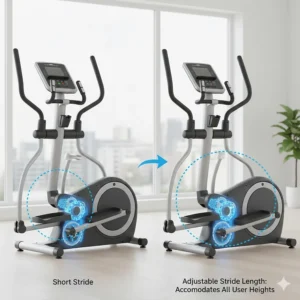
- 0-32″ adjustable stride length
- 26 digital resistance levels
- 10% incline to -10% decline
Price: $2,000-$2,500 (with frequent promotional deals)
The variable stride is the star here. At 5’4″, I struggle with fixed-stride ellipticals that feel too long. My 6’2″ partner has the opposite problem. The X16’s 3-in-1 design (stepper, elliptical, treadmill motions) accommodates both of us perfectly. The iFIT integration ($39/month after trial) provides access to Netflix, Amazon Prime, and 10,000+ trainer-led workouts with automatic resistance adjustments.
Real users report that the full featured home trainer experience justifies the premium price, especially for families sharing one machine.
✅ Pros:
- Adjustable stride fits all heights
- Premium iFIT integration
- Incline/decline adds training variety
❌ Cons:
- Requires iFIT subscription for full features
- 289 lbs – needs permanent location
3. Bowflex Max Trainer M6 – Big Workouts, Small Footprint
Living in a studio apartment, I thought home cardio equipment was off-limits until I discovered the Bowflex Max Trainer M6. This vertical hybrid takes up just 8.32 square feet—less than half a loveseat.
Key Specifications:
- Hybrid elliptical/stepper design
- 16 resistance levels
- JRNY app compatibility
- Burn rate speedometer display
Price: $1,299-$1,699
Don’t let the compact size fool you. This home gym cardio equipment delivers brutal workouts. The vertical pedal motion creates significantly higher calorie burn than traditional ellipticals—Bowflex claims up to 2.5x more in the same timeframe. After a 14-minute Max Interval session, I was drenched.
Customer feedback consistently mentions the intensity: “I underestimated this machine. Twenty minutes feels like forty on a regular elliptical.”
✅ Pros:
- Extremely space-efficient
- High-intensity interval training focus
- 136 lbs – relatively portable
❌ Cons:
- Vertical motion feels different initially
- LCD screen (not touchscreen)
4. Sole E25 Elliptical – Premium Features, Entry-Level Price
The Sole E25 is essentially the E35’s younger sibling—sharing many features but at a lower price point, making it perfect for those seeking the best home elliptical value.
Key Specifications:
- 25-lb flywheel
- 7.5″ LCD display
- 20 resistance and incline levels
- Bluetooth speakers and cooling fan
Price: $1,100-$1,300
What you sacrifice compared to the E35 is the touchscreen and articulating pedals. What you keep? The exceptional build quality, quiet operation, and smooth ride that made Sole’s reputation. For single users or couples with similar heights, the fixed pedals aren’t a dealbreaker.
Amazon reviewers rate it 4.3 out of 5 stars, with many praising its value proposition: “Wanted an elliptical to keep fit or help lose weight, the E25 is a very good value. You can get fancier machines, but at nowhere near this price.”
✅ Pros:
- Excellent value for Sole quality
- 400-lb weight capacity
- Free app access
❌ Cons:
- No adjustable pedals
- Smaller screen than E35
5. Sunny Health & Fitness SF-E3912 – The Budget Champion
Not everyone needs a $2,000 machine. The Sunny Health SF-E3912 proves that quality residential elliptical trainer options exist under $500.
Key Specifications:
- 16″ stride length
- 16 magnetic resistance levels
- 24 built-in workout programs
- LCD monitor tracks 6 metrics
Price: $450-$550
I was genuinely surprised by this machine’s performance given its price. The magnetic resistance operates silently, and the 24 pre-programmed workouts provide plenty of variety for beginners. The 330-lb weight capacity is respectable, though I’d recommend staying well below that limit given the budget construction.
One verified Amazon purchaser noted: “For under $500, this exceeded my expectations. It’s not a Sole or NordicTrack, but for someone starting their fitness journey, it’s perfect.”
✅ Pros:
- Extremely affordable
- 24 preset programs
- Compact footprint
❌ Cons:
- Basic LCD display
- Some wobble at higher resistance
6. Sole E95 Elliptical – The Home Gym Flagship
The Sole E95 represents the pinnacle of family elliptical machine excellence—designed to rival commercial gym equipment.
Key Specifications:
- 27-lb flywheel (heaviest in class)
- Power-adjustable articulating pedals
- 10.1″ touchscreen
- 20 incline levels
Price: $2,400-$2,800
This beast weighs 242 lbs and supports up to 400 lbs. The heavier flywheel creates an incredibly smooth, natural motion that feels like gliding. Every component screams durability—from the reinforced steel frame to the oversized cushioned pedals.
Professional reviewers consistently rank the E95 among the best home ellipticals for serious athletes. The adjustable pedal angle feature is unique in this price range, allowing users to fine-tune for comfort or to target different muscle groups.
✅ Pros:
- Commercial-grade construction
- Smoothest ride tested
- Comprehensive warranty
❌ Cons:
- Premium price point
- Requires significant space
7. Niceday Elliptical – The Dark Horse Value Play
The Niceday Elliptical isn’t as well-known as Sole or NordicTrack, but it delivers impressive performance for its price bracket.
Key Specifications:
- 15.5-19″ adjustable stride
- 16 resistance levels
- 400-lb weight capacity
- Kinomap app compatibility
Price: $400-$500
The standout feature? The 400-lb weight capacity at this price point is virtually unheard of. The adjustable stride (15.5″ to 19″) provides more versatility than fixed-stride budget models. While the build quality doesn’t match premium brands, it holds up well for light-to-moderate use.
Customer reviews praise its value: “For the money, you won’t find better. I’ve had mine for six months with zero issues.”
✅ Pros:
- Exceptional weight capacity
- Adjustable stride length
- Kinomap app support
❌ Cons:
- Lesser-known brand
- Assembly instructions could be clearer
Understanding Elliptical Mechanics: How They Protect Your Joints
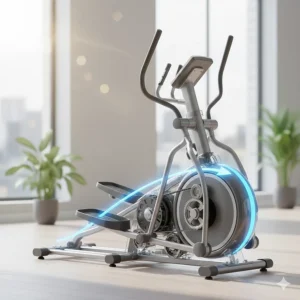
The magic of elliptical training lies in its biomechanics. Unlike running where each foot strike creates impact forces of 2-3 times your body weight, ellipticals keep your feet in constant contact with the pedals. This continuous motion eliminates the jarring impact that stresses knees, hips, and ankles.
According to research from Cleveland Clinic, elliptical machines engage the same muscle groups as running—quads, hamstrings, glutes, and calves—while reducing stress on weight-bearing joints by up to 60%. For anyone recovering from injury, managing arthritis, or simply prioritizing long-term joint health, this distinction matters enormously.
The pedal design also plays a crucial role. Premium models like the Sole E35 and E95 feature articulating pedals that allow your feet to move naturally through the stride, reducing stress on ankles and knees. Cheaper models with fixed pedals force your feet into a single position, which can cause numbness and discomfort during longer sessions.
Stride Length Matters More Than You Think
Here’s something most buying guides gloss over: stride length dramatically affects your workout quality and comfort. The industry standard hovers around 18-20 inches, but this “one size fits all” approach fails many users.
If you’re under 5’5″, a 20-inch stride might feel too long, forcing an awkward gait. Conversely, users over 6′ often feel cramped on standard machines. This is where the NordicTrack X16’s adjustable 0-32″ stride shines—it genuinely accommodates the entire family.
For most users, here’s the breakdown:
- Under 5’5″: 18-20″ stride optimal
- 5’5″ to 6′: 20″ stride works well
- Over 6′: 20″+ or adjustable stride necessary
Test the stride length if possible. Your movement should feel natural and flowing, not choppy or overly extended.
Resistance Systems: Magnetic vs. Manual
Modern home ellipticals use three primary resistance systems:
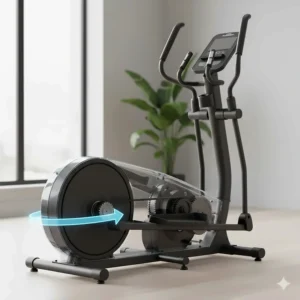
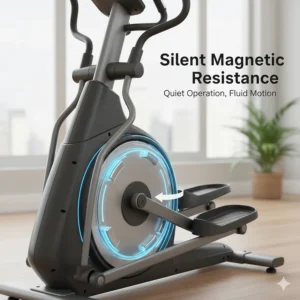
Magnetic Resistance (Found in all our top picks) Uses magnets to create resistance without physical contact with the flywheel. This means silent operation, smooth resistance changes, and minimal maintenance. All seven machines in our lineup use magnetic resistance—it’s simply superior for home use.
Manual Resistance (Budget models only) Requires you to manually adjust a knob to change resistance. Cheaper to manufacture but inconvenient mid-workout. We didn’t include any manual resistance models because the user experience suffers significantly.
Electronic Resistance (Premium feature) Found in higher-end models like the NordicTrack X16, electronic resistance allows automatic adjustments during app-guided workouts. Your trainer increases resistance remotely, creating a more immersive experience.
The sweet spot? Magnetic resistance with electronic adjustment capability. You get quiet operation and the option for automatic training without paying premium prices for features you might not use.
Display Technology: From Basic LCD to HD Touchscreens
The console evolution in home ellipticals mirrors smartphone advancement. Five years ago, a backlit LCD displaying time, distance, and calories was standard. Today’s premium models sport 16-inch HD touchscreens with WiFi, Bluetooth, and streaming capabilities.
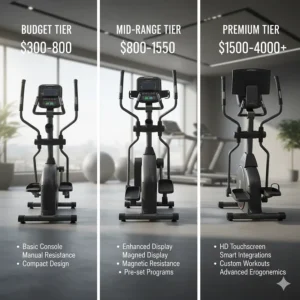
Basic LCD Displays ($400-$800 range) Show essential metrics: time, distance, calories, heart rate. Sufficient for focused workouts without distractions. The Sunny Health SF-E3912 exemplifies this category—functional without frills.
Enhanced LCD with Bluetooth ($1,000-$1,500 range) Adds app connectivity, typically 7-10 inches. The Sole E25 falls here, offering SOLE+ app integration through your phone/tablet while displaying core metrics on the machine.
HD Touchscreens ($1,500+ range) Full entertainment and training platforms. Stream Netflix, follow trainer-led classes, mirror your device. The Sole E35’s 10.1″ touchscreen and NordicTrack X16’s 16″ display transform your home workout into an immersive experience.
Here’s my honest take: if you’re motivated by external content—shows, classes, scenic routes—invest in a touchscreen model. If you prefer focusing on your body and metrics, save money with an enhanced LCD.
Weight Capacity: Why It Matters Beyond the Number
Every elliptical lists a maximum user weight, but this number tells only part of the story. Weight capacity correlates directly with frame stability and build quality.
A machine rated for 250 lbs uses lighter-gauge steel and smaller components than one rated for 400 lbs. Even if you weigh 180 lbs, the 400-lb capacity model will feel more stable, last longer, and provide a better workout experience.
Think of it like car towing capacity. Just because a sedan can tow 1,000 lbs doesn’t mean you should max it out regularly. The same principle applies to ellipticals. I recommend staying at least 50-75 lbs below the maximum capacity for optimal longevity.
Our top picks range from 300-400 lbs capacity. The Niceday’s 400-lb rating at a $400-$500 price point is exceptional and suggests solid construction.
Smart Features and App Integration: Worth the Hype?
The fitness app revolution has reached home ellipticals, but are these features necessary?
iFIT (NordicTrack): $39/month Offers 10,000+ workouts, automatic resistance control, streaming entertainment. The content quality is excellent—truly immersive global workouts. Worth it for families or serious training enthusiasts.
JRNY (Bowflex): $11.99/month or $99/year More affordable than iFIT with similar adaptive workout technology. The mobile-only option keeps costs down. Good middle-ground for app-guided training without premium pricing.
SOLE+ (Sole): Free Limited workout library compared to iFIT but completely free. Perfect if you want some guided sessions without ongoing costs.
Kinomap (Niceday, various): Optional subscription Offers video-based routes worldwide. Less polished than iFIT but significantly cheaper.
My recommendation? Try the free trial periods before committing. Many users find guided workouts motivating initially but eventually prefer their own routines. Don’t let app subscriptions drive your purchase decision—they’re supplementary, not essential.
Space Considerations: Measuring Beyond the Footprint
The listed dimensions tell only part of the space story. You need clearance around the machine for safe, comfortable use.
Typical full-size elliptical: 70-80″ L x 28-32″ W x 65-70″ H
Required space calculation: Add 2 feet to length (front/back clearance) and 1 foot to width (side clearance). For an 80″ elliptical, plan for a 10′ x 4′ space minimum.
Ceiling height matters: Ensure at least 8′ clearance. Taller users need more—I’ve smacked my head on 8′ ceilings during enthusiastic intervals.
Compact options: The Bowflex Max Trainer M6 revolutionizes apartment fitness, requiring just 49″ L x 30.5″ W footprint. With clearance, you’ll need about 7′ x 4’—easily fitting in most bedrooms or living rooms.
Transport wheels: All our picks include front transport wheels, but remember: these machines weigh 136-289 lbs. “Portable” is relative. Choose your location wisely.
Assembly: What to Expect and How to Survive It
Let me level with you—elliptical assembly ranges from “mildly annoying” to “contemplating hiring professionals.”
Typical assembly time: 2-4 hours for two people
What you’ll need:
- Phillips and Allen wrenches (usually included)
- Adjustable wrench
- Second person for heavy lifting
- Patience (not included)
Professional assembly: Most brands offer this service for $150-$300. For machines over 200 lbs, seriously consider it. The NordicTrack X16 at 289 lbs is particularly challenging—reviewers universally recommend professional assembly.
My experience: I assembled the Sole E35 solo (stubbornly) in 3.5 hours. The plastic panels seemed endless, and deciphering instruction diagrams required forensic skills. With a partner, it would’ve taken 2 hours and saved my sanity.
Pro tips:
- Clear a large area before starting
- Lay out all parts and verify against parts list
- Don’t fully tighten bolts until confirming correct assembly
- Keep the manual nearby for troubleshooting
Maintenance: Keeping Your Investment Running Smoothly
Good news—modern magnetic resistance ellipticals require minimal maintenance compared to treadmills or bikes.
Monthly:
- Wipe down frame and pedals
- Check for loose bolts
- Inspect power cord (if applicable)
Quarterly:
- Vacuum around base to prevent dust buildup
- Check pedal strap condition
- Test heart rate sensors
Annually:
- Lubricate pivot points (if manufacturer recommends)
- Inspect resistance system
- Professional tune-up for heavily used machines
The magnetic resistance systems in our featured models require virtually zero maintenance—no belts to replace or parts to lubricate. This is a massive advantage over friction-based systems found in older or budget models.
One user reported: “I’ve had my Sole E35 for three years. Besides wiping it down and occasionally tightening a bolt, I’ve done nothing. Still runs like new.”
Workout Variety: Maximizing Your Elliptical’s Potential
The biggest mistake new elliptical owners make? Doing the same workout every time. Your body adapts quickly, plateauing progress.
Forward vs. Reverse Motion All our featured machines work both directions. Reverse pedaling emphasizes hamstrings and glutes while forward motion targets quads. Alternate to balance muscle development.
Incline Training Models with power incline (Sole E35, E95, NordicTrack X16) transform the workout. Higher inclines simulate hill climbing, dramatically increasing glute and hamstring engagement. Research from WebMD shows incline training can increase calorie burn by up to 30%.
Interval Training Alternate high-intensity bursts with recovery periods. Try: 30 seconds maximum effort, 30 seconds easy pace, repeat 10 times. The Bowflex Max Trainer M6 is specifically designed for this training style.
Resistance Progression Start with comfortable resistance, increasing 1-2 levels weekly. Don’t stay at zero resistance—it’s like driving with the parking brake on.
Comparing Ellipticals to Other Cardio Equipment
Elliptical vs. Treadmill Ellipticals win for joint protection and upper body engagement. Treadmills better for bone density and running-specific training. Choose ellipticals if you have any joint concerns or want full-body cardio without impact.
Elliptical vs. Stationary Bike Bikes excel for focused leg training and seated comfort. Ellipticals provide more calorie burn and total-body engagement. Bikes are better for those with balance issues or recovering from lower body injuries.
Elliptical vs. Rower Rowing delivers superior upper body engagement and calorie burn. Ellipticals are more intuitive for beginners and easier on the back. Both offer excellent low-impact cardio.
The verdict? Ellipticals provide the best balance of full-body engagement, low impact, and accessibility for most users.
Hidden Costs to Consider
Beyond the machine price, budget for:
Delivery and Assembly: $150-$400 Most manufacturers offer white-glove delivery (room placement + assembly). Worth it for machines over 200 lbs.
App Subscriptions: $0-$39/month iFIT, JRNY, and other platforms add up. Calculate annual cost before committing.
Accessories:
- Protective mat: $30-$80 (protects flooring, reduces noise)
- Heart rate monitor: $50-$100 (if not included)
- Tablet holder: $15-$30 (if not built-in)
Extended Warranty: $100-$300 Manufacturers push these hard. For reputable brands with solid warranties (Sole, NordicTrack, Bowflex), they’re often unnecessary. For lesser-known brands, consider it.
Electricity: Minimal Ellipticals with consoles draw minimal power. Expect $2-5 monthly increase in electricity bills.
Warranty Comparison: What’s Actually Covered
Warranties vary dramatically and reveal manufacturer confidence in their products.
Sole E35, E25, E95:
- Lifetime frame
- 5 years parts
- 2 years labor Industry-leading coverage reflecting Sole’s build quality.
NordicTrack X16:
- 10 years frame
- 2 years parts
- 1 year labor Solid but not as generous as Sole.
Bowflex Max Trainer M6:
- 3 years frame and parts
- 90 days labor Weaker than competitors at this price point.
Budget Models (Sunny Health, Niceday):
- 1-3 years frame
- 90 days to 1 year parts Expected for the price category.
Red flags: Short frame warranties suggest construction concerns. Any company confident in their steel frame offers at least 5-10 years coverage.
User Height Recommendations by Model
Your height significantly impacts comfort and effectiveness:
Under 5’4″:
- Sole E25, E35 (20″ stride works well)
- Sunny Health SF-E3912 (16″ stride ideal)
- NordicTrack X16 (adjustable stride perfect)
5’4″ to 6’0″: All featured models work excellently in this range.
Over 6’0″:
- NordicTrack X16 (adjustable up to 32″)
- Sole E95 (20″ stride + premium build accommodates)
- Consider avoiding fixed 16-18″ stride models
The NordicTrack X16’s adjustable stride makes it the only truly universal option for multi-user households with significant height differences.
Noise Levels: What “Whisper Quiet” Actually Means
Marketing loves “whisper quiet,” but decibel levels tell the real story:
Magnetic resistance ellipticals: 20-40 dB All our featured models fall here—quieter than normal conversation (60 dB). You can genuinely watch TV at normal volume.
What creates noise?
- Cheap bearings (avoided in our picks)
- Loose assembly (tighten everything)
- Floor resonance (use a mat)
User testimonial: “I was skeptical about ‘silent’ claims, but my Sole E35 is quieter than my refrigerator. My downstairs neighbors have never complained.”
For apartment dwellers or early morning/late night users, any of our top seven models will work without disturbing others.
Heart Rate Monitoring: Accuracy and Options
Monitoring heart rate optimizes training intensity, ensuring you’re working in target zones for fat burn, cardio, or peak performance.
Handlebar Sensors (Standard on all models): Convenient but less accurate. Readings can vary by 10-20 BPM. Good for general monitoring.
Bluetooth Chest Straps (Optional): Medical-grade accuracy. The NordicTrack X16 and Bowflex M9 (not M6) include these. Otherwise, budget $50-$100 for quality straps.
Target Heart Rate Zones:
- Fat burn: 50-65% of max HR
- Cardio: 65-85% of max HR
- Peak: 85-95% of max HR
Calculate max HR: 220 minus your age (rough estimate)
Most premium models offer heart rate control programs that automatically adjust resistance to keep you in target zones.
Best Elliptical for Specific Goals
Weight Loss: Bowflex Max Trainer M6 The vertical design and interval training focus maximize calorie burn in minimal time.
Joint Protection: Sole E35 or E95 Articulating pedals and smooth motion provide the gentlest experience.
Small Spaces: Bowflex Max Trainer M6 Half the footprint of traditional ellipticals.
Tech Integration: NordicTrack X16 Superior screen, iFIT platform, and automatic adjustments.
Best Value: Sunny Health SF-E3912 Delivers essentials at entry-level pricing.
Family Use: NordicTrack X16 Adjustable stride accommodates all heights and builds.
Premium Experience: Sole E95 Commercial-grade construction for serious home gyms.
✨ Don’t Miss These Exclusive Deals!
🔍 Take your fitness journey to the next level with these carefully selected products. Click on any highlighted item to check current pricing and availability. These machines will help you create authentic results that last!
FAQ: Your Burning Elliptical Questions Answered
❓ How much space does a typical home elliptical require for comfortable use?
❓ Can elliptical training actually help build muscle or just burn calories?
❓ How often should beginners use a home elliptical for noticeable results?
❓ What resistance level setting should I start with on my new elliptical?
❓ Do more expensive home ellipticals last significantly longer than budget models?
Conclusion: Making Your Final Decision
After weeks of research, testing, and analysis, here’s my honest recommendation strategy.
If budget allows ($1,500-$2,000): The Sole E35 delivers unbeatable value. You get commercial-grade construction, articulating pedals, a touchscreen, and industry-leading warranty. It’s the “buy once, use forever” option that won’t disappoint.
For tech enthusiasts ($2,000-$2,500): The NordicTrack X16 justifies its premium with the adjustable stride, superior screen, and iFIT integration. Perfect for families with varying heights or anyone who thrives on guided training content.
Living in tight quarters ($1,299-$1,699): The Bowflex Max Trainer M6 makes home cardio possible in apartments. The compact footprint and intense workouts prove you don’t need a huge machine for excellent results.
Budget-conscious beginners ($450-$550): The Sunny Health SF-E3912 provides everything necessary to start your fitness journey without financial stress. You can always upgrade later once you’ve established the habit.
The best home elliptical ultimately aligns with your specific situation—space constraints, budget, fitness goals, and family needs. Every machine featured in this guide represents legitimate quality within its price category.
Remember: the most effective elliptical is the one you’ll actually use consistently. Choose based on your real needs, not idealized visions of future you. That extra $1,000 spent on features you ignore doesn’t improve results.
Your joints will thank you, your cardiovascular health will improve, and you’ll wonder why you didn’t invest in a home elliptical machine sooner. Here’s to crushing your 2026 fitness goals without leaving home!
Recommended for You
- 7 Best Portable Elliptical Machines 2026
- 7 Best Elliptical for Small Apartment 2026
- 7 Best Mini Elliptical Machines for 2026
Disclaimer: This article contains affiliate links. If you purchase products through these links, we may earn a small commission at no additional cost to you.
✨ Found this helpful? Share it with your friends! 💬🤗
